

Educational note: This article is for general educational purposes only. Medical school admissions expectations vary by school and cycle, and this is not legal, financial, tax, or professional admissions advice. For school-specific guidance, use official admissions resources and consult qualified advisors.
Can free clinic volunteering actually count as strong med school hours? Yes. Absolutely. And in many cases, it counts better than flashier experiences because it shows something admissions committees care about a lot: you chose to serve people who often get left out of the healthcare system.
But here's the catch. Just standing in a clinic doesn't magically become great clinical experience. Logging hours is easy. Building an experience that clearly shows patient exposure, service, maturity, and commitment? That's the part most students mess up.
What med schools want to see is pretty straightforward:
- real patient-facing contact
- consistency over time
- reliability and professionalism
- teamwork in a healthcare setting
- reflection on what you learned
- exposure to underserved care and barriers to access
I've seen applicants undersell excellent clinic work because they described it like a bland shift log. I've also seen weak experiences dressed up with inflated language. Admissions readers can tell. Fast.
If your free clinic role puts you around patients, teaches you how care actually works, and gives you stories that changed how you think about medicine, those hours can be excellent. The goal isn't to collect a big number. The goal is to make your volunteering read like evidence that you belong in medicine.
If you're still building your overall premed activities plan, it helps to compare free clinic work with other clinical volunteering experiences, think about how it differs from physician shadowing, and make sure it fits the bigger story in your medical school application.
1) Choose roles that are clearly clinical, not just administrative
Not all free clinic volunteering is equal. That's the truth.
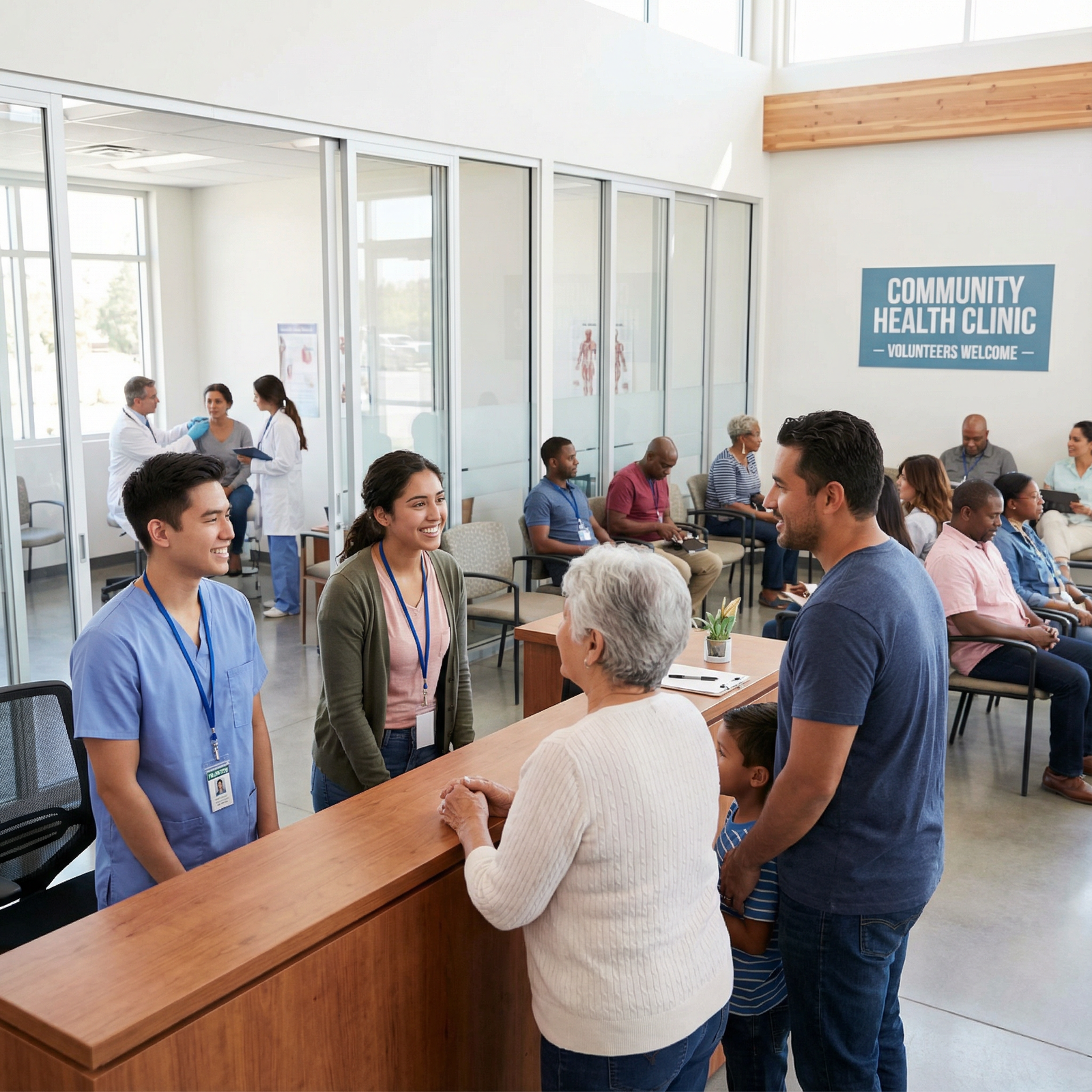
If your entire role is filing papers in a back office, that's service, but it's not strong clinical exposure. If you're greeting patients, helping with intake, taking vitals under supervision, rooming patients, guiding them through clinic flow, interpreting if you're truly qualified, or scribing where allowed, that's much stronger.
A simple test: Are you meaningfully interacting with patients as part of care delivery? If yes, you're probably in clinical territory.
Strong free clinic roles often include:
- patient check-in with actual interaction, not just paperwork
- intake interviews
- obtaining vitals if trained and permitted
- rooming patients
- patient navigation between stations
- discharge instruction support under supervision
- Spanish interpretation, but only if you're genuinely fluent and approved
- scribing or documenting encounters when the clinic allows it
- supervised observation paired with active volunteer duties
Weaker roles include:
- filing
- stocking closets only
- data entry with no patient interaction
- scheduling in isolation
- general event support disconnected from care
Now, real life is messy. A lot of clinic jobs are mixed. Maybe half your shift is registration and half is escorting patients, answering questions, and helping them move through intake. That's fine. Just describe it honestly.
Don't write:
“I performed administrative tasks in a free clinic.”
Write:
“Welcomed and checked in uninsured patients, helped guide them through intake and rooming, coordinated flow between front desk and clinical staff, and answered patient questions during visits.”
Same role. Totally different impression. One sounds passive. The other sounds like healthcare exposure.
2) Stay long enough to show commitment, not a one-time shift
Admissions committees are not impressed by random bursts of activity. A hundred disconnected hours scattered across three weekends is weaker than a steady role you held every Tuesday evening for eight months.
Consistency wins. Every time.
A practical framework:
- 3 months: minimum for this to start feeling real
- 6 months: solid and credible
- 12 months or more: excellent if the role stayed meaningful
Frequency matters too:
- weekly is ideal
- every other week can still work well
- one-off events are fine as extras, not as your main clinical foundation
Why does this matter so much? Because long-term clinic volunteering shows three things at once:
- Reliability — you kept showing up
- Depth — you saw patterns, not just isolated moments
- Trust — supervisors usually give more responsibility to people who stick around
And there’s another benefit students don’t think about enough: continuity. In a free clinic, long-term volunteers start to understand the actual barriers patients face. Missed follow-up. Transportation problems. Medication costs. Language gaps. Fear of bills. That’s the stuff that turns “I volunteered in a clinic” into “I understand why access to care is fragile.”
It also makes recommendation letters and activity descriptions better. A coordinator who has known you for nine months can say a lot more than someone who saw you twice. If you later need a letter for your premed committee packet or individual applications, that history matters.
3) Turn passive helping into real patient exposure
A lot of students get stuck in passive roles because they never ask for more. They do one safe task, week after week, and then wonder why the experience feels thin.
If you're trained, dependable, and professional, ask for more patient-facing responsibility.
Good ways to do that:
- “I’ve gotten comfortable with check-in. Is there a way I can help with intake or patient flow?”
- “If the team needs help rooming patients, I’d love to learn that process.”
- “I’m happy to keep doing front desk work, but I’d also like more direct interaction if there’s a supervised role available.”
That’s how you grow the experience without sounding entitled.
The best free clinic volunteers become useful in the boring, unglamorous parts of patient care. Escorting a nervous patient to the right room. Explaining clinic flow clearly. Noticing that someone looks confused and checking whether they need language support. Helping maintain dignity when the system feels chaotic.
That counts. A lot.
But don't get sloppy. Strong clinical volunteering isn't about pretending to be a provider. It's about being excellent within your role.
That means:
- protect confidentiality every single shift
- don't exaggerate language ability
- don't perform tasks you weren't trained to do
- don't tell stories about patients carelessly
- stay respectful with underserved patients whose lives don't look like yours
- understand cultural humility isn't a buzzword; it's basic competence
I've seen students torpedo otherwise good experiences by overclaiming. “I helped manage treatment plans.” No, you didn't. You were a volunteer. Be honest. Your value is in communication, observation, reliability, and support of care delivery. That's already enough.
4) Document the experience like an applicant, not like a time sheet
You need better records than “about 150 hours maybe.”
Track your clinic work like someone who knows they'll need to enter it into an application later. Because you will.
After each shift, record:
- date
- start and end time
- total cumulative hours
- your specific duties
- what was patient-facing
- supervisor or coordinator name
- one or two quick reflection notes
Your reflection notes matter more than people think. Capture moments like:
- what you noticed about access to care
- a communication challenge you handled
- how the team worked together
- something that changed your view of medicine
- a patient interaction that stuck with you, without violating privacy
This doesn't need to be a diary. Just enough detail so six months later you still remember what happened.
Here’s the formula for a strong activity description:
- Role: what you actually did
- Responsibility: what you were trusted with
- Impact: how you supported patients or clinic flow
- Insight: what the experience taught you
Bad description:
“Volunteered at a free clinic helping staff and patients.”
Better description:
“Supported evening clinic operations for uninsured patients by assisting with intake, rooming, patient flow, and front-desk communication; learned how transportation, language, and cost barriers shape follow-up care.”
That second version sounds real because it is.
If you want to avoid scrambling later, use the same documentation habits you’d use for AMCAS work and activities or other centralized application entries.
5) Translate your volunteering into a strong application story
This is where students either make the experience land or waste it.
Your free clinic work should connect to three big themes:
- why medicine
- why service
- what you learned about health inequity
If you can't explain those links, the hours stay flat.
Use this framework in essays and interviews:
- Situation — what was happening?
- Action — what did you do?
- Insight — what did you learn?
- Future impact — how does this shape the physician you want to become?
Example:
- Situation: A patient was visibly anxious during intake and unsure how the clinic process worked.
- Action: You slowed down, explained the steps, coordinated with staff, and helped them feel oriented.
- Insight: You realized how often confusion and fear are part of seeking care, especially for uninsured patients.
- Future impact: You want to become a physician who treats communication as part of care, not as an afterthought.
That works because it's specific. Not fake-deep. Not generic.
And don't overclaim clinical skill. That's a bad look. You're not trying to sound like a half-trained doctor. You're trying to show growth.
Focus on what you genuinely developed:
- comfort around patients
- communication under pressure
- teamwork with clinic staff
- sensitivity to barriers in care
- respect for continuity and follow-up
- a more grounded understanding of underserved medicine
If the experience truly changed you, then yes, it can belong in a most meaningful activity entry. But earn that choice. Don't force it because you think it sounds strategic.

6) Use supervisors and program structure to strengthen verification
A good supervisor makes your experience much stronger. Not because you need someone to flatter you, but because med school applications rely on accurate verification and credible descriptions.
If your free clinic has a volunteer coordinator, charge nurse, physician lead, or operations manager, make sure that person knows who you are.
How to build that relationship without being annoying:
- show up early
- communicate clearly if you have a conflict
- follow instructions the first time
- ask smart questions after you’ve done your part
- volunteer for needed tasks, not just interesting ones
- thank people and follow through
That’s it. No networking theater. Just being solid.
I've seen students chase “leadership” titles while being flaky on basic responsibilities. Bad move. In a clinic, reputation is built on whether people trust you at 6:15 p.m. when the waiting room is full and everyone’s tired.
You also need to know when to stay versus when to move on.
Stay in the role if:
- you have regular patient interaction
- you're still learning
- your responsibilities are growing
- the clinic can verify your work clearly
- the experience gives you strong reflection material
Consider seeking a different opportunity if:
- you never interact with patients
- months go by with no added responsibility
- supervision is chaotic or unverifiable
- the clinic mainly uses you as unpaid clerical labor
- you dread every shift because the role has no educational value
Not every free clinic position is automatically strong. Some are excellent. Some are glorified filing jobs with a stethoscope nearby. Be honest about which one you have.
7) Build an underserved-care lens, not just a clinic resume line
This is the part that separates a good applicant from a box-checker.
Free clinic volunteering matters because it can teach you how healthcare fails people. Not in theory. In real rooms, with real delays, real cost barriers, real fear, and real tradeoffs. If you miss that lesson, you missed the point.
Pay attention to patterns:
- Why are patients using this clinic?
- What happens when they need follow-up they can't afford?
- How do transportation, work schedules, childcare, or language barriers affect care?
- What role do volunteers, nurses, physicians, social workers, and interpreters each play?
Those questions give your experience depth.
You don't need to become a policy expert overnight. But you should come away with a sharper understanding of why underserved care demands patience, flexibility, teamwork, and humility. If your volunteering taught you that medicine isn't just diagnosis and treatment but also access, trust, and systems, that's powerful.
And admissions committees notice. Because that kind of insight sounds different. More mature. Less rehearsed.
Key takeaways
- Free clinic volunteering becomes strong med school experience when it's clearly patient-facing, consistent, and well documented.
- A smaller number of meaningful, long-term clinical hours beats a flashy pile of scattered shifts.
- Your best application angle is service plus patient exposure plus reflection on underserved care.
- Good supervisors, honest descriptions, and specific stories make the experience credible.
- Don't inflate your role. Do deepen it.
If you're already volunteering at a free clinic, don't just collect hours. Upgrade the experience. Ask for patient-facing responsibility, stay consistent, keep records, and reflect like an applicant who's paying attention. That's how ordinary volunteering turns into one of the strongest parts of your med school application.


