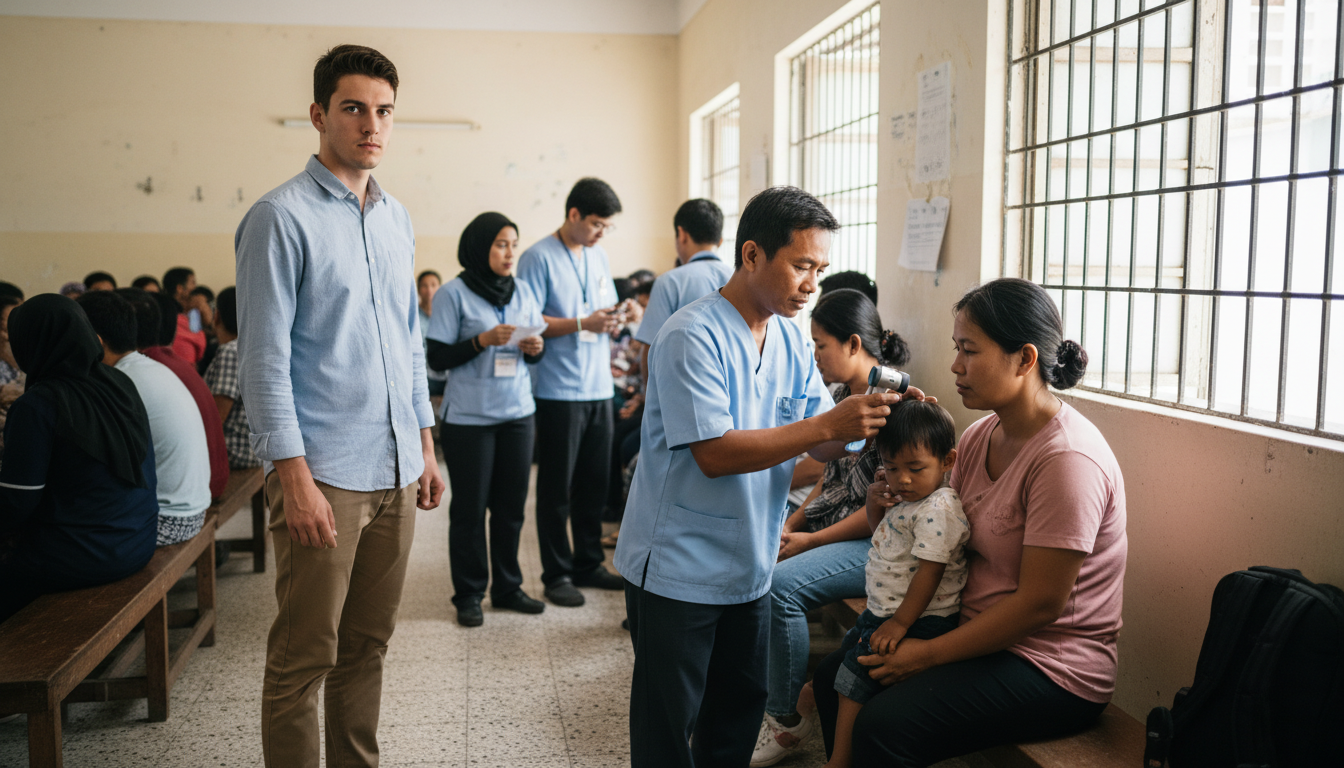
The myth that an international medical trip will magically transform your med school application is one of the most persistent—and most harmful—ideas in pre‑med culture.
It is overhyped, ethically messy when done wrong, and far less impressive to admissions committees than social media and volunteer companies want you to believe.
Let’s dismantle this properly.
The Big Myth: “Medical Missions Look Amazing on Applications”
The dominant narrative goes like this:
Spend a week or two in a low‑income country. Wear scrubs. Take photos with local children. Maybe even hold a stethoscope, shadow a “mission doctor,” and tell a dramatic story in your personal statement.
Result? Instant admissions gold. Right?
Not according to the people actually reading applications.
When you look at statements from AAMC, LCME standards, ethics literature, and what experienced admissions committee members say at conferences and on record, a very different picture emerges:
- Short‑term “medical mission trips” are, at best, neutral on applications.
- At worst, they are a red flag when there’s any hint of unethical clinical involvement or “poverty tourism.”
- Consistent local service and long‑term commitment usually impress committees more than an expensive two‑week trip abroad.
Why? Because med schools aren’t grading your Instagram. They’re evaluating your judgment, your understanding of health systems, your humility, and your ethics.
(See also: What Admissions Committees Really Think About Hospital Volunteering for more insights.)
A 7‑day trip that cost $3,000 and produced a dozen sunset photos may say more about your access to money than your commitment to medicine.
What the Evidence Actually Shows (Not the Marketing Copy)
Volunteer-sending organizations are very good at selling a story: “Make a difference. Gain clinical experience. Stand out to med schools.” Many are for-profit. Their websites read like travel brochures wearing a stethoscope.
The academic literature is far less flattering.
Research on short-term medical missions and pre‑health “voluntourism” repeatedly flags several problems:
Questionable benefit to host communities
Studies in Globalization and Health, Academic Medicine, and The Lancet have documented that short-term, unintegrated trips often:- Duplicate local services rather than fill true gaps
- Disrupt continuity of care
- Drain local health workers’ time to supervise untrained visitors
- Prioritize visitor experience over sustainable health outcomes
Ethical concerns about scope of practice
Papers on pre‑medical students abroad report students:- Taking vital signs, giving injections, or “assisting” with procedures without proper training or local credentialing
- Misrepresenting their level of expertise to patients—often because local staff or program leaders introduce them as “future doctors” in ways that blur boundaries
- Working in settings where regulatory oversight is weak or absent
For admissions committees, this is not “initiative.” It’s poor ethical judgment.
Distorted perceptions of global health
Short, highly curated trips can:- Reinforce “savior” narratives (“I went to help them”)
- Oversimplify systems-level issues (colonial histories, economic policies, governance, local health workforce dynamics)
- Normalize unsafe or substandard practices that would be unacceptable at home
Ethics guidelines from the American College of Physicians, AAMC Global Health Learning Opportunities, and institutional global health offices echo the same theme: short-term programs must be carefully structured, supervised, and aligned with local partners’ needs. Anything else is suspect.
That’s not the way most commercial “pre‑med abroad” packages operate.
How Admissions Committees Really View These Trips
Here’s the part almost nobody tells pre‑meds: a generic “international medical volunteering” line on your activities list is not automatically a plus.
What matters is how you did it and what you learned.
Experienced admissions reviewers see patterns:
- “One‑off, no context” trips with no prior or subsequent service engagement
- Essay narratives focused on how “grateful” the applicant is now, with minimal reflection on power dynamics or ethics
- Photos or stories that suggest clinical involvement beyond a pre‑med’s scope
Those raise more questions than they answer. Committees ask themselves:
- Why travel abroad when they haven’t meaningfully served in their own community?
- Did this applicant understand their limitations?
- Were local needs or local partners centered, or was this about their own experience?
By contrast, here’s what actually reads as strong:
- Long‑term community engagement (local or global), even if it’s not glamorous
- Ethically structured international work that clearly followed local regulations and didn’t use patients as training props
- Reflection that shows awareness of global power imbalances, health systems, and the limits of short-term visits
You can see this in how AAMC and individual schools describe “meaningful experiences”: depth, continuity, responsibility, and reflection—not stamps in a passport.
The Most Dangerous Myth: “It’s OK If I Do Clinical Stuff There, I Can’t in the U.S.”
This is the ugliest fiction in the entire space.
The idea that it’s fine for you, a pre‑med with no clinical license, to take on clinical tasks abroad that would be illegal at home is not just naive. It is ethically indefensible.
Two realities you need to hold simultaneously:
- Many health systems abroad are under‑resourced and overwhelmed.
- That does not make patients in those systems less deserving of safe, competent, licensed care.
Performing procedures, doing physical exams, helping deliver babies, or prescribing medications as a pre‑med—even “under supervision”—crosses a clear ethical line in most scenarios. The fact that a trip organizer or a local clinician “allows” it doesn’t absolve you of responsibility.
Admissions committees know how these trips operate. When they read an essay where a pre‑med casually describes “doing stitches in Honduras” or “delivering a baby in Uganda,” they don’t think, “Impressive.” They think, “Huge judgment problem.”
If your primary motivation for going abroad is “I can do more hands‑on stuff there,” you’re telling on yourself.
You should not seek clinical experiences abroad that you are not allowed to do at home. If anything, the standard should be tighter, because the power imbalance is greater.
The Equity Problem: Who Can Afford These Trips?
Let’s talk about something most glossy brochures never mention: cost.
Many “medical mission” or shadowing trips marketed to pre‑meds run $2,000–$6,000 for 1–3 weeks, not including flights. Families are encouraged to fundraise. Some programs openly market themselves as “a great investment in your child’s future in medicine.”
From an equity perspective, this is a problem.
- It advantages students with disposable income or social networks who can subsidize the trip.
- It pressures lower-income students to feel “behind” if they can’t afford it.
- It pushes a false narrative that “serious” applicants must have international clinical experience.
Medical schools are increasingly aware of these dynamics. Many explicitly state—sometimes in advising webinars with pre‑health advisors—that international travel is not required, not expected, and not inherently more valuable than local service.
Some admissions officers will even discount these experiences mentally when they suspect they were expensive, packaged, and superficial.
If you have limited time and money, the data and the ethics both point you away from paying thousands for a one‑time trip and toward sustained, local, low-cost involvement.
When International Experiences Actually Make Sense
So is all international experience bad? No. That would be another myth.
There are ways to engage globally that are:
- Ethically grounded
- Educationally rich
- Respectful of local expertise
- Actually valued by admissions committees
Common threads in strong international experiences:
They’re embedded in a real program, not bought off a website.
Examples:- A semester‑long global health course with a field component through your university
- A structured NGO internship where your role is non‑clinical (data analysis, health education under supervision, program evaluation)
- Participation in collaborative research led or co-led by local institutions
They don’t rely on you doing clinical work beyond your training.
You might:- Observe clinical care, then debrief with faculty
- Interview patients or community health workers with proper consent
- Work on quality-improvement or public health projects under senior guidance
They show continuity with your other interests.
If you’ve spent two years volunteering at a local free clinic and then participate in a well-designed global health project focused on primary care access, that tells a coherent story. If you randomly fly to another country for 10 days with no prior related experience, it does not.They demonstrate reflection, not self-congratulation.
In your personal statement or secondary essays, a solid international experience:- Acknowledges limits: of short-term work, of your own role
- Describes what local professionals taught you
- Recognizes your own biases and early missteps
- Connects to concrete changes in how you approach patients or systems at home
The difference isn’t the latitude and longitude. It is the structure, purpose, and humility.
What Actually Strengthens a Pre‑Med’s Clinical Volunteering Profile
Here’s the uncomfortable truth: the boring-sounding choices usually outperform the flashy ones.
From an admissions and ethics standpoint, these carry more weight than a “medical mission”:
- Consistent volunteering in a local clinic, hospital, or hospice where your role is appropriate (transport, stocking supplies, patient comfort, basic admin, interpreter work if qualified).
- Long-term involvement with underserved communities locally—refugee health programs, migrant farmworker outreach, urban free clinics, rural health fairs—where you build relationships over months or years.
- Structured clinical shadowing with debriefing and reflection, even though you’re mostly observing.
- Public health or health systems work, like helping with vaccination drives, community health education, or social determinants of health initiatives through reputable organizations.
Does that sound less Instagram‑worthy than photos in a foreign clinic? Yes.
Does it often read as more mature, grounded, and equitable to admissions committees? Also yes.
The point isn’t to never travel. It’s to recognize that “international” is not a magic prefix that makes an otherwise shallow activity meaningful.
How to Evaluate an International Opportunity Before You Sign Up
If you’re still considering a trip, scrutinize it the way a bioethics committee would.
Ask:
- What exactly will my role be? Is it strictly non‑clinical, or limited to what I could ethically do in the U.S.?
- Who designed and runs this program? A local institution with long-term presence, or a foreign company selling pre‑med experiences?
- How does this activity fit into local health systems? Are we plugging into existing clinics, or parachuting in for a photo op?
- Does the website emphasize education and local partnership, or your future med school application and hands‑on clinical access?
- Is there pre‑departure training in ethics, culture, language, and health systems—and structured debriefing afterward?
- Could I explain this experience, in detail, to an admissions interviewer without feeling defensive about ethics or scope of practice?
If your honest answers make you uncomfortable, trust that instinct. An adcom member reading your application might feel the same discomfort.
The Bottom Line: Myths vs Reality
Here’s the stripped-down reality about international medical volunteering for pre‑meds:
It is not necessary for medical school admission, and it doesn’t automatically boost your application. Depth and continuity beat passport stamps every time.
Ethical pitfalls are real, and admissions committees are aware of them. Anything involving you “doing” clinical work you’re not licensed to do at home is a liability, not an asset.
Local, sustained, unglamorous service often demonstrates exactly what med schools are trying to measure. Reliability, humility, understanding of healthcare, and commitment to communities.
You don’t need a plane ticket to show you’re ready for medicine. You need judgment, consistency, and respect for patients—wherever they live.