You’re a premed trying to build clinical experience, but you do not have a car. Your friends are bragging about their EMT shifts 40 minutes away, their scribe jobs in suburban ERs, and their hospice volunteering out in the suburbs. You’re staring at a bus schedule and your bank account, thinking: “How am I supposed to compete with this?”
You are not alone. Many premeds are in dense cities, on tight budgets, or on visas that make driving complicated. Others have anxiety about driving, lost a license, or just cannot afford a car right now. Yet med schools still want to see consistent, meaningful clinical volunteering.
So the situation is:
You need real clinical exposure. You do not drive. You have limited time and money. What do you actually do next?
Let’s walk through it step-by-step, as if we’re building your activity list from zero.
(See also: balancing jobs and clinical volunteering wisely for more details.)
Step 1: Map Your Actual Radius (Not Your Imaginary One)
Before you think about what to do, define where you can reliably get.
You need a realistic “commute bubble” based on:
- Walking distance (comfortable: up to 30 minutes one way)
- Public transit (prefer under 60 minutes door-to-door including transfers)
- Bike/scooter options (only if safe and legal, and you’re comfortable)
- Occasional ride-share (for rare, high-yield opportunities, not weekly)
Do this in one focused session
Open Google Maps (or similar).
- Put in your home address.
- Search for: “hospital,” “clinic,” “nursing home,” “rehabilitation center,” “dialysis center,” “blood donation center,” “hospice,” “free clinic,” “community health center.”
Turn on transit layer.
- Check how long it takes to reach each site by:
- Walking only
- Bus/train
- Mark everything that is:
- ≤ 30 minutes walking
- ≤ 45–60 minutes by transit, with a schedule that works for you (e.g., not one bus every 90 minutes).
- Check how long it takes to reach each site by:
Screenshot or sketch a “volunteering map.”
Literally circle:- 1–3 hospitals or large medical centers
- 3–5 outpatient clinics (student health center, FQHC, Planned Parenthood, community health centers)
- 2–4 long-term care facilities (nursing homes, rehab, assisted living)
This is your no-car opportunity zone.
Everything else is optional and bonus.
Step 2: Target Settings That Fit “No Car” Life
Some clinical environments are naturally car-dependent (rural hospitals, suburban SNFs). Others are built into transit-heavy, walkable areas.
Here’s where you focus.
1. Academic medical centers & big hospitals
Why they’re ideal for non-drivers:
- Often on or near major bus/train lines
- Large volunteer departments with structured roles
- Evening and weekend shifts you can stack around classes
- More likely to have diversity, inclusion, and support systems
Look for roles like:
- Emergency department volunteer (transport, stocking, patient rounding)
- Inpatient unit volunteer (comfort rounding, answering call lights, family support)
- Outpatient clinic support (waiting room liaison, vitals if allowed, patient escorts)
Key tip: Academic hospitals in cities (NYU Langone, UCSF, UChicago, etc.) explicitly get that many students don’t drive. Their systems are built for public transit.
2. University health services / student health center
If you’re on a college campus, this is gold.
Why it works:
- Walking distance
- Flexible hours between classes
- Staff who are used to students coming and going on foot
- Often easier onboarding than big hospitals
Potential roles:
- Front desk/check-in support
- Shadowing + basic tasks (room turnover, stocking)
- Health education or outreach events (flu-shot clinics, wellness fairs)
3. Free clinics and FQHCs near transit lines
Search terms:
“free clinic near [city],” “Federally Qualified Health Center,” “community health center,” “student-run clinic.”
These often sit in dense, urban neighborhoods:
- Easy to reach via bus/metro
- Done with underserved communities (great mission fit)
- Broad exposure to primary care, chronic disease, social determinants
You might:
- Room patients, take vitals (with training and if permitted)
- Translate/interprete if you’re bilingual
- Do patient intake and history forms
- Make phone calls for follow-ups or referrals
4. Long-term care, rehab, and nursing homes
These are underrated yet extremely powerful for clinical exposure.
Search: “nursing home,” “skilled nursing facility,” “inpatient rehab,” “[your city] assisted living.”
Focus on facilities:
- Within walking distance
- On a reliable bus route with evening return options
Roles might include:
- Bedside conversation, reading or activities for residents
- Helping transport residents to therapy within the building
- Supporting staff with non-clinical tasks that put you around nurses/PT/OT daily
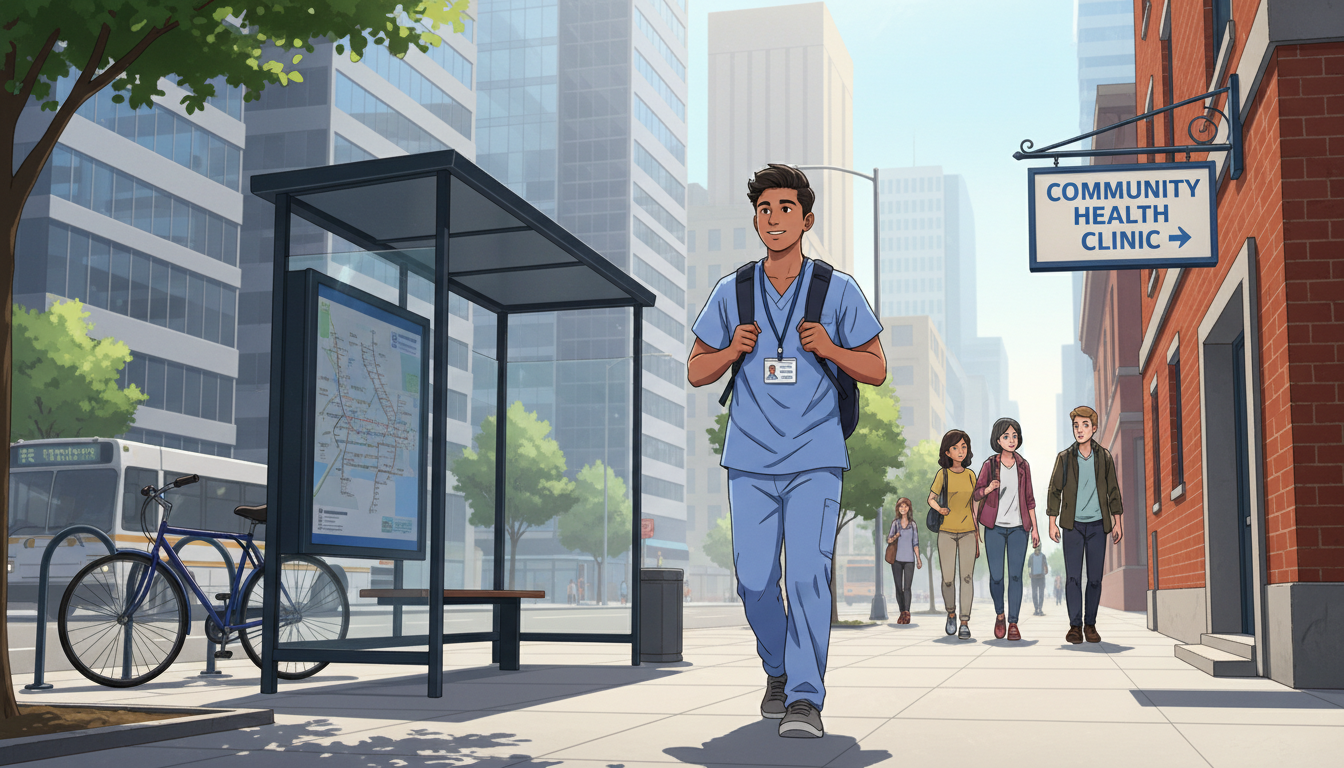
Step 3: Use “On-Site” and “Virtual-Adjacent” Clinical Roles
Without a car, you should prioritize:
- One or two physically accessible roles you can stick to long term
- One “virtual-adjacent” role that adds hours and impact without travel
Option A: Hospital/clinic roles scripted around transit
When you do not drive, the biggest pain isn’t distance. It’s unpredictability.
Here’s how you minimize it:
- Pick 1 consistent shift per week that fits transit (e.g., Saturdays 9–1 or Tuesdays 4–8 pm).
- Choose daylight or early evening until you’ve tested the return bus or walking route.
- Ask the coordinator directly:
“I rely on public transit. Are there shifts where a missed bus or 10–15 minute delay is less of a problem?”
You want roles where if you’re slightly delayed once in a while, the world doesn’t collapse. Stocking, patient rounding, and clinic support beats high-traffic check-in for this reason.
Option B: Remote clinical support (yes, it’s possible)
Not “telehealth scribe from day one” — that’s rare. But there are hybrid or remote positions that clearly sit inside the clinical world:
Examples:
Remote patient navigation / outreach
Community clinics sometimes hire or accept volunteers to:- Call patients about appointments, vaccines, screenings
- Help reschedule missed visits
- Provide basic script-based education (with training)
Telehealth support for clinics
Some clinics need people to:- Help patients log into patient portals
- Walk them through connecting to video visits
- Call before telehealth visits to confirm access
Crisis hotlines / warm lines (borderline clinical but still patient-facing)
These are not purely “clinical,” but they demonstrate:- Emotional resilience
- Direct work with people in distress
- Communication under pressure
Ex: National Suicide & Crisis Lifeline partners, local youth crisis lines, domestic violence hotlines.
You’ll still want at least one in-person clinical activity, but remote-adjacent work can boost hours without any commute.
Step 4: Let Your Schedule Work With Your Transit, Not Against It
Most non-driving premeds burn out because their schedule fights their commute. Build yours the other way around.
Break your week into “reachable blocks”
Grab your class schedule and mark:
- Mornings you’re free (8–12)
- Afternoons you’re free (12–5)
- Evenings you’re free (5–9)
- Full open days
Now overlay:
- Bus/metro schedules
- Clinic/hospital volunteer shift options
Then choose roles that:
Fit into 4–5 hour blocks, including commute
Example:- Shift: 1–4 pm at hospital
- Commute: 45 minutes each way
- Total: ~5 hours. That’s realistic once a week.
Cluster when possible
If your clinic is 40 minutes away, it makes more sense to:- Volunteer 4 hours every Saturday
than - 1 hour four times a week (which is impossible with that commute)
- Volunteer 4 hours every Saturday
Respect your transit “cutoff” times
Decide your limits:- “I won’t leave home before 7 am for volunteering.”
- “I’ll be home by 9:30 pm on school nights.”
Once you define these, tell coordinators honestly. Many are more flexible than you think if you’re upfront.
Step 5: Lean Into Hyper-Local Opportunities
If you live near a hospital or clinic, that can become your entire clinical backbone. You don’t need 6 different places. You need depth.
Build a “single site” narrative
Imagine this path without a car:
- Year 1: Start as a volunteer in the hospital’s outpatient clinic 3 hours/week.
- Year 2: Add patient rounding in the inpatient wards at the same hospital.
- Year 3: Become a volunteer lead or trainer, still there, plus some shadowing with a physician you met on the wards.
All within walking or bus distance.
Admissions committees love:
- Longitudinal commitment
- Increasing responsibility
- Clear understanding of healthcare systems
They don’t care that you didn’t drive 50 minutes to a rural clinic, if you can speak deeply about what you saw where you were.
Use your campus as the hub
If you live on or near a university campus:
- Campus health center volunteering
- Student-run free clinic affiliated with the med school
- Local community screening events (BP checks, health fairs)
- Public health outreach run by campus organizations
Then build from there into 1 nearby hospital or clinic reachable on the main bus line.
Step 6: Explain the No-Car Reality (Subtly but Clearly)
You don’t need to write an essay about transportation, but you can contextualize your choices.
Ways to do it:
Activity descriptions (AMCAS/AACOMAS/TMDSAS)
In the experience description, you can quietly signal:
- “Volunteered weekly at the community health center located 20-minute walk from my campus.”
- “Chose a local safety-net clinic accessible by bus to allow consistent commitment during semesters without a car.”
One simple sentence signals resource constraints and intentionality.
Secondary essays / adversity prompts
If a school asks about challenges, you might mention:
- Growing up or studying without a car
- Needing to plan everything around transit
- How it taught you:
- Planning and reliability
- Empathy for patients who can’t easily access care
- Creative problem-solving to still reach clinical roles
Make it part of a larger story, not the whole story.
Step 7: If You’re Far From Everything — Extreme Cases
Sometimes students live in true “transit deserts.” Maybe you’re in a commuter town with a campus but no bus to the nearest hospital.
Then you shift strategy.
Anchor to breaks and summers
Options:
- Summer full-time clinical role in a better-connected city
- Hospital volunteer, scribe, MA, or CNA roles
- 8–12 weeks, 20–40 hours/week
- Winter/holiday intensive volunteering
- 1–3 weeks where you’re staying with family in a city
- Daily volunteering at a local clinic or hospital
Even 1–2 intensive blocks like this can add up to substantial hours.
Combine with structured remote experiences
Examples:
- National crisis hotlines with remote training and shifts
- Remote patient navigation for large systems
- Virtual bilingual patient outreach if you speak another language
Then your application shows:
- Real in-person clinical experience (even if seasonal)
- Longitudinal remote patient-facing work
Step 8: Tactics for Getting Positions Without a Car
When you actually start emailing or applying, adjust your strategy to your situation.
How to email coordinators
Subject line:
“Premed student interested in consistent weekly volunteering – reachable by transit”
Body (short version):
Dear [Name],
I am a premedical student at [School] living in [Neighborhood]. I’m very interested in a consistent weekly clinical volunteer role at [Hospital/Clinic], specifically in positions that involve direct patient interaction or support.
I rely on public transportation and walking, and your facility is within a [15-minute walk/20-minute bus ride] from campus. I can reliably commit to a [3–4]-hour shift on [list 2–3 days/times].
Could you please let me know if there are any current or upcoming roles that would be a good fit? I’d be glad to complete any required training or health clearances.
Sincerely,
[Your Name]
You’re signaling:
- You’ve thought about logistics.
- You’ve got specific availability.
- You won’t flake because of transportation.
Ask about shift “clustering”
If they require, say, 3 hours per week, ask:
- “Can I do one slightly longer shift each week instead of two shorter ones? I rely on public transit and want to minimize missed time from commuting.”
Most coordinators will say yes.
Sample Weekly Plan for a No-Car Premed
Let’s put it all together.
Assumptions:
- You live 25 minutes’ walk from an academic hospital.
- There’s a community health center 15 minutes by bus.
- You have moderate course load.
Example:
Tuesday 4–8 pm:
Walk to hospital, volunteer on inpatient floor (patient rounding, stocking).Saturday 9 am–1 pm:
Bus to community clinic; help with check-in, rooming patients, and vitals.Thursday 7–9 pm (Remote):
Crisis hotline shift from your apartment.
No car. Three strong experiences. About 8 hours/week combined, sustainable, and extremely defensible on an application.
FAQs
1. Does not having a car hurt my chances at getting into medical school?
No, as long as you still develop meaningful, longitudinal clinical experience. Admissions committees do not track whether you drove, biked, or walked to your shifts. They care about:
- What you did
- What you learned
- How long you did it
- How it shaped your understanding of medicine
If your experiences are all clustered near transit lines or campus, that’s fine. You can even mention transportation constraints briefly to show resourcefulness and planning, but the main focus should stay on the substance of your clinical work.
2. Can virtual clinical experiences fully replace in-person volunteering?
They should not fully replace in-person work, but they can supplement and extend it. Remote roles like crisis hotlines, telehealth support, or patient navigation are valuable and real. Yet medical schools still expect:
- At least one substantial, face-to-face clinical role
- Evidence that you’ve seen patients in physical clinical spaces
- Comfort around illness, bodily care, and healthcare teams
Think of virtual roles as additive, not primary. Aim for at least one consistent in-person setting that you can reach without a car, even if it’s just once a week.
3. How many clinical hours do I need if my options are limited by transportation?
There’s no magic number. With transit constraints, aim for:
- At least 100–150 hours of solid, in-person clinical exposure as a baseline
- Ideally 250–400+ hours across college, often through 1–2 long-term roles
- Extra hours from virtual/remote patient-facing activities if available
What matters more than the exact total is trajectory: starting early, sticking with it, gradually taking on more responsibility, and being able to speak in depth about the experiences. A student with 250 well-spent hours at a nearby hospital is more compelling than someone with 600 scattered hours at far-flung sites they barely remember.
Key takeaways:
- You can build a strong clinical profile without a car by anchoring yourself to a realistic transit/walking radius and going deep in 1–2 local sites.
- Combine accessible in-person roles with selective remote/virtual patient-facing work to expand hours without exhausting commutes.
- Be upfront with coordinators about your transport limits, cluster your shifts, and use your no-car experience to highlight planning, resilience, and empathy for patients who face the same barriers.