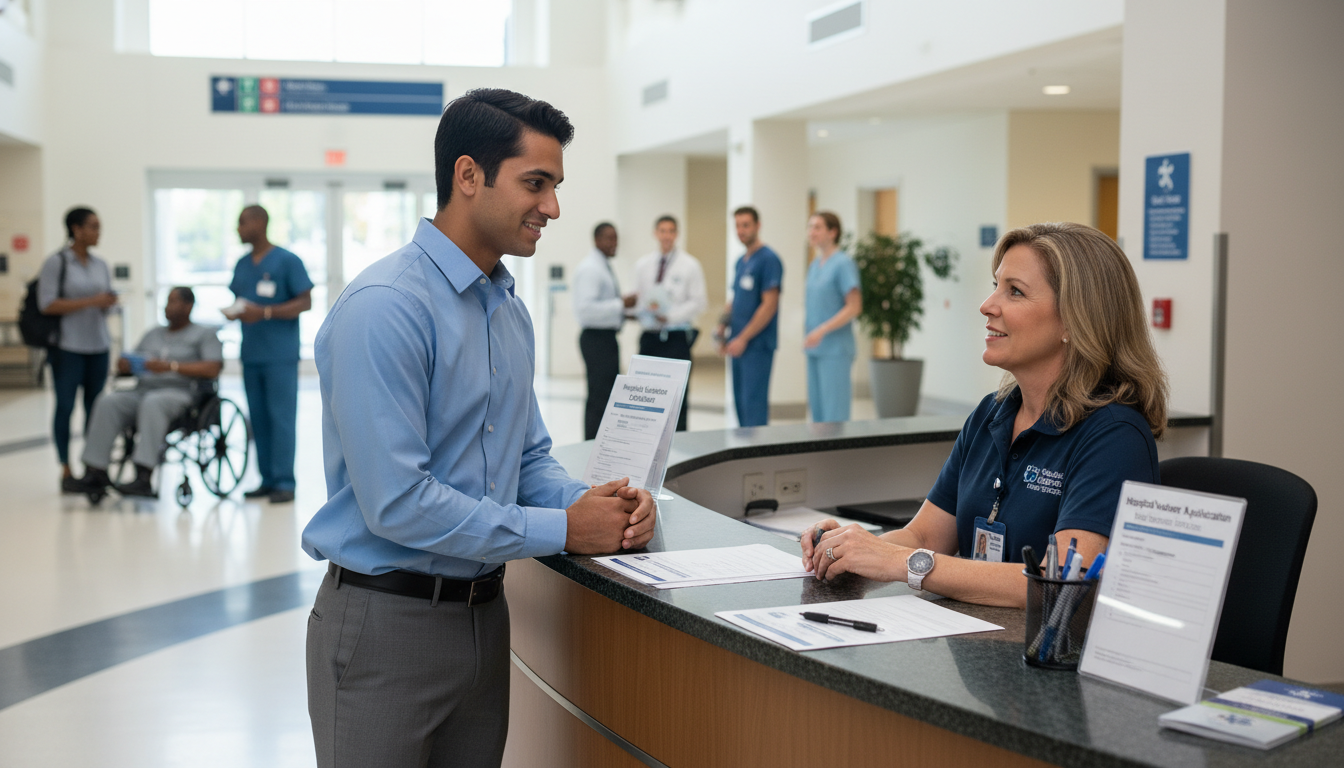
Most international premeds are not “unqualified” for clinical volunteering — they’re just asking the wrong people the wrong questions.
If you’re an international student in the US trying to get real clinical experience, you’re probably hearing some version of:
- “We don’t take non–US citizens.”
- “You need to be a permanent resident.”
- “Our volunteers must have a Social Security number.”
You walk out of yet another “no,” wondering if it’s even possible to build a competitive application for US med schools without a green card.
(See also: Handling a Toxic Clinical Volunteer Environment as a Pre‑Med for more details.)
Here’s the reality: acceptable, meaningful clinical volunteering is possible as an international student in the U.S.—but you have to be strategic, relentless, and a little unconventional. This is not a “sign up online and wait” situation. You’re going to have to engineer some of these opportunities.
This guide is written for you if:
- You’re on F‑1 (or similar) status at a US college/university
- You want direct patient exposure that US medical schools will respect
- You’re running into “citizens/green card only” policies again and again
Let’s walk through what actually works in this situation and how to move from repeated rejections to real clinical hours.
1. Get Crystal Clear on What Counts as “Clinical” for Med Schools
Before you spend months chasing the wrong thing, lock this in.
Most US medical schools want clinical exposure where you:
- Interact with sick or injured people
- See healthcare delivery up close
- Observe the roles of physicians and other health professionals
- Develop comfort in medical environments (not just labs or offices)
Commonly accepted clinical volunteering (for both domestic and international students):
- Hospital volunteer roles with patient contact
- Emergency department (ED) volunteer
- Inpatient floor volunteer (helping nurses, answering call lights)
- Hospice volunteering with patients or families
- Free clinic volunteering in patient areas
- Medical interpreter (if fluent in another language)
- Clinic-based scribe or MA-type support roles (where allowed)
Borderline / less clinical (still can be useful, but not your core):
- Front desk only, zero patient interaction
- Hospital gift shop
- Data entry in research offices
- Telehealth tech support with no patient contact
You, as an international student, have the same target as everyone else: consistent, longitudinal, patient-facing experience. What’s different is how you get there and where you’re allowed in.
2. Understand the Barriers You’re Actually Facing
You are not imagining it: hospitals and clinics often push back on international students for specific reasons. Knowing those helps you work around them instead of bouncing off them.
The usual blockers
Background checks requiring SSN
Many hospital systems run background checks through vendors that expect a Social Security number. Some will simply say “no SSN = no volunteer.”Malpractice / liability concerns
Institutions feel safer limiting certain roles to citizens/PRs “just in case,” even if the logic is shaky.HR policies written for employees, applied to volunteers
They copy-paste employment requirements (citizenship, I‑9, etc.) onto volunteer positions that legally don’t require them, just because it’s easier.Misunderstanding of immigration rules
Staff often confuse “paid work” (regulated for F‑1 students) with unpaid volunteering. They think saying “yes” might be illegal.Lack of time to handle exceptions
If their online form flags you as “foreign address,” “no SSN,” or “visa holder,” they may default to no because they don’t want extra administrative work.
None of these are about you being unqualified. They’re about systems that are not built with you in mind.
Your strategy: go where the systems are more flexible, and make it as easy as possible for them to say yes.
3. Start Where Your Visa Is Safest: On-Campus and University-Linked Options
If you’re on F‑1, you’re allowed to volunteer, but universities and hospitals sometimes confuse “volunteering” with “employment.” The cleanest path is often through places already used to hosting international students.
A. Campus health centers and student clinics
Many universities have:
- Student health centers
- Counseling centers with health education programs
- University-affiliated free clinics or mobile clinics
These are often much more flexible about:
- Citizenship/PR
- SSN requirements
- Paperwork, because you’re already vetted as a student
Tactics:
Email your premed advising office:
- “Which clinical volunteering options do your international premeds usually do?”
If they say “we’re not sure” — push: - “Can you connect me with 1–2 international students who successfully volunteered clinically?”
- “Which clinical volunteering options do your international premeds usually do?”
Search your university name + these terms:
- “student-run free clinic”
- “mobile health clinic”
- “global health initiatives”
- “refugee clinic”
- “community health project”
These university-affiliated clinics often love committed volunteers, and many already have F‑1 students involved.
B. Departments with “service” components
Look for:
- Nursing school community clinics
- Public health school community screening events
- Physical therapy / OT clinics that take student volunteers
Email program coordinators directly. You’re not asking for “a premed position”; you’re asking:
“Do you have any roles where students can interact with patients or support clinical operations as volunteers?”
That language matters. It sounds useful to them, not needy from you.

4. Hospitals and Clinics: How to Get Past the First “No”
Many international students give up after hitting a few hospital volunteer pages that mention citizenship or SSN. You cannot stop there.
Step 1: Stop relying only on the online form
The public volunteer form is designed for the average local volunteer, not a motivated, bilingual, premed international student.
You need human contact:
- Call the volunteer services department directly.
- Ask for the Volunteer Coordinator by name if listed online.
- If you get voicemail: leave a precise, 30–45 second message. Then follow up via email.
Sample script (phone):
“Hi, my name is [Name]. I’m an undergraduate student at [University] majoring in [X]. I’m on an F‑1 international student visa and I’m very interested in volunteering in a patient-facing role if that’s possible. I’m happy to complete any extra paperwork you need. Could you let me know whether your program can accommodate international students without a Social Security number, and if so, what kinds of roles might fit?”
Then, email something similar, but a bit more formal. Attach a 1-page resume. You’re signaling: I’m serious, I’m organized, I’m worth your time.
Step 2: Ask specifically about which requirements are rigid
If they say:
“We require a Social Security number.”
You ask:
“Is that requirement from your background check vendor, or is it a hospital policy? I know some systems allow international students to volunteer using passport information.”
Sometimes, they genuinely don’t know. But a surprising number will say:
- “For non‑SSN volunteers, we do X instead.”
- “We have some roles that don’t require the full background check.”
You’re not arguing. You’re just probing to see if categories exist that are not visible on the website.
Step 3: Target specific departments
Some parts of hospitals are much more open to international volunteers:
- Emergency Department: often used to managing complex volunteer schedules, more patient contact roles.
- Patient Transport / Patient Support: moving patients, answering call lights, comfort rounding.
- Hospice services affiliated with the hospital: more likely to welcome diverse volunteers.
- Language services: if you’re fluent in another language in high demand (Spanish, Mandarin, Arabic, etc.), you can be an asset.
Email something like:
“I speak [Language] fluently and am interested in any volunteer role that supports [language]‑speaking patients or improves communication in clinical areas. I’m happy to help with patient rounding, wayfinding, or comfort measures.”
Now you’re solving their problem, not presenting your problem.
5. Community Sites: Often the Easiest Wins for International Students
If hospitals feel like brick walls, shift your energy where doors are already half open.
A. Free clinics and community health centers
Look for:
- “Free clinic [your city]”
- “Federally qualified health center volunteer”
- “Community health center volunteer”
- “Student volunteer clinic [your state]”
Why these help you:
- They often operate on tighter budgets and rely heavily on volunteers
- They may not use the same HR/background check systems as big hospital chains
- They tend to serve immigrant, refugee, and low-income populations — where your language skills and cultural background are a strength
Common roles:
- Patient intake and registration
- Vital signs (after training), rooming patients
- Health education, navigation, paperwork assistance
- Interpreting (if your language skills are truly strong)
When you contact them, emphasize:
- Your language skills
- Your long-term interest and reliable schedule
- Willingness to take training and start in a basic role
You’re trying to become a dependable regular, not a “premed tourist” who shows up for 10 hours and disappears.
B. Hospice organizations
Hospice can be deeply meaningful clinical exposure, and many programs accept international student volunteers.
Possible roles:
- Visiting patients in nursing homes or at home (within program policies)
- Supporting families and caregivers
- Sitting vigil with patients who are dying
- Administrative support linked directly to patient care teams
Hospice volunteer coordinators are usually very used to explaining processes and navigating background checks. Ask them directly:
“Do you accept international student volunteers who don’t have a Social Security number? If yes, what roles would be most helpful?”
If they say no, ask:
“Are there partner organizations you know that are more flexible about international students?”
Hospice staff often know the broader community ecosystem very well.
6. Use Your Strengths as an International Student Instead of Hiding Them
You bring real assets that many domestic applicants simply do not.
Languages
If you speak a non-English language fluently:
- Put it at the top of your resume, clearly labeled:
- “Languages: Native [Language]; Fluent English”
- In emails, explicitly state:
- “I am fluent in [Language] and comfortable interpreting in medical settings after appropriate training.”
Target:
- Free clinics that serve your language community
- Hospital interpreter departments
- Community organizations that run health fairs, vaccination drives, screening days
Cultural competence
You may understand:
- How healthcare is perceived in your home country
- Barriers immigrant families face here
- How to build trust with patients who don’t fully trust US systems
Frame this clearly:
“As an international student from [Country], I’ve seen how difficult it can be for people to navigate a new healthcare system. I’d like to volunteer in roles that help patients feel understood and supported.”
Volunteers who understand culture + language + health are gold. But you must say this explicitly — coordinators do not guess it from your passport.
7. Immigration & Legal Safety: Stay Inside the Lines
You do not want your “clinical volunteering” to get misclassified as unauthorized employment.
Ground rules for F‑1 students
Volunteering must be truly unpaid
- No under-the-table pay
- No “stipends” that are essentially wages
- No swapping of “free volunteering” for something that obviously should be a paid role (e.g., replacing a paid MA entirely)
Stick to traditional volunteer roles
If it looks like a job a hospital would normally pay someone to do full time, be cautious. Many clinical volunteer roles are clearly established as volunteer-based (ED volunteers, hospice visitors, clinic intake helpers). Those are fine.Talk to your international student office early
Email them:“I’m a premed student looking for purely volunteer, unpaid roles in hospitals or clinics to gain exposure to healthcare. Are there any restrictions on this under my F‑1 status?”
Ask them to put their response in writing. If a site gets nervous, you can show that your university supports what you’re doing.
CPT/OPT vs. volunteering
- CPT/OPT are for paid or formal practical training tied to your field of study.
- Volunteering is separate and does not use your CPT/OPT time if it’s genuinely unpaid and in a traditional volunteer setting.
Don’t let people confuse these categories and shut you down unnecessarily.
8. If You Just Keep Hearing “No”: Create Your Own Acceptable Path
Some cities and systems are simply more rigid. If you keep getting blocked, you’ll have to get creative but still remain within what med schools consider “clinical.”
A. Shadowing as a backbone, not the only pillar
Shadowing alone is not enough, but it helps if:
- You arrange longitudinal shadowing: same clinic 3–4 hours a week, for months
- You’re allowed to observe real patient encounters
- You see repeated follow-ups and continuity of care
Find physicians who:
- Trained or grew up outside the US (often more sympathetic to your situation)
- Are in community clinics or private practices, not just large academic centers
Use your university’s alumni network, LinkedIn, ethnic community organizations, religious communities, or faculty connections.
Ask for:
“Ongoing shadowing 1–2 half-days per week for at least a semester, so I can understand patient care over time.”
Document it clearly on your application as clinical exposure (schools know shadowing is limited but still count it as clinical exposure, especially if longitudinal).
B. Health-related community roles with indirect clinical exposure
If direct hospital roles stay closed, pair shadowing with:
- Volunteering at nursing homes / assisted living: feeding assistance, activity groups, mobility help
- Working with refugee resettlement agencies that assist with medical appointments and navigation
- Volunteering at blood drives (American Red Cross or local): check-in, donor support, recovery area
- Health education projects: BP screenings at community centers (after training), health fairs
These are still clinical-adjacent: you’re interacting with ill or vulnerable people in health-related contexts. Combined with shadowing, they build a credible narrative.
9. How to Explain Your Clinical Volunteering as an International in Applications
When it’s time to talk about your experiences, you’ll need to show:
- You got real exposure despite structural barriers.
- You didn’t give up when doors closed.
- You understand what physicians actually do.
Example framing in secondaries or interviews:
“As an international student, I wasn’t eligible for many hospital volunteer programs, especially those that required Social Security numbers or restricted roles to citizens or permanent residents. After being turned away by several large health systems, I shifted strategies. I worked with my university to find a student-run free clinic that could accept international volunteers. I started in a basic intake role and, over two years, became one of our primary [Language] interpreters and patient navigators. I supplemented this with long-term shadowing in a community clinic.
These experiences, built slowly and often in the face of initial rejection, taught me how to adapt to structural limitations while staying focused on patient care.”
That’s not an excuse. That’s resilience and resourcefulness — both very attractive to admissions committees.
10. A Concrete 6–12 Month Action Plan
If you’re overwhelmed, here’s a direct blueprint.
Month 1–2
- Meet with:
- Premed advisor
- International student office
- Identify:
- Campus health center opportunities
- University-affiliated clinics or community partnerships
- Send 8–10 targeted emails:
- 3 hospitals (volunteer services or ED)
- 2 free clinics
- 2 hospices
- 1–3 community health centers
Month 3–4
- Secure at least one of:
- Free clinic or community health center role
- Hospice volunteer position
- Campus clinic role
- Start shadowing 1 physician (even just 4 hours/week)
- Commit to a consistent weekly schedule; aim for 3–6 clinical hours/week.
Month 5–12
- Maintain consistency. Admissions like to see:
- Minimum 6 months in one place
- Ideally 1+ year somewhere
- If one site is not giving direct patient contact:
- Ask explicitly: “Are there ways I can gradually take on more patient-facing responsibilities?”
- Continue searching for a second clinical site once the first is stable:
- Maybe add hospice if you started in a clinic, or vice versa.
By the time you apply, you want:
- 100–200+ hours of clinical volunteering (or more)
- One long-term site where you grew and took on more responsibility
- Shadowing layered on top
As an international student, that’s realistic and respectable.
FAQ (Exactly 5 Questions)
1. Do US medical schools count international students’ clinical volunteering the same as for US citizens?
Yes. Admissions committees evaluate what you did, not your citizenship. If your role involved real patient interaction, consistent commitment, and meaningful exposure to healthcare, it counts. You just need to be clear in your description about your responsibilities, not your immigration status.
2. Is hospital volunteering required, or will clinics and hospice be enough?
Hospital volunteering is not mandatory. A strong combination of free clinic work, hospice, community health centers, and shadowing can absolutely satisfy clinical exposure expectations. Many successful applicants have never worn a hospital volunteer badge but have excellent clinic-based experiences.
3. Can I list shadowing as “clinical volunteering” on my application?
No. You should list shadowing under shadowing/observation if the application platform separates them (AMCAS does). But shadowing is considered clinical exposure. You just need to pair it with more active roles (volunteering, patient support) so your application doesn’t look passive.
4. What if every hospital near me refuses international volunteers due to no Social Security number?
Then you pivot hard to non-hospital options: free clinics, community health centers, hospice, nursing homes, refugee agencies, and long-term shadowing. You can still build a solid portfolio of clinical and clinical-adjacent experiences without a single hospital shift. Many international students have done exactly that.
5. Will explaining these barriers sound like I’m making excuses to admissions committees?
Not if you frame it correctly. Do not complain about policies; instead, briefly acknowledge the constraint, then emphasize what you did anyway. “Despite being ineligible for many hospital programs due to my international status, I found…” and then highlight the concrete, patient-facing roles you held. Schools respect applicants who adapt and persist.
Key points to keep in mind:
- You can get acceptable, patient-facing clinical volunteering as an international student — but you must be strategic and persistent.
- Prioritize flexible environments: university-linked clinics, free clinics, community health centers, and hospice programs.
- Combine whatever clinical volunteering you secure with long-term shadowing and community health roles to build a credible, resilient story for admissions.