The belief that you “cannot get enough clinical experience from a rural college” is flat-out wrong.
If you are in a town with one small hospital or no hospital at all, you are not stuck. You just cannot use the default playbook that works for students next to large academic medical centers. You need a different strategy and a more creative definition of “clinical.”
This is the playbook for your situation.
(See also: Handling a Toxic Clinical Volunteer Environment as a Pre‑Med for tips on navigating challenging volunteer settings.)
Step 1: Get Ruthlessly Clear on What Counts as “Clinical”
Before you spend time and gas money, you need to know what actually moves the needle for admissions committees.
- You are interacting (directly or closely) with patients or families
- In a health-related setting
- With some level of exposure to illness, treatment, or healthcare systems
Non-negotiable elements:
- Human illness or vulnerability is present – nursing homes, rehab centers, free clinics, hospice, etc.
- You see or participate in patient care – not just filing charts in a back office
- You’re close enough to observe the realities of medicine – suffering, communication, ethics, uncertainty
Traditional examples:
- Hospital volunteering
- EMT
- Medical assistant
- Scribe
- Free clinic volunteer
Rural-friendly examples that absolutely “count”:
- Nursing home / long-term care facility volunteer with resident interaction
- Hospice volunteer (in-home or facility-based)
- Home health aide (with proper boundaries and documentation)
- Behavioral health / addiction recovery centers
- Mobile clinic volunteering
- Telehealth support roles (helping patients connect to virtual visits)
- Rural public health outreach with patient interaction (screenings, home visits)
You’re not being graded on the name of the place (big hospital vs. small clinic). You’re being evaluated on:
- Proximity to patients
- Quality and depth of involvement
- Longevity and consistency
- Insight and reflection you gain
Your job in a rural area is to widen the definition of where medicine is actually happening.
Step 2: Map Your Realistic Clinical Radius
If you’re rural, transportation and time are your major constraints. You cannot pretend you live next to a Level 1 trauma center when your reality is a 60–90 minute drive for any hospital.
Do this today:
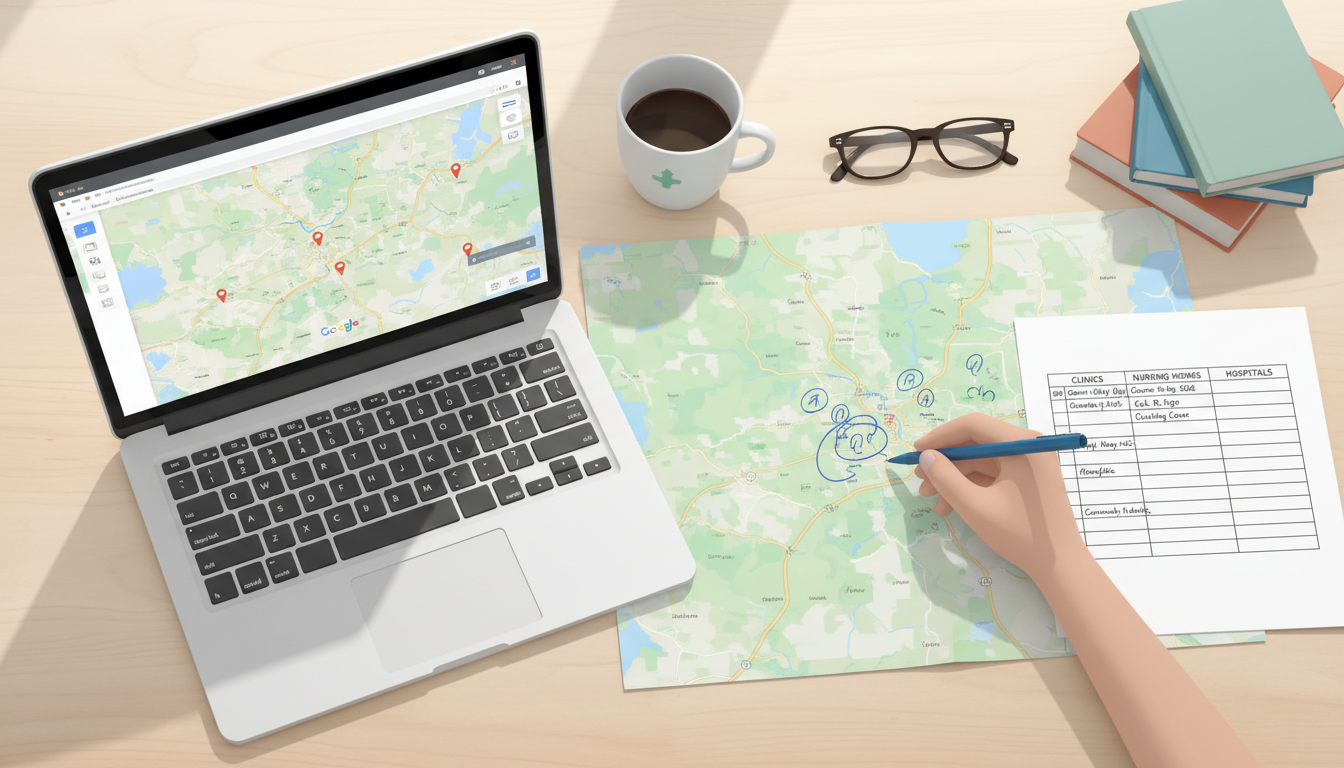
Draw a 30–60 mile radius around your campus/home
Use Google Maps. Mark:- Hospitals (even tiny critical access ones)
- Federally Qualified Health Centers (FQHCs)
- Free or sliding-scale clinics
- Nursing homes / skilled nursing facilities
- Assisted living facilities
- Hospice organizations
- County public health departments
- Behavioral health clinics and substance use treatment centers
- Dialysis centers
Create a simple spreadsheet
Columns:- Name of facility
- Type (nursing home, FQHC, etc.)
- Distance / drive time
- Phone number
- Website
- Contact person (if known)
- Notes
Rank by “effort vs. payoff”
- High-payoff, lower effort: long-term care facility 10 minutes away that takes volunteers
- High effort, high payoff: hospital 1 hour away with a structured volunteer or scribe program
- Medium payoff: public health department with occasional outreach events
This is your territory map. You are not “stuck in the middle of nowhere” once you see all the health-related sites around you.
Step 3: Exploit the Most Underrated Rural Option – Long-Term Care & Nursing Homes
If you only remember one thing from this article, make it this:
Nursing homes and long-term care facilities are gold for rural premeds.
Why they’re so powerful:
- They are everywhere – even tiny towns with no hospital often have one
- They’re used to volunteers (church groups, high schools, community members)
- Residents have complex medical histories – dementia, diabetes, COPD, heart disease, post-stroke, polypharmacy
- You see the intersection of medicine, function, and family dynamics
What you can actually do there:
- Visit residents, play games, read aloud, accompany them to facility activities
- Assist with group activities (bingo, exercise classes, crafts)
- Help with non-clinical but patient-facing tasks (delivering mail, escorting residents to dining room)
- Observe interactions with nurses, CNAs, therapists, visiting doctors and NPs
How to make this a strong clinical experience:
- Aim for at least 2–3 hours per week for 6+ months
- Ask if you can:
- Shadow different roles occasionally (RN, PT, OT)
- Sit in on family meetings (with permission)
- Help with memory care/Alzheimer’s unit activities
- Keep a reflection log: short notes after each shift about patients, conversations, emotions, communication strategies you saw
What to say when you email or call:
“I’m a premed student at [College Name] hoping to gain experience working with patients. I’d love to volunteer in a role where I can interact with residents and learn more about caring for older adults. Do you currently accept volunteers, and if so, whom should I speak with to learn more?”
Do not undersell this in your applications. A student with 150–300 hours in a rural nursing home, with clear reflection and insight, often looks more mature than someone who handed out blankets in a huge urban hospital.
Step 4: Build Clinical Exposure Through Rural Public Health and Home-Based Care
Rural medicine often happens where people live, not in big buildings. Lean into that reality.
County Public Health Departments
Many rural counties run:
- Vaccination clinics
- STD/STI screening days
- WIC programs
- Home visits for high-risk infants or pregnant individuals
- Chronic disease screening events (BP checks, diabetes screenings)
Possible roles:
- Help with patient check-in and forms at a screening event
- Prepare materials and observe education sessions
- Assist with outreach for flu shot or COVID-19 vaccine clinics
- Help with data entry or follow-up calls
You may not be “in the room” for everything, but you will:
- See how access works (or does not work) in your community
- Witness real health education and behavior change attempts
- Understand resource limitations first-hand
Hospice and Home Health
This is serious, emotionally heavy experience – but extremely meaningful and valued.
Hospice organizations in rural regions sometimes:
- Provide in-home support volunteers (respite for families, companionship for patients)
- Need help with office tasks, bereavement support, or events
- Offer volunteer training on end-of-life issues
What counts as clinical:
- Time with patients and families in their home or facility
- Observing how care teams communicate around prognosis, pain, and dignity
- Participating in emotional support (within your training and boundaries)
Approach carefully and thoughtfully. Ask:
“Are there volunteer roles that involve direct contact with patients or families that might be appropriate for a premed student? I’m looking to learn about the experience of serious illness and end-of-life care in our community.”
You will have to complete training, background checks, possibly TB testing. That is normal.
Step 5: Use “Cluster Scheduling” for Distant Hospitals and Clinics
If the nearest hospital is 45–90 minutes away, you can still use it. You just have to structure it differently than weekly two-hour shifts.
Option A: One Long Day per Week
For example:
- Every Friday: drive 1 hour to the regional hospital
- Volunteer 6–8 hours in a patient-facing area (ED, transport, patient liaison, etc.)
- Drive back
What makes this viable:
- No classes that day, or a light schedule
- Consistent weekly commitment for at least a semester
Option B: Seasonal or Break “Clinical Sprints”
Target winter break, summer, or even a single month where you:
- Live with family or friends closer to a hospital, or
- Commit to commuting for a finite period
Example:
- During summer, scribe in an ED 3 shifts/week for 10 weeks
- Or volunteer 3 full days/week at a city academic medical center
Admissions committees don’t care if your hours were “spread out nicely” as long as:
- You can show sustained engagement (many weeks or months)
- You clearly learned and grew from it
If you know you can only access real hospitals during breaks, plan backwards:
- Freshman/sophomore summers: get general exposure, maybe EMT, CNA, or scribe training
- Junior summer: more intense clinical role
- Academic year: maintain local nursing home / hospice / public health involvement

Step 6: Turn Your Rural Context into a Strength, Not an Apology
You are not trying to “explain away” your lack of a prestigious hospital. You’re showing how you engaged with the community in front of you.
In your future personal statement or interviews, you want to communicate:
- You recognized your environment’s limitations
- You actively sought out real patient contact anyway
- You gained insight into rural health, resource constraints, and continuity of care
Ways to frame this:
- “At my rural college, there was no large teaching hospital nearby. This pushed me to seek clinical experiences in settings where most care actually happens for our community: a 45-bed nursing home, a county public health department, and a mobile clinic that visited farm towns twice a month.”
- “I learned that in rural communities, medicine is often about relationships built over years, not quick visits in large systems. Volunteering at the only long-term care facility in a 40-mile radius showed me…”
- “Driving an hour each week to volunteer in the regional hospital’s ED made me think very differently about what ‘access to care’ really means for the patients I met back home.”
Rural context helps you:
- Stand out from the hundreds of applicants with generic big-city hospital volunteering
- Demonstrate commitment to underserved populations
- Show maturity and resourcefulness
Do not hide that you’re rural. Use it.
Step 7: Sample Plan for a Rural Premed (Years 1–4)
Here is a concrete, realistic path if you’re starting in or near a rural college:
Year 1 (Freshman)
Goal: Basic exposure + test your interest.
- Shadow local primary care or family medicine provider 2–3 full days (during breaks or scattered)
- Start volunteering at a nearby nursing home 2 hours/week
- Attend 1–2 public health events (flu clinic, county fair health booth, etc.)
- Use school breaks to explore:
- One-day shadowing with a local surgeon, OB/GYN, or hospitalist at the regional hospital
- Ride-alongs with local EMS if allowed
Year 2 (Sophomore)
Goal: Increase responsibility and depth.
- Continue nursing home volunteering (or shift to hospice if appropriate) – aim for 75–100+ total hours this year
- Ask for more involved roles: memory care unit activities, consistent visits with a few residents
- If possible, complete EMT or CNA training during summer at a community college closer to home/city
- Use summer to:
- Work as EMT/CNA, or
- Volunteer/intern at a hospital near home for 2–3 days/week
Year 3 (Junior)
Goal: Advanced, immersive clinical role.
- Maintain 2–4 hours/week locally (nursing home, hospice, free clinic, or public health)
- During academic breaks:
- Work as an EMT, CNA, medical assistant, or scribe in a more populated area
- Consider:
- Telehealth support roles (helping patients log in, troubleshooting) at a local clinic
- Helping faculty or local physicians with small quality improvement projects related to rural care
Year 4 (Senior / Application Year)
Goal: Sustain involvement and prepare to talk about it.
- Keep one consistent patient-facing role (even 2 hours/week counts)
- Use your accumulated experiences to:
- Write about rural health challenges in your secondaries
- Emphasize continuity and long-term relationships with patients
- If you take a gap year:
- Consider a full-time clinical job in a rural or underserved setting (FQHC, Native health clinic, rural hospital, mobile clinic)
By the time you apply, you want:
- 150–300+ clinical hours minimum
Many strong rural applicants end up with more, especially if they worked as EMTs/CNAs. - Multiple settings: at least 2 distinct environments (e.g., nursing home + hospital or hospice + ED)
- Evidence of depth, not just “hour collecting”
Step 8: How to Ask for Opportunities When No Program Exists
At many rural sites, there is no official “volunteer program.” You’ll hear, “We’ve never had a premed ask before.”
This is where you differentiate yourself.
Use a simple script by email or phone:
“Hello, my name is [Name], and I’m a premed student at [College]. I’m hoping to gain experience working with patients and learning about healthcare in our community. I understand you might not have a formal volunteer program. Would it be possible to speak with someone about whether there are any roles — even small ones — where I could help and learn, especially if it involves interacting with patients or supporting their care?”
Key points:
- You’re humble but clear about what you’re after: patient interaction and learning
- You acknowledge they may not have a program, which lowers defenses
- You’re open to small roles at first
Be prepared to:
- Complete background checks, TB test, HIPAA training
- Start with small, non-glamorous tasks (but still around patients)
- Prove reliability over a few months before asking for more exposure
You may need to call 5–10 places to get 1–2 opportunities. That’s normal.
Step 9: Document Everything Like a Future Applicant
Do not trust your memory. Keep ongoing records from the start.
Track:
- Date, hours, location
- Type of activity (nursing home visits, ED volunteer, hospice companion)
- Brief notes on:
- What you did
- One interaction that stood out
- One thing you learned/observed
This will:
- Make your AMCAS/AACOMAS clinical experience entries far easier
- Give you real material for secondaries like “Tell us about your clinical exposure”
- Help you see your own growth over years
You want your future application to show:
- A coherent story: “I started with X, then added Y, then deepened with Z”
- Real reflection: what you learned about medicine and yourself, not just “I helped a lot”
FAQs
1. Will admissions committees think my rural clinical experiences are “less impressive” than big academic hospitals?
No, if you frame them well. Committees care about:
- Direct patient interaction
- Longevity and depth
- Insight into healthcare realities
A year of consistent nursing home or hospice involvement, plus seasonal hospital or EMT work, looks very strong. The key is reflection and continuity, not the brand name on your badge.
2. How many clinical hours do I need if I’m starting late and stuck in a rural area?
If you’re starting late (junior year or later), aim for:
- At least 150 solid clinical hours before applying
- Try to cluster hours during breaks (intense volunteering or paid clinical work)
- Maintain something ongoing locally during the semester, even if just 2–3 hours/week
Quality beats quantity. Better 150 hours of genuine patient interaction in rural settings than 400 hours of standing at an information desk.
3. What if I truly cannot drive to any hospital or clinic beyond my small town?
Then your focus becomes:
- Maximizing what does exist: nursing homes, assisted living, school nurse, public health department
- Adding non-clinical but health-related work: crisis hotlines, health education, virtual patient support
- Planning summers and breaks very strategically to live elsewhere (with relatives, friends, or near programs) and immerse in hospital or clinic work
Today, take one concrete step: open Google Maps, search “nursing home,” “clinic,” and “public health” near your college or home, and make a list of five places you will call or email this week.