The way deans actually use clinical volunteering when ranking applicants is very different from what premed advisors tell you.
Most students think hours matter. Deans think patterns matter. And when the committee door closes, your “200 hours at the hospital” is usually a five‑second conversation—if that.
Let me walk you through how this really plays out in the room where your file is judged.
(See also: Clinic Volunteering Roles That Quietly Signal ‘Future Physician’ for more details.)
What Deans Actually Look At When They See “Clinical Volunteering”
Here’s the part nobody says out loud: clinical volunteering is less about service and more about risk management.
Deans are trying to answer four quiet questions when they see your clinical work:
- Have you actually seen what sick people look like up close?
- Are you going to melt down on the wards when medicine is messy, imperfect, and unfair?
- Are you at risk of quitting in M3 when you discover you do not like real patients?
- Are you mature enough to work around vulnerable people without becoming a liability?
They use your clinical volunteering as a proxy for all of that.
When your application is on the screen during a committee meeting, the discussion doesn’t sound like:
“Wow, she has 500 hours at the free clinic. So impressive.”
It sounds more like:
“Okay, she’s been in a longitudinal clinic role for two years, lots of direct patient contact, consistent. She knows what she’s signing up for.”
versus
“He ‘shadowed’ for a week and did logistics at a charity race. No real patient contact, nothing sustained. I’m not convinced he understands clinical work.”
The hours are the number on the surface. The real ranking comes from the underlying narrative they can infer.
The Myth of “More Hours = Better Applicant”

I have watched admissions committees at mid‑tier and top‑tier schools—places like Michigan, UCSD, Yale, and a bunch of private schools you quote on SDN all the time—go through thousands of files.
Here’s what shocked most of the students I mentored: past a baseline threshold, the exact number of hours basically stops mattering.
Typical internal thinking:
- 0–20 hours: Red flag. “Tourist.” Often an auto‑downrank unless there’s a serious explanation.
- 50–100 hours: Bare minimum. “Okay, technically exposed, but shallow. Let’s see if essays rescue this.”
- 100–300 hours: Comfortable range. “Likely adequate exposure. Check for depth and reflection.”
- 300+ hours: Only impressive if it shows longitudinal commitment or increasing responsibility. Otherwise: “Hospital warm body. Fine, but not special.”
That “baseline threshold” varies slightly by school, but I’ve heard deans at several institutions say some version of: “If they haven’t had around a hundred hours of real clinical exposure, I’m nervous about them.”
Notice the word “real.” That’s where students misunderstand the game.
What Counts as “Real” Clinical Volunteering to a Dean
Faculty aren’t fooled by labels. They look for three specific things when they read your activities:
- Proximity to the patient
- Continuity over time
- Emotional exposure
You can be in a hospital for 400 hours and still not be “real” in their eyes if all you did was refill blanket warmers and wipe down wheelchairs without ever talking to patients.
Let me break this down the way they actually talk about it.
Proximity to the patient
When we scan your activity descriptions, we’re mentally sorting you into three rough buckets:
- Peripheral – Health fairs, race-day med tents, check‑in desks, purely administrative volunteer roles, transporting supplies, “hospital ambassador” who mainly gives directions. These look nice but do not prove you understand day‑to‑day medicine.
- Near‑patient, low stakes – Volunteer in pre‑op/post‑op who talks with patients while they wait, emergency department liaison, clinic receptionist who checks in patients and hears their stories, hospice visitor, inpatient visitor program. Not doing procedures, but you are seeing real suffering and real systems.
- Direct‑patient, high stakes (for premed level) – Scribing, medical assistant roles, certified nursing assistant, EMT with more than a summer of experience, clinic coordinator who also rooms patients or gathers histories.
Deans are not expecting you to function like a resident. They just want to know you’ve seen the reality: long waits, complicated social situations, confused families, angry patients, burned‑out nurses, overworked attendings.
Continuity over time
This matters more than you think.
Three months of once‑a‑week volunteering in the same clinic beats ten different one‑day health fairs every time. When I sat in on ranking discussions, the phrase that kept coming up was:
“Is this someone who sticks with things, or someone who collects checkboxes?”
A typical internal monologue:
- “She’s been at the same free clinic from sophomore year through graduation, increasing hours gradually and eventually training new volunteers. That’s evidence of reliability and growth.”
- “He has 12 clinical entries, each 10–20 hours, across three years. That’s not exploration; that’s resume padding.”
Emotional exposure
This is the part you rarely hear in public.
Deans know medicine is emotionally brutal. People die. Families scream. Staff snap at you. Systems fail patients. They want evidence that you’ve stood in that environment and didn’t run.
Hospice, oncology clinics, inpatient psych units, emergency departments, long‑term care facilities—these experiences weigh heavily if you can articulate what you learned without sounding performative.
On several occasions, I’ve watched a committee member flip from neutral to strongly supportive of an applicant based on a hospice volunteering description that showed maturity and insight.
How Clinical Volunteering Actually Affects Your Rank
Let’s get into the mechanics, because this is where the “Insider” stuff lives.
Most schools use some variation of a scoring system before committee. Something like:
- Academics: 1–5
- MCAT: 1–5
- Experiences (research, leadership, service, clinical, etc.): 1–5
- Mission fit / diversity / context: 1–5
Sometimes clinical exposure is its own column. Sometimes it’s folded into “Experiences” or “Readiness for Medicine.”
Here’s what happens functionally:
You can be auto‑screened out (pre‑committee) if you have effectively zero clinical exposure, even with a 520+ MCAT. I’ve seen this at both state and private schools.
You rarely get max points for clinical exposure. The bar for “5/5 clinical” is much higher than premeds think. That usually goes to people who’ve worked for years as EMTs, scribes, CNAs, or full‑time clinical staff with strong reflection.
Weak clinical volunteering doesn’t always kill you, but it makes you vulnerable. When a committee is drowning in strong files, the ones that get quietly deprioritized are often those where someone says, “I just don’t see real clinical engagement here.”
Strong clinical volunteering can rescue a borderline file. I’ve seen applicants with modest MCATs get serious consideration because a dean said, “This person clearly understands patients and has stuck with it. I trust they’ll survive clinical years.”
The key: clinical volunteering is less about boosting your rank and more about preventing your rank from falling.
In other words, stellar clinical work is rarely the sole reason you get in. Poor or superficial clinical work is often the silent reason you don’t.
Shadowing vs Volunteering: What Deans Really Think

Let me settle the shadowing debate the way admissions folks talk about it behind closed doors:
- Shadowing alone does not count as sufficient clinical exposure.
- Shadowing is treated as an introductory activity, not as “clinical volunteering” in the deeper sense.
When committees see 60–80 hours of shadowing across a few specialties, it checks a box: “Okay, this person has seen doctors at work.”
But it does not answer the more important question: “How do they respond to patients, suffering, and health‑care systems?” Shadowing is too passive.
Typical reactions you never hear:
- “He has 150 hours OR shadowing and that’s basically his clinical experience. Not good enough.”
- “She shadowed a neurosurgeon for 20 hours but also has two years at the community clinic. The clinic matters; the shadowing is extra.”
Deans want active roles where you’re part of the care environment, even at a junior level. Shadowing is garnish, not the entrée.
The “Story” Your Clinical Volunteering Tells About You
When faculty piece together your ECs, they’re not just counting hours; they’re reading a story—whether you intended to write one or not.
Here are the three archetypes that come up over and over, whether anyone names them aloud or not.
1. The Tourist
Profile: 50–80 hours across a semester; brief shadowing; a couple of health fairs.
Story we infer: “This applicant looked at medicine from the outside. They ‘tried it on’ but never really lived in it. They may not know what they’re getting into.”
In committee, these applicants get language like:
- “Exposure is thin.”
- “I’m uneasy about their readiness.”
Translation: your rank slides down, especially if there are any other concerns.
2. The Collector
Profile: 200–400 hours, but scattered. Ten different roles, each 10–40 hours. Lots of variety, no depth.
Story we infer: “Enjoys accumulating experiences and titles. May be more focused on applications than on patients.”
Depending on the rest of the file, this can be okay, but it rarely excites anyone. You’re safe, but not sticky in the discussion.
3. The Embedded
Profile: One or two core clinical roles held consistently over 1–3 years, increasing responsibility, often combined with a more “hands-on” role like scribing, MA, or EMT.
Story we infer: “This person chose a clinical environment and stayed. They saw enough cycles, crises, and ordinary days to understand reality. They’ll adjust to wards faster and are less likely to burn out in M3.”
These applicants routinely get comments like:
- “Excellent clinical preparation.”
- “I’d trust this person with patients.”
That’s the phrase you want someone to say when your name is on the screen.
What Deans Really Value in Your Descriptions and Essays
Here’s a detail most students never think about: the language you use to describe your clinical work is as revealing as the hours.
Committee members read hundreds of activity descriptions in a row. We can spot fluff and copy‑paste clichés instantly.
Patterns that raise your score in our heads:
- You describe specific patient interactions (without violating privacy) and what you learned from them.
- You show respect for nurses, techs, and other staff rather than presenting the physician as the only important figure.
- You mention systems issues (access, insurance, language barriers, social determinants) in a grounded way, not as a performance of “wokeness.”
- You admit some discomfort or growth: “At first I struggled with X, over time I learned Y.”
Patterns that hurt you:
- You sound like a brochure: “I learned the importance of empathy and communication in medicine.”
- You only talk about “getting to see what doctors do” and never mention patients or other staff.
- You exaggerate your role: “I helped save a patient’s life” when you held a clipboard in the corner.
- You use melodrama: every shift is “heartbreaking,” every story is “life‑changing.”
A committee member at a top‑20 school once said in a meeting, almost word for word:
“Her clinical hours aren’t actually that high, but the way she writes about them is so grounded and specific that I’m confident she paid attention.”
That applicant moved up our internal ranking list, despite having fewer hours than many others.
How Clinical Volunteering Interacts with MCAT and GPA
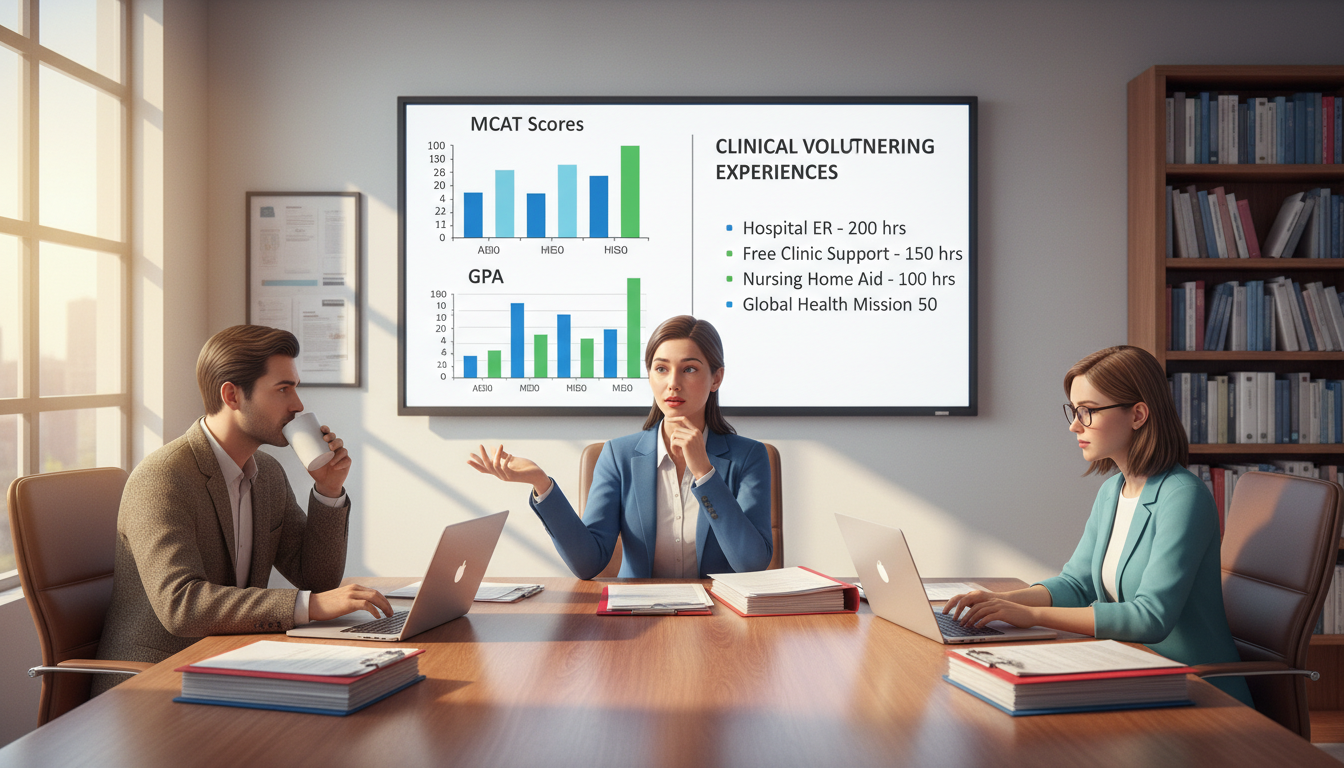
You will not find this in any official rubric, but here’s the honest way deans mentally balance things:
High stats + weak clinical = “Looks good on paper, but I’m concerned they’ll crumble or disengage on the wards. Do we want to risk this?”
These applicants might still be admitted at numbers‑driven schools, but they’re often less liked by faculty reviewers.Solid stats + strong clinical = “Safe bet. They can handle the work and they know what medicine is actually like.”
These are the files that slide smoothly up the ranking tiers.Borderline stats + exceptional, long‑term clinical = “They’ve really proven they belong at the bedside. Can we support them academically if they struggle?”
At mission‑driven and service‑heavy schools, this combination can get you in the door when others are left out.
What deans are trying to avoid is a mismatch: brilliant test takers who hate patient care or are shocked by the realities of hospitals. Your volunteering is the hedge against that risk.
How to Design Clinical Volunteering That Actually Helps You in Ranking
If you’re early in the process, the goal is not to chase the magic number. It’s to architect a pattern that looks irresistible behind closed doors.
Here’s the insider blueprint that quietly works at most schools:
Start earlier than you think.
Even 3–4 hours a week, sustained over a year, looks far better than a frantic 15‑hours‑a‑week cram during your last semester.Anchor yourself in one main setting.
A free clinic, ED, inpatient floor, hospice program, or scribe job that you keep for 12+ months becomes the backbone of your narrative.Layer one or two higher‑intensity roles later.
Scribing, EMT, MA, CNA, or clinic coordinator roles show you didn’t just observe—you worked.Stay long enough to see the ugly side.
If you leave a setting after the honeymoon phase, we wonder why. Long‑term volunteers see burnout, bureaucracy, and sadness—and choose to stay.Reflect in real time.
Keep notes after shifts. What surprised you? What bothered you? What changed your perspective? Those details become gold in your application.
When those pieces are in place, deans don’t have to stretch to rank you highly. Your file reads like someone who has already started becoming a clinician.