The most common mistake MS1s and MS2s make with clinical volunteering is simple: they copy someone else’s schedule instead of building one their life and energy can actually sustain.
You need a timeline, not a flex.
Big-Picture Ground Rules Before You Start
At this point—before day one of MS1—you should anchor around three non‑negotiables:
- Your primary job is to learn medicine.
- Your secondary job is to stay healthy enough to do #1 for four straight years.
- Clinical exposure is the third priority that must fit around the first two, not the other way around.
A realistic clinical volunteering target for most students:
- MS1 Fall: 0–4 hours/month (yes, per month)
- MS1 Spring: 4–8 hours/month
- MS1 Summer: 2–6 hours/week (short bursts or a structured program)
- MS2 Fall: 4–8 hours/month
- MS2 Spring (pre‑dedicated): 2–4 hours/month
- Dedicated board study (if applicable): 0 hours
You can absolutely match into competitive specialties with that level of ongoing clinical activity if you’re consistent, reflective, and not exhausted.
Pre‑Matriculation: 2–3 Months Before MS1
At this point you should focus on positioning, not hours.
Step 1: Clarify Your Capacity (30–45 minutes)
Sit down with a blank weekly grid and block:
- Sleep (7–8 hours/night)
- Commute
- Meals
- Desired exercise (3–5 sessions/week)
- Non‑negotiable family/relationship time
Whatever’s left is theoretical availability. You’ll use about half of that at most for anything extra, including clinical volunteering.
Step 2: Research Opportunities (Over 2–3 Weeks)
Aim for one primary clinical site for MS1:
- Hospital volunteer services (ED, patient transport, information desk)
- Free clinic/ student‑run clinic
- Hospice or palliative care volunteer
- Nursing home / long‑term care facility
At this point you should:
- Make a simple spreadsheet:
- Columns: Site, Role, Minimum commitment, Training dates, Commute, Contact
- Email 3–5 places with a short message:
- Ask about:
- Minimum weekly commitment
- Weekend or evening options
- Training schedule
- Flexibility during exams
- Ask about:
Target opportunities with:
- Shift length: 2–4 hours
- Minimum commitment: ≤ 4 hours/week
- Time blocks: evenings or weekends
Step 3: Decide a Provisional MS1 Fall Plan
You’re not locking in forever. You’re choosing a 90‑day experiment.
Example decisions:
- “I’ll apply for the Saturday morning student‑run clinic, 2x/month.”
- “I’ll do the hospital ED volunteer program, 4 hours every other Sunday.”
- “If nothing low‑intensity is available, I’ll delay until MS1 Spring.”
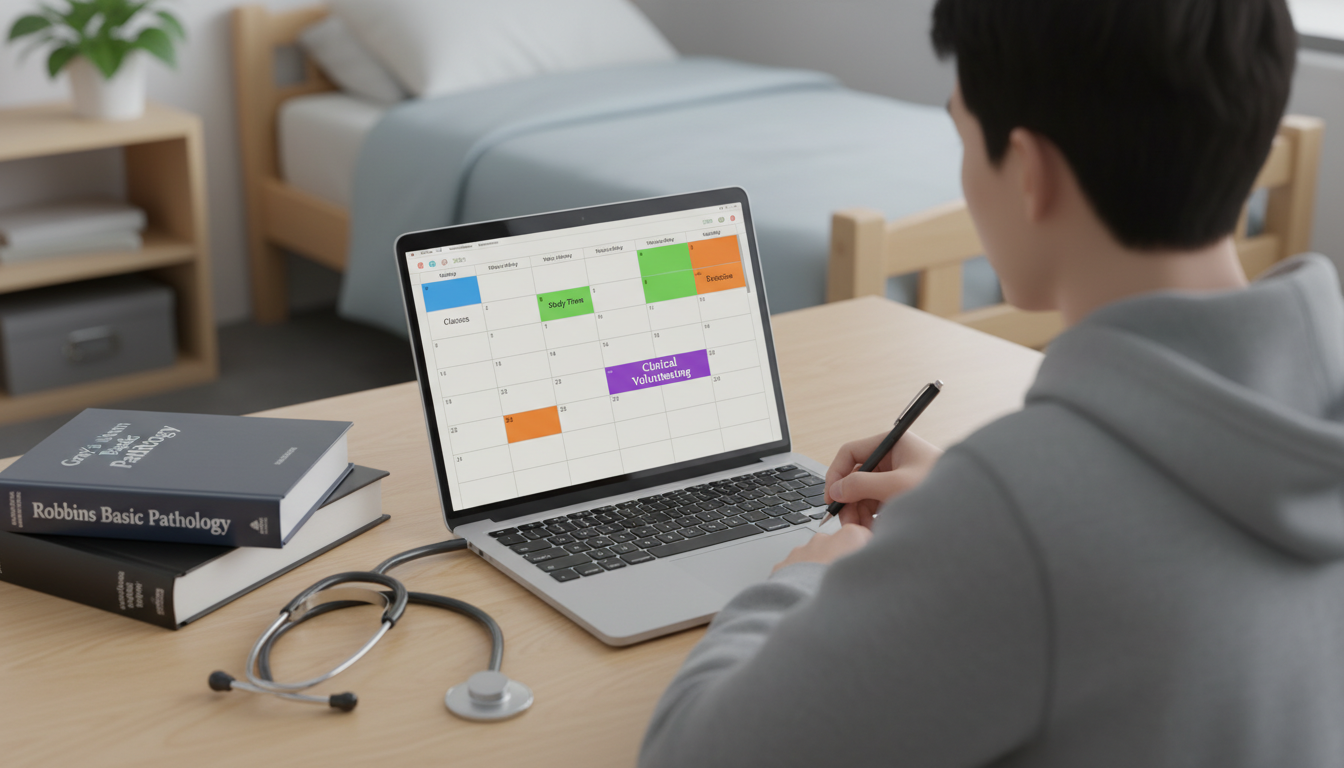
MS1 Fall: Survival First, Exposure Second
This is the semester when many students overcommit and then quietly disappear from volunteer roles at exam #2. Avoid that cycle.
Month 0–1 of MS1 (Orientation + First 4 Weeks)
At this point you should not have a weekly clinical commitment.
Your goals:
- Learn your school’s rhythm:
- How often are quizzes?
- How heavy is anatomy?
- Are there mandatory small groups?
- Track your real weekly workload for 2–3 weeks:
- Use your calendar to note:
- Hours actually spent studying
- Times when your brain is fried
- Natural low‑productivity periods
- Use your calendar to note:
During this time:
- Finish any remaining onboarding paperwork/trainings for your chosen site
- Communicate clearly:
- “I’ll be ready to start regular shifts after [date], once my academic schedule stabilizes.”
Month 2–3 of MS1 (Weeks 5–12)
At this point you should start with one small, predictable clinical commitment.
Recommended schedule:
- Every other week
- 3–4 hour shift
- Same day, same time
- Maximum:
- 6–8 hours/month
Sample week (lecture‑heavy curriculum):
- Mon–Fri:
- Day: class + ~4–5 hours study
- Saturday:
- AM: 3–4 hours deep study
- PM: off
- Sunday (Volunteering week):
- 9:00–12:00: ED or clinic volunteering
- 13:00–17:00: light review / Anki
- 17:00–20:00: rest / social
Critical rule:
If you have a major exam within 5 days, you skip that week’s volunteering and notify the site early.
Month 4 of MS1 (Weeks 13–16 / Pre‑Finals)
At this point you should:
- Evaluate:
- Did you miss >25% of your planned shifts?
- Are you consistently exhausted the day after volunteering?
- Did your grades dip after you started?
If any answers are yes:
- Keep the same or reduced schedule for spring
- Don’t add anything new yet
If everything feels solid:
- You may consider adding 1–2 extra shifts during lighter academic weeks, but do not convert to weekly if biweekly is working well.
MS1 Spring: Gentle Increase, Not a Leap
By now you know how you study and how exams feel. This is the semester to gently increase exposure if it fits.
January: Reset and Plan (Weeks 1–2)
At this point you should:
- Review fall:
- Total volunteer hours (rough count)
- Reliability (missed vs completed shifts)
- Energy after shifts (quick 1–10 rating)
- Decide on your spring structure:
- Option A: Maintain biweekly schedule
- Option B: Shift to weekly, but shorten shifts (e.g., 2–3 hours)
- Option C: Keep schedule the same, but add one‑off events (e.g., health fairs)
Realistic spring targets:
- 1 regular weekly or biweekly shift:
- Weekly: 2–3 hours
- Biweekly: 3–4 hours
- Expected total:
- 20–40 hours for the semester
February–April: Peak Routine
Sample weekly plan for a systems‑based curriculum:
- Mon:
- Classes + 3–4 hours review
- Tue:
- Classes + small group
- Wed:
- Heavier study day
- Thu:
- Lighter study, exercise
- Fri:
- Afternoon or evening 2–3 hour volunteer shift
- Sat:
- Long study block
- Sun:
- Half‑day prep for upcoming week + rest
Rule of thumb for adjustments:
- During “exam weeks” (full exam block, not quizzes):
- 0 shifts
- During lighter / inter‑block weeks:
- You may add 1 extra shift if energy is good

MS1 Summer: Time-Limited Intensification
This is where you can safely increase clinical immersion without burning out, because academic pressure is lower.
Early Spring: Plan Your Summer (March–April)
At this point you should decide what your main summer identity will be:
- Research‑heavy with light clinical
- Clinical‑heavy with light research
- Non‑medical (family, wellness, personal projects) with optional clinical
Options that pair well with balanced clinical time:
- 6–8 week research program + 1 clinic shift/week
- 4–6 week full‑time clinical volunteering (e.g., hospital program) + 4–6 weeks mostly off
- Short medical mission / rural outreach only if it’s ethical, supervised, and educational (not tourism with a stethoscope)
Realistic summer schedule (8–10 weeks total focus):
- Weeks 1–2: Rest + light prep for any program
- Weeks 3–8: Denser activity
- Clinical volunteering: 2 half‑days/week (8 hours total)
- Or 1 full day/week (6–8 hours)
- Weeks 9–10: Transition, reading, light shadowing
Remember: summer intensity is temporary. You’re not setting a pattern to maintain during MS2.
MS2 Fall: Strategically Consistent, Not Heroic
Now boards (USMLE Step 1/COMLEX Level 1) start creeping into your brain. Energy is finite.
August–September: Stabilize Academics First
At this point you should:
- Map your MS2 curriculum:
- Heavier systems (e.g., cardio, renal)
- Integrated board prep sessions
- Decide your clinical baseline:
- For most students:
- 2–4 hours every other week
- Occasionally 2–3 extra hours during light blocks or breaks
- For most students:
Sample safe baseline:
- 3–4 hours twice per month
- Same site as MS1 if possible (continuity = stronger narrative, less onboarding stress)
October–December: Maintain a Low, Steady Drip
MS2 fall can feel deceptively manageable before board panic sets in. Don’t ramp up.
Weekly example:
- Mon–Fri:
- Classes or online modules
- Daily board‑style question blocks (e.g., 20–40 QBank questions)
- One evening every other week:
- 3‑hour shift at free clinic or hospital
- Weekends:
- One heavy study day
- One lighter day/rest/errands
Non‑negotiable rule:
If board QBank performance or class performance drops meaningfully and persistently after volunteering increases, you reduce clinical hours, not study hours.
MS2 Spring: Taper and Protect Dedicated
This is where burning out becomes expensive. You’re close to clinical rotations and boards.
January–February: Decide Your Taper Strategy
At this point you should know your exam/dedicated timeline:
- Traditional schedule:
- MS2 classes through spring
- 4–8 weeks of dedicated study
- Step 1/Level 1 near end of spring or early summer
From here:
- Set a hard stop date for ongoing volunteering:
- 8–12 weeks before your exam date works for most
- Communicate early with your site:
- “My last regular shift this year will be [date] due to board preparation.”
Target schedule until taper:
- 2–3 hours every 3–4 weeks, not weekly
- Or:
- A couple of one‑off weekend clinics/health fairs instead of continuous shifts
6–8 Weeks Before Dedicated: Final Wind‑Down
At this point you should:
- Stop all regular volunteering
- Keep only:
- Rare, low‑time‑commitment shadowing if it recharges you
- Brief clinical exposures integrated with studying (e.g., seeing cases that match your current system)
During dedicated:
- 0 volunteer commitments
- 0 regular shadowing
- Only exceptions:
- Short, unscheduled “treat” shadowing (2–3 hours) after a practice exam if it genuinely motivates you and does not replace rest
Week‑by‑Week Example Schedules
Example: MS1, Average Week (With Biweekly Volunteering)
Week A (with volunteering):
- Mon:
- 8–12: Lectures
- 13–17: Study + Anki
- Tue:
- 8–12: Lab
- 13–17: Review
- Wed:
- 8–12: Small group
- 13–16: Study
- Thu:
- 8–12: Lecture
- 13–15: Light review
- 17–18: Exercise
- Fri:
- 8–12: Lecture
- 13–16: Study
- 17–20: Free time
- Sat:
- 9–13: Deep study
- Afternoon off
- Sun:
- 9–13: Clinical volunteering
- 14–17: Light review
Week B (no volunteering):
- Sunday morning converts to:
- Practice questions
- Longer rest period
Example: MS2, Two Months Before Dedicated (Light Volunteering)
- Mon:
- Day: Class + 40 QBank
- Tue:
- Day: Class + 40 QBank
- Wed:
- Day: Class + 40 QBank
- Thu:
- Day: Class + review
- Fri:
- Day: Class + 20 QBank
- 17–20: 3‑hour clinic shift (only on one Friday this month)
- Sat:
- 6–8 hours of review/questions
- Sun:
- 4–6 hours review
- Half‑day off
This kind of schedule preserves academic performance, keeps you clinically engaged, and doesn’t chew through your reserves before boards.
Practical Rules to Avoid Burnout
At any point in MS1–MS2, you should pull back on clinical volunteering if:
- You’re consistently sleeping < 6.5 hours/night
- You’re routinely studying late the night before a clinical shift to “clear time”
- You dread going, not from nerves, but from exhaustion
- You’re missing > 20–25% of shifts for academic reasons
Simple adjustment ladder:
- Keep same frequency, shorten shift length by 1–2 hours
- Switch from weekly to biweekly
- Switch from biweekly to occasional events only
- Pause for one block and reassess
What Actually Matters to Residency Programs
Across MS1–MS2, aim for:
- Consistent involvement at 1–2 sites over time
- Progression of responsibility (e.g., from basic tasks to teaching new volunteers or coordinating a clinic session)
- Reflective understanding of what you saw:
- Keep a small “clinical log”:
- Not HIPAA‑violating details
- Just key cases, what you learned, what surprised you
- Keep a small “clinical log”:
Residency applications care more about:
- A coherent story: “I volunteered at our student‑run clinic from MS1 through MS3, gradually taking on more responsibility”
- Insight: “Here’s how that shaped the way I think about [population/condition/health system]”
than about raw hours.
You don’t need 500+ hours in preclinical years. For many students, 75–150 well‑chosen hours across MS1–MS2 is plenty.
Quick Summary: Core Moves by Phase
MS1 Fall:
- First month: no regular shifts; stabilize school
- Then: 3–4 hours every other week maximum
MS1 Spring + Summer:
- Spring: consider gentle increase to weekly 2–3 hour shifts
- Summer: time‑limited increase (e.g., 1 day/week), then rest
MS2 Fall + Spring:
- Fall: maintain low, steady schedule (2–4 hours every other week)
- Spring: taper to occasional shifts; stop before dedicated
Protect your energy, be deliberately consistent, and let clinical volunteering serve your learning—not sabotage it.