
Educational note: This article is for general medical-education purposes only. It is not legal, financial, tax, accounting, compensation, or professional application advice. Application policies, platform rules, school expectations, unpaid-versus-paid classification, and any compensation-related reporting standards vary. Confirm details with official application instructions and qualified advisors when needed.
Meta description: Learn how to count mixed clinical volunteering hours honestly, classify blended roles correctly, avoid double-counting, and report application totals accurately and credibly.
You open your spreadsheet and instantly feel sick.
Hospital volunteer shifts from sophomore year. Free clinic Saturdays. A hospice program where half the time you talked with families and half the time you restocked supplies. An emergency department role with patient transport, front desk help, and a lot of weird in-between time where you were technically "there" but not exactly doing something clinical every minute.
And now the totals look messy. Dates overlap. Duties blur together. One supervisor called you a patient liaison, another called you a volunteer assistant, and your own notes from two years ago say things like "3-7 pm, mostly discharge stuff??"
This is where people spiral. I know, because this is exactly the kind of thing that keeps applicants up at 1:14 a.m. You start thinking admissions is going to assume you padded your hours, or worse, that you don't understand what clinical volunteering even is.
Here's the reassuring truth: mixed clinical volunteering is normal. Very normal. What matters is that you count it cleanly, truthfully, and conservatively. You do not need a perfect app. You need a credible one.
This is how to separate roles, classify activities, and report your totals without double-counting, overclaiming, or making your application look sloppy.
This article is for educational purposes only. It is not financial advice, not legal advice, and not tax advice. Figures vary by individual circumstances, consult a qualified professional before acting.
What Counts as Clinical Volunteering When Your Roles Are Blended?
Clinical volunteering is unpaid service that puts you in a healthcare environment with real exposure to patients, illness, care delivery, or the people providing that care.
Plain English? If you're volunteering and you're meaningfully around patients, families, or the care process, that's usually clinical volunteering.
Not everything in a hospital or clinic is clinical, though. That's where people get themselves in trouble.
Here's the basic sorting system I wish more applicants used:
- Clinical volunteering: unpaid, patient-facing or directly supporting patient care in a healthcare setting
- Clinical employment: paid work, even if it's deeply clinical
- Shadowing: observing a clinician, usually with little or no service role
- Research: collecting data, consenting subjects, chart review, lab work
- Nonclinical service: helping people, but not in a healthcare/patient-care context
- Administrative help: filing, scheduling, desk work, scanning papers, stocking generic materials, unless it's tightly tied to patient-facing service
If you volunteered at a hospital front desk greeting visitors and guiding families to rooms, that may still count as clinical if the role genuinely exposed you to patient flow and the realities of care. If you spent the entire time alphabetizing binders in a back office? That's not clinical. Hospital walls do not magically make everything clinical. I wish they did. They don't.
Mixed-role shifts are the real headache. Let's say your 4-hour shift looked like this:
- 1.5 hours escorting patients to imaging
- 1 hour helping with wheelchair transport and discharge coordination
- 1 hour answering the volunteer desk phone
- 0.5 hours restocking pamphlets and sitting around waiting
That is not automatically "4 clinical hours." The patient escort and discharge support are clearly clinical. The desk phone may or may not be, depending on what you were actually doing. Restocking and idle time usually aren't.
That's the part applicants hate, because it feels like you're losing hours. Maybe you are. But you're also protecting yourself from looking inflated, and that matters more.
Schools care a lot less about whether every minute fits perfectly than whether your categorization is honest and internally consistent. If your app says 180 clinical volunteer hours, and your description makes it obvious that a huge chunk was clerical or passive, that's a problem. Not because you're doomed. Because it looks careless.
Use common sense. Use restraint. If a shift was blended, count the clinical portion if that's the most truthful way to report it.
How to Count Mixed Hours Without Double-Counting or Guessing
Here's the safest rule: count only the time you can defend.
Not the commute. Not the 25 minutes you sat in the volunteer lounge waiting for an assignment. Not the orientation lunch because it happened in a hospital conference room. And definitely not the same block of time in two different categories because it "kind of" involved both service and clinical exposure. That's how people create suspicious totals.
A conservative count is your best friend.
If you had a 4-hour volunteer shift but only 2.5 hours were truly patient-facing or directly clinical, record 2.5. Yes, that feels stingy. Yes, it may lower your total. Do it anyway. Overcounting by convenience is dumb. It's the kind of dumb that can make an otherwise solid application feel unreliable.
The cleanest way to count mixed shifts
Use this hierarchy:
- Count full time if the entire shift was clearly clinical and unpaid.
- Count partial time if only part of the shift involved patient-facing or direct clinical support.
- Do not count passive waiting, commuting, and unrelated setup.
- Use caution with training and orientation.
That last one trips people up. Required training can sometimes be included if it was a genuine part of the volunteer role and directly related to carrying out clinical responsibilities. But if you're stretching to count every module, onboarding email, or tuberculosis clearance appointment, stop. That's exactly the kind of nickel-and-diming that makes totals look padded.
A few common scenarios
Scenario 1: Hospital volunteer, all patient escort work You worked every Sunday from 1-5 pm escorting patients, helping with wheelchairs, and guiding families through discharge. Count: the full 4 hours, assuming that was consistently the actual role.
Scenario 2: Mixed clinic support shift You were there from 8 am-12 pm. Two hours were spent rooming patients and helping with flow. One hour was front desk intake. One hour was filing and cleanup. Count: 2 to 3 hours depending on the actual intake role. If front desk intake involved direct patient interaction in a clinical workflow, I'd be comfortable counting that portion. If it was mostly office admin, I wouldn't.
Scenario 3: Hospice volunteering You spent some visits talking with patients and families, and some time restocking supplies or attending volunteer meetings. Count: the direct service time, and maybe the required meeting time only if it was truly part of ongoing service and you can explain it cleanly.
Scenario 4: Free clinic event days You volunteered at blood pressure screenings, checked people in, translated for families, and helped with health education. Count: usually all or most of it, because the event itself is patient-facing and service-driven. Just don't count the social downtime before or after because everyone hung around.
How to handle overlapping roles
This is where the panic gets real. You volunteered at a hospital, but your role included both clinical and nonclinical tasks. Or you had one organization where you did different things on different days.
Do not merge categories just to make the number bigger.
If you had:
- 60 hours of patient transport
- 20 hours of visitor desk coverage
- 15 hours of supply organization
you do not need to pretend all 95 were clinical. You can report the experience as one activity if that makes sense, but your clinical total should reflect only the defensible clinical portion.
Likewise, if you volunteered in one clinic and also separately did community outreach for the same organization, don't mash it all together as "clinical volunteering." Separate it if the substance is different. Clarity beats glamour.
Keep a master log. Seriously.
I've seen applicants trust memory, and it goes badly. Two years later, all shifts blur into "around three hours each, I think?" That's how people end up inventing numbers without meaning to.
Your master log should include:
- Date
- Location
- Supervisor or coordinator
- Shift length
- Main tasks
- Clinical portion counted
- Running total
Even a basic spreadsheet works. Something like:
- 9/14/23, Community Clinic, 4 hours present, roomed patients, translated, stocked forms, counted 3 clinical hours
- 9/21/23, Community Clinic, 4 hours present, front desk only, filing, counted 1 hour or 0 depending on actual patient interaction
- 9/28/23, Hospital volunteer, 3 hours present, wheelchair transport, discharge escort, counted 3 hours
That way, when you enter the final number on your application, it's not a vibe. It's documented.
What makes applicants look careless
A few mistakes are so common they're almost boring.
- Aggressive rounding. If your real total is 87.5 hours, don't magically call it 100.
- Double-counting the same time. A shift cannot be both shadowing and clinical volunteering at full value.
- Counting passive time. Sitting there in scrubs does not equal clinical exposure.
- Using labels you didn't earn. "Direct patient care" is a strong phrase. Don't use it if your actual role was mostly clerical support.
- Inflating with fuzzy math. "About 6 hours a week for a year" becomes nonsense fast if you missed weeks, had holidays, or changed roles.
This isn't about being paranoid. It's about not doing something sloppy that could've been avoided with ten extra minutes and a spreadsheet.
How to Describe Mixed Clinical Volunteering in the Activities Section
Your activities section is not the place to sound defensive. It's the place to sound organized.
If one experience included varied duties, write the entry so the reader immediately understands three things:
- Where you served
- What you actually did
- Why the reported hours are clinical
A good description is specific and calm. Not dramatic. Not apologetic.
Try language like:
- "Volunteered in a patient-facing hospital support role, escorting patients, assisting with wheelchair transport, and supporting discharge flow."
- "Provided clinic support through patient intake, room turnover, and direct service to patients and families during free weekend clinics."
- "Served as a hospice volunteer providing companionship to patients and support to family members during scheduled visits."
Those phrases work because they describe real functions, not buzzwords.
If your duties varied a lot, say so plainly:
"Responsibilities varied by shift and included patient escort, family wayfinding, discharge assistance, and limited front-desk support. Reported hours reflect patient-facing and clinical service time only."
That one sentence does a lot of work. It tells the admissions reader you thought carefully about what counted. That's good. It makes you sound trustworthy.
Should you split one experience into multiple entries?
Only if the categories truly differ and splitting improves clarity.
Split it if:
- one part was clearly clinical and one part clearly nonclinical
- one role changed substantially over time
- combining everything would make the description confusing or misleading
Don't split it just to create more line items or make your application look busier. That trick is transparent. It annoys readers.
If one hospital role was 80% patient escort and 20% desk support, I'd usually keep it as one entry and describe it honestly. If you spent one semester doing hospice companionship and another doing office scheduling for the same organization, I'd separate them.

If You're Worried Your Total Is Lower Than Someone Else's
This fear is brutal because it never shuts up.
You count conservatively and end up with 115 clinical volunteering hours. Then somebody online claims they have 400, and suddenly you're convinced you've ruined everything by being honest.
Don't do that to yourself.
A smaller, accurate total is better than a giant number that falls apart under basic scrutiny. Every time. I would trust the applicant with 120 real hours and a coherent story over the applicant with 350 mushy, overcounted, vaguely clinical hours.
Admissions readers are not only counting. They're reading for commitment, reflection, maturity, and actual exposure to patients and care settings. Raw volume matters some. Of course it does. But volume without credibility is weak.
If some hours are borderline, keep them separate from your clearly clinical hours. You can still mention the broader service in your description if it helps explain the role. Just don't force every ambiguous minute into the clinical bucket because you're scared your number looks small.
That instinct is understandable. It's also how people get themselves into avoidable trouble.
A coherent story wins:
- I served consistently.
- I know what my role was.
- I understand what counted.
- I reported it honestly.
That story is strong. Stronger than you think.
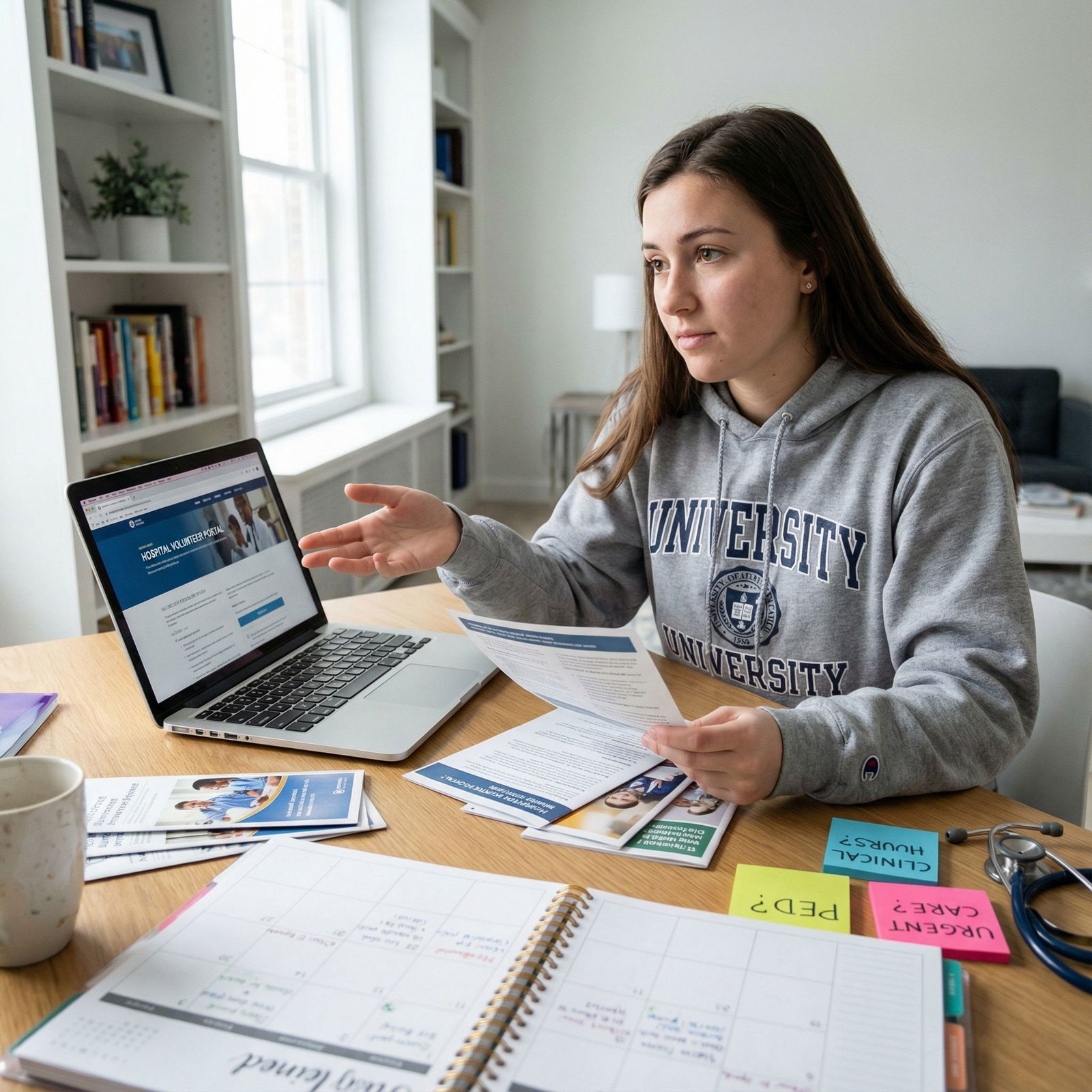
Closing Reminder: Accuracy Protects Your Application
Here's the rule I'd follow without hesitation: count only what is truly clinical volunteering, keep mixed roles separate when needed, and document how you got your total.
That's the safe path. The smart path too.
A careful, honest count won't hurt your application. A polished-looking exaggeration might. And that's the part anxious applicants forget when they start obsessing over whether they can squeeze in another 18 "maybe" hours from a blurry semester two years ago.
Before you submit, check your totals one last time against your log, dates, and descriptions. Make sure the numbers match the story.
Then let it go.
You do not need perfect hours. You need defensible ones.
Key takeaways
- Count mixed clinical volunteering conservatively and only include the time that is truly clinical and unpaid.
- Keep a detailed log so your hour totals, descriptions, and categories all match if anyone ever asks.