
Educational disclaimer: This article is for general educational purposes only and is not financial, legal, tax, or professional advising. Application costs, budgeting decisions, and residency strategy should be discussed with your medical school advisors and other qualified professionals who understand your specific situation.
Scenario: The Radiology Applicant Who Wonders Whether Community Programs Mean Better Odds
You are applying radiology with a profile that is good. Not perfect. Maybe you are an MD with solid scores, decent clerkship grades, a couple of radiology projects, and no giant academic pedigree. Maybe you are a DO applicant with strong clinical evaluations, respectable boards, good letters, but not a CV stacked with abstracts from every major imaging meeting. You open ERAS, pull up your program list, and hit the same question everybody eventually hits:
Should I add more community radiology programs? Will that actually improve my odds, or am I just paying to send applications into the void?
That is the real dilemma. Not “academic versus community” as a prestige debate. That debate is usually shallow and unhelpful. The real issue is interview yield and rank-list security. If your list leans heavily academic, especially in competitive metros, you can absolutely end up with fewer interviews than your application deserves. I have seen this happen over and over. Strong applicants. Smart applicants. Applicants who assumed radiology would reward being “pretty solid across the board,” then discovered that a top-heavy, research-heavy list is unforgiving.
Community programs can help. But only if they fit the actual weaknesses or constraints in your application strategy.
Here is the part applicants get wrong: they treat “community” like a generic safety label. That is lazy thinking. A community radiology program is not just a less famous place. In practice, these programs are often smaller, more clinically focused, less research-intensive, and sometimes closely tied to regional hospitals or university affiliates without being true flagship academic departments. Their class sizes may be small. Their interview style may be more practical, less performative. Their mission may center on producing dependable, efficient radiologists rather than future department chairs.
That matters.
A community-heavy list may be smart for one applicant and completely misguided for another. Your board metrics matter. Your research depth matters. Your geography matters. Your signals matter. Most of all, your actual willingness to train in that environment matters. If you secretly want a research-heavy academic department with deep subspecialty exposure and a major fellowship pipeline, adding twenty community programs “for safety” is not strategy. It is fear in spreadsheet form.
So yes, community programs may improve your odds. But not automatically. And definitely not randomly.
How Community Radiology Programs Fit Into the Match Strategy for MD and DO Applicants
Let me break this down specifically.
Community radiology programs often become highly relevant for applicants who are stronger clinically than academically on paper. That includes a lot of perfectly good matchable people. If you have solid board performance, good work habits, strong letters from people who trust you on service, and a believable interest in diagnostic imaging, many community departments will view you favorably even if you are not carrying a heavy publication count. They are often asking a different question than the most research-focused academic programs.
Not “Will this person publish?”
More often: “Will this person work hard, learn fast, be normal at 2 p.m. and 2 a.m., and function well in a high-volume department?”
That is not a lesser standard. It is a different standard. In many community settings, service reliability is everything. Throughput matters. Communication matters. Being teachable matters. Showing up prepared matters. If your application supports that story better than a scholarly one, community programs may not just be backup options. They may be better targets.
Now the crucial distinction: more applications is not the same thing as better-targeted applications.
Sending applications to a random pile of community programs because the match feels scary is sloppy. It wastes money, muddies your narrative, and often produces weak interview conversion because your materials do not match the program’s mission. Better-targeted applications mean you are using community programs to widen your net in a way that actually aligns with your competitiveness, your geography, and your goals.
For example:
- If your Step 2 or COMLEX performance is solid but not standout, adding regionally appropriate community programs makes sense.
- If your radiology research is thin, community programs may give you more grace than publication-driven academic departments.
- If you are geographically restricted because of family, spouse, or support system, community programs can dramatically expand viable options in a region.
- If your school lacks a home radiology department or national name recognition, a broader community list can offset branding limitations.
MD versus DO adds nuance, but people often handle this badly.
The wrong question is: “Are community programs for DOs?”
No. That framing is outdated and insulting. The better question is: “Where is my application most likely to be read in a favorable context?”
Some academic programs remain heavily research-selective, pedigree-sensitive, or simply more comfortable with applicants who fit a traditional university pipeline. That is reality. Not all programs, but enough to affect strategy. DO applicants, especially those without a deep research portfolio or major institutional connections, may benefit from adding more community programs because those programs often weigh clinical maturity and departmental fit more heavily than academic branding. But the driver is not the degree alone. It is the whole competitiveness picture.
A strong DO applicant can match academic radiology. A weaker MD applicant can absolutely need community breadth. Degree letters do not erase application mechanics.
This topic also mirrors a classic exam pattern: matching institutional priorities to applicant traits. If a question stem describes a smaller regional program that values continuity, patient access, and practical service, the right answer is usually not “highest publication count wins.” It is fit. Community service. Regional ties. Clinical readiness. Programs tell you what they care about. Applicants just ignore it because prestige noise is loud.
That is a mistake. Read the mission. Believe what they are telling you.
Who Should Strongly Consider Applying to More Community Programs?
There are certain applicant profiles where I strongly recommend expanding the community-program list. Not because community programs are “easier.” That word causes bad decisions. I recommend it because the applicant needs more realistic routes to interviews.
Here are the big ones.
1. Applicants with borderline or uneven board metrics
If your board performance is acceptable but not reassuringly strong for radiology, you need more interview security. That applies whether you are MD or DO. An all-academic list in that situation is wishful thinking. Community programs may still care deeply about boards, but many will evaluate them in the broader context of your work ethic, rotations, letters, and professionalism.
2. Applicants with limited radiology-specific research
Radiology has become more academically polished. Even average applicants now show up with posters, case reports, or departmental projects. If you committed late to radiology or came from a school with fewer opportunities, your lack of radiology-specific output can hurt you at research-heavy institutions. Community programs are often more forgiving here, especially if your letters and personal story are credible.
3. Applicants with fewer honors or an uneven clinical transcript
Maybe you honored medicine and surgery but not everything else. Maybe preclinical performance was messy and then you improved. Maybe there is a failed exam or a leave that needs context. Those applicants often do better with a mixed list that includes community programs likely to read the file more holistically.
4. Late converts to radiology
I have seen this a lot. A student decides on radiology after another specialty does not fit, scrambles for letters, secures one away elective, and applies with a decent but compressed story. That applicant needs interview-generating programs, not just dream programs. Community departments may be more receptive if the applicant can clearly explain the switch and show maturity rather than indecision.
5. Applicants with serious geographic restrictions
This one is huge. If you must stay in one state or one metro region, the normal “broadly apply academic” advice can become dangerous. In restricted geographies, community programs often become essential because they increase your interview density inside the only area you can realistically rank.
6. Applicants whose strengths are clearly clinical and interpersonal
Some people simply interview well, work well on teams, and get excellent comments from attendings about dependability and communication. Those strengths matter everywhere, but community programs may reward them more directly because daily departmental function depends on them.
Now, nuance. Strong applicants also sometimes should add community programs.
If you are highly competitive but you absolutely want to stay in Chicago, South Florida, Southern California, or another crowded region, adding a few community programs is smart insurance. Same if you know you do not want a hyperacademic environment. Same if you want more interview volume in a year that feels unusually tight. There is nothing unsophisticated about keeping a balanced list.
But do not overdo it.
If you are sitting on excellent scores, strong radiology mentorship, meaningful research, and a genuine desire for major university training, spending a huge chunk of your application on community programs can dilute your focus. Not because community training is inferior. Because your list should reflect your actual goals. If you want heavy subspecialty exposure, built-in research infrastructure, big-name fellowship pipelines, and tertiary-care complexity every day, then a bloated community list may move you away from where you actually want to train.
This is where “fit risk” matters.
A community program can be excellent and still be wrong for you. Smaller faculty bench. Fewer niche fellowships on-site. Less formal scholarly support. Different case mix. Faster service expectations. Sometimes less room to build a deep academic CV. If your long-term plan depends on those opportunities, be honest. Do not apply somewhere you would never rank just because the word “community” sounds safer.
Bad strategy. Expensive too.
How Many Community Programs Should You Add—and How Do You Avoid a Random List?
I do not like fixed-number advice here because it gives false confidence. “Add ten community programs” sounds tidy and is often useless. The right approach is to build an interview security buffer.
That means adding enough community programs to compensate for the uncertainty in your application.
What creates uncertainty?
- Borderline or non-elite board metrics
- Limited radiology research
- Weak or late networking in radiology
- Restricted geography
- Fewer strong signals of commitment
- Applying from a school with lower visibility in radiology
- A difficult application year with tighter interview distribution
If you have several of those factors, your buffer should be larger. If you have none, it can be modest.
Here is the practical framework I use.
Build three buckets
Do not make an “academic list” and a “community list.” Make a strategic list.
- Reach programs: places where you would be thrilled to match but where your profile is less likely to stand out
- Target programs: places where your metrics and story fit well
- Safer community programs: programs where your application is plausibly above or comfortably within the usual range and where your goals still make sense
That last phrase matters: and where your goals still make sense. Never use “safer” as a synonym for “random.”
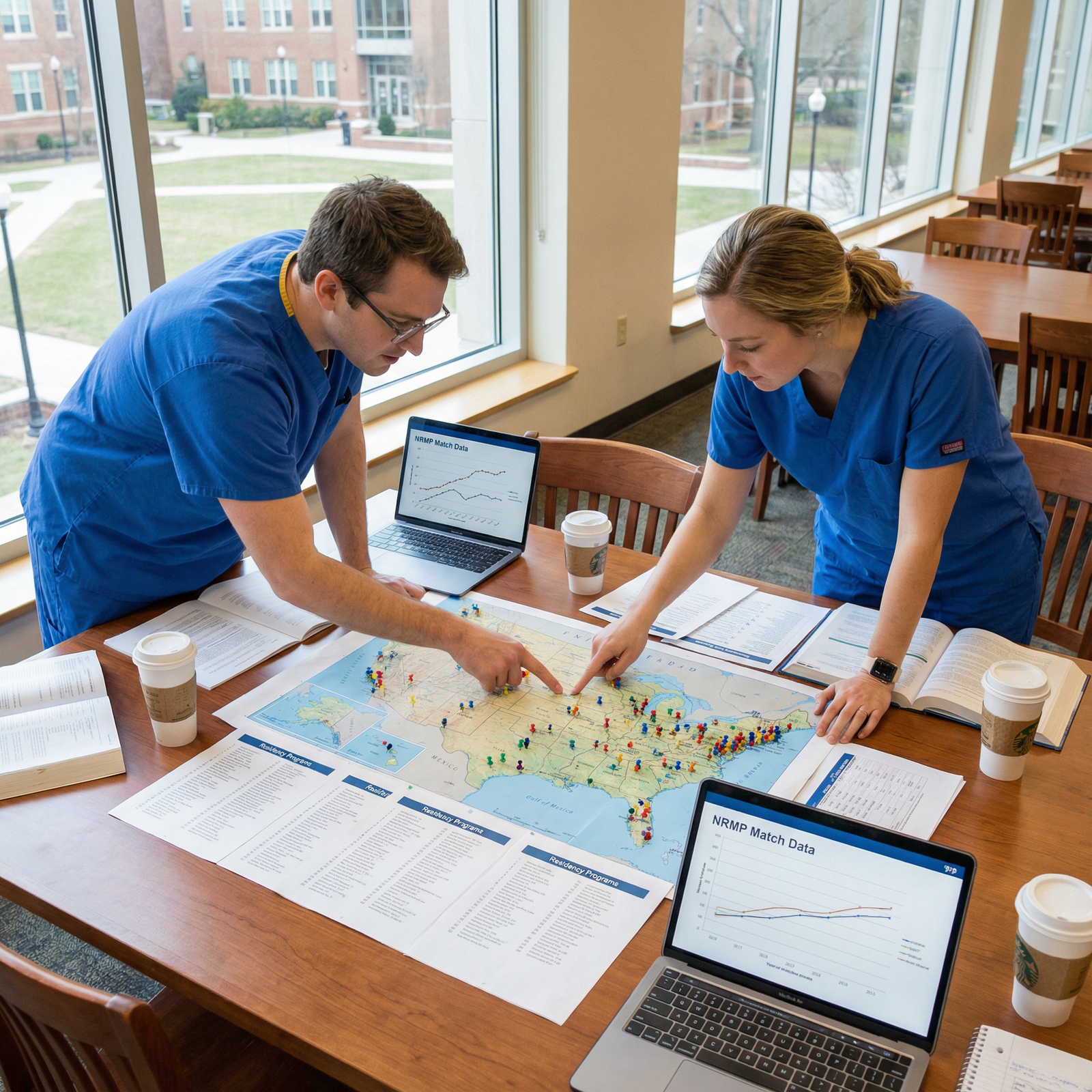
Decide how many to add based on missing security, not panic
If your current list is heavily academic and your interview risk is obvious, adding a meaningful block of community programs is rational. If your list is already balanced and you have a strong profile, a few targeted community additions may be enough. The point is not to chase an arbitrary total. The point is to improve interview odds where your current list is thin.
Screen each community program for actual fit
Before adding a program, ask:
- Do they routinely take applicants from my degree path and background?
- Is there evidence they value strong clinical performance over heavy research output?
- Do I have a geographic tie or credible reason to train there?
- Does their case mix and training style fit my goals?
- Would I genuinely rank this program?
If the last answer is no, take it off the list. Applicants love to ignore this. Then March arrives and they are horrified at the consequences of their own spreadsheet.
Avoid the common red flags
Community applications fall flat for very predictable reasons.
Generic personal statements.
If your essay reads like it was written for ivory-tower academic radiology and then sprayed across thirty regional hospitals, people can tell.
No regional ties and no explanation.
Programs notice when you apply to a city or state where you have zero connection and no stated reason to be there.
No clear interest in community-based practice or hands-on service.
If your entire narrative is research, subspecialty prestige, and tertiary-care quaternary complexity, you may look like someone using the program as a fallback.
Failure to articulate why the environment fits you.
You need an answer better than “I want good training.” Everybody says that. Useless.
Use a tracking method
I tell applicants to build a simple spreadsheet with columns for:
- Program type
- Region
- Class size
- University affiliated or fully community-based
- Research expectation
- Your tie to the region
- Whether signaled
- Interview offer status
- Final rank likelihood
This is not busywork. It lets you see where your list is lopsided. If all your targets are in one coastal city, that is a risk. If all your “safer” options are places you would hate living, that is also a risk.
Reassess after signals, aways, and advisor input
Signals matter. Home program support matters. Away rotation outcomes matter. If you got strong feedback from a regional community elective and faculty know you well, that should increase the weight of similar programs on your list. If your only serious support is from an academic chair with strong connections, then your academic targets may deserve more emphasis.
The strongest applicants do not just apply broadly. They apply coherently.
What Community Programs Actually Evaluate in Radiology Applicants
If you want to interview well at community radiology programs, understand what many of them are actually screening for.
They want reliability. They want people who show up prepared, read efficiently, handle feedback without drama, and function in a team. They care about board readiness because radiology is cognitively dense and progression matters. They care about clinical competence because good radiologists do not emerge from a vacuum; they understand patient context, not just images. They care about interpersonal maturity because smaller departments feel every personality problem immediately.
This differs from more academic environments, where research output, subspecialty identity, institutional pedigree, and scholarly potential may carry more weight up front. Again, not always. But often enough that applicants should stop pretending every interview is evaluating the same person in the same way.
Community programs frequently ask a simpler, sharper question:
Will this applicant thrive in a high-volume, practical, service-heavy radiology department?
That question should shape your interview preparation.
You should be ready to explain:
- Why community radiology appeals to you
- Why you value strong clinical training
- How you handle fast-paced workflow
- What kind of teammate you are
- How you communicate with clinicians
- Why this region or hospital makes sense for your life and career

This is also where MD/DO prestige noise tends to fade a bit. Not vanish entirely. I am not going to insult you with fantasy. Bias exists in medicine. But community programs are often more mission-driven and less obsessed with academic branding. If you present as capable, grounded, professional, and ready to contribute, your degree status may matter less than applicants fear.
That is good news for DO applicants. It is also a warning to MD applicants who assume the letters after their name will carry a mediocre application. They will not. Community programs are often excellent at spotting who will actually pull their weight.
Action Steps: A Practical Decision Framework for MD and DO Applicants
Here is my position, plainly stated: MD and DO applicants should apply to more community radiology programs when their current list is too narrow to provide interview security. Especially if the list leans academic, the geography is restricted, or the application is clinically strong but not heavily research-signaled.
Do not ask, “Should I apply to community programs?” Ask, “Does my profile need a broader, more realistic net?”
That question gets you to the right answer faster.
Use this framework:
Audit your competitiveness honestly.
Look at boards, grades, research, letters, home support, and geography. Not your ego. Not your classmates’ opinions.Classify programs into reach, target, and safer community options.
Build a balanced list instead of a prestige fantasy list.Add community programs with a reason for each one.
Region. Clinical fit. Interview likelihood. Training style. Real reasons.Tailor your narrative.
Your personal statement, program-specific communication, and interview answers should explain why community-based radiology training fits your goals.Do not panic-apply.
Random volume is a bad substitute for judgment.
Final rule: apply more broadly when you need security, but do it on purpose. Community programs should be a deliberate part of a coherent radiology strategy. Not a late-night fear purchase in ERAS.
If you would rank them, train there, and fit there, add them. If not, leave them off. That is the cleanest answer in this whole conversation.