
The usual advice about “strong applicants can apply to fewer programs” is dangerously oversimplified.
Here’s the truth: strong applicants can apply to fewer programs—but only if they are brutally honest about their risk factors, their specialty, and their geography. Many “strong” applicants blow their match because they assumed they were the exception. They weren’t.
I’m going to give you a practical framework you can actually use to decide how many programs to apply to, even if you think you’re a top-tier candidate.
Step 1: Are You Actually a “Strong” Applicant?
Stop using vague labels like “competitive” or “above average.” You need to define strength in a way that predicts interview invites, not just vibes.
Strong applicant usually means:
- You are above the national mean for your specialty on Step 2 CK (or COMLEX Level 2 if osteopathic-focused).
- You have no major red flags: no fails, no LOA for academic reasons, no professionalism issues.
- Your home institution and advisors keep saying, “You’ll do fine,” and they actually know the specialty.
- You have a realistic list of programs and not just a fantasy Top 10 list.
If some of these don’t apply, you’re not “strong.” You may be “okay” or “solid,” which is not the same.
Here’s a concrete way to self-categorize for your specialty:
| Category | Board Scores vs Specialty Avg | Class Rank / MSPE | Research & Extras |
|---|---|---|---|
| Top-tier | ≥ +1 SD above | Top 25% | Multiple pubs, strong LORs |
| Strong | Around +0.5 SD above | Top half | Some pubs or strong projects |
| Average | Around average | Middle | Typical activities |
| At-risk | Below average or fail | Bottom third | Sparse or weak experiences |
If you are truly top-tier within a less competitive specialty (e.g., categorical IM in most markets), yes, you may not need 60+ applications. But if you are average or just slightly above average and you’re applying in derm, ortho, ENT, plastics, urology, neurosurgery, integrated IR, you are not in the “I can safely apply to fewer” group.
Step 2: Specialty Competitiveness Changes the Math
You cannot ignore specialty competitiveness. It is the single biggest driver of “how many programs do I need?” and it’s why blanket numbers like “You only need 20 programs” are nonsense.
Here’s the rough hierarchy:
- Hyper-competitive: Derm, Ortho, ENT, Plastics, Neurosurgery, Urology, Integrated IR, Rad Onc
- Competitive: EM (getting weird but still), Anesthesia (in some regions), OB/GYN, Gen Surgery, Radiology
- Moderate: Internal Medicine, Pediatrics, Neurology, PM&R, Psych (getting more competitive but still accessible)
- Less competitive overall (but not everywhere): Family Medicine, Pathology, some IM prelims, Transitional Year (varies heavily)
Do strong applicants in less competitive specialties need 60–80 applications? Almost always no. Do strong applicants in derm need to apply to “only 20” because they feel confident? That’s how you end up unmatched.
Here’s a reality snapshot:
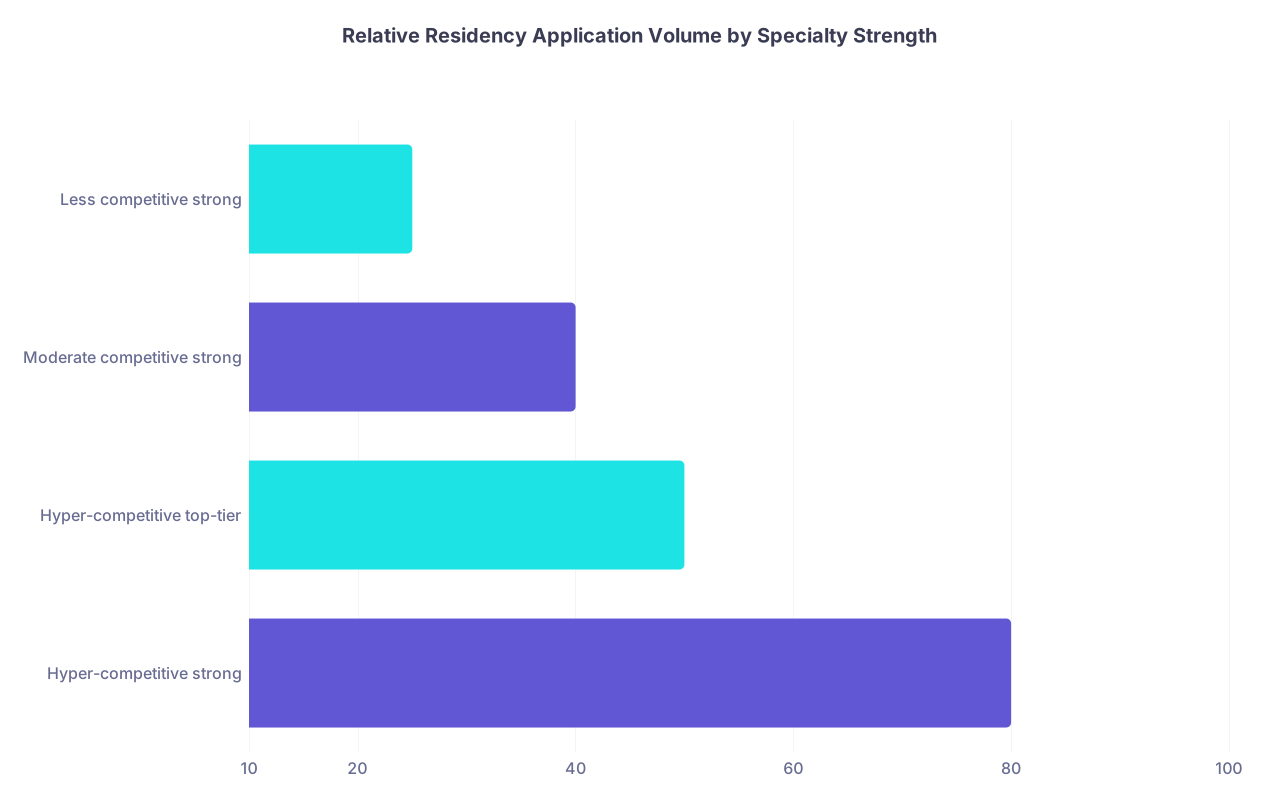
| Category | Value |
|---|---|
| Hyper-competitive strong | 80 |
| Hyper-competitive top-tier | 50 |
| Moderate competitive strong | 40 |
| Less competitive strong | 25 |
Those aren’t official numbers; they’re the kind of targets I’ve seen advisors use in real life that don’t get people burned.
Step 3: The Real Risk Strong Applicants Underestimate
The dangerous assumption is: “Because I’m strong, someone will take me.”
That’s not wrong in a vacuum, but the match isn’t a vacuum. Here’s what actually burns strong applicants:
Overconcentrated lists
Applying to 25 programs where 18 are Top 20 or “dream” locations. You might be strong, but so is everyone else they interview. A strong but unhooked applicant can absolutely get lost there.Geographic myopia
“I only want the coasts” or “only this one city” when you have no inside connection to those regions. Strong? Sure. Special there? Not necessarily.Ignoring fit signals
Some programs actively prefer homegrown, regional, or DO/IMG/MD-specific applicant pools. Thinking your score wipes out those preferences is naive.Underestimating interview inflation
Programs now invite more people than they can interview easily because of virtual interviews. That means more competition per invite and thinner margins for error.
So yes, you’re strong. But you’re playing a probabilistic game, and strength buys you better odds, not certainty.
Step 4: A Framework: How Many Programs Should You Apply To?
Let me give you a practical framework instead of vague comfort.
1) Look at your interview target number
Most applicants should aim for:
- 10–12 interviews in most core specialties (IM, Peds, Psych, Neuro, FM)
- 12–14+ interviews in more competitive but not extreme specialties (Gen Surg, OB/GYN, Anesthesia, Radiology)
- 14–18+ interviews in hyper-competitive fields (Derm, Ortho, ENT, Plastics, Neurosurg, etc.)
Strong applicants may match with fewer, but these are safer targets.
2) Estimate your interview rate conservatively
Ask: “Out of 10 applications, how many interview invites am I realistically likely to get?”
If you have:
- Strong application in a moderately competitive specialty, 20–30% invite rate is normal.
- Top-tier in less competitive specialty at mid-tier programs, maybe 40–50%.
- Hyper-competitive specialty, even strong candidates might see 10–20%.
Then back-calculate.
Example:
Strong anesthesia applicant. You want 12 interviews. If you guess a 25% invite rate:
12 interviews ÷ 0.25 = 48 applications.
Could you end up with more interviews than you need? Yes. That’s a good problem to have.
3) Adjust for your personal risk factors
You reduce applications only if you truly have:
- No fails or leaves.
- No significant timeline gaps.
- No extreme geographic restriction (e.g., “must be within 2 hours of this one city”).
- At least one of: strong home program, strong away rotation performance with letters, or a clear regional tie.
If all of that is true, you can often trim by 15–30% from the “average” recommended numbers and still sleep at night.
If even one of those is false, do not get cute. Stay closer to or above the typical range.
Step 5: Strong Applicants: When You Can Safely Apply to Fewer
Now to the actual question.
Yes, strong applicants can apply to fewer programs, but only in specific scenarios. Here are classic cases where trimming your list is reasonable:
You’re strong in a less competitive field (e.g., IM, Peds, FM, Path)
- Step 2 at or above the average for that field
- Good clinical grades and letters
- No red flags
Reasonable range: 20–35 programs, assuming you’re not geographically boxed in.
You’re strong and have a powerful home institution in your field
Example: Strong surgery applicant at a big academic center with supportive faculty.- Your home program is likely to interview you and heavily consider you.
- You have a couple of strong aways.
Reasonable range: 30–45 programs in a competitive field instead of 60+.
Dual applying wisely
If you’re strong but applying in one risky field plus a safer backup, you can sometimes apply to slightly fewer programs in the safer backup because your main goal is simply to secure enough interviews, not maximize prestige.
Step 6: When It’s Flat-Out Dumb for “Strong” Applicants to Cut Too Much
You should not aggressively cut your list just because:
Your mentor said, “You’ll be fine, you don’t need that many.”
(Ask them for specific numbers and recent data. Vibes are not a strategy.)Your classmates say, “I only applied to 25 and matched.”
Different year. Different specialty. Different geography. Survivor bias.You feel guilty about money or overwhelmed by the ERAS list.
Those are real issues, but the cost of reapplying and sitting out a year is much worse.
Here’s a simple decision flow you can use.

| Step | Description |
|---|---|
| Step 1 | Start |
| Step 2 | Apply very broadly 70 plus |
| Step 3 | Strong or top tier 50 to 70 |
| Step 4 | 20 to 40 programs |
| Step 5 | 35 to 60 programs |
| Step 6 | Hyper competitive specialty |
| Step 7 | Any red flags or average stats |
| Step 8 | Less or moderate competitive specialty |
| Step 9 | Strong applicant |
Is this perfect? No. Is it vastly better than guessing or copying your friend’s number? Yes.
Step 7: Balancing Cost, Burnout, and Probability
Let’s talk about the two real objections strong applicants have to applying broadly:
Cost
ERAS gets expensive fast. I’m not going to pretend it’s trivial. But if you’re deciding between “apply to 35 programs” vs “apply to 50” and the extra cost is a few hundred dollars, you need to weigh that against:- Delaying your career by a year
- Lost attending salary
- The emotional and psychological hit of not matching
Time and secondaries / signaling / extras
Yes, more programs = more work. But beyond a certain point, you’re mostly recycling your content. The mental burden is real, but it’s temporary. No match, on the other hand, is not temporary.
Strong applicants should optimize like this:
- Do not apply to every program in the country in your field just because you’re anxious. That’s noise.
- Do diversify across tiers and regions.
- Do slightly overshoot rather than undershoot. I’ve never had a resident say, “I really regret applying to 10 extra programs,” but I have seen people say, “I was too confident. I should’ve added 15–20 more.”
Step 8: How to Build a Smart List as a Strong Applicant
Instead of “fewer vs more,” think “smarter distribution”:
Rough distribution for a strong applicant:
- 20–30% “reach” (top academic/very popular locations)
- 40–50% “target” (solid mid-tier programs where your stats match or exceed their usual)
- 20–30% “safety-ish” (less popular location, newer programs, community-heavy programs)
Then adjust the total number based on your specialty and true strength.
Here’s a quick comparison.
| Specialty Type | Applicant Strength | Approx. Range |
|---|---|---|
| Less competitive (FM) | Strong | 20–30 |
| Moderate (IM, Peds) | Strong | 25–40 |
| Competitive (Anes, OB) | Strong | 35–50 |
| Hyper-competitive | Strong | 50–70 |
If your gut reaction is “That seems like a lot,” remember: a single interview can swing your entire match outcome.
Inline Visual: How “Strong” Cuts Might Look
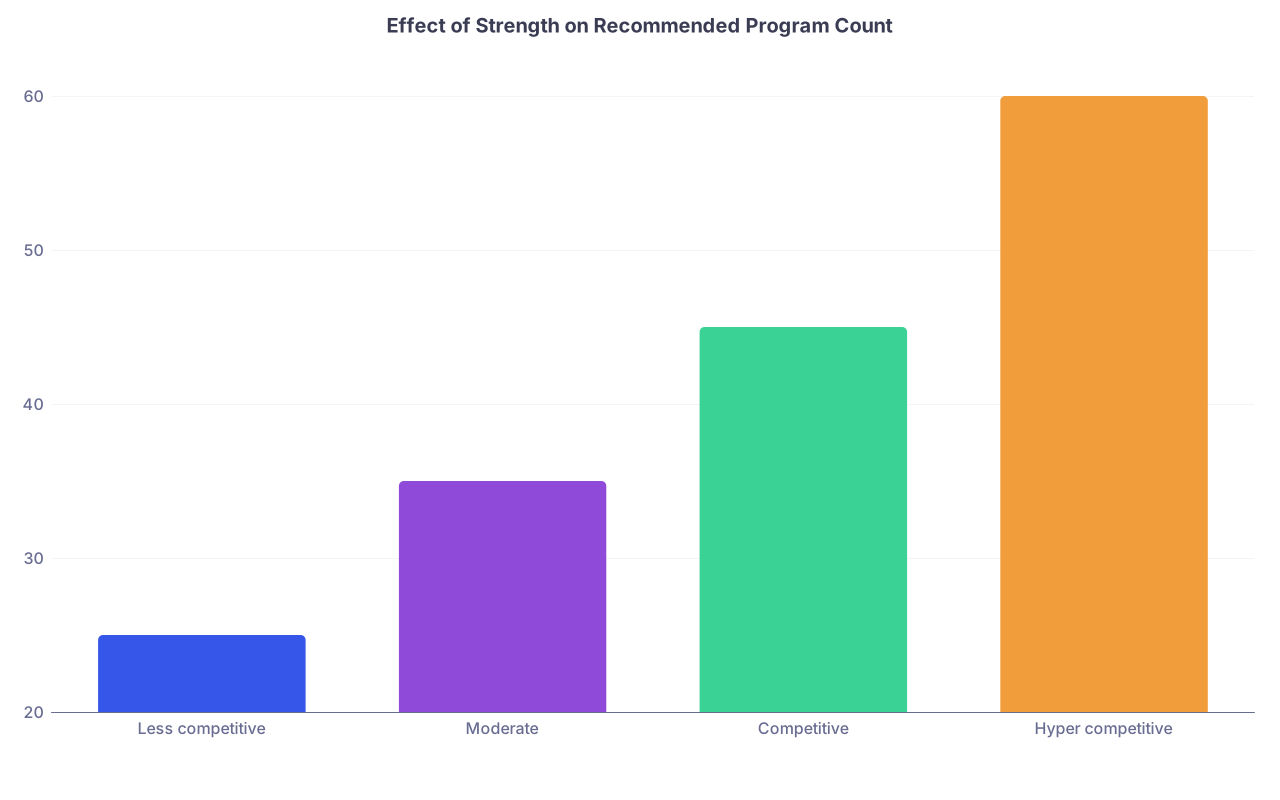
| Category | Value |
|---|---|
| Less competitive | 25 |
| Moderate | 35 |
| Competitive | 45 |
| Hyper competitive | 60 |
Those numbers are for strong applicants. Average applicants should usually be thinking higher.
Key Takeaways
- Being “strong” means you can trim your list slightly, not cut it in half and hope.
- Specialty competitiveness and your real risk factors matter more than your ego or your classmates’ stories.
- Aim for a realistic interview count, assume conservative invite rates, and let that math—plus your specialty—determine how many programs you apply to.
FAQ (Exactly 6 Questions)
1. I’m a strong internal medicine applicant at a mid-tier US MD school. How many IM programs should I apply to?
If you truly have no red flags, are around or above the average IM Step 2 for matched applicants, and you’re flexible geographically, 25–35 well-chosen programs is reasonable. If you’re tied to a narrow region or have any soft concerns (average clinical grades, weaker letters), push closer to 35–45.
2. I’m applying to a hyper-competitive specialty and consider myself strong. Can I safely apply to only 30–40 programs?
Usually no. Even strong or top-tier applicants in derm, ortho, ENT, plastics, neurosurgery, urology, and integrated IR should consider something in the 50–70+ range unless they have truly exceptional hooks (major-name research, multiple publications, glowing letters from big-name mentors). Competition density is brutal.
3. My advisor says I only need to apply to 15–20 programs. Should I trust that?
Only if: your advisor has recent, specialty-specific data; you’re in a less competitive specialty; you’re top-tier, not just “strong”; and you’re flexible on where you end up. Ask them: “How many applicants in my exact situation did this work for in the last 2–3 years?” If they can’t answer, be cautious and add more.
4. Can I use preference signals (e.g., signaling tokens) to safely apply to fewer programs?
Signals help, but they’re not a shield. Strong applicants can use signals to slightly concentrate their effort, but they should not use them as an excuse to slash their total applications aggressively. Think: trim by maybe 10–20%, not 50%.
5. I’m dual applying. Does that mean I should apply to fewer programs in each specialty?
Sometimes, but not automatically. Dual applying is mostly a risk-management strategy. If one field is clearly your backup and less competitive (e.g., IM or FM), then yes, you can often apply to fewer programs in that backup while still getting enough interviews. But your primary competitive field probably still requires a robust number of applications.
6. What’s the biggest mistake strong applicants make when deciding how many programs to apply to?
They overestimate how “special” their application looks in a national pool and underestimate how concentrated their list is (too many high-tier programs, too few geographic regions, too many popular cities). The smart move is to slightly over-apply, diversify your list, and treat your strength as a margin of safety—not a reason to gamble.