
The usual “just apply to more programs” advice is lazy.
Having no home residency program changes your strategy—but it does not mean you should apply everywhere and hope.
Here’s the real answer:
If you have no home institution, you generally should increase your program count compared to a similar applicant with a strong home program—but only in a controlled, targeted way, not a blind spending spree.
Let’s break down how to decide how much to increase and where those extra applications should actually go.
1. Why Having No Home Institution Actually Matters
A home program does three big things for an applicant:
- Gives you a “default” interview almost regardless of Step scores (unless you’re far below their usual bar).
- Provides strong, specialty-specific letters from faculty who know you.
- Lets you show sustained interest and fit just by existing in their department.
If you do not have that—maybe your med school has no affiliated residency in your specialty, is new, or you’re an international grad—then you lose:
- One “likely” interview spot.
- A built-in advocacy network (“I know this student, they’re solid—interview them.”).
- Organic signals of commitment to the specialty at your home institution.
Programs know this. I’ve heard PDs say, “We always interview our own unless there’s a major red flag.” That safety net is gone for you. So yes, you’re starting with a disadvantage.
But here’s the mistake people make:
They compensate by going from 40 to 90 programs instead of from 40 to 60—with no strategy. That’s not smart; it’s expensive noise.
2. Baseline Numbers: How Many Programs Is “Enough”?
Your specialty matters more than your home status. No home program modifies the baseline; it doesn’t replace it.
Here’s a rough framework (US MD/DO, average-ish applicant):
| Specialty Type | Baseline Range (Has Home Program) | With No Home Institution |
|---|---|---|
| Very competitive (Derm, Ortho, Plastics, ENT, Neurosurg) | 60–90 | 75–110 |
| Moderately competitive (EM, Gen Surg, Anes, OB/GYN) | 40–60 | 55–75 |
| Primary care (FM, IM, Peds) | 20–40 | 30–55 |
Those are starting points, not commandments. You adjust up or down based on:
- USMLE/COMLEX scores
- Class rank/AOA
- Research and specialty exposure
- Red flags (gaps, failures, leave of absence)
- IMG vs US grad
No home institution typically justifies about a 25–40% increase in applications relative to what you would have applied if you had a strong, supportive home program.
So if your peers with a home EM program are applying to 45–50 programs, you sitting at a school without EM might want to be around 60–70, not 90–100.
3. When You Should Absolutely Increase Program Count
There are situations where “no home program” is only one of your problems. In those cases, yes, you push your numbers more aggressively.
Increase well above baseline if you have:
Below-average scores for your specialty
Example:- Applying EM with Step 2 = 225
- Applying Gen Surg with Step 2 = 230
You’re already fighting uphill. No home program means fewer automatic looks. Here a 50% increase over baseline can be rational.
Little to no specialty-specific research or experiences
- No home program → fewer opportunities for specialty research or sub-I’s.
If you don’t compensate with away rotations or outside mentors, programs may be skeptical you’re truly invested.
- No home program → fewer opportunities for specialty research or sub-I’s.
IMG / Caribbean / Non-US grad + no home
- This is a double handicap.
You’re competing with applicants who have home programs and US clinical experience. Here, your “increase” might be 2–3x the baseline of a US MD with a home program in the same specialty.
- This is a double handicap.
Red flags
- Step failure
- Repeated coursework
- Extended time to graduation
Combine that with no home program and you simply can’t be surgical with your list. You need volume plus targeting.
In all these scenarios, more programs makes sense—but only if your list is broad and realistic, not top-heavy and delusional.
4. When You Should Not Just Add More Programs
On the flip side, here’s where people waste money:
- You’re a strong applicant (good scores, decent research, solid letters) in a less competitive specialty like FM, IM, or Peds.
- You have no home program but you do have:
- 1–2 away rotations
- Strong letters from known faculty in the field
- A clear geographic preference you’ve actually lived or rotated in
In that scenario, increasing from 35 to 80 FM programs is not “smart;” it’s anxious overkill. Better to:
- Apply to 35–45 programs.
- Make sure they’re in regions where you have a plausible tie (school, family, previous residence, etc.).
- Avoid obvious reaches where you’d never be ranked high anyway.
If your stats are comfortably within or above the median for your specialty and there are no major red flags, no home program alone is not a reason to double your apps.
5. How to Compensate Strategically (Beyond Just More Programs)
Here’s where people with no home institution actually win: they’re often more proactive. You have to be. If you do it right, you can make up ground.
A. Away Rotations Become Your De Facto “Home”
You don’t have a home program? Then build one.
Do 1–3 away rotations (sub-I’s) in your specialty at:
- A realistic “mid-tier” academic or strong community program.
- A region where you’re willing to match.
- A place that historically takes outside students into their residency.
These rotations give you:
- Specialty-specific letters from people programs recognize.
- A place that might treat you almost like a home applicant if you impressed them.
- A network—attendings who email PDs: “We had this student; you should interview them.”
If you do 2 away rotations and perform well, those are essentially two “home-ish” programs for your file.

| Step | Description |
|---|---|
| Step 1 | No Home Program |
| Step 2 | Choose Away Sites Wisely |
| Step 3 | Rotate at 1 to 3 Programs |
| Step 4 | Secure Strong Letters |
| Step 5 | Get Advocacy Emails |
| Step 6 | Boost Interview Odds |
B. Letters of Recommendation Matter More
With no home program, your letters carry extra weight because they’re your only “this person is truly into the specialty” proof.
Aim for:
- At least two letters from the specialty you’re applying into.
- From people who actually worked with you closely (not just “they were on my team for a week”).
If your school doesn’t have that specialty:
- Use away rotations.
- Use adjacent specialties that programs respect (e.g., ICU/Anesthesia letters for EM; hospitalist IM letters for Gen Surg showing work ethic).
C. Show Clear Specialty Commitment
Programs look for patterns:
- Did this student do an elective, a sub-I, or research in this field?
- Did they write a personal statement that feels specific, not generic?
- Are they involved in a specialty interest group, case reports, QI, or conferences?
With no home program, you must create that pattern manually: conferences, posters, case reports, and targeted electives.
6. How to Actually Build Your Program List
Here’s a better approach than “crank up the total”:
Decide your baseline range based on specialty and stats.
Say: EM, mid-tier scores, no major red flags → 40–50 with home program; so aim for 60–70 without.Categorize programs:
- Reach: Top academic, highly selective, or significantly above your stats.
- Realistic: Your scores and experiences are in line with their usual match range.
- Safety: Community or less sought-after locations, Step cutoffs below or at your level.
Prioritize geographies where you have some tie
- Family, grew up there, undergrad, med school, prior employment.
Balance:
- ~20–30% reach
- ~50–60% realistic
- ~20–30% safety
Then increase proportionally due to no home institution.
If baseline was 50 total, and you decide on a 30% bump → 65–70 programs. That bump should mostly be in the realistic and safety categories, not more reaches.
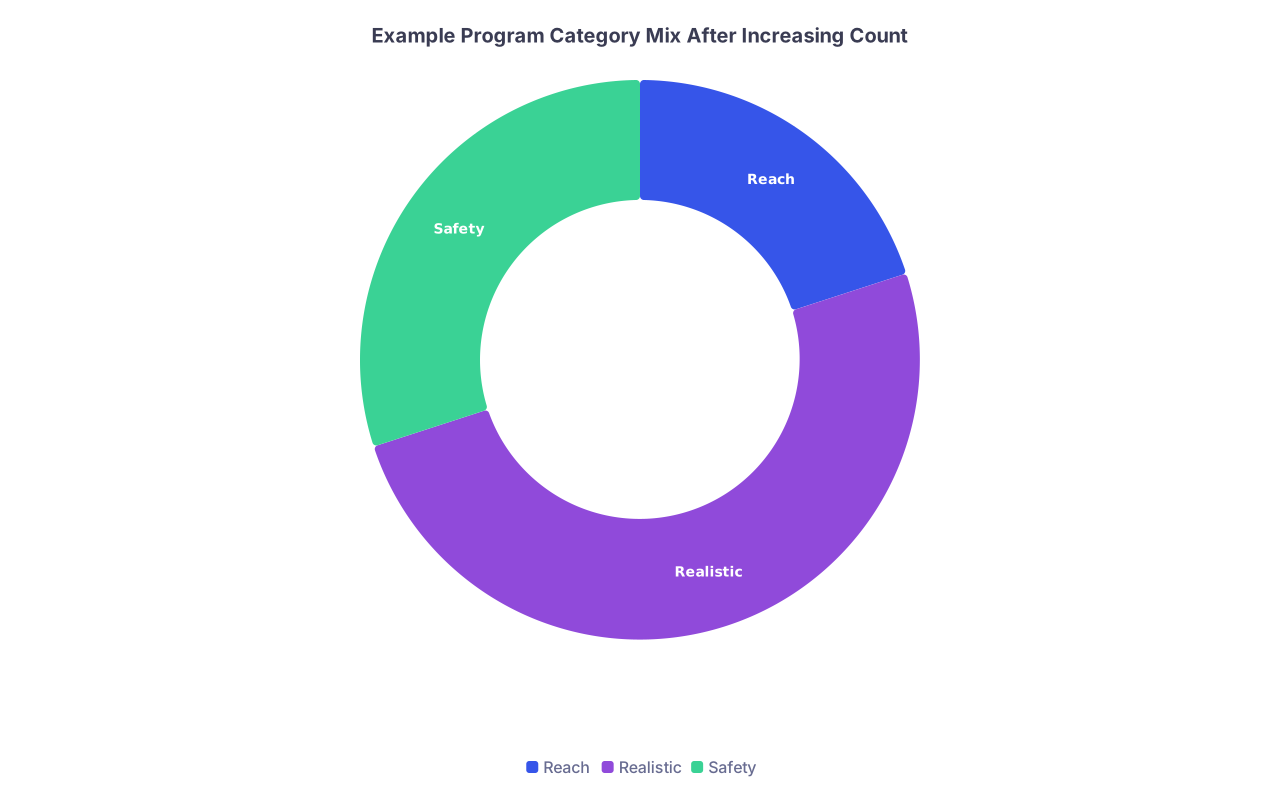
| Category | Value |
|---|---|
| Reach | 20 |
| Realistic | 50 |
| Safety | 30 |
7. Special Cases: IMGs, New Schools, and Niche Programs
IMGs with No Home Program
You already know this: the game is different.
Most successful IMGs in moderately competitive specialties cast a wide net:
- IM: 80–150+ programs
- FM: 60–120+ programs
- More competitive fields: often highly risky unless your profile is exceptional
Here, not having a home program is baked into the equation—so yes, you already need high program counts, and no home institution reinforces (not changes) that.
Students at New or Unrecognized Schools
If your school is new or not well known:
- You do not get the “oh, we know that school; their students are good” bias.
- Combine that with no home program and you should favor slightly higher applications, especially to places that have previously interviewed your graduates (if anyone has graduated yet).
Niche or Small Specialties
For fields like PM&R, Rad Onc, Med Genetics, etc., programs are fewer in number:
- You cannot just “double your count” and magically be safer.
- Strategy shifts toward:
- Applying to nearly all realistic programs.
- Doing targeted aways.
- Considering a backup specialty if your profile is shaky.
8. Costs, Time, and Sanity: The Real Trade-Off
The more programs you apply to:
- The more money you spend (ERAS fee curve is brutal).
- The more time you waste on generic or rushed applications.
- The more interviews you may get in places you have zero interest in living.
You don’t want to match somewhere you already resent.
So ask yourself:
- “Would I actually go here for 3–7 years?”
- “Is this program within any reasonable range for my profile?”
- “Does adding 20 more programs raise my chance of 10–12 interviews, or just my credit card bill?”
That last part is key. The goal is not total applications. It’s 10–15 solid interviews in most specialties, or ~8–10 for less competitive ones.
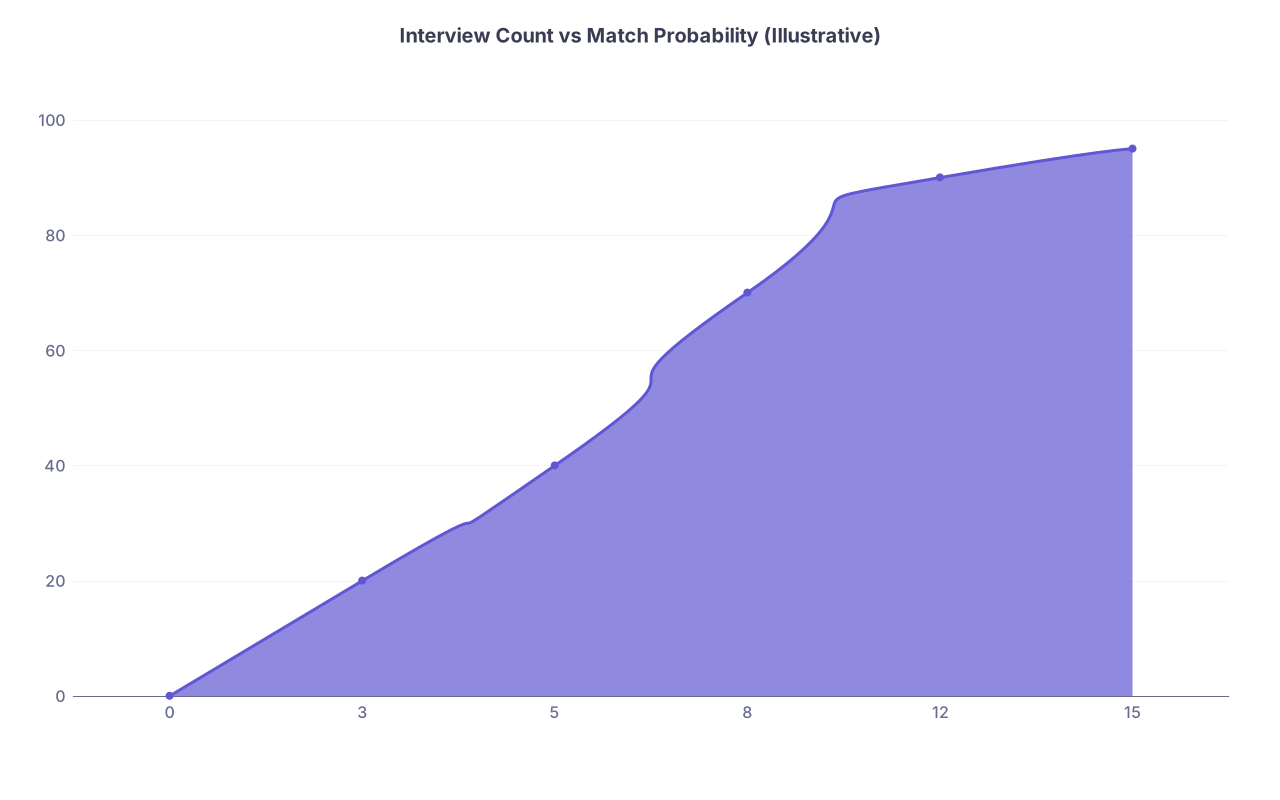
| Category | Value |
|---|---|
| 0 | 0 |
| 3 | 20 |
| 5 | 40 |
| 8 | 70 |
| 12 | 90 |
| 15 | 95 |
Once your expected interview count is likely in that 10–15 range, spraying more apps rarely changes the outcome meaningfully.
9. Quick Decision Framework: Should You Increase Your Program Count?
Ask yourself this sequence:

| Step | Description |
|---|---|
| Step 1 | Choose Specialty |
| Step 2 | Check Your Stats vs Specialty |
| Step 3 | Plan Higher Baseline Count |
| Step 4 | Use Standard Baseline |
| Step 5 | Increase 25 to 40 percent |
| Step 6 | Keep Baseline |
| Step 7 | Adjust List Mix Realistically |
| Step 8 | Below Average? |
| Step 9 | No Home Program? |
If you’re below average and have no home program → more applications, plus aways, plus better letters.
If you’re average or above average and your only “issue” is no home program → modest increase in applications, plus at least one good away rotation and strong specialty letters.
FAQ (Exactly 7 Questions)
1. If I have no home program, should I always apply to 20–30 extra programs?
Not always. A good rule is roughly a 25–40% increase over what a comparable applicant with a home program would do. That might be 10 extra in some specialties or 30 in others. Blindly adding 20–30 in every case is lazy and usually wasteful.
2. Is doing away rotations more important if I don’t have a home institution?
Yes. Away rotations become your de facto “home” experiences. They generate specialty-specific letters, advocacy from faculty, and demonstrate real interest. One strong away that leads to a solid letter is more valuable than 15 extra random applications.
3. How many interviews do I need if I have no home program?
The target does not change because of your home status. For most specialties, you want ~10–15 solid interviews to feel reasonably safe, and ~8–10 in less competitive fields like FM. No home program just means you may need more applications and more intentional strategy to reach those numbers.
4. I’m an IMG with no home program. Does this change my numbers?
For IMGs, “no home institution” is the norm, so you already start in the high-application world. For IM and FM, 80–150+ (IM) and 60–120+ (FM) applications are common. Your main focus should be realistic programs, US clinical experience, and strong letters, not obsessing over small tweaks in total count.
5. What if my school has the specialty but the residency is very small or non-supportive—does that count as a home program?
Functionally, maybe not. If they don’t regularly interview or match their own students, you shouldn’t treat them as a true safety. In that case, you should plan your applications more like someone with no home program and lean strongly on aways and outside letters.
6. Is it better to apply to more programs or rewrite a weak personal statement and improve my letters?
Fix the content first. A strong personal statement and clear, specific letters move the needle far more per dollar than 15 more rushed applications. Once your core materials are good, then expanding your list strategically helps. Doing the opposite (spray more apps with mediocre content) is a common, costly mistake.
7. Can I rely on my school’s dean’s letter or MSPE to make up for no home program letters?
No. The MSPE is background context, not a specialty endorsement. Programs care far more about letters from physicians in your chosen field who actually worked with you. If your school lacks that specialty, you must get those letters from away rotations or adjacent fields that programs respect.
Key takeaways:
No home program means you should usually apply to more programs than a similar applicant with a strong home—but not double. Use about a 25–40% increase as a starting point. Then make up the rest of the gap with targeted aways, strong specialty letters, and a realistic, well-balanced list instead of a panicked application explosion.