
The worst advice I hear about away rotations is this: “Just apply to as many programs as you can afford.” That is how you end up with 80 ERAS applications, 30 interviews you cannot reasonably attend, and a rank list built on panic rather than data.
You can do better than that.
The away rotation season is not just a four-week audition. It is a month-long feedback engine you can use to refine how many programs you apply to—and which ones—even before ERAS locks in your life for the next three years.
Here is how to use each month of the away season, step by step, to calibrate your risk, adjust your list size, and stop guessing.
Big Picture: How Feedback Should Change Your List Size
Before we go month-by-month, anchor the strategy.
You are using three main feedback streams from away rotations:
Performance feedback
- Verbal comments on rounds
- Written evaluations
- End-of-rotation meetings
Signal feedback
- Hints about “strong fit” or “would love to have you back”
- Invitations to stay in touch, meet PDs, or give a talk
- Early interview “vibes” from faculty and residents
Market feedback
- How your peers are talking about numbers: applications, interviews, competitiveness
- Advice from chiefs and residents at those programs
Your application list size should flex up or down based on this data. Not your feelings at 2am on call.
To keep this tangible, here is a rough, realistic range of list sizes by competitiveness level and specialty:
| Applicant Profile | Competitive Specialty (e.g., Derm, Ortho, ENT) | Moderate Specialty (e.g., EM, IM, Gen Surg) | Less Competitive (e.g., FM, Psych) |
|---|---|---|---|
| Strong | 30–40 | 18–25 | 10–15 |
| Middle-of-the-pack | 45–60 | 25–35 | 12–18 |
| At-risk | 65–80+ | 35–45+ | 18–25 |
You are going to move yourself between those rows over the away season based on how things actually go.
June–Early July: Before Your First Away Starts
At this point, you should be building an initial application list and setting a provisional size. You are guessing—but it should be an informed guess.
Week-by-week
Week 1–2 (early pre-aways) – Establish your baseline risk category
At this point, you should:
Place yourself honestly into a risk group:
- Strong:
- Step 2 ≥ 250 in competitive specialties or ≥ 240 in others
- Honors / HP-heavy clinical record
- Strong home program advocacy
- Middle-of-the-pack:
- Step 2 around 235–245
- Mixed H/HP/P, no major red flags
- At-risk:
- Step 2 < 230 or failed Step; remediation; weak clinical comments; late exam
- Strong:
Use that category to draft a starting list size using the table above.
Week 3–4 – Build your actual program spreadsheet
At this point, you should:
- Create a simple sheet with:
- Program name
- Tier (reach / realistic / safety)
- Region
- Reasons for interest (3 bullets max)
- “Keep / Drop” column you will revise later
- Fill it to match your starting target number (e.g., 30 programs for strong IM applicant).
You are not locking this in yet. This is your version 1.0.
Late July–August: First Away Rotation – Calibration Phase
This is where you stop guessing and start recalibrating. The first away is your baseline measurement.
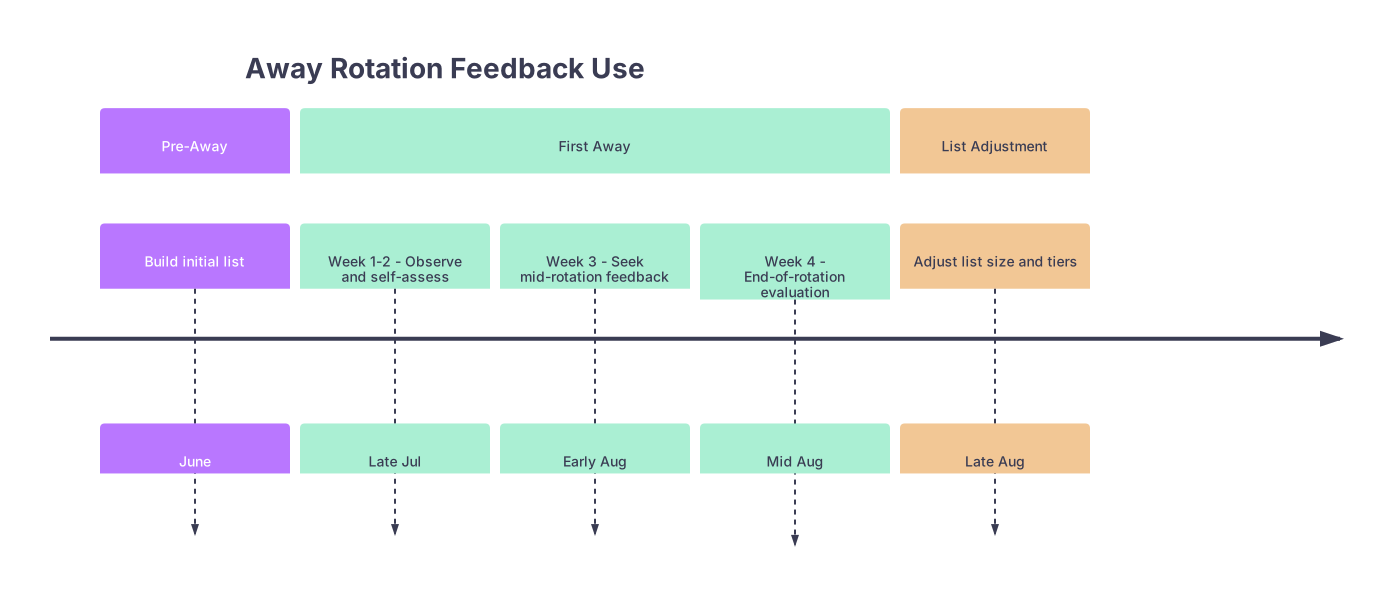
| Period | Event |
|---|---|
| Pre-Away - Build initial list | June |
| First Away - Week 1-2 - Observe and self-assess | Late Jul |
| First Away - Week 3 - Seek mid-rotation feedback | Early Aug |
| First Away - Week 4 - End-of-rotation evaluation | Mid Aug |
| List Adjustment - Adjust list size and tiers | Late Aug |
Week 1: Watch and Compare
At this point, you should quietly benchmark yourself against other rotators and residents.
Daily checklist:
- After each call day, ask:
- Am I keeping up with notes and pre-rounding?
- Do I understand the plans on my patients as well as interns do?
- Notice:
- Who is getting pulled into cool cases, consults, or more responsibility
- Whether residents ask you questions at a higher level or are re-explaining basics
No list changes yet. You are collecting data.
End of Week 2: First Informal Temperature Check
At this point, you should seek a low-stakes check-in with a resident you trust.
Ask something concrete like:
- “Compared to other rotators you have seen, am I about average, above, or below?”
- “Is there anything specific I could do over the next 2 weeks to stand out more?”
How to translate that into list strategy:
- If you hear:
- “You are one of the stronger rotators we have had this year” or “You are functioning like an intern”
- Mental note: you might be slightly underestimating yourself.
- “You’re doing fine, solid student”
- You are probably right where your baseline risk category placed you.
- “Make sure you work on X so you do not fall behind”
- Flag yourself as borderline. You will need more programs unless things improve.
- “You are one of the stronger rotators we have had this year” or “You are functioning like an intern”
Week 3: Mid-Rotation PD / Faculty Feedback
If your rotation has a formal mid-rotation evaluation, this is critical.
At this point, you should:
- Explicitly ask your attending or site director:
- “Do you see me as someone who could be competitive at programs like this?”
- “If I applied here, would I be in the serious consideration group, or would I need to cast a wider net?”
Listen to the wording:
- “You would be very competitive here” → you can likely shave 5–10 programs off your initial plan if this aligns with other signals.
- “You would be in the mix” → keep your original range.
- Vague, noncommittal comments → hold your range or consider increasing by 5–10.
Week 4: End-of-Rotation Meeting – First Real Adjustment Point
This is your first hard data point.
At this point, you should:
- Get your written evaluation (or detailed verbal summary if written is delayed).
- Ask one very direct question:
- “Given what you have seen, how broadly do you think I should apply in this specialty?”
Now convert that feedback into numbers.
Example scenarios:
Scenario A – Strong first away
- Comments: “Top 10% of rotators,” “Would be thrilled to have you here,” “Functioned at intern level.”
- Your starting plan: 35 programs in Gen Surg (middle-of-the-pack applicant).
- Adjustment: Drop to 25–28 programs, especially trimming marginal safeties.
Scenario B – Solid but not exceptional
- Comments: “Reliable, good team member, grew over the month,” nothing superlative.
- Keep your original range. Do not overreact.
Scenario C – Mixed or concerning
- Comments: “Needed close supervision,” “Improved but initially struggled with organization,” any mention of “concern.”
- Your starting plan: 25 EM programs.
- Adjustment: Increase to 30–35, and add a few more lower-tier / community options.
This is also where you use your first chart.
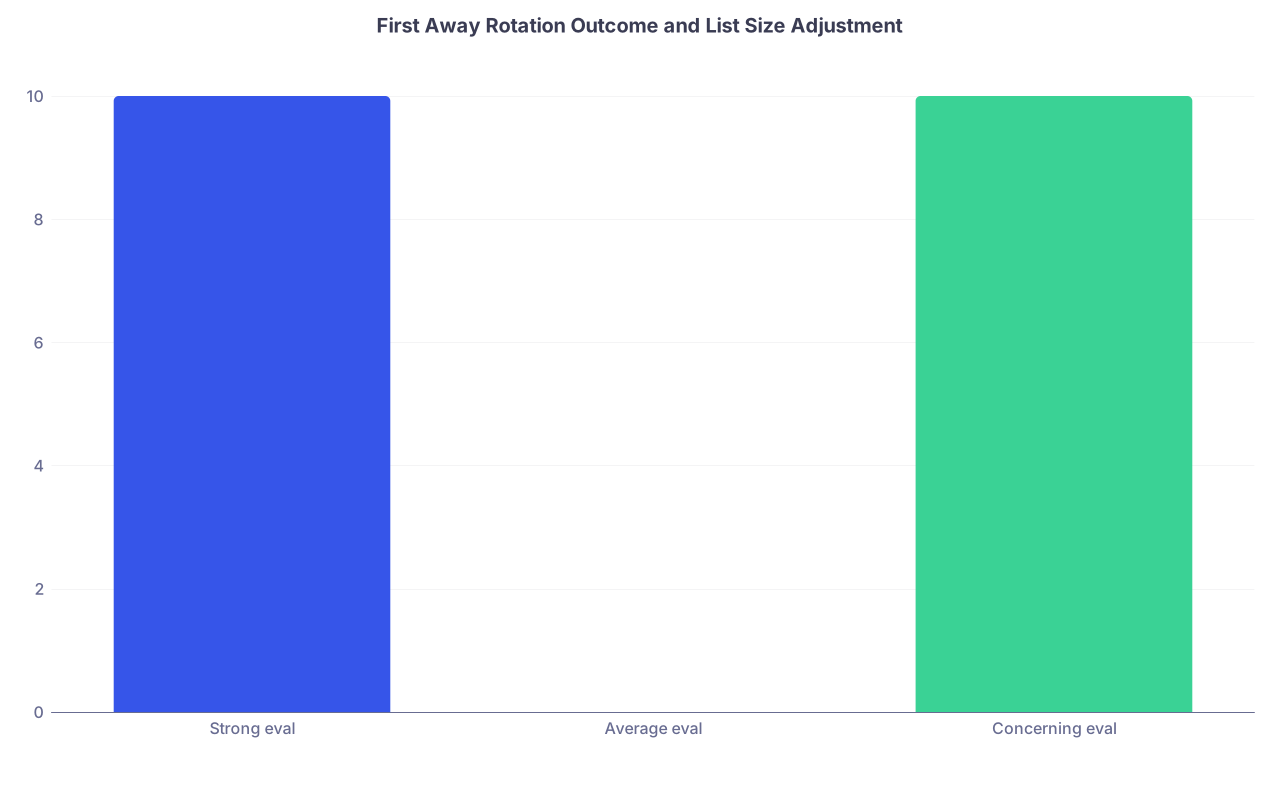
| Category | Value |
|---|---|
| Strong eval | 10 |
| Average eval | 0 |
| Concerning eval | 10 |
Interpretation: strong eval → cut 10; average → no change; concerning → add ~10.
September: Second Away Rotation – Refinement and Tiering
By now, ERAS is open or about to open. You cannot be completely indecisive anymore. But you still have room to refine.
At this point, you should be using your second away to check if your first result was a fluke or a pattern.
Early September: ERAS Draft Lock
Before your second away is halfway done, you need a working list ready to submit when applications open.
At this point, you should:
- Lock in a provisional final size based on:
- Baseline metrics
- First-away eval
- Any early informal reads from the second away
You will still be able to add or slightly trim later, but you need something close to final now.
Week 1–2 of Second Away: Pattern Recognition
Same process:
- Compare yourself to peers
- Seek informal resident feedback
- Ask early: “Am I hitting the right level for a potential resident here?”
What matters most now is consistency:
- Strong at rotation #1 and #2 → you are probably underrating yourself if your list is huge.
- Strong at #1, shaky at #2 → keep the current size; wait for final eval.
- Shaky at both → you are under more risk than you thought. Increase numbers.
Week 3–4 of Second Away: Final Pre-Submission Adjustments
You should now decide whether to shift your list size up or down within ±10 programs of your provisional number.
Decision rules:
Two strong aways, PDs explicitly supportive
- Competitive specialty, strong profile
- Example: You planned 60 ortho applications as a “middle” applicant.
- At this point, you should drop to 40–45, especially trimming low-yield geography or programs you do not actually want.
Mixed aways
- One strong, one average or unknown
- Keep your current plan. Maybe move 3–5 programs from “reach” to “solid” tier instead of changing the total count.
Two mediocre or weak aways
- You cannot pretend this is fine.
- Emergency medicine planned list: 25 programs.
- At this point, you should increase to 30–35 and add more safety programs and community programs.
Here is a simple way to frame it:
| Rotation Pattern | Risk Interpretation | Recommended Shift in List Size |
|---|---|---|
| Strong + Strong | Lower risk than expected | Decrease by 10–15 programs |
| Strong + Average | As expected | Keep current size |
| Average + Average | Slightly higher risk | Increase by 5–10 programs |
| Any Concerning Eval | Higher risk | Increase by 10–20 programs |
October–November: Interview Invite Season – Reality Check
Away feedback does not stop once the rotation ends. How programs respond when invites go out is feedback on steroids.
At this point, you should be tracking invite patterns weekly and dynamically responding.
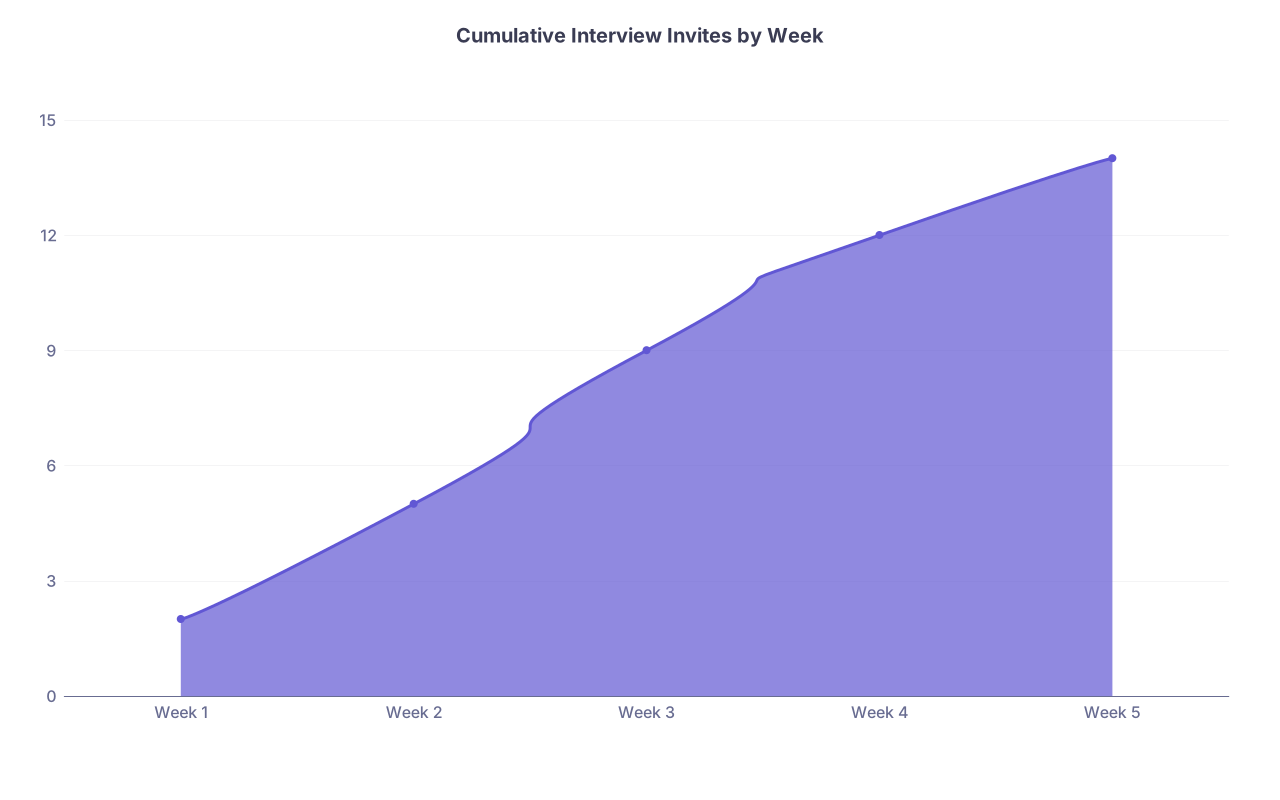
| Category | Value |
|---|---|
| Week 1 | 2 |
| Week 2 | 5 |
| Week 3 | 9 |
| Week 4 | 12 |
| Week 5 | 14 |
Early October: First Wave of Invites
At this point, you should:
- Create a simple tracking sheet:
- Program
- Date invite received
- Away / home / cold application
- Program tier (reach / solid / safety)
Watch for:
- Are your away institutions inviting you early, on-time, or not at all?
- Are “solid” programs responding, or are only safeties biting?
Rough benchmarks by early–mid October (varies by specialty, but pattern holds):
- Strong applicant:
- 6–10 invites already from a 25–30 application list.
- Middle-of-the-pack:
- 4–7 invites from a 30–40 list.
- At-risk:
- 2–4 invites from a 35–50 list.
If you are dramatically below what your peers in the same specialty are seeing, that is more feedback: your risk was underestimated.
Mid–Late October: Strategic Add-Ons (If Available)
Some specialties and programs accept applications later; others are strict. Within what is realistically possible:
At this point, you should:
- Consider adding programs only if:
- You have fewer than ~8–10 interviews projected in a moderately competitive field
- Away programs have not responded positively
- You can realistically attend more interviews geographically
What not to do:
- Do not blindly add 20 random programs you do not care about.
- Do not add only high-tier “hail Mary” programs. Those are ego padding, not strategy.
Focus add-ons on:
- Community programs
- Less saturated regions
- Places where your home or away attendings know someone and can contact them quickly
December–January: Interview Performance Feedback – Final Risk Correction
By now, your list is set. But you are not done using feedback. Interview season itself will tell you whether your “how many” estimate actually produced a safe number of rankable programs.
At this point, you should be tracking two things:
- Total number of interviews
- How many feel like genuinely rankable, good-fit options
After Each Interview
At this point, you should write down—same day:
- Did I feel like I connected with faculty and residents?
- Did anyone say “We hope to see you here” or “You would fit well here”?
- Gut score: 1–5 for both fit and how I performed.
Why this matters:
- If half your interviews feel terrible, you need more interviews in total to end up with enough rankable programs.
- If you consistently feel strong, your original list size was probably adequate (or even overkill).
Mid-January: Rank List Prep and Retrospective
Now step back and look at the system.
At this point, you should:
- Count:
- Total interviews
- Number of programs you would be genuinely comfortable ranking
- Compare to safe targets:
- Competitive specialties: aim for ~10–12 rankable programs.
- Moderate specialties: ~8–10.
- Less competitive: ~6–8 may be enough, depending on geography.
If you are well above these numbers, you likely over-applied. Learn from it. If you are barely hitting them, your cautious application volume was justified.
Specialty-Specific Realities (Quick Hits)
Some fields punish under-applying more than others. You use away feedback differently across them.

Orthopedics / Derm / ENT / Plastics
- Away feedback is huge. If two aways call you “top rotator,” you can afford not to spray 80 programs.
- If feedback is lukewarm, do not be cute. Push application numbers to the high end.
Emergency Medicine
- SLOEs matter more than your gut feeling. If your away SLOE is strong, you can be in the lower-middle of the recommended range.
- If your SLOE is average, your list should expand.
Internal Medicine / Family / Psych
- Over-applying is rampant and usually unnecessary.
- If two aways (or one away plus home) treat you like a very strong candidate, you can absolutely trim to the lower end of ranges.
How to Avoid the Two Classic Mistakes
I have watched this play out year after year.
Mistake 1: Ignoring Good Feedback and Still Over-Applying
Pattern:
- Two strong aways
- PD tells you, “You should be fine with 20–25 programs.”
- You panic and submit 50 anyway.
How to avoid it:
- Set a hard max number beforehand based on your risk grouping.
- Let positive feedback lower you toward the bottom of that band. Trust people who see hundreds of applicants every year more than your fear at 11:59pm before ERAS submission.
Mistake 2: Hand-waving Away Bad Feedback and Under-Applying
Pattern:
- Mixed or weak away feedback
- You decide, “They just did not like me; other places will,” and you still apply at the low end of the range.
How to avoid it:
- Use a rule you commit to now:
- Any evaluation describing concern, slow growth, or below-level performance → automatically add 10–15 programs to your provisional list.
You are not special enough to be the exception to the market.
A Simple Month-by-Month Summary

| Month | Focus | List Size Action |
|---|---|---|
| June | Baseline risk, draft list | Set initial target range |
| July–Aug | First away | Adjust ±10 based on eval |
| September | Second away + ERAS open | Lock provisional final size |
| October | Early interview invites | Add programs if invites very low |
| November | Ongoing invites | Minor tweaks only |
| Dec–Jan | Interview feedback | Evaluate whether strategy worked |
Today’s Action: Turn Feedback into Numbers
Do this now: open your away rotation evaluations—formal or informal—and write one number next to each:
- +10 if concerning
- 0 if average
- −10 if clearly strong and enthusiastic
Add those adjustments to your original application plan. That new total? That is the number of programs you should actually be applying to this season.