

You’re not crazy for obsessing about how many programs to apply to. You’re just stuck in a broken system that forces you to gamble with your future and your bank account at the same time.
Let’s say the quiet part out loud: you’re afraid of two nightmares.
- You undershoot, don’t match, and feel like you ruined your entire career because you tried to “save” a few hundred dollars.
- You overshoot, spend thousands you don’t have, and still lie awake wondering if you did it wrong.
You and I both know you’re going to err on the side of applying to more. Because that feels safer. But there is such a thing as too few. And there is a point where more programs stop helping and just light your money on fire.
Let’s walk through this like an actual human, not some “average applicant” fantasy.
The Core Fear: “What If I Don’t Match Because I Tried to Save Money?”
This is the thought that won’t shut up at 2 a.m.
You’re staring at your ERAS cart thinking:
“If I just add 5 more… or 10 more… that’s my safety net, right?”
And then you do the math in your head and feel sick:
“$29 per program × 50 programs = I hate this.”
Here’s the ugly truth: the system rewards your anxiety. Programs don’t get punished if you over-apply. You do.
But you can’t just pick a random number and hope. You need a ballpark that’s grounded in your actual situation: specialty, competitiveness, your stats, and how much risk you can tolerate without unraveling.
To stop spiraling, you need three things:
- A realistic range, not a magical “perfect” number
- A sense of when “too few” really is too few for you
- Permission to stop at “enough” instead of chasing infinity
Let’s break it up by specialty and how strong/average/at-risk you are.
The Brutally Honest Numbers (So You Can Stop Guessing)
I’m going to use rough ranges that line up with what I’ve seen actual applicants use and what roughly tracks with NRMP data and advisor norms. These aren’t holy scripture, but they’re 1,000x better than “vibes.”
First, what kind of specialty are you in?
Think like this:
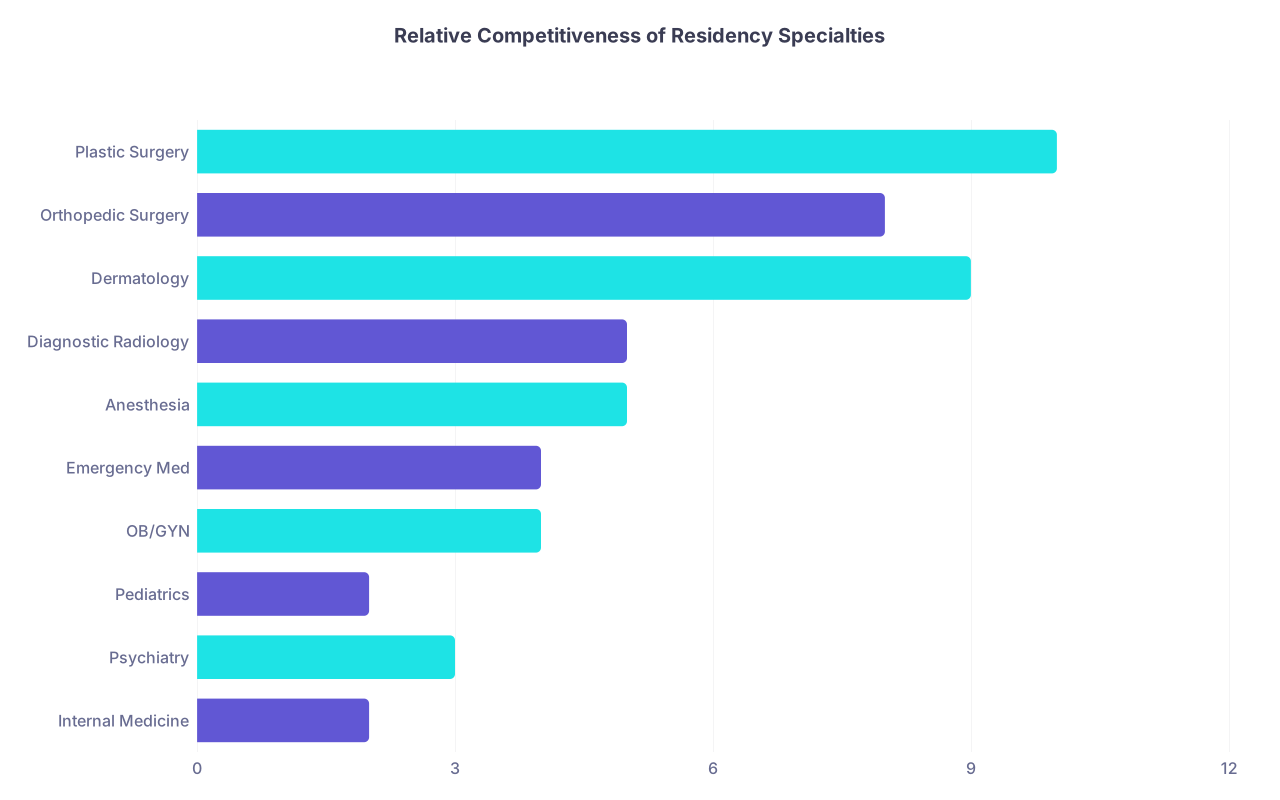
| Category | Value |
|---|---|
| Internal Medicine | 2 |
| Psychiatry | 3 |
| Pediatrics | 2 |
| OB/GYN | 4 |
| Emergency Med | 4 |
| Anesthesia | 5 |
| Diagnostic Radiology | 5 |
| Dermatology | 9 |
| Orthopedic Surgery | 8 |
| Plastic Surgery | 10 |
- Less competitive: FM, IM (categorical), peds, psych, neurology, pathology
- Mid-range: EM, OB/GYN, anesthesia, radiology, some surgical prelims
- Very competitive: ortho, derm, plastics, ENT, neurosurg, IR, some rads, ophtho (SF Match), urology (AUA)
Then, where do you land?
Be honest, not cruel.
- Strong: Above-average board scores, no red flags, solid clinical evals, some research, decent letters
- Average: Around mean scores, maybe limited research, normal letters, nothing glaring
- At-risk: Low scores, failed Step, leaves of absence, limited home support, no home program, career change, IMG, etc.
Now combine those.
| Specialty Tier | Applicant Profile | Rough Program Range |
|---|---|---|
| Less competitive | Strong | 15–25 |
| Less competitive | Average | 20–30 |
| Less competitive | At-risk/IMG | 30–60 |
| Mid-range | Strong | 25–35 |
| Mid-range | Average | 30–45 |
| Very competitive | Strong | 40–60 |
| Very competitive | Average | 60–80 |
| Very competitive | At-risk/IMG | 80–120 |
If your planned number is way below these ranges, that’s where “too few” alarm bells should be ringing.
If you’re way above, you’re probably moving into “money bonfire” territory unless you have very specific reasons.
How to Know If Your Number Is “Too Few” (Not Just Scary)
Here’s the part where your brain is going to fight me, because anxiety doesn’t care about logic. But I’m going to lay out the questions that matter.
1. Are you geographically restricting yourself?
If you’re saying things like:
- “I really want to stay in the Northeast”
- “My partner’s job is in one city”
- “I won’t move to the middle of nowhere, I just won’t”
Then you have to pay for that choice in number of programs. Fewer locations = more applications per region.
If you’re heavily restricted and you’re planning:
- Less than ~25 for less competitive fields
- Less than ~35–40 for mid-range
- Less than ~60 for very competitive
You’re flirting with “too few” unless your app is genuinely stellar.
2. Do you have any red flags?
I’m talking:
- Step 1 or Step 2 fail
- Low score for your specialty (e.g., <220 trying for ortho; sub-210 for mid-range fields)
- LOA, professionalism issues
- Very weak or late clinical letters
- Non-US grad, nontraditional path, long gap
If you checked even one of those and your number is below the “average” ranges in the table above, that’s probably too few.
Not guaranteed-fail too few. Just: you’re adding more risk than the money you’re saving is worth.
3. Are you dual-applying?
If you’re applying to, say, EM + IM, or derm + prelim medicine, or anesthesia + FM as a “backup,” your total combined number may be high, but each specialty’s list might be too short.
A pattern I see a lot:
- 25 programs in a competitive field
- 10–15 in the backup
That’s not a backup. That’s a wish.
If you’re dual-applying, think:
- Competitive field: at least ~40–50
- Backup field: at least ~25–30
Or flip the emphasis depending on what’s actually realistic.

| Step | Description |
|---|---|
| Step 1 | Choose Specialty |
| Step 2 | Start 20-30 programs |
| Step 3 | Start 30-45 programs |
| Step 4 | Start 60-80 programs |
| Step 5 | Add 10-20 more |
| Step 6 | Add 5-15 more |
| Step 7 | Hold at range |
| Step 8 | Less, mid, or very competitive |
| Step 9 | Any red flags |
| Step 10 | Strong regional limits |
The Money Panic: “I Literally Can’t Afford To Go Crazy”
You’re not being dramatic. This stuff gets stupidly expensive fast.
Let’s rough it out.
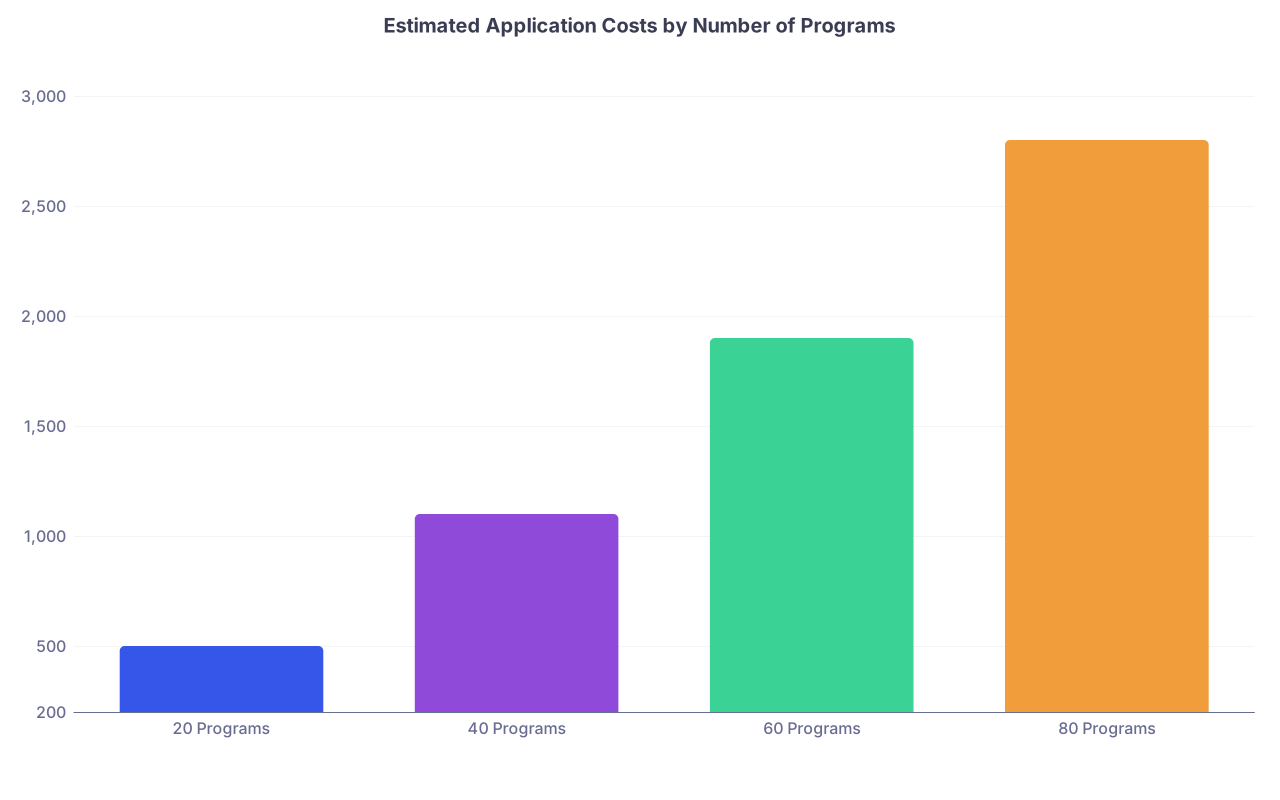
| Category | Value |
|---|---|
| 20 Programs | 500 |
| 40 Programs | 1100 |
| 60 Programs | 1900 |
| 80 Programs | 2800 |
(These are ballpark ERAS totals just for application fees, not interviews, flights, hotels, etc.)
At some point you’re not just choosing between “more chances” and “less chances.” You’re choosing between:
- More programs
vs. - Being able to afford traveling to the interviews you do get
Here’s how I’d think about it if I were in your shoes and broke:
Set an actual dollar ceiling first. Not a vibe. A real number.
“I cannot go over $X total for ERAS fees.”Look at your specialty and competitiveness tier and pick a target range within that budget.
If you literally cannot hit the “ideal” numbers, your strategy has to adjust:- Broaden location
- Add more community programs
- Deprioritize long-shot academic places
Ruthlessly cut the fantasy programs.
I’ve watched people apply to MGH, UCSF, Hopkins with shaky scores and then short-change community programs… and then cry in March. Don’t do that to yourself.Double-check you’re not paying for duplicates.
I’ve seen people accidentally apply to both categorical and prelim at the same program for fields where that makes no sense.
You are not obligated to match at your “dream” institution. You are obligated to match somewhere if this is the career you want. The prestige fantasy is expensive. Reality is cheaper and kinder in the long run.
Where More Programs Stop Helping (And Just Feed Your Anxiety)
Here’s the trap: you feel safer as the number climbs… up to a point.
But after a certain threshold, more programs don’t increase your chance of matching much. They just:
- Make your personal statement generic and soulless
- Flood you with more secondaries/emails/portals to track
- Give you interviews you can’t physically attend
- Increase the emotional noise without real benefit
For many people, “diminishing returns” look roughly like this:
- Less competitive fields: past ~30–35, returns drop fast
- Mid-range: past ~45–50
- Very competitive: past ~80–100
I’ve watched people apply to 120+ programs in a competitive field and still end up with 5 interviews. Not because they should’ve applied to 150—but because their core application issues weren’t fixable with volume.
If you’re tempted to go way above the ranges, ask yourself bluntly:
“Am I trying to fix a quality problem with quantity?”
If the answer is yes (low scores, weak letters, minimal research in a research-heavy field), then no number will fully erase that. You’re better off:
- Dual-applying
- Adding a more realistic specialty
- Or planning a dedicated year to strengthen your app
Instead of rage-clicking “Add to Cart” on ERAS.
How to Build a List That’s Big Enough Without Being Stupid
Here’s a simple structure that saves a lot of people from chaos.
Let’s say you’re applying to IM, mid-ish competitive, average applicant, willing to go almost anywhere, aiming for ~40 programs.
Rough breakdown:
- 10 “reach” programs (top academic, big cities, dream places)
- 20 “solid realistic” programs (mid-tier academic, strong community, mix of locations)
- 10 “safety-ish” programs (less competitive locations, more community heavy, places that tend to interview more generously)
Do not flip this and do:
- 25 reach
- 10 realistic
- 5 actual safety
That’s the “I applied to 40 but it was secretly 10” trap.
Also: don’t put 10 programs in cities you don’t actually want and lie to yourself that “I’d be happy anywhere.” You probably wouldn’t. But you also can’t only apply to 8 coastal cities and call that “anywhere.”
You need:
- Geographic spread
- Mix of academic and community (for most fields)
- Realistic targets based on your scores and CV
If you want to sanity-check your list:
Send it to someone blunt. Not just someone “supportive.” A mentor, advisor, or upper-year resident who will say, “These 8 are a waste, add 6 of these instead.”

How Few Is “Too Few” in Real Human Terms?
Let me be very direct.
If you tell me any of these, my stomach drops for you:
- “I’m applying ortho with a Step score in the low 220s and I’m only applying to 25 programs to save money.”
- “I’m an IMG applying IM but only to 15 programs my friends liked.”
- “I failed Step 1, passed Step 2, and I’m applying to 12 EM programs because I really want to be in one city.”
Could it work? Technically yes. Does it usually? No.
That’s not frugality. That’s self-sabotage dressed up as “budgeting.”
Reasonable “absolute minimums” where I stop breathing hard (for most people, with caveats):
- Less competitive US grad with no red flags: ~20–25 absolute bare minimum
- Mid-range field, average US grad: ~30–35 bare minimum
- Very competitive field, US grad: ~45–50 bare minimum
- IMG, any field: I start to relax more around ~50+ unless your application is insanely strong and targeted
If you’re below those numbers, you need either:
- Very strong application
- Ultra-strategic list
- Or an advisor explicitly telling you, “Yes, you’re fine”
Not just hope.

Making Peace With “Enough”
Here’s the part you probably don’t want to hear, but need to.
There will always be one more program you could add. One more city. One more long-shot name-brand institution.
There is no magic program number that makes the fear vanish. The fear isn’t math-based. It’s existential.
So your goal isn’t:
“Find the number at which I feel totally safe.”
Your goal is:
“Find a number and a list I can defend to myself later, even if this doesn’t go perfectly.”
That means being able to say:
- “I matched or didn’t match, but my choices were rational.”
- “I didn’t underapply out of denial, but I also didn’t destroy myself chasing fake security.”
- “Given my stats, my finances, and my specialty, this range was reasonable.”
If you can say that—and your number is somewhere near the ranges we talked about—you are not doing it wrong. You’re just existing in a rigged system and trying to survive it.
And honestly? That’s enough.
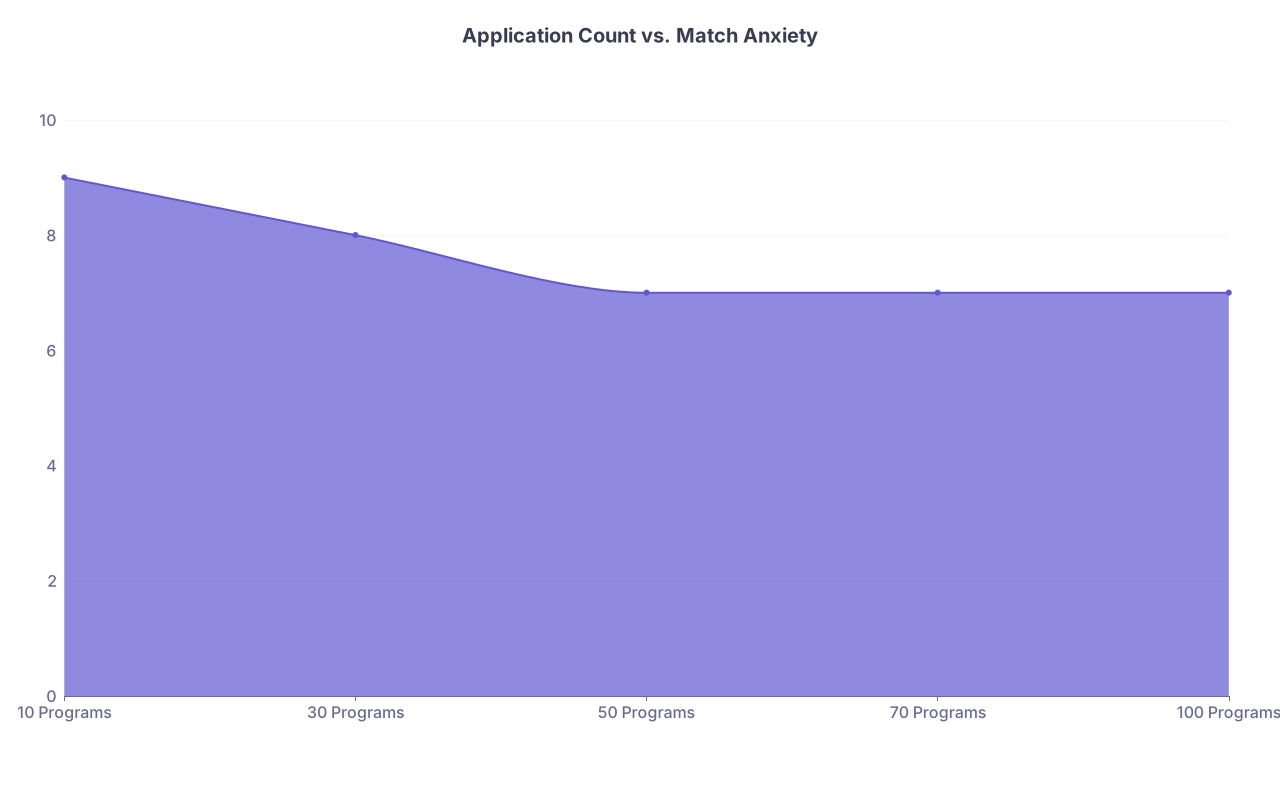
| Category | Value |
|---|---|
| 10 Programs | 9 |
| 30 Programs | 8 |
| 50 Programs | 7 |
| 70 Programs | 7 |
| 100 Programs | 7 |
(That chart is the reality: anxiety drops a bit as you move from way-too-few to reasonable… and then just plateaus. More programs won’t fix what’s actually scaring you.)
FAQ (Exactly the Stuff You’re Afraid to Ask Out Loud)
1. Is it better to overapply and be broke, or underapply and risk not matching?
If we’re being brutally honest: between the two, slightly overapplying is the lesser evil. But “overapply” doesn’t mean go from 40 to 100 for no reason. It means if you’re unsure between, say, 35 and 45 in a mid-range field, 45 is safer. Once you’re way beyond the ranges we discussed, you’re not buying safety anymore—you’re just paying extra to stay anxious.
2. I can only afford about 20–25 programs. Am I doomed?
Not automatically. But you lose the luxury of fantasy. You have to be cutthroat strategic: mostly realistic and safety programs, broad geography, fewer “dream” reaches. You may also want to consider a slightly less competitive field or dual-apply strategically. And if your specialty is very competitive, 20–25 is usually not enough unless you’re incredibly strong and well-advised.
3. What if my advisor says I’m fine with a low-ish number, but I don’t believe them?
Then ask them for specifics. “Given my Step scores, class rank, research, and specialty, how many programs do people like me usually apply to? How many do they actually match with?” If they can’t answer concretely, get a second opinion—from a different advisor, a resident in your specialty, or someone who actually looks at match lists, not just vibes. But if multiple people who know your file say you’re okay, at some point you have to trust data over fear.
4. I already submitted with what now feels like ‘too few’ programs. Is there anything I can still do?
Yes. You can:
- Add more programs later if they’re still accepting applications.
- Go hard on signaling interest (if your specialty uses signals).
- Email genuinely targeted programs with thoughtful interest (not copy-paste spam).
- Absolutely crush your interviews where you do get invites.
It’s not ideal, but it’s not game over. People match every year with fewer programs than they “should” have. Your job now is to maximize every single chance you actually have, not spiral about chances you didn’t buy.
Key points to hang onto:
- “Too few” depends on your specialty, your risk factors, and your geography—not some magic universal number.
- Slightly overapplying within a reasonable range is usually safer than underapplying, but there is a point where more programs just waste money.
- Your real goal isn’t to kill your anxiety; it’s to build a list and a number you can defend to yourself later, with clear, honest reasons behind it.


