Why Program Selection Strategy Matters So Much in Dermatology
Dermatology is one of the most competitive specialties in the Match. A thoughtful, data‑driven program selection strategy can be the difference between a happy derm match and an avoidable SOAP scramble.
Applicants often focus heavily on “how to get in” (research, scores, letters) but underestimate how to choose residency programs strategically. In dermatology, a miscalculated application list—too top‑heavy, too narrow geographically, or simply too small—can sink an otherwise competitive applicant.
This guide walks you through an evidence‑based, practical framework to build a smart derm program list, decide how many programs to apply to, and tailor a program selection strategy that matches your profile and priorities.
We’ll cover:
- Key factors that affect your competitiveness in dermatology
- How to categorize programs into “reach, target, and safety”
- Choosing programs based on curriculum, culture, and career goals
- Geographic and personal considerations
- A step‑by‑step method to build and refine your list
- Practical numbers and examples for “how many programs to apply”
Step 1: Know Your Dermatology Applicant Profile
Before you can design a program selection strategy, you need a realistic view of your competitiveness. Dermatology residency selection is holistic, but some variables consistently matter.
1. Academic Metrics (USMLE/COMLEX and Class Rank)
Although Step 1 is now Pass/Fail, your academic metrics still influence where you’re competitive.
Key academic elements:
- Step 2 CK / COMLEX 2
- Higher scores expand your options and increase interview yield.
- Many derm programs now emphasize Step 2 more heavily.
- Class rank/percentile and honors
- AOA or GHHS membership can help at more academic, research‑oriented programs.
- Consistent honors, especially in medicine and dermatology‑adjacent rotations, are beneficial.
Action point:
Group yourself (honestly) into one of three tiers:
- Tier 1 (Highly competitive):
- Strong Step 2 CK (well above national average for matched derm), strong clinical performance, maybe AOA/GHHS.
- Tier 2 (Solid but not elite):
- Above‑average scores and grades, but not top decile; perhaps some minor blemishes.
- Tier 3 (Underdog or “at risk”):
- Average or below‑average scores, repeats, gaps, or significant academic issues.
You won’t share this label with anyone—but you should use it to guide program selection.
2. Dermatology‑Specific Experiences
Dermatology is small and relationship‑driven. Programs look for commitment to the field and evidence that you understand what derm actually is.
Important components:
- Home dermatology department experience
- Dermatology rotations, continuity clinic, longitudinal experiences.
- Away rotations / Audition electives
- These are often critical for derm; strong performance can lead to interviews.
- Aim for at least 1–2 if feasible and if your home program is limited.
- Dermatology research
- Publications, posters, QI projects, case reports.
- More important at academic programs, but helpful across the board.
- Letters of recommendation
- Strong, specific letters from dermatology faculty (ideally including chair or program director if they truly know you).
Action point:
Reflect on how strong your derm‑specific profile is relative to your peers at your home institution. A strong derm portfolio can offset slightly weaker standardized metrics at many mid‑tier programs.
3. Non‑Traditional or “Red Flag” Elements
You must factor in any issues that may affect how many programs you apply to and how broad your program list should be:
- Gaps in training
- Leaves of absence (particularly for non‑medical reasons)
- Past failures/remediation (Step failures, clerkship remediations)
- Prior attempts to match in derm (re‑applicants)
- Prior training in another specialty (e.g., internal medicine prelim year)
Action point:
If you have one or more of these, assume:
- Lower interview yield, especially at top‑tier programs.
- Need for a wider net and more “safety” programs.
- Extra importance of personal contacts and advocacy from mentors.

Step 2: Clarify Your Priorities and Career Goals
A common mistake is to treat all dermatology residency programs as interchangeable simply because “derm is derm.” In reality, programs vary significantly in culture, training focus, and outcomes.
Defining your priorities early will help you decide how to choose residency programs that fit you, not just ones that might rank you.
1. Academic vs. Private‑Practice Orientation
Ask yourself:
- Do you see yourself in academics (research, teaching, subspecialty fellowship)?
- Or primarily in community / private practice?
While any dermatology training gives you a strong foundation, program emphasis differs:
- Highly academic programs
- Strong research infrastructure
- Major subspecialty clinics (pediatric derm, complex medical derm, autoimmune blistering, etc.)
- Higher likelihood of fellows and subspecialty mentorship
- May have heavier conference and research expectations
- Community‑oriented or hybrid programs
- High clinical volume, procedural exposure
- Strong preparation for private practice efficiency
- May have fewer research requirements
Impact on program selection strategy:
- If you want academia or a competitive fellowship (e.g., Mohs, peds, dermpath), you might prioritize programs with:
- High fellowship match rates
- Strong publication records among residents
- Known subspecialty leaders
- If you’re focused on general dermatology or community practice, you might favor:
- Programs known for heavy clinical volume
- Strong procedural exposure and autonomy
- Locations where you might want to practice long‑term
2. Geography and Lifestyle
Geography heavily influences derm program selection—and vice versa. Program directors know that regional ties often predict where residents will rank and ultimately train.
Consider:
- Regions where you genuinely want to live for 3+ years
- Where you have family or partner connections
- States/regions where you might want to practice afterward
Be honest with yourself about:
- Cost of living (e.g., SF/NYC vs Midwest/South)
- Climate and outdoor activities
- Support systems
- Commute and call structure
Impact on derm match strategy:
- Strong geographic ties (grew up there, trained there, family there) can meaningfully boost your chances at programs in that region.
- If you have no ties to a competitive area (e.g., California), you may want to:
- Apply more broadly within that state/region if you truly want to end up there, and
- Simultaneously protect yourself by applying to less saturated regions (Midwest, South).
3. Program Size, Structure, and Culture
Programs differ in:
- Size (e.g., 1–2 residents/year vs 6–8 residents/year)
- Main hospital type (academic center vs community-based vs VA-heavy)
- Rotations (inpatient consults, peds derm, cosmetic curriculum)
- Call schedules and workload
- Degree of resident autonomy
Think about:
- Do you prefer a small, tight‑knit program where everyone knows you well?
- Or a larger program with diverse co‑residents and potentially more subspecialty exposure?
- Are you comfortable in a more “intense,” high‑volume environment, or do you value a more balanced schedule?
These softer factors significantly impact day‑to‑day satisfaction and should influence which programs you prioritize on your list.
Step 3: Understanding the Dermatology Landscape and Tiers
To create a rational program selection strategy, you need a framework for categorizing programs relative to your competitiveness. You’re not ranking them by quality, but by probability of securing an interview and matching.
1. Conceptual Tiers of Dermatology Programs
While every program can train excellent dermatologists, in terms of competitiveness you can broadly (and loosely) think of programs in three groups:
- Highly competitive / “Reach” programs
- Prestigious academic centers or highly desirable locations (e.g., coastal, major cities).
- Often have very high volume of applicants per spot.
- Strong national reputation, heavy research emphasis.
- Mid‑range / “Target” programs
- Solid training, good outcomes, moderate research opportunities.
- May be less flashy in name but excellent clinically.
- Often in mid‑sized cities or less saturated regions.
- Less competitive / “Safety-ish” programs
- Newer programs or smaller institutions.
- Less well known nationally, but often strong clinically.
- Some in less popular or more rural locations.
You won’t find these labels explicitly anywhere; they are a tool for planning, not a formal classification.
2. Matching Tier to Applicant Category
Combine your applicant tier (Step 1) with program tiers to get a rough strategic approach:
Highly competitive applicant (Tier 1):
- You can target:
- A substantial number of “reach” academic programs
- A moderate number of mid‑range programs
- A smaller number of safety programs (but don’t eliminate safety entirely)
Solid but not elite (Tier 2):
- Emphasize:
- A core of mid‑range programs as your “bread and butter”
- Some reach programs (but not the majority of your list)
- A meaningful group of safety programs, especially in less saturated regions
Underdog or at risk (Tier 3):
- Focus heavily on:
- Safety and mid‑range programs
- Broad geographic spread (especially in regions less flooded with applicants)
- Programs where you have personal or institutional connections
This doesn’t mean you can’t apply to your dream “reach” programs—you should. But they should not dominate your list if you want a realistic derm match.

Step 4: How Many Dermatology Programs Should You Apply To?
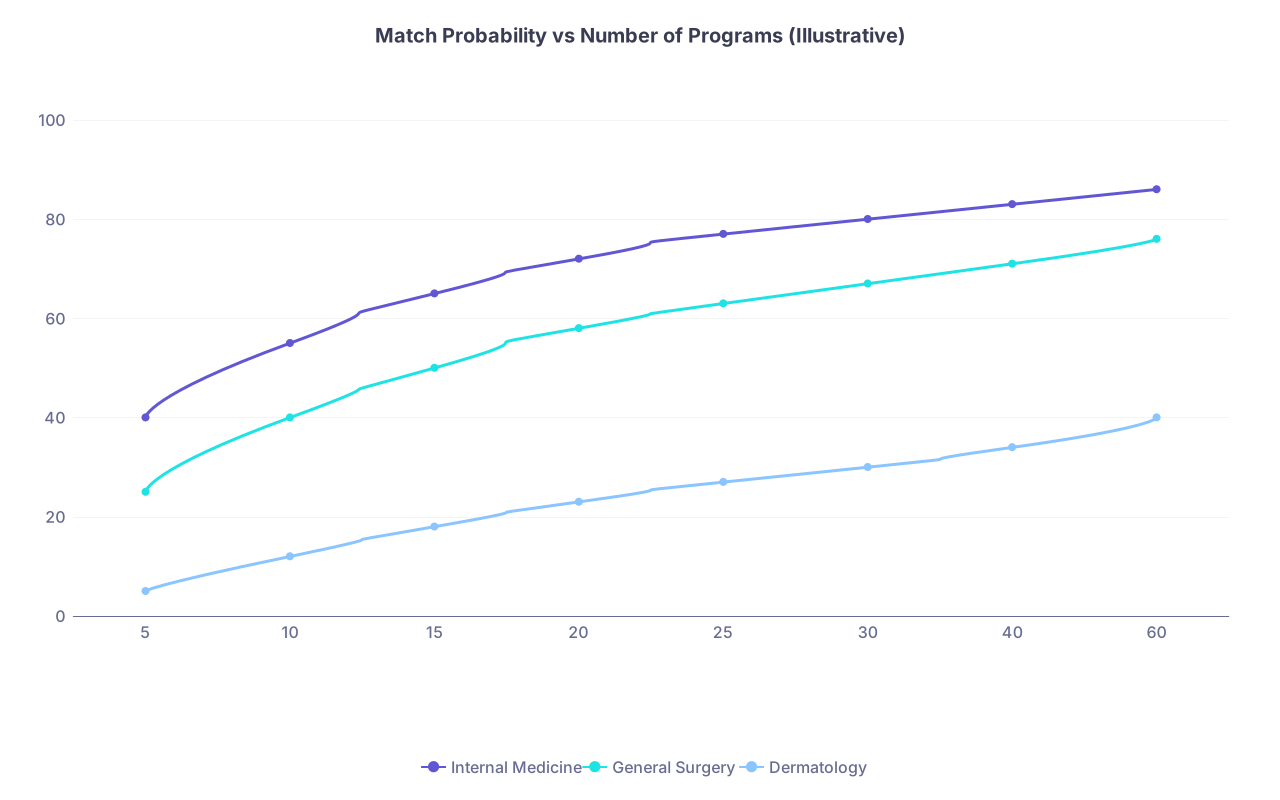
There is no universal magic number, but you must anchor your program selection strategy with realistic application counts. Dermatology is competitive enough that under‑applying can be risky—even for strong applicants.
Below is a conceptual framework (not official data, but informed by current trends and NRMP patterns as of 2024).
1. Baseline Considerations
Factors that push you to apply to more derm programs:
- Lower or borderline Step 2 / COMLEX scores
- Significant red flags or re‑applications
- Limited or no dermatology research
- Coming from a less well‑known medical school with few derm matches
- No home dermatology program
- Limited away rotations
Factors that allow you to moderate your application number:
- Strong academic metrics and derm research
- Robust home program support with a strong derm Match track record
- Strong away rotations with clear departmental advocacy
- Strong geographic ties in desired areas
2. Approximate Ranges by Applicant Profile
Use these as starting points and refine with your advisor or derm mentor.
Tier 1 (Highly competitive applicant)
- Typical range: 25–40 dermatology programs
- Composition:
- ~30–40% reach programs
- ~40–50% mid‑range programs
- ~10–20% safety-ish programs
- Rationale:
- You may not need 60+ applications, but wide variety still improves interview odds and future options.
Tier 2 (Solid but not elite)
- Typical range: 40–60 dermatology programs
- Composition:
- ~20–30% reach programs
- ~40–60% mid‑range programs (the core of your list)
- ~20–30% safety-ish programs
- Rationale:
- You’re competitive, but there’s substantial uncertainty; a broad, balanced list is protective.
Tier 3 (Underdog / at risk)
- Typical range: 60–80+ dermatology programs
- Composition:
- ~10–20% reach programs (don’t overspend here)
- ~40–50% mid‑range
- ~30–40% safety-ish programs, especially in less saturated geographic regions
- Rationale:
- Lower expected interview yield; you must cast a wide net while leveraging any connections or geographic advantages.
Remember that these numbers refer to dermatology programs only. Many derm applicants also apply to backup specialties (often internal medicine, transitional year, or prelim programs) depending on risk tolerance and mentor advice.
3. Integrating Transitional/Preliminary Year Programs
Because dermatology is an advanced specialty, you’ll also need a PGY‑1 year (prelim or transitional). This affects the “how many programs to apply” question.
- If you are highly competitive overall:
- You may not need an extremely large number of prelim/TY applications (e.g., 10–15).
- If you are less competitive or risk‑averse:
- You may want to apply to more prelim/TY programs (e.g., 15–25), especially in locations where you’d be happy if you ended up doing only the PGY‑1 there.
Coordinate application numbers in derm and PGY‑1 carefully with your advisor so you don’t under‑ or over‑apply.
Step 5: Building and Refining Your Program List
Now that you understand your profile and the general application numbers, here is a step‑by‑step program selection strategy you can execute.
Step 5.1: Initial Data Gathering
Use resources such as:
- FREIDA, program websites, and ERAS data
- NRMP/Charting Outcomes (for historical trends)
- Your school’s match list and derm match alumni
- Online program info sessions and open houses
Create a spreadsheet with columns like:
- Program name and location
- Program size (residents/year)
- Academic vs community orientation
- Research emphasis
- Known strengths (e.g., peds, Mohs, complex med derm)
- Geographic region and your ties (Y/N)
- Perceived competitiveness (reach/target/safety-ish)
- Personal interest level (1–5)
- Notes from current or former residents you speak with
Step 5.2: Preliminary Filtering
Filter out programs that are truly not compatible with your basic needs:
- Locations you know you cannot live due to family/visa/other constraints
- Programs that don’t sponsor your visa type (if applicable)
- Programs with rotation structures or call expectations you cannot accept
Don’t filter too aggressively based on prestige alone at this stage—you’re building breadth.
Step 5.3: Assigning “Reach, Target, Safety-ish” Categories
For each program, make a tentative classification based on:
- Your metrics vs program’s perceived competitiveness
- Your own school’s historical interview/match record there
- Input from mentors who know derm well
Your aim is not perfection—just a rough calibration so your list isn’t accidentally 80% “reach.”
Practical example:
- Dream coastal academic center with heavy research and nationally known chair:
- Likely “reach” for most applicants.
- Solid university‑affiliated program in a mid‑sized Midwestern city:
- Likely “target” for many.
- Newer program in a smaller city without brand‑name recognition:
- More likely “safety-ish,” though still competitive.
Step 5.4: Adjusting for Geography and Ties
Next, adjust your categories with geography:
- Programs in regions where you have strong ties (grew up, college, spouse’s job, prior training) might function as slightly less competitive for you than for the average applicant.
- A “reach” program may become “upper‑target.”
- A “target” may behave more like “safety-ish.”
- Conversely, highly desirable locations where you have no ties may be functionally harder to match into than you expect.
You can note this in your spreadsheet (e.g., “Reach (but strong geographic tie)”).
Step 5.5: Finalizing “How Many Programs to Apply” and Mix
Now compare your running total to the target ranges from Step 4:
- If you’re a Tier 2 applicant and your list currently includes:
- 50 programs total
- 20 reach, 20 target, 10 safety-ish
You may be over‑weighted toward reach and need more safety/mid‑range.
- If you’re Tier 3 with 45 programs, most of them mid/upper tier, you likely need:
- More overall programs
- More safety‑leaning options, especially in less saturated areas.
Aim for a distribution where:
- You can realistically imagine matching at a large proportion of your list.
- Your dream programs are present, but not overwhelming the strategy.
- Geographic diversity is reasonable, unless you truly have strong reasons to be limited to one region (and you fully accept the associated Match risk).
Step 6: Subtle but Important Factors in Choosing Dermatology Programs
Once you have a balanced list, you can sharpen it by considering more nuanced factors that affect fit and long‑term satisfaction.
1. Educational Philosophy and Resident Autonomy
Read websites, talk to residents, and ask:
- How much autonomy do residents have in clinic and procedures?
- Is the environment supportive and collegial, or more hierarchical?
- How is feedback given—formal, structured, or mostly informal?
Programs where residents feel trusted and supported usually foster better learning and well‑being.
2. Case Mix and Procedural Exposure
Dermatology is broad. Consider:
- Medical vs surgical vs cosmetic balance
- Exposure to:
- Complex derm (oncology, autoimmune, inpatient)
- Mohs surgery and excisions
- Cosmetic procedures (lasers, injectables)
- Pediatric dermatology
If you want a procedural or Mohs‑heavy career, procedural volume and faculty interests should influence your choices.
3. Research and Career Development Support
For those eyeing academia or fellowship:
- Are there structured research blocks?
- Do residents regularly present at national meetings?
- What is the fellowship match history (Mohs, dermpath, peds, complex med derm)?
- Are there mentors in your particular interests (e.g., global derm, skin of color, AI in dermatology)?
Even if you’re not research‑focused, programs with rich scholarly activity can expand your future options.
4. Resident Culture and Wellness
This is harder to quantify but critically important:
- Do residents seem genuinely happy when you talk to them?
- How do they describe their work‑life balance?
- What is the call burden like?
- Are there formal wellness initiatives, and do residents feel they are meaningful?
Red flags:
- High resident turnover
- Consistently negative or vague answers about “how’s the culture?”
Positive signs:
- Residents hang out together by choice
- Alumni stay involved and speak highly of training
5. Long‑Term Placement and Alumni Network
Finally, consider:
- Where do graduates go after residency?
- Academics vs private practice
- Geographic spread vs localized practice
- Does the program’s alumni network align with your career aspirations?
Programs that consistently place graduates into the kinds of jobs (or fellowships) you want are inherently good fits for your goals.
FAQs: Program Selection Strategy in Dermatology
1. How many dermatology programs should I apply to if I have average scores but strong research?
If your Step 2/COMLEX scores are around average but you have robust dermatology research (publications, posters, strong derm letters), you might be a Tier 2–leaning applicant. A common strategy is to apply to 40–60 dermatology programs, with:
- ~20–30% reach (particularly research‑heavy academic centers)
- ~40–60% mid‑range programs
- ~20–30% safety-ish programs, especially in regions less saturated with applicants
Refine these numbers in discussion with your dermatology advisor, who knows how your school’s graduates have fared historically.
2. Should I avoid applying to programs where I have no geographic ties?
No. Lack of geographic ties does not mean you should avoid a region entirely, but it does mean you should be strategic. For very popular coastal cities or high‑prestige academic centers, lack of ties may reduce your odds, so:
- Include some of these if you truly want them, but
- Balance them with programs in regions where you do have ties and in less saturated areas (Midwest, South, smaller cities).
A balanced geographic spread protects you while still allowing you to aim for dream locations.
3. Is it worth applying to extremely competitive “name brand” programs if I’m not a top‑tier applicant?
Yes—within reason. Including a modest number of highly competitive “reach” programs is reasonable for almost all applicants. However:
- Avoid letting them dominate your list.
- Recognize they may be low‑yield, especially without strong metrics, research, or connections.
- Ensure that most of your list consists of realistic target and safety-ish programs so you maintain a viable derm match strategy overall.
4. How should I factor in backup specialties when deciding how many programs to apply to in dermatology?
Your backup strategy depends on your risk tolerance and your profile:
- If you’re a highly competitive applicant with strong derm indicators, you might:
- Focus your primary effort on derm (e.g., 25–40 programs)
- Apply to a small but strategic set of prelim/TY programs.
- If you’re more borderline or a re‑applicant, you may:
- Apply broadly to derm (e.g., 60–80+ programs)
- Simultaneously apply to a backup categorical specialty (internal medicine, pediatrics, etc.), plus prelim/TY programs.
Discuss this thoroughly with your dean’s office and derm mentors; your program selection strategy needs to balance your desire to pursue dermatology with the practical necessity of matching into a residency.
Thoughtful planning of your dermatology residency list—grounded in honest self‑assessment, clear priorities, and a data‑informed program selection strategy—can significantly improve both your chances of a successful derm match and your long‑term satisfaction in the specialty.