
58% of unmatched U.S. MD seniors had at least one interview but still did not match.
So no, the line between “safe” and “screwed” is not simply “did you hit 15 interviews or not.” The story is more complicated, and the data do not back the absolute way this myth gets repeated on Reddit and in hallways.
Let’s tear this apart properly.
Where the “15+ Interviews” Rule Actually Comes From
That magic “12–15 interviews” number is not something your dean pulled out of a hat. It’s a mangled version of what NRMP data actually say in the “Charting Outcomes in the Match” and “Interactive Charting Outcomes” tools.
Here’s the real picture: for most core specialties, once U.S. MD seniors have around 12 ranked programs, their probability of matching levels off above 90%. For DO seniors it’s a bit higher; for IMGs it’s higher still.
That’s ranked programs, not interviews. Big difference. People conflate:
- Interviews received
- Interviews attended
- Programs actually ranked
And they pretend all three are interchangeable. They’re not.
You cancel a few for distance, some are prelim only, one felt toxic, one was clearly a backup you’d never choose unless held at gunpoint. You might attend 15 interviews and rank 10. Or attend 10 and rank all 10. Only the last number matters to NRMP probabilities.
So the first myth: “15 interviews” is not a hard epidemiologic threshold. It’s a rough ballpark that came from looking at rank list length, then being misquoted into a universal rule.
What the NRMP Data Actually Show (By Applicant Type)
Let me give you a saner, data-driven framing.
| Applicant Type | Rank List Length for ~90%+ Match Chance* |
|---|---|
| US MD Senior (Core IM/FM/Peds) | ~10–12 programs |
| US DO Senior (Core) | ~12–15 programs |
| US MD Senior (Highly Competitive) | Often 15+ and still not ‘safe’ |
| US IMG (Any) | 20+ and still significant risk |
| Reapplicant / Red Flags | No ‘safe’ number; context-dependent |
*These are approximate patterns from NRMP Charting Outcomes and match data trends, not single exact cutoffs.
A few reality checks:
Core specialties (IM, FM, Peds, Psych, Neuro, Path, etc.)
For U.S. MD and DO seniors in these, the match probability increases steeply up to around 8–10 programs ranked, keeps improving to ~12–15, and then flattens.
So if you’re a solid U.S. MD applying Internal Medicine and you have 14 interviews and realistically will rank 12–13, your odds are already very high. Interview #18 isn’t fundamentally changing your life.
Competitive specialties (Derm, Ortho, ENT, Plastics, etc.)
The “15+” rule is actually too optimistic here. I’ve seen U.S. MDs with 18–20 interviews in ortho or ENT still go unmatched. Why? Because supply-demand is brutal and rank lists are short on the program side.
A program ranking 10–15 people for 1 spot behaves very differently from a primary care program ranking 100+ for 10 spots.
IMGs and DOs in competitive fields
For IMGs, 15 interviews might look “great” subjectively, but the match probabilities don’t flatten at the same point. The NRMP graphs for IMGs show a much slower rise and less of a plateau. More interviews help, but they never guarantee.
So the blunt version:
- For a typical U.S. MD in primary care, you don’t need 15+ interviews to be very likely to match.
- For a U.S. MD in derm/ortho/ENT, 15 may not be enough.
- For IMGs, the number where things flatten is higher and fuzzier.
The myth takes all that nuance and flattens it into one lazy line: “You need 15+ interviews to be safe.” False.
The Bigger Myth: Interviews Alone Decide Your Fate
There’s an even dumber assumption hiding under the 15+ rule: that match probability is a simple function of how many interviews you get.
I’ve sat with applicants who said things like:
“Once I hit 15 invites, I knew I was chill. Game over.”
Then they canceled “less desirable” places and tried to rank 10–11. Some matched. Some didn’t. Same interview counts, different outcomes.
Here’s what actually matters more than the raw count:
Specialty supply-demand ratio
Anesthesia with hundreds of positions is not the same as neurosurgery with a tiny number of spots. Saying “15 interviews” without specifying specialty is like saying “you need 10 units of money to be rich” without specifying currency.
Program type and competitiveness
Fifteen interviews at Harvard/MGH/UCSF-level programs is one kind of risk. Fifteen at mid-tier community IM programs is another. Your odds of being high enough on somebody’s list vary dramatically.
Your position on each rank list
Programs don’t rank everyone they interview equally. How you performed on interview day, letters, perceived fit, red flags—all of that moves you up or down. Two applicants with the same number of interviews can have wildly different match odds because one is routinely ranked top 5 at programs, and the other is consistently in the “maybe if we dig way down” zone.
How many programs you rank
People forget this: NRMP data is about rank list length. Every interview you cancel, every prelim you decide “not to bother ranking,” shrinks your list. I’ve seen people go from a “relatively safe” 12 interviews to ranking 8 because they got picky. And they rolled the dice harder than they realized.
So no: piling up interviews doesn’t magically override weak letters, poor fit, or applying to the wrong tier of programs.
The Real Question: How Many Programs Should You Apply To?
This is the part everyone actually cares about, even if they frame it as “How many interviews do I need?”
Let’s flip it. The more relevant question is: How many programs should you apply to so that you end up with a sufficient rank list?
You’re trying to back-calculate from: “I want 10–15 realistic programs on my rank list” to “How many total applications and interviews do I need to get there?”
Broad strokes, if you’re applying smartly (i.e., to an appropriate mix of reach/target/safety programs for your profile):
U.S. MD, non-competitive specialty, middle-of-the-road stats:
Applying to ~25–40 programs often yields enough interviews to end up ranking 10–15.U.S. DO in non-competitive specialty:
Often 40–70 applications. More if you’re weak on scores, red flags, or geography is highly restricted.IMGs:
You are not playing the same game. 80–150+ applications are common. The variance is huge, but trying to “save” on application fees here is usually false economy.
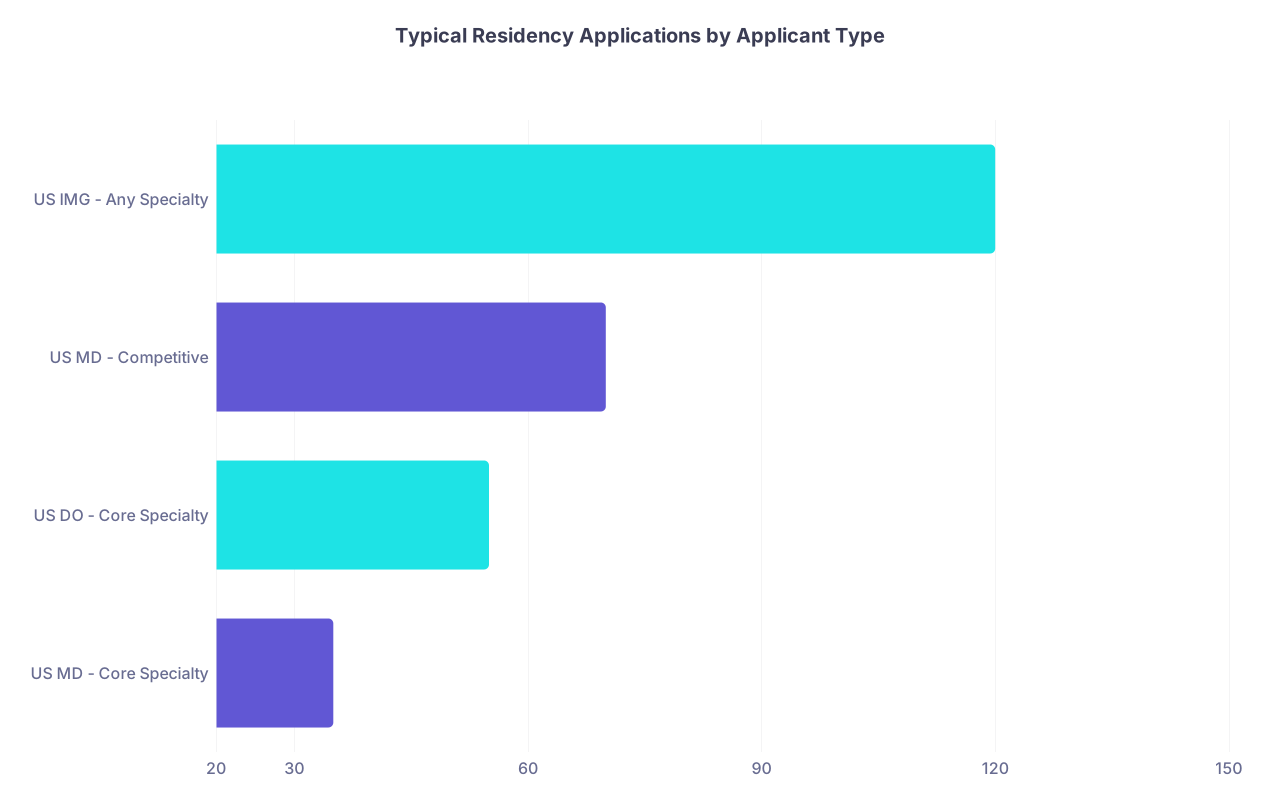
| Category | Value |
|---|---|
| US MD - Core Specialty | 35 |
| US DO - Core Specialty | 55 |
| US MD - Competitive | 70 |
| US IMG - Any Specialty | 120 |
Notice what I didn’t say: I didn’t say “Apply to 200 programs because more is always better.” That’s not true either. Once you’re past the point where you’re realistically getting enough interviews, extra apps mostly just donate money to ERAS and flood programs with noise.
Why the 15+ Myth Refuses to Die
Every year on the trail, you’ll hear the same lines:
- “My advisor said 15 interviews = 99% chance.”
- “Someone unmatched with 8, so I’m terrified.”
- “Derm people say you need 20+ just to breathe.”
Why does the myth persist?
1. People confuse correlation with threshold
Applicants who end up with 15+ interviews often have good apps and match at high rates. That doesn’t mean 15 causes the outcome. It’s a marker of applicant strength in many cases, not a universal safety switch.
2. Survivorship bias
You don’t hear a lot from the person who ranked 5 community IM programs and quietly matched. You hear from the person who interviewed at 18 ortho programs and unmatched in a spectacular, highly public crash. Fear stories travel farther than boring successes.
3. Lazy advising
Some schools and mentors still work off ancient rules-of-thumb rather than actually looking at current NRMP graphs by specialty. Saying “aim for 12–15 interviews” is simple, easy to remember, and usually conservative-ish. But it’s also intellectually lazy.
4. Applicant anxiety
Honestly, some of this is on applicants too. You want certainty from an inherently probabilistic system. You grab onto any number that sounds like a guarantee. “15+” becomes a talisman. A comfort blanket. That doesn’t make it true.
A Smarter Way to Think About Your Strategy
Here’s a more adult, data-respecting way to frame it.
1. Start with your profile and your specialty
Pull the NRMP “Charting Outcomes” for your year or the most recent one. Look for:
- Your Step 2 / COMLEX range vs matched in your specialty
- Match probabilities by number of ranks for your applicant type
Then be honest: are you above average, average, or below for your target field?
2. Translate that into a rank list target, not an interview target
Rough rules:
- If your specialty’s curve flattens at 10–12 ranked programs → aim to be able to rank 12–15.
- If it never truly flattens (some IMGs, some ultra-competitive fields) → aim as high as your sanity and wallet can tolerate.
3. Work backward to applications and interviews
Assume some drop-off:
- Not every interview becomes a rank (bad vibes, location, categorical vs prelim).
- Not every application generates an interview.
So you want redundancy. But rational redundancy, not panic-fueled binge applying.

| Step | Description |
|---|---|
| Step 1 | Know Stats and Specialty |
| Step 2 | Check NRMP graphs |
| Step 3 | Set Rank List Target |
| Step 4 | Estimate Needed Interviews |
| Step 5 | Choose Application Count |
| Step 6 | Adjust Mid-Season if Needed |
Why this matters: it keeps you focused on the actual endpoint (a robust rank list) and not on some arbitrary interview number.
The Silent Killer: Overconfidence After Early Invites
One of the most dangerous misunderstandings of the “15+ interviews” rule happens in October and November.
I’ve watched this movie:
- Applicant gets 10 invites early in the season.
- They hear “12–15 = safe,” so they mentally declare victory.
- They stop signaling interest to safer programs, cancel a few that feel beneath them, and rank 9–10 in the end.
Then March rolls around and they discover “10 interviews” is not the same as “10 high ranks” at every program that met them.
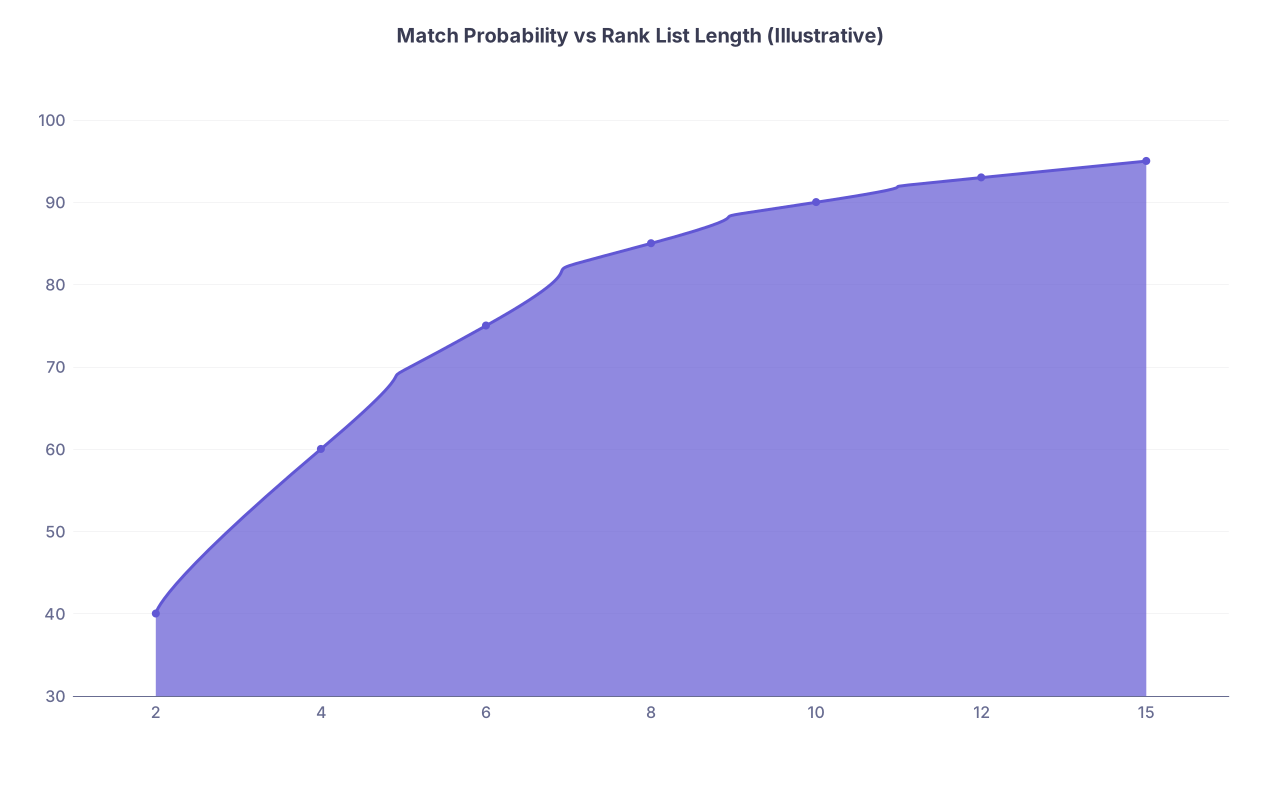
| Category | Value |
|---|---|
| 2 | 40 |
| 4 | 60 |
| 6 | 75 |
| 8 | 85 |
| 10 | 90 |
| 12 | 93 |
| 15 | 95 |
Look at that curve. Notice the problem? Going from 10 → 15 ranks doesn’t double your safety. It nudges it. But dropping from 12 → 8? That can hurt.
So yes, protect your mental health and schedule. But understand: every time you cancel an interview, you’re reducing your eventual rank list length. If you’re sitting at the borderline (say 8–10), reckless culling is asking for trouble.
What You Should Actually Do With All This
Let’s translate this into concrete action, not just philosophy.
Ignore anyone who quotes “15 interviews” without mentioning specialty and applicant type. They’re reciting superstition.
Look up your specific specialty data on NRMP—U.S. MD vs DO vs IMG each have different curves. Don’t borrow a derm rule for family medicine or vice versa.
Aim for a strong rank list, not a magic interview count. If your field flattens at ~12 programs, don’t obsess over squeezing Interview #19 into your calendar.
Don’t get cocky with early invites in competitive fields. Keep safer programs on your list until you’ve truly built a deep rank list.
If you’re an IMG or have red flags, assume the usual thresholds do not apply to you. You will probably need more applications and more interviews for similar match odds.
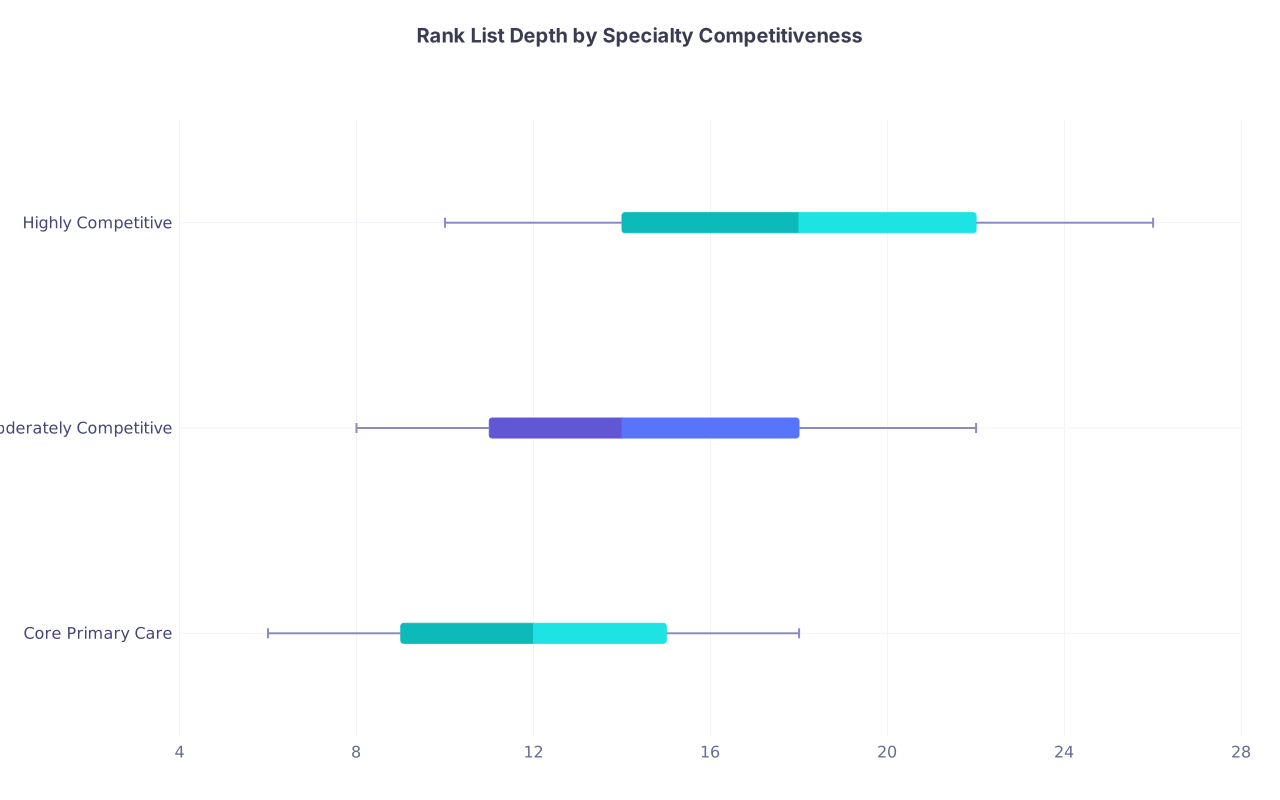
| Category | Min | Q1 | Median | Q3 | Max |
|---|---|---|---|---|---|
| Core Primary Care | 6 | 9 | 12 | 15 | 18 |
| Moderately Competitive | 8 | 11 | 14 | 18 | 22 |
| Highly Competitive | 10 | 14 | 18 | 22 | 26 |
Quick Reality Check Before You Panic
If you’re late in the season staring at your calendar and freaking out because you only have 9 or 10 interviews in a core specialty as a U.S. MD or DO: you’re not automatically doomed. The NRMP curves don’t say that.
If you’re applying derm/ortho/ENT with 12 interviews as an average applicant: yes, that’s riskier. Not because you didn’t cross the magic “15+” line, but because match odds in those fields are brutal even for well-interviewed people.
And if you’re an IMG with 15 interviews in IM? That’s good. But no, it’s not the same world as a U.S. MD with 15 IM interviews. Different baselines. Different curves. Different risk.
The Bottom Line
Three key takeaways and then we’re done:
There is no universal “15+ interviews = safe” threshold. The NRMP data are about rank list length, are specialty-specific, and depend heavily on applicant type.
Your goal is a robust, realistic rank list, not hoarding interview invites. Think in terms of how many programs you’ll actually rank, and plan applications and interviews backwards from there.
Context matters more than raw counts. Specialty competitiveness, program types, and your own profile shape what “enough” looks like. Any rule that ignores those is not advice; it is folklore.