
The honest answer: expanding your program list late in the season can help you match—but only if you do it strategically. Blindly panic-applying in November or December is mostly a money bonfire.
Let’s walk through when it is worth it, when it’s a waste, and exactly how to decide.
The Core Question: Will More Programs Still Move the Needle?
Here’s the threshold you actually care about:
“Is adding more programs now likely to increase my chance of matching in this cycle, enough to justify the time and money?”
You’re not deciding “Is more better?”
You’re deciding: “Is more, this late, still powerful?”
The answer depends on:
- Your specialty competitiveness
- Your current interview count
- The calendar date
- Your geographic flexibility
- How realistically you’re willing to broaden (community vs university, less desirable locations, less ‘prestige’)
If you want the 10-second decision rule:
- If you’re 0–2 interviews and it’s October or early November → yes, strongly consider targeted expansion
- If you’re 3–5 interviews in a competitive specialty → maybe, but be selective and realistic
- If you’re 6+ interviews in a non-ultra-competitive specialty → usually no, save your money
- If it’s January or later → only very targeted applications to programs that explicitly say they’re still reviewing
Now let’s make that more concrete.
Step 1: Look at Your Interview Count vs Specialty
You need a sanity check on where you stand. Here’s the rough reality for most U.S. MD/DO seniors:
| Specialty Type | Safer Range (US Seniors) | High Risk Range |
|---|---|---|
| Primary Care (FM, IM, Peds) | 8–10+ interviews | ≤5 |
| Mid-competitive (EM, OB, Psych, Anes) | 10–12+ interviews | ≤6–7 |
| Competitive (Gen Surg, Ortho, ENT, Derm, Rad/IR) | 12–15+ interviews | ≤8–9 |
Is this perfect for every applicant? No. But it’s a solid, real-world guideline.
So:
- If you’re way below these numbers and it’s still fall → expansion is absolutely on the table
- If you’re already in or near these ranges → expanding late is usually low yield, unless you have major geographic constraints or red flags
Step 2: Factor In the Calendar
Timing matters a lot more than people admit.
Think of the season in rough phases:
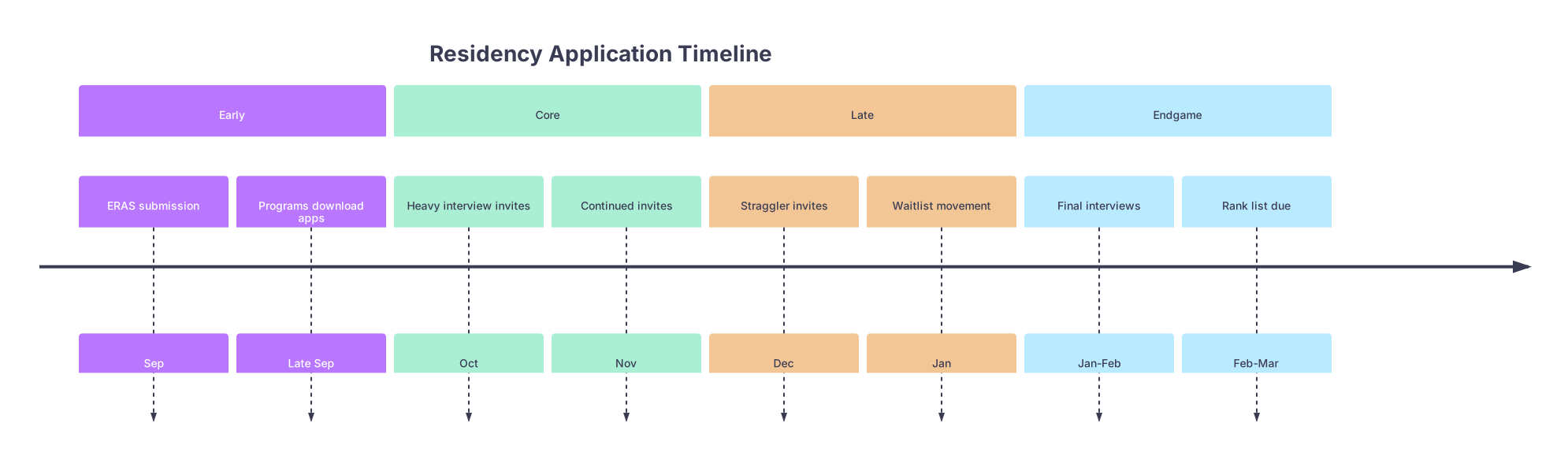
| Period | Event |
|---|---|
| Early - ERAS submission | Sep |
| Early - Programs download apps | Late Sep |
| Core - Heavy interview invites | Oct |
| Core - Continued invites | Nov |
| Late - Straggler invites | Dec |
| Late - Waitlist movement | Jan |
| Endgame - Final interviews | Jan-Feb |
| Endgame - Rank list due | Feb-Mar |
Here’s how expansion plays out by month:
Late September – October
Adding programs now still makes real sense. Most programs are actively reviewing. Late additions can be fully considered with everyone else.
November
Still viable, but you’re late to the main review wave. Some programs are nearly full with interview offers, some are still looking. Expansion should be targeted now.
December
You’ve entered “scramble prevention” mode. Expansion only makes sense if:
- You’re on track for very few interviews
- You target programs that tend to send late invites (community, newer, less competitive locations)
- You’re okay with low yield
January or later
You’re basically hoping to catch:
- Programs that had people cancel
- Places that under-invited and realized they need more applicants
- Programs expanding their class size late
It’s not insane to add a couple, but the return on investment is extremely low unless a program explicitly tells you they’re still reviewing new applications.
Step 3: Decide Why You’re Expanding (Not Just “Because I’m Panicking”)
You should be able to clearly answer:
“What’s going to be different about this new batch of programs?”
Bad reasons:
- “Everyone else seems to be getting more interviews.”
- “I just saw this fancy university program and I like their Instagram.”
- “I’m already at 12 interviews for family medicine but more can’t hurt, right?”
Good reasons:
- You realize your original list was too top-heavy (all big academic centers, very competitive locations).
- You only applied to 20–30 programs in a competitive specialty and are sitting on 0–3 interviews.
- Your personal situation changed (partner matched somewhere, family needs, visa issues).
- You had a late USMLE/COMLEX score release that’s better than expected and opens up new options.
If you can’t clearly articulate a new strategy for expansion, you’re probably just paying for anxiety.
Step 4: Expand Smart, Not Just More
If you’re going to spend more money, spend it intelligently.
Shift where you’re looking, don’t just add more of the same.
That usually means:
- Move from “Top 20 only” → include solid mid-tier university and strong community programs
- Move from “Big coastal cities only” → include Midwest, South, smaller cities, less trendy locations
- Add programs with:
- Higher proportion of IMGs/DOs
- Lower average Step/COMLEX scores
- Historically larger classes
You can often see this from:
- Program websites and resident lists
- FREIDA filters and data
- Recent match experiences from your school’s grads
Here’s how the late-season strategy should actually look:
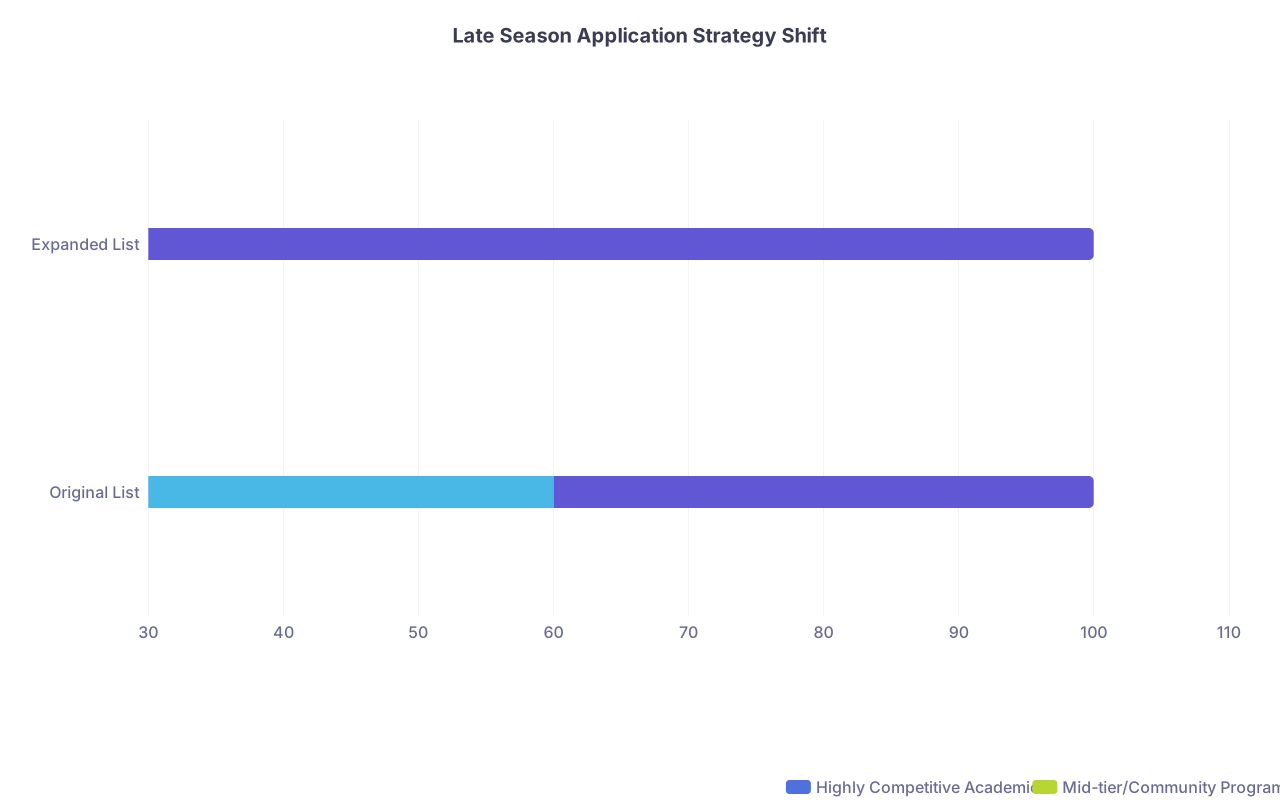
| Category | Highly Competitive Academic | Mid-tier/Community Programs |
|---|---|---|
| Original List | 60 | 40 |
| Expanded List | 30 | 70 |
If your late expansion list is still mostly elite academic programs in Boston, NYC, Bay Area, LA, Chicago—don’t bother. You’re not fixing the problem.
Step 5: Consider the Real Cost
People underestimate how expensive “just a few more programs” gets.
For ERAS, that per-program cost climbs quickly once you’re beyond the first 30–40. For many students, late panic expansion easily hits $200–$500+ with minimal return.
So ask yourself:
- How much have you already spent this cycle (primaries, secondaries, ERAS, interviews, travel if in-person)?
- If you add 15–20 more programs and get zero interviews from them, will you regret that money next year if you have to reapply?
- Would that money be better used on:
- Extra rotations or observerships
- A dedicated Step 3 attempt (for IMGs/DOs especially)
- Application strategy help or mock interviews
- Saving for next cycle if you don’t match
If you can afford it and you’re low on interviews, I’d generally say it’s worth one strategic expansion push in the same season. But not three different waves of “maybe this will help.”
Red Flags: When Late Expansion Is Usually a Waste of Time
I’m going to be blunt. It’s probably not worth expanding late if:
- You’re already at 8–10+ interviews for a less competitive specialty and don’t have major red flags
- You’re adding programs that are more competitive than the ones that already rejected you
- You’re unwilling to widen geographic preferences at all
- Your main issue is clearly:
- Very low scores and
- Multiple failures and
- No change in your application this season
In that last scenario, more applications now is often worse than just accepting you may need:
- A research year
- A prelim year
- A stronger letter or updated score
- Or a completely reworked strategy next cycle
When Late Expansion Absolutely Makes Sense
Here are situations where I’ve seen late expansion genuinely help:
You targeted only “dream” programs initially
Example: Applied to 30 anesthesia programs, all top 30 academic centers, now sitting on 1 interview in early November.
Fix: Add 30–40 more programs that are mid-tier, community-based, or in less competitive regions. That can save your match.You got a better-than-expected late Step 2/Level 2 score
Your original app had only Step 1/Level 1, or an average Step 2 projected. You did great. Now you can reasonably reach a bit higher or apply to programs that required Step 2 scores to review.You dramatically under-applied
You applied to 15 IM programs and have 0 interviews by early November. That’s not a “fit” problem, that’s a volume problem. You should fix it now, not next year.Visa-dependent or IMG/DO with too few programs
I’ve lost count of how many IMGs/DOs I’ve seen apply to 30–40 programs in internal medicine or family med and then panic. They needed 100+ from the start in many cases. Late expansion, especially targeting IMG-friendly programs, can still turn things around.
How Many More Should You Add?
Let’s be specific.
If you’re low on interviews (0–3) and it’s still October or early November:
- Primary care (FM/IM/Peds/Psych): consider adding 30–60 more, if you haven’t already hit 80–120
- Mid-competitive (EM/OB/Anes): consider 20–40 more
- Competitive (Gen Surg, Ortho, etc.): consider 30–50 more, but mostly at the community and less sought-after programs
If it’s late November or December:
- Cut those numbers in half
- Target only the most realistic subset (more IMG/DO friendly, less competitive locations, larger classes)
Don’t forget: adding 10 very realistic programs is better than 40 fantasy programs.
What To Do Before You Click “Add”
Before you expand, do these three things:
Talk to someone who has context
Not just your friend applying with you. A PD, APD, advisor, or recent grad from your specialty who knows match data and your specific situation.Audit your own application
Ask: is my problem:- Too few programs?
- Too competitive a list?
- Weak personal statement/letters?
- Poorly constructed experiences or gaps?
- Low scores / failures?
If your app itself is the core issue, expansion won’t fully solve it, but you might still get some bites with the right programs.
Update anything you can
- New Step/Level scores
- New publications or presentations
- Strong new letter of recommendation
- A tightened, improved personal statement
Then expand—once, deliberately.
FAQ: Late-Season Program List Expansion (5 Questions)
1. Is it too late to add programs in November?
No, November is still reasonable for expansion, especially if you’re low on interviews. You won’t be reviewed in the first wave, but plenty of programs are still filling their interview calendars then. Just make your additions focused: more open locations, more community programs, and more IMG/DO-friendly places if that’s you.
2. Does adding programs late hurt my chances at places I already applied to?
No. Programs can’t see when you applied to other places, and they don’t care how many total programs you applied to. The only downside is your money and focus. Adding more doesn’t decrease your chances at current programs—it just spreads your attention and budget thinner.
3. I have 4 interviews in a competitive specialty. Should I expand?
Probably yes, if it’s still Oct–Nov and you have the financial capacity. Four is below the comfort zone for most competitive specialties. I’d lean toward adding more realistic, less glamorous programs—community, mid-tier university, and less desirable locations—rather than more of the same high-tier places.
4. Is it ever worth adding programs in January?
Only very selectively. If a program publicly says they’re still reviewing new applications, or you get a very specific recommendation from a mentor to apply to a certain place, it might be worth it. Otherwise, most interview slots are already filled by January, and the chances of a cold application turning into an invite are low.
5. What’s worse: over-applying early or under-applying and expanding late?
Under-applying and having to expand late is usually worse. Early applications get full consideration; late ones are fighting for leftover interview slots. Ideally, you apply broadly and strategically from the start. But if you’re already in the season and under-applied, a smart, targeted late expansion is much better than doing nothing and hoping.
Open your ERAS programs list right now and ask yourself: “Am I adding genuinely different, more realistic programs—or just paying to repeat the same mistake?” Adjust your list once, on purpose, and then commit.