Understanding the Landscape: Radiation Oncology and IMGs
Radiation oncology is a small, highly specialized field with a limited number of residency positions each year. For an international medical graduate (IMG), this creates both challenges and opportunities. A clear, data‑driven program selection strategy is essential if you want to maximize your chances in the rad onc match without wasting time and money.
Unlike large specialties (Internal Medicine, Family Medicine), radiation oncology has:
- Relatively few residency programs and few PGY-2 positions per year
- Research-intensive culture, often favoring applicants with strong academic output
- A historically competitive applicant pool, though competitiveness can fluctuate with workforce concerns and changing interest
For IMGs, this reality means you cannot simply “apply everywhere and hope for the best.” Instead, you need a targeted IMG residency guide tailored to radiation oncology, with a realistic understanding of where an international medical graduate is more likely to be seriously considered.
In this article, we’ll walk through:
- How to analyze your profile and competitiveness
- How to categorize programs into tiers
- A step-by-step program selection strategy for radiation oncology
- How many programs to apply to as an IMG in rad onc
- Common pitfalls and how to avoid them
Throughout, the focus will stay practical and actionable, so you can build a program list that matches your goals, budget, and profile.
Step 1: Assessing Your Competitiveness as an IMG in Radiation Oncology
Before you can decide how many programs to apply to or which ones, you must understand where you stand. Program selection always starts with self-assessment.
1. Academic Metrics and Exams
Key metrics programs evaluate:
- USMLE Step 1: Now pass/fail, but programs still see the score date and may infer performance from other components.
- USMLE Step 2 CK: Now the primary numerical academic comparison.
- Class rank and honors (if available)
- Medical school reputation and affiliation
For a competitive radiation oncology residency, strong academic metrics are typical. As an IMG, you ideally want:
- Step 2 CK: ≥ 240 improves your ability to be seriously considered at many academic programs; ≥ 250 makes you more competitive for stronger research-heavy programs.
- If you have a lower score, you must compensate with exceptional strengths elsewhere (research, strong US LORs, advanced degrees, etc.).
Programs will rarely state a strict cutoff, but some will screen applications automatically.
Action point:
Create a simple academic summary for yourself:
- Step scores (or equivalent if you took alternative exams)
- Class rank / honors
- Any failed attempts (USMLE or coursework)
- Advanced degrees (PhD, MPH, MSc in related fields)
Be honest about any red flags (exam failures, prolonged gaps). These don’t disqualify you, but they influence which programs you should prioritize.
2. Research Experience in Radiation Oncology or Oncology
Radiation oncology is research-centric. Publications and academic output can strongly offset IMG disadvantages, especially:
- Peer-reviewed oncology or radiation oncology publications
- Abstracts and posters at ASTRO, ASCO, or other oncology meetings
- Prospective or retrospective clinical studies, translational research, or physics projects
Programs particularly value applicants who:
- Have multiple first-author or co-author publications
- Conducted research within a U.S. institution, particularly in a radiation oncology department
- Have letters of recommendation (LORs) from well-known radiation oncologists
Self-check:
- Do you have > 3 oncology-related publications?
- Any first-author work?
- Any U.S.-based rad onc research experience?
If your research profile is minimal, you may still match, but you will need to target a different program subset and apply more broadly.
3. Clinical Experience and Letters of Recommendation
For IMGs, U.S. clinical experience (USCE) in radiation oncology is extremely valuable:
- Electives, observerships, sub-internships in rad onc or oncology
- Strong, narrative LORs from U.S. radiation oncologists or oncologists
Letters should:
- Be specialty-specific (radiation oncology preferred, or at least oncology)
- Come from faculty who know you well and can speak concretely about your performance
- Ideally be from academic programs with residency programs of their own
If you lack U.S. radiation oncology experience, plan your program selection strategy assuming:
- Some programs may be less willing to take a chance on an IMG without prior U.S. exposure.
- You may benefit from including community-based or hybrid programs (if available) and programs that historically interview more IMGs.
4. Visa, ECFMG, and Timing Considerations
As an international medical graduate, program selection must factor in:
Visa sponsorship:
- J-1 vs. H-1B eligibility and preferences
- Some programs do not sponsor any visas; others sponsor only J-1.
ECFMG certification status:
- Must be certified by rank order list deadline.
- If not certified yet, select programs known to review IMGs with pending certification.
Graduation year:
- Recent graduates (within 3–5 years) are generally preferred.
- Older graduates may need a stronger research or clinical portfolio.
Action point:
Create a one-page “profile snapshot” covering:
- Scores, year of graduation, research, USCE, visa needs, ECFMG status
- This will guide which programs are realistic and how aggressively you must apply.

Step 2: Understanding Radiation Oncology Programs and Their IMG Friendliness
The next step in your program selection strategy is to understand the types of rad onc programs and how they differ in competitiveness and openness to IMGs.
1. Academic vs. Community vs. Hybrid Programs
Most radiation oncology residencies are university-based or university-affiliated. Pure community rad onc residencies are rare, but you may see:
- Large academic centers
- Strong research focus
- NCI-designated cancer centers
- Typically more competitive
- Often prefer U.S. grads and MD/PhD applicants
- Medium academic or hybrid programs
- University affiliation with strong clinical exposure
- Some research, but less intense than top-tier centers
- May be more open to IMGs if your profile aligns well
- Smaller or newer programs
- Fewer residents
- Often growing, building reputation
- May be more flexible about IMG status if you add clear value (research, work ethic, niche skills)
2. Using Data: Past IMG Matches and Program Histories
A central part of an IMG residency guide is learning to read program histories. You should examine:
Program websites and resident lists
- Look at current and past residents for clues:
- Are there any IMGs?
- Are there non-traditional applicants (PhD-to-MD, career changers)?
- If no IMG has matched in the last 10–15 years, the program may be less IMG friendly.
- Look at current and past residents for clues:
Program-specific data from NRMP and FREIDA
- Some databases show whether programs accept IMGs and what visas they sponsor.
- Cross-check with program websites and call or email if unclear (politely).
Networking and informal knowledge
- Talk to current rad onc residents, your research mentors, or alumni.
- Ask tactful questions: “Have you seen IMGs match here or at similar programs?”
This research helps you classify programs as:
- Historically IMG-friendly
- Occasionally accepting IMGs
- Rarely or never taking IMGs
3. Program Priorities and Culture
Radiation oncology residencies can differ in their priorities:
- Research-heavy, academic:
- Want applicants with strong publication records and academic ambition.
- Some may prefer MD/PhD or PhD-level research experience.
- Clinically focused:
- Prioritize excellent clinical performance, professionalism, communication skills.
- May care less about high-volume publications.
To determine a program’s culture:
- Read their mission statements and faculty bios.
- Look at residents’ CV highlights (often a short bio is posted).
- Check recent departmental news (grants, trials, educational projects).
Align your own profile with these patterns. For example, if your strength is clinical performance with strong narrative LORs but minimal research, research-only powerhouses may be true “reaches.”
Step 3: Building a Structured Program List (Reach, Target, Safety)
Once you understand yourself and the landscape, you can build a structured list to guide your program selection strategy.
1. Categorizing Programs
A typical framework divides programs into:
Reach programs
- Highly competitive, top-tier institutions
- Minimal or no IMG history OR heavy MD/PhD emphasis
- You should still apply to a few if you have standout features (e.g., major rad onc research, strong U.S. rad onc letters).
Target programs
- Reasonably competitive but with a realistic match probability based on your profile
- May have recent IMGs, robust clinical training, and manageable research expectations
- Ideally, a good alignment with your strengths (e.g., strong oncology research, specific clinical interests).
Safety programs
- Historically interview and rank IMGs
- May be newer, smaller, or in less popular locations
- Less research pressure, more clinically oriented
- You should be above the average profile of their recent residents.
For each program you research, place it into one of these three buckets based on:
- Academic competitiveness
- IMG friendliness
- Your profile match
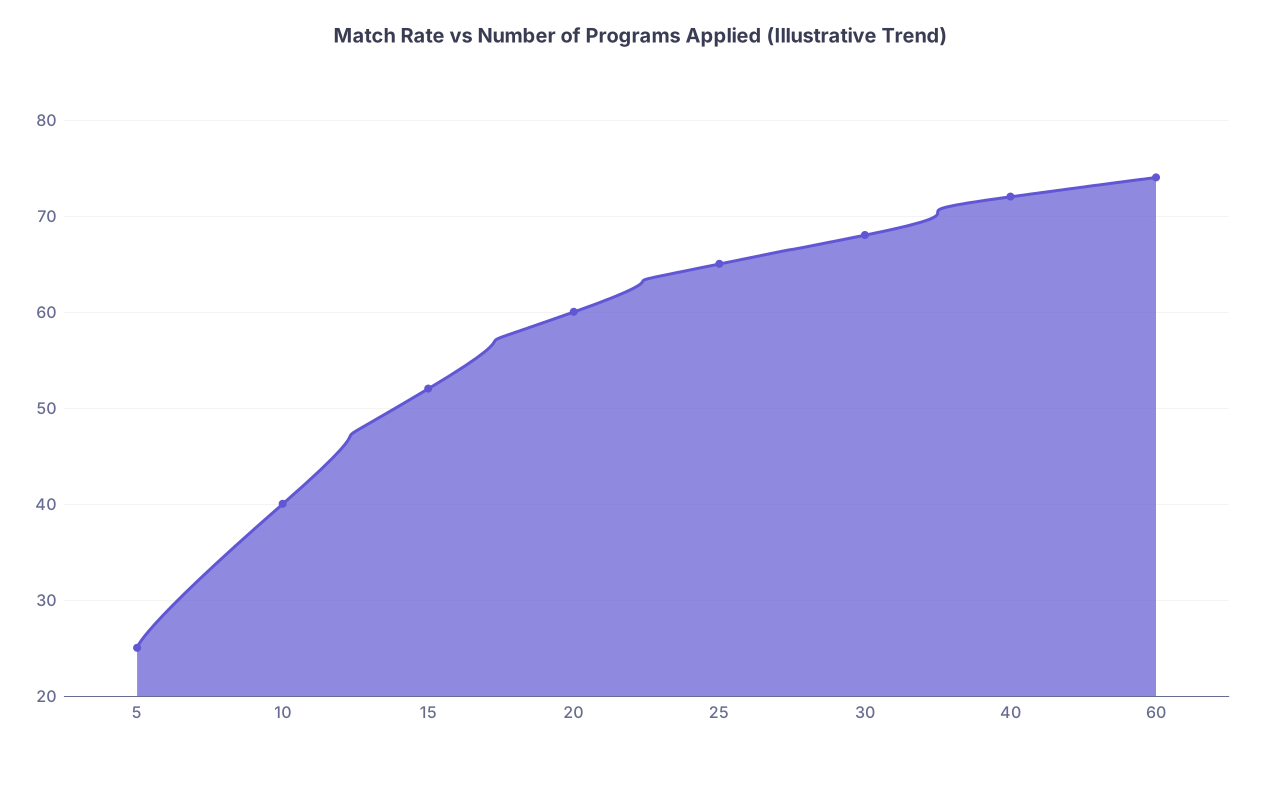
2. How Many Programs to Apply to as an IMG in Radiation Oncology?
Because radiation oncology has relatively few positions, the question of how many programs to apply to is critical.
There is no perfect number, but indicative ranges for a typical IMG:
Highly competitive IMG profile
- Step 2 CK > 250, multiple oncology publications (including first-author), U.S. rad onc research, strong U.S. LORs, no visa issues
- Recommended: ~25–35 programs (if that many exist the year you apply, including preliminary/transitional year if needed)
Moderately competitive IMG profile
- Step 2 CK 235–250, some oncology research, at least one strong U.S. LOR, possible visa requirements
- Recommended: ~35–50 programs, including a considerable number of historically IMG-friendly programs
Less competitive IMG profile
- Step 2 CK < 235, limited research, significant gaps or red flags, older graduation year
- Recommended: 45–60+ programs if available, with strong emphasis on IMG-friendly and smaller programs, plus consideration of backup specialties
Because radiation oncology has a smaller overall number of programs, in some years you may reach close to “apply broadly to nearly all programs you would realistically attend.” However, avoid applying to places where:
- They explicitly do not sponsor your visa type
- They clearly state they do not accept IMGs
- There is zero IMG match history and you lack compensating strengths
Each application costs money and time. The goal is strategic breadth, not blind volume.
3. Sample Distribution of Reach/Target/Safety
As a rough starting point:
For a strong IMG profile (top-tier academic orientation):
- Reach: 30–40% of programs
- Target: 40–50%
- Safety: 10–20%
For a typical IMG profile:
- Reach: 20–30%
- Target: 40–50%
- Safety: 30–40%
For a weaker IMG profile:
- Reach: 10–20%
- Target: 30–40%
- Safety: 40–60%
Adjust these percentages based on your comfort level, finances, and professional goals.

Step 4: Practical Program Selection Strategy for the Rad Onc Match
Now we’ll convert principles into a step-by-step guide you can follow.
Step A: Build a Master List
Start from official sources:
- FREIDA, ERAS Program Search, ACGME listings
- Professional society resources (ASTRO residency listings)
Create a spreadsheet with columns for:
- Program name, location
- PGY-2 positions offered
- Visa sponsorship (J-1 / H-1B / none)
- Notes on IMG history (resident list review)
- Research intensity (high / moderate / lower)
- Your estimated category (reach/target/safety)
- Application deadlines and special requirements (e.g., PhD preferred, personal statement prompts)
This becomes the backbone of your IMG residency guide for this application cycle.
Step B: Screen for Non-Negotiables
Filter out programs that clearly do not fit:
- Do not sponsor your visa type
- Explicitly state “no IMGs” or “U.S. citizens only”
- Require qualifications you do not have (e.g., PhD, specific prior training)
Do not waste time or money applying to programs that cannot rank you, regardless of your merits.
Step C: Evaluate IMG Friendliness
For the remaining programs:
Review resident lists for the last 5–10 years:
- Count how many IMGs or international-sounding names/institutions appear.
- Consider emailing current residents (professionally and respectfully) to ask broad questions about the program’s culture toward IMGs.
Use online forums or alumni networks cautiously:
- Verify information from unofficial sources whenever possible.
- Prioritize up-to-date, first-hand information (current or recent residents).
Label each program as:
- IMG-friendly
- Neutral/unknown
- IMG-uncommon
Step D: Align with Your Profile and Preferences
Next, integrate your personal priorities:
- Academic vs. clinical orientation
- Geographical preferences (big city vs. smaller region)
- Family and support systems
- Interest in particular disease sites or research areas
Rank programs based on:
- Your probability of being seriously considered
- How well the program fits your career goals
- Practical living and visa considerations
Then assign each program to reach/target/safety categories based on earlier criteria.
Step E: Finalize Your Application Number and Distribution
With all the above in place:
- Count how many rad onc programs fit your criteria.
- Decide on a total application number based on your profile strength and budget.
- Adjust the reach/target/safety distribution:
- If your list is very small, you may need to include slightly more ambitious programs.
- If your list is very large, you can exclude those with minimal IMG history unless you have strong ties.
If you are significantly concerned about matching (e.g., very limited research, lower scores, major gaps), parallel planning is essential:
- Consider a backup specialty (e.g., Internal Medicine) with a larger number of positions.
- Apply simultaneously to backup programs to secure a position while you continue building your radiation oncology portfolio.
Step F: Customize and Prioritize Applications
For each chosen program, your program selection strategy should also inform:
Personal statement tailoring:
- Mention specific features (research focus, clinical strengths, faculty interests).
- Highlight why your background as an international medical graduate is an asset to that particular program.
Letters of recommendation:
- Where possible, assign the strongest oncology/radiation oncology letters to programs most likely to value them.
- Some applicants use slightly different letter combinations for research-heavy vs. clinically-focused programs.
Pre-application outreach (judiciously):
- A short, professional email to a program coordinator or faculty member may be appropriate if you have a genuine connection (shared research interest, prior rotation, mutual mentor).
- Avoid generic mass emails; they rarely help and may backfire.
Step 5: Common Mistakes IMGs Make and How to Avoid Them
Even strong candidates can hurt their chances with a poorly planned program list. Be aware of the following pitfalls:
1. Applying Too Narrowly
Because radiation oncology has limited spots, you cannot rely on:
- Only top 5–10 “dream” academic centers
- Only programs in one or two large cities
- Only programs where your mentor has a connection
A narrower list may be appropriate for U.S. MDs or MD/PhDs, but as an IMG you need broader coverage, especially if you lack a unique advantage (e.g., landmark research work).
2. Ignoring Visa and Policy Restrictions
Many international medical graduates lose money applying to programs that clearly:
- Do not sponsor visas
- Restrict to U.S. citizens or permanent residents
- Have explicit policies against certain graduate years
Always verify visa and eligibility information from official program sources before adding them to your list.
3. Underestimating the Value of Research Alignment
In radiation oncology, research alignment matters heavily:
- Programs want applicants whose research interests match their current projects or strategic growth areas (e.g., proton therapy, AI in treatment planning, immuno-radiotherapy).
- As an IMG, if you can show deep engagement in an area that a program emphasizes, you may overcome initial biases against non-U.S. grads.
Do not present generic oncology research as if it fits everywhere. Tailor your personal statement and CV highlights to each program’s focus when possible.
4. Lack of Backup Plan
Radiation oncology positions are few; even excellent applicants sometimes go unmatched. Common errors:
- Applying only to rad onc with no backup specialty
- Failing to consider preliminary or transitional year implications if needed
- Not planning for what to do if you don’t match (research year, additional degree, repeat cycle)
A smart program selection strategy for IMGs includes contingency planning from the start.
Step 6: Putting It All Together – Example Scenarios
To illustrate, here are brief composite scenarios (not real individuals) and how program selection might differ.
Scenario 1: Strong Academic IMG with U.S. Rad Onc Research
- Step 2 CK: 254
- 8 oncology publications (3 first-author, 2 specifically in rad onc)
- 1 year of research at a U.S. NCI-designated cancer center
- 2 strong U.S. rad onc letters, 1 strong internal medicine letter
- Requires J-1 visa
Strategy:
- Apply to ~30–35 rad onc programs.
- Include top-tier academic centers, especially where your research mentors have ties.
- Reach: 10–12 programs (elite institutions, MD/PhD-heavy rosters).
- Target: 15–18 programs (academic/hybrid with IMG-neutral history).
- Safety: 5–7 programs (smaller or less popular locations but solid training, known to accept IMGs).
Scenario 2: Mid-Range IMG with Limited Research
- Step 2 CK: 240
- 1 oncology-related publication, several case reports
- 3 months of U.S. internal medicine observerships, but no rad onc rotation
- 1 U.S. IM letter, 2 home-country LORs
- Requires H-1B visa
Strategy:
- Apply to ~40–50 rad onc programs (depending on availability).
- Emphasize IMG-friendly and neutral programs that sponsor H-1B (if possible) or at least J-1 and consider if J-1 is acceptable to you.
- Reach: 8–10 programs (where strong scores may help despite limited research).
- Target: 15–20 programs (that have small but consistent IMG representation).
- Safety: 15–20 programs (newer or less popular geographic locations, more clinically focused).
- Strongly consider a backup specialty (e.g., Internal Medicine) with 60–80 programs.
Scenario 3: Older Graduate with Gaps and No U.S. Experience
- Step 2 CK: 232
- Graduated 7 years ago, with intermittent clinical work
- Minimal research, no publications
- No U.S. experience, no U.S. letters
- Requires J-1 visa
Strategy:
- Unless you can first strengthen your profile (research fellowship, observerships, additional degrees), your immediate rad onc chances are low.
- First priority: Seek a 1–2 year U.S. research or observership position in radiation oncology or medical oncology.
- After enhancing your profile, apply broadly (45–60+ programs), emphasizing any IMG-friendly programs and locations other applicants may overlook.
- Develop a robust backup strategy (another specialty or multi-cycle plan).
FAQs: Program Selection Strategy for IMGs in Radiation Oncology
1. As an IMG, is radiation oncology too competitive for me to consider?
Not necessarily, but it is more challenging compared to many larger specialties. Success is most likely if you:
- Have strong USMLE scores (especially Step 2 CK)
- Build a substantial oncology research profile, preferably in the U.S.
- Obtain strong U.S. letters from radiation oncologists
- Apply with a thoughtful program selection strategy and an appropriate number of programs
If you are early in your journey, you can plan multi-year steps (research, observerships, advanced degrees) to become competitive.
2. How many programs should I apply to if my budget is limited?
If financial constraints limit you, prioritize quality and fit over raw quantity:
- Identify programs with clear IMG-friendliness, visa compatibility, and match with your strengths.
- Instead of applying to 50 programs haphazardly, you may apply to 25–30 carefully chosen ones.
- Spend extra time tailoring your personal statements and making the most of any connections or alignment.
If budget is very tight, consider applying in a cycle where your profile is strongest (after research or U.S. rotations), rather than rushing with a weaker application.
3. Do I need a research year in the U.S. to match into rad onc as an IMG?
A U.S.-based research year is not mandatory, but it is often highly beneficial, especially for IMGs. It can:
- Provide publications and conference presentations
- Introduce you to potential letter writers in U.S. radiation oncology
- Help you understand U.S. cancer care systems and build professional networks
If you currently have no research or U.S. experience, a research year (or more) can significantly improve your chances and allow you to target stronger programs.
4. Should I email programs to tell them I’m interested before applying?
Selective, well-crafted outreach can help slightly, but only when you have a genuine connection:
- Previous rotation or research at that institution
- Shared mentor or faculty contact
- Strong alignment with a specific program initiative or research area
Avoid mass, generic emails. Program directors and coordinators are flooded during application season. Poorly targeted outreach can harm rather than help.
By carefully assessing your profile, understanding the rad onc training landscape, and building a structured, data-driven program list, you can turn a daunting process into a strategic plan. As an international medical graduate, you may face additional hurdles, but with the right preparation and program selection strategy, you can significantly increase your chances of a successful radiation oncology match.