
You’re on your couch, post-call, with two tabs open: “Internal Medicine programs” and “Anesthesiology programs.” You’ve decided to dual apply. Your advisor said it’s “reasonable.” Your classmates gave you horror stories. And now you’re stuck on the practical question that nobody answers clearly:
Should you split programs 50/50 between the two specialties?
Here’s the blunt answer:
Usually, no. A rigid 50/50 split is almost always the wrong way to think about this.
Let me walk you through what actually works.
Step 1: Understand What Dual Applying Is Really For
Dual applying is not about “keeping options open.” It’s about risk management.
You dual apply when:
- Your primary specialty is competitive for you (based on scores, research, school, etc.), and
- You want to avoid the real risk of going unmatched.
That means one specialty is your true goal (primary), and the other is your safety net (or co-primary). Pretending you “love them both equally” might feel honest, but it’s not how programs think, and it won’t help you build a smart program list.
So before talking about 50/50:
- Name your primary specialty.
- Name your backup (or co-primary) specialty.
- Be honest: If you matched into only one, which one would hurt more?
If you can’t answer that, stop here and solve that first. Every other decision depends on it.
Step 2: The Real Question Is Not “50/50” — It’s “Do I Have Enough Shots?”
A split like 50/50 only matters after you know how many programs you need overall.
For each specialty, you’re playing a volume game: enough interviews → high match probability.
Very rough interview targets (for most specialties):
- 12–15 interviews: You’re usually in a good spot
- 8–11: Moderate risk but potentially okay
- <8: Risky for anything competitive
So you work backward:
- What specialty is primary?
- How competitive are you for that specialty?
- How many interviews do you realistically need in that primary group?
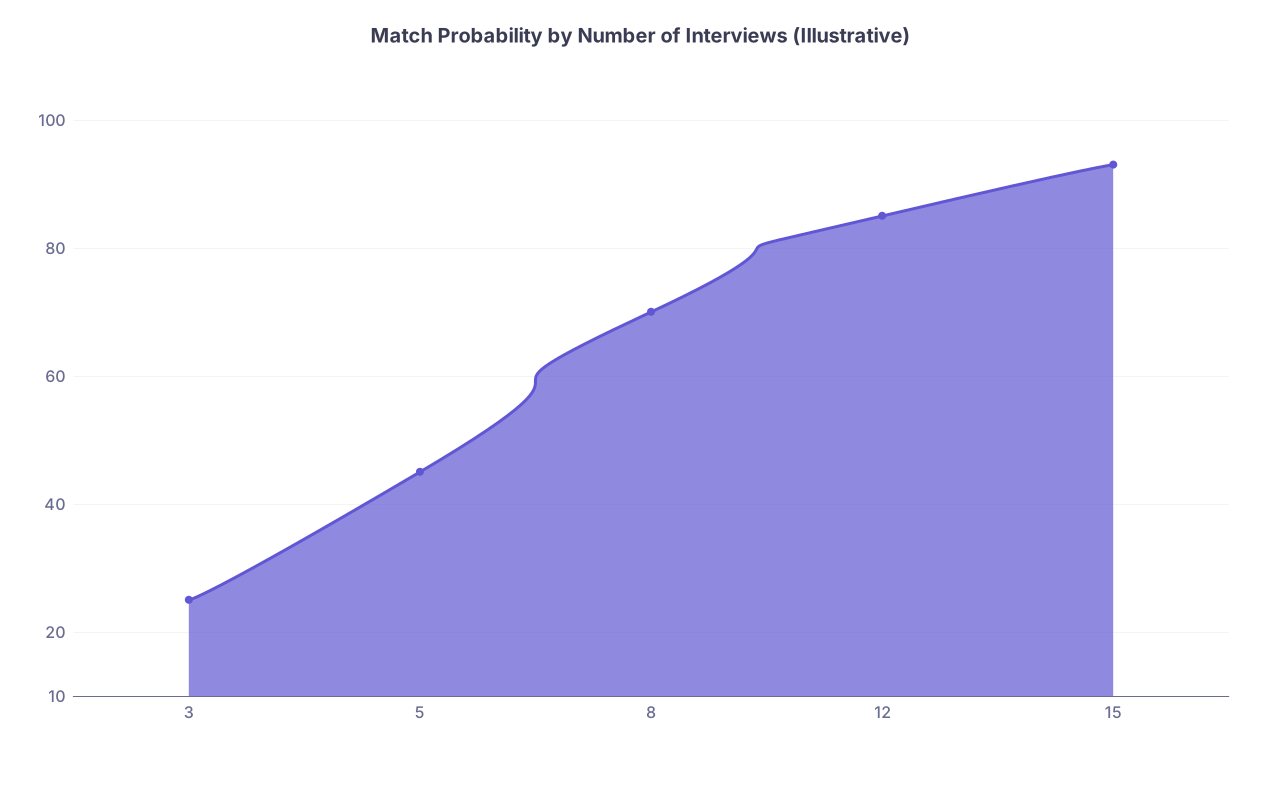
| Category | Value |
|---|---|
| 3 | 25 |
| 5 | 45 |
| 8 | 70 |
| 12 | 85 |
| 15 | 93 |
If your profile suggests you’ll need ~12 interviews in your primary specialty to feel okay, your question becomes:
“How many programs in that specialty do I need to apply to give myself a real shot at 12+ interviews?”
Only after that do you decide how many to add from the second specialty.
Step 3: When a 50/50 Split Is Clearly Wrong
There are a few common patterns where a strict 50/50 split is just bad strategy.
Scenario 1: Primary is more competitive than backup
Example: Derm + Internal Medicine. Or Ortho + Family Medicine.
If you apply to 60 derm and 60 IM “because 50/50 sounds fair,” you’ve done something dumb:
- Derm might realistically give you 0–3 interviews.
- IM might give you 20+.
You did not need 60 IM programs to be safe. You probably needed 25–40.
You did potentially need more derm to squeeze out every possible interview.
A better framing: “Max reasonable derm, then enough IM to secure safety.”
Scenario 2: You’re strong in one, weak in the other
Example: Step 1 pass, Step 2 249, no research. You want Rad Onc (dream), but you’re clearly stronger for Internal Medicine.
If you split 50/50:
- Half your shots are going to a specialty where your odds are poor.
- You may still fail to get enough IM interviews because you under-applied there.
You don’t owe your dream specialty half your application slots. You owe yourself a job next July.
Scenario 3: Geographic constraints
If you’re tied to one city or region, a 50/50 split by specialty often becomes absurd. The right metric becomes:
“How many realistic programs in each specialty actually exist in the places I can live?”
If that’s 15 Psych and 50 IM within your geographic box, a 50/50 specialty split is mathematically impossible and conceptually useless.
Step 4: A Better Framework Than 50/50
Here’s the decision framework I actually recommend.
1. Classify yourself honestly in each specialty
For each specialty, ask:
- Are you above average, average, or below average for:
- Exams (Step 2 score, COMLEX if relevant)
- Clinical performance (honors, strong comments, away rotations)
- Research/activities in the field
- School “brand” and connections
Then use the NRMP Charting Outcomes or program director surveys (if updated) to ground your sense of competitiveness.
| Metric | Primary (e.g., EM) | Backup (e.g., IM) |
|---|---|---|
| Step 2 Score | Slightly below avg | Above avg |
| Research | Strong in EM | Minimal in IM |
| Clinical evals | Mixed | Strong |
| Letters | 2 strong EM | 2 moderate IM |
This tells you where applications will likely “convert” to interviews.
2. Decide your must-have interview number for the primary specialty
Based on competitiveness and how much risk you can tolerate:
- Very strong applicant in primary: maybe 8–10 interviews feels safe.
- Average: shoot for 12–14.
- Below-average: might need 15+ to sleep at night.
3. Translate that into an application count
This part is art, not science, but here’s a reasonable starting point:
- If you’re strong:
- Primary: ~30–40 programs
- If you’re average:
- Primary: ~40–60 programs
- If you’re below average:
- Primary: 60+ (up to the point of diminishing returns)
Then adjust for your situation: DO vs MD, home program, visa status, previous attempts, etc.
4. Add the backup specialty to hit an overall safety floor
Once you’ve pushed the primary specialty to a level you can live with, you add enough of the backup to create a floor: “I am very unlikely to go unmatched.”
For backup specialty:
- Strong for backup: 15–25 might be fine
- Average: 25–40
- Below average: could be 40–60+
Total programs applied between both may look like 60–120, depending on competitiveness and specialty.
Notice what I didn’t say: “Split evenly.”
Step 5: Concrete Examples (What People Actually Do)
Here are some “real world” patterns I’ve seen that made sense.
Example 1: EM + IM, average US MD
- US MD, Step 2: 240s, solid EM SLOEs, average research. Wants EM, open to IM.
- Primary: EM
- Approach:
- Apply EM: ~60 programs (to aim for 12+ EM interviews)
- Apply IM: ~25–30 programs as safety
Not 50/50. More like 70/30 in favor of the primary.
Example 2: Ortho + General Surgery, below-average applicant
- US MD, Step 2: low 230s, one ortho rotation, limited research, average third-year.
- Primary (emotionally): Ortho
- Reality: Much stronger for Gen Surg
- Approach:
- Ortho: ~40–50 programs (all realistic, maybe a few reaches)
- Gen Surg: ~60–80 programs (to ensure a match somewhere)
Here the list might look almost 40/60 or even 30/70 by count. That’s fine. Their actual goal: “Take as many ortho shots as I can without risking going unmatched.”
Example 3: Psych + FM, IMG applicant
- IMG, Step 2: mid 240s, good US rotations in FM, weaker Psych ties.
- Primary: Psych
- Backup: FM
- Approach:
- Psych: ~80–100
- FM: ~40–60
The ratio isn’t the point; the safety margin is.
Step 6: Where 50/50 Can Make Some Sense
Now, are there rare times when 50/50 is reasonable? Yes, a few narrow situations.
Two moderately competitive specialties, similar profile.
Example: IM and Neurology, both realistic, no clear primary. You’d genuinely be happy in either. You’re roughly equally strong in both. Then you might:- Apply 40 IM and 40 Neuro.
- Or 50/50 if total numbers are high.
Couples match with complementary goals.
You and your partner are balancing different specialties, and the combined strategy leads to something like 50/50 each. That’s fine if it came from a deliberate plan, not a rule.You really don’t care which specialty you match into.
Honestly rare, but if you’d truly be equally happy in either, then the split is less critical. In that special case, 50/50 becomes “not harmful,” but still not required.
Important point: In these scenarios, 50/50 is a byproduct of your priorities, not a target.
Step 7: Don’t Sabotage Yourself With Bad Dual-Application Behavior
Splitting programs is only part of the story. Dual applicants also screw up in predictable ways:
- Weak, generic personal statements that don’t sound committed to either field. Programs smell that a mile away.
- Mixed signals in letters (e.g., a letter in EM that calls you “undecided,” which is basically poison).
- Not tailoring applications (same generic paragraph copied into every “Why X program?” box).
If you dual apply, you must look like a serious applicant in each specialty:
- Separate, specialty-specific personal statements.
- Strong, specialty-specific letters for each.
- A clear story in your ERAS experiences that fits both without sounding fake.
Half-hearted in two specialties is worse than fully committed in one.
Step 8: Quick Sanity Check Before You Hit Submit
Use this checklist right before certifying your ERAS:
- Can I name my primary specialty in one sentence without hesitation?
- Have I applied to enough programs in that primary specialty to reasonably expect my target number of interviews?
- Does my backup specialty list create a realistic safety net for me, given my metrics and background?
- Do my documents (PS, letters, experiences) read as if I’m fully committed to each specialty list they go to?
- If I only matched in my backup specialty, would I be okay practicing it for a career?
If you fail #5, you’re not dealing with a backup plan—you’re dealing with denial.
A Simple Visual: Strategy vs. 50/50

| Step | Description |
|---|---|
| Step 1 | Choose primary specialty |
| Step 2 | Estimate competitiveness |
| Step 3 | Set target interview number |
| Step 4 | Calculate primary programs needed |
| Step 5 | Add backup specialty for safety |
| Step 6 | Submit applications |
| Step 7 | Increase primary or backup count |
| Step 8 | Does plan feel safe and realistic? |
Final Takeaways
- Don’t aim for a 50/50 split; aim for enough interviews in your primary specialty plus a real safety net in the backup.
- Your split should reflect competitiveness and priorities, not some arbitrary notion of fairness between specialties.
- Dual applying only works if you look serious in each field—half-committed in both is how people waste money and still go unmatched.