
It’s late January. You and your partner have just finished your last virtual interview. Your spreadsheets are a mess: tiers, colors, notes like “PD smiled” and “resident looked dead inside.”
ERAS is behind you, interviews are mostly done, and now everyone keeps repeating the same completely unhelpful line:
“Just rank what you like in the true order of your preference. The algorithm favors the applicant.”
That line is technically true.
And also wildly incomplete for couples.
What nobody is explaining to you is what program directors actually say about couples matching when the Zoom recording is off, the residents have left the room, and they’re staring at their rank list trying to decide whether to move two names together… or drop one of you entirely.
Let me walk you through what really happens.
What PDs Actually Think When They Hear “We’re Couples Matching”
There are three honest reactions I’ve heard over and over in PD meetings, file review rooms, and pre-rank huddles.
1. The “Great, built-in retention” PDs
These are the minority, but they exist. Usually at:
- Mid‑tier academic IM programs trying to keep people from jumping ship to a bigger name.
- Community programs in decent cities that lose people to “brand name” institutions across town.
- Programs in less desirable locations where retention is a constant war.
They look at couples like this:
“If we take both, odds are very high they’ll stay all three years. Less chance they leave for a ‘better’ PGY2 spot. That’s stability.”
I’ve seen PDs at places like UConn IM, Iowa, Medical College of Wisconsin literally move an applicant up because their partner was already near the top of the other list. The logic: we get two reasonably strong residents, both more likely to stay, both more likely to be happy. That matters when your alternative is a long tail of decent but not amazing applicants who might rank you 12th.
These PDs like couples. They will stretch a little to align your ranks.
2. The “I’ll play ball… within reason” PDs
This is the majority.
They’re not anti‑couples. They’re not pro‑couples. They’re pragmatic.
Their attitude is something like:
“I’ll move someone five, maybe ten spots if the partner is very strong on our other list and we genuinely like both. But I’m not setting my whole rank list on fire for a couple who might not even rank us high.”
Translation: yes, being a couple can help you. But only at the margins. Only if:
- You’re already in the zone to be ranked.
- At least one of you is clearly strong for that program.
- You’ve signaled genuine interest (more on that later).
If you’re a marginal applicant and your partner is also marginal? The couple status doesn’t save you. It can actually hurt (I’ll get to that).
3. The “Couples are a headache” PDs
They won’t say this in public. But I’ve heard versions in more than one conference room.
Their grievances:
- “I hate trying to coordinate with four other specialties every time there’s a couple.”
- “They all think they should be ranked like a package deal at the top. They’re not.”
- “I don’t want to take a mediocre applicant just because their partner is great.”
These PDs do the bare minimum to acknowledge couples. They check the couples box in NRMP reports, adjust a few spots if it’s low‑risk, and then stop caring.
If you’re applying to a hyper‑competitive program in a saturated city (MGH, UCSF, Columbia, UCLA, etc.), assume the default is: couples matching will not help you; it will only hurt you if one of you is notably weaker.
The Ugly Truth: When Being a Couple Hurts You
Here’s something you won’t hear at any info session: some PDs will drop you for being part of a couple.
I’ve watched this happen live.
You’ll hear comments like:
- “Her partner is never coming here with his scores; we’re not going to burn a spot on her.”
- “Their geographic priorities are New York or bust. We’re just their backup coordination spot.”
- “If they rank us 10th and 12th, we’ll never see them anyway. Move them down.”
The logic is cold but rational: if they believe your couple configuration makes it unlikely that you’ll actually land at their program, they may not “waste” a rank spot—especially in smaller programs.
So who gets hurt?
Asymmetrical couples at different competitiveness tiers
Example: One is a 260+ Step 2, AOA, IM applicant interviewing at MGH/BWH/UCSF. The other is a below‑average FM or Peds applicant with limited interviews.
High‑tier PD’s thought:
“Her partner cannot match here. If we take her high and she ranks us 1, she still risks splitting. She might not actually do that. This becomes messy. I’d rather take the single star who can fully commit.”“New York or nothing” or “California or bust” couples
PDs in mid‑tier Midwest/South programs see right through this.
They won’t always say it. But on rank day, someone will point to the couple’s application and say:
“They told us they loved our program, then also said they’re only ranking coasts high. So we’re their safety. Move them down; we have people who actually want to be here.”Couples who oversell commitment
Residents talk. If they sense you came just for the city or just for the partner program, that filters back to PDs.
There’s a particular flavor of interview answer that kills trust:
“We’re open to anywhere, we just want to be together,” said by a couple who only has interviews in Boston, New York, and SF.
PDs see your interview list on ERAS. They know.
The Math PDs Actually Use (And Why Your List Needs to Be Longer)
Let’s talk numbers, because this part is rarely spelled out for couples.
NRMP publishes this, but PDs look at it with a very specific lens. Rough ballpark:
- Single applicant with 12 ranks in IM has a very high match rate.
- Couples are not even close to that safe at 12 programs each. The risk of coming up empty—or split—is much higher.
I’ve watched PDs stare at NRMP couples reports and say things like:
- “They only ranked 8 pairs? They rolled the dice.”
- “This couple had 18 pairs and still partially unmatched; that’s the new floor for risk tolerance.”
Here’s the candid version many advisors avoid:
If you’re couples matching and both of you are not rock‑solid, top‑of‑the-pool applicants in non‑hypercompetitive fields, you should be thinking in terms of 15–25+ paired ranks, not 8–10.
Not 15 total individual programs each.
Fifteen paired combinations on the couples screen.
That’s not the same thing.
To make this concrete:
| Scenario | Approx. Comfortable Rank Length |
|---|---|
| Strong single applicant in IM/FM | 10–12 ranks |
| Average single applicant in IM/FM | 12–15 ranks |
| Strong couples pair in IM/FM | 14–18 paired ranks |
| Average couples pair (IM + Peds/FM) | 18–25 paired ranks |
| One strong + one weaker partner | 20–30 paired ranks |
These aren’t official thresholds. They’re the “PD in the room” gut-level comfort numbers I’ve heard tossed around when they talk about couples they’ve seen blow up or succeed.
How PDs Actually React to Your List Length (Yes, They Guess)
Let me ruin a myth for you: PDs do speculate about how many programs you’re ranking and how.
Do they see your actual rank list? No.
Do they see hints? Absolutely.
They see:
- Your interview spread (geography + tiers).
- Where your partner has interviewed (often known via whispers, emails, or staff).
- What you say on interview day about “priority regions” and “backup plans.”
In off‑record discussions, I’ve heard this line multiple times:
“If they’re smart, they’ll rank at least 15–20 pairs. If they don’t, that’s their problem.”
PDs assume you’ll build enough depth if you’re serious about avoiding disaster. They’re not planning their list around saving you from a too‑short couples list. The emotional burden of “not matching together” sits with you, not them.
So when they’re deciding whether to coordinate for a couple, they’re thinking:
- “If we put him at 15 and her at 12, we’re in the middle of their list if they’re realistic.”
- “This is a mid‑tier option in a big city; they’ll have us somewhere in the 10–20 range. That’s fine.”
- “If they only rank 7–8 pairs, there’s a good chance we never see them anyway.”
They are not adjusting their rank strategy assuming you’ll be reckless. If your list is thin, the algorithm doesn’t “save” you because you’re a couple. It just runs out of options.
Quiet Backchanneling: How Much Do Programs Really Coordinate?
You are wildly overestimating how much time PDs spend on you specifically.
Here’s what actually happens behind the scenes:
The limited coordination reality
There are three levels of coordination, roughly speaking.
Same‑institution, same‑department couples
Example: IM + Neuro at the same academic center.
These get the most love. PDs might send actual emails:
“We really like Applicant A. Applicant B is good too. Are you comfortable ranking them top‑5 if we do the same?”
I’ve seen this at places like Iowa, Colorado, UNC. It happens. But usually only for couples that are already reasonably high on both lists.Same‑institution, different‑department, different competitiveness
Example: Derm + IM. Or Ortho + FM.
Here, reality bites. Derm and Ortho are protecting their list; they will not drop a strong single applicant from #3 to #10 just to help the couple. They might say:
“We like them both; we’re not hurting ourselves to move them. We’ll rank where they belong.”
Translation: some coordination talk, limited impact.Cross‑institution, cross‑city fantasies
“Maybe my PD will call your PD at that other program across town and line it all up.”
Do not bank on this. It’s rare, limited, and mostly fluff. PDs don’t have time to orchestrate city‑wide puzzles for couples.
The internal triage conversation
In rank meetings, I’ve heard coordinators pull up the “couples” filter from NRMP data and say:
“These five pairs are relevant to us. Partner A is high on our list. Partner B is mid. How much are we willing to move either one?”
Half the time, the answer is: “Not much.”
The other half of the time, they might nudge by a few spots. That’s it.
They are not rewriting their entire rank list for you.
How Long Should Your List Be as a Couple?
This is where you always get vague, safe garbage advice like “rank enough programs that you’d be comfortable with your odds.”
Let’s be more concrete. And more honest.
I’ll break it the way PDs talk about it when they think of risk.
1. Both solid, both in non‑hypercompetitive fields (IM, Peds, FM, Psych, Neuro at typical programs)
You both have:
- Decent Step 2 (let’s say 230–245 range for IM/Peds/FM at mid‑tier places).
- No major red flags.
- 10+ interviews each with significant overlap in at least 2–3 cities.
What I tell these couples:
- Under 12 paired ranks: you’re being optimistic.
- 14–18 paired ranks: reasonable and generally safe.
- 20+ paired ranks: conservative, smart if you’re risk‑averse.
2. One clearly stronger, one average/weak, still non‑hypercompetitive
One of you:
- Has many more interviews.
- Is pushing for “better” programs or locations than the other can realistically anchor.
This is the danger zone. PDs see huge gaps in your individual competitiveness and quietly assume you might split or go SOAP.
You need:
- 18–25+ paired ranks minimum if you genuinely want to avoid split or unmatched.
- A frank conversation: “Would we rather risk splitting at high‑tier places or drop down in prestige to stay together?”
Most couples avoid this conversation until rank certification week. That’s a mistake.
3. One or both in hypercompetitive fields (Derm, Ortho, ENT, Plastics, competitive EM in some regions, etc.)
Here’s the off‑record PD view:
Many of them think couples matching with a hypercompetitive field is reckless unless you’re both exceptional.
You need:
- As many realistic pairs as you can line up. 20–30 paired ranks is not crazy.
- A staged strategy on your rank list (I’ll outline that next).
- Absolute clarity between you two on how much you’re willing to sacrifice in prestige/location for proximity.
This is where you see high‑achieving couples end up angry, crying on Match Day: they built a couples list that reflected how they wished the market valued them, not how it actually did.
How PDs Interpret Your Rank Strategy (Even Though They Can’t See It)
They don’t see your certifiable list. But they infer your strategy from what you say and where you applied.
Here’s the part almost nobody tells applicants:
On interview day and in post‑interview emails, couples inadvertently telegraph their future rank structure.
A few patterns I’ve watched PDs pick apart:
“We really want to be together, but we each have a couple of dream programs we’d consider even if it meant distance for a year”
PD translation: They will probably build a rank list with:- A block of “both together in same city”
- Followed by solo dream options
“We’re only ranking places where we can both be in the same metro area”
PD translation: They’ll likely throw away solo options in other cities. If we’re the weaker partner’s only anchor in this region, they might still not rank us high enough to land here.“We’re open to all parts of the country, we just want solid training and a chance to stay together”
If your interview list says otherwise (all coastal, no Midwest/South), PDs clock the mismatch. They assume your ranking behavior will favor glamor over realism.
You might think this doesn’t matter. But on rank night, tiny perception differences decide whether you get nudged from #14 to #9. Or from #22 to #30.
How to Actually Build a Smart Couples Rank List (The Way a PD Would)
Here’s the problem: PDs don’t care if your list is smart. They care that their list is smart. So you have to think like them.
Let me lay out a structure I’ve seen work, and that aligns with how PDs talk about risk.
Stage 1: Reach pairs in your dream scenario
Top 3–6 pairs where:
- You both like the programs.
- They’re realistically high on your individual lists.
A PD’s view: Fine, shoot your shot. This doesn’t affect them much; they either get you or they don’t.
Stage 2: Strong but realistic “together” options
The next 8–15 pairs should not be fantasy. They should be:
- Programs where at least one of you has a clearly good shot.
- Locations you could actually tolerate.
- Institutions that have some history of taking couples (ask current residents quietly; they know).
PDs in this band are exactly where you get nudged a few spots for being a couple—if you’re both reasonable gets.
Stage 3: Uncomfortable but safe “backup together” options
This is where couples fail.
You need a band of programs—often away from coasts, name brands, or favorite cities—where you both say:
“We won’t be thrilled, but we will be together, we will graduate, and our careers will be fine.”
These are the places PDs love picking up couples:
- They know you’re likely to stay.
- They know you’ll end up being among the stronger residents there.
- They feel like they “won” in the market.
If you’re not at least considering 3–5 such pairs, you’re prioritizing ego over outcome. PDs can’t fix that.
Stage 4: Only then consider reasonable “split” scenarios
Some couples are absolutely unwilling to split, and that’s fine. But if you are willing, be honest and explicit with each other:
- Is a year apart OK if it gets one of you a huge career boost?
- Are there cities where a short‑distance commute (e.g., Philly–NYC, Durham–Chapel Hill, Denver–Aurora) is tolerable?
PDs don’t see this, but your strategy here affects how often they end up in situations where one of you matches high and the other scrambles in SOAP. That’s what they fear and roll their eyes about later.
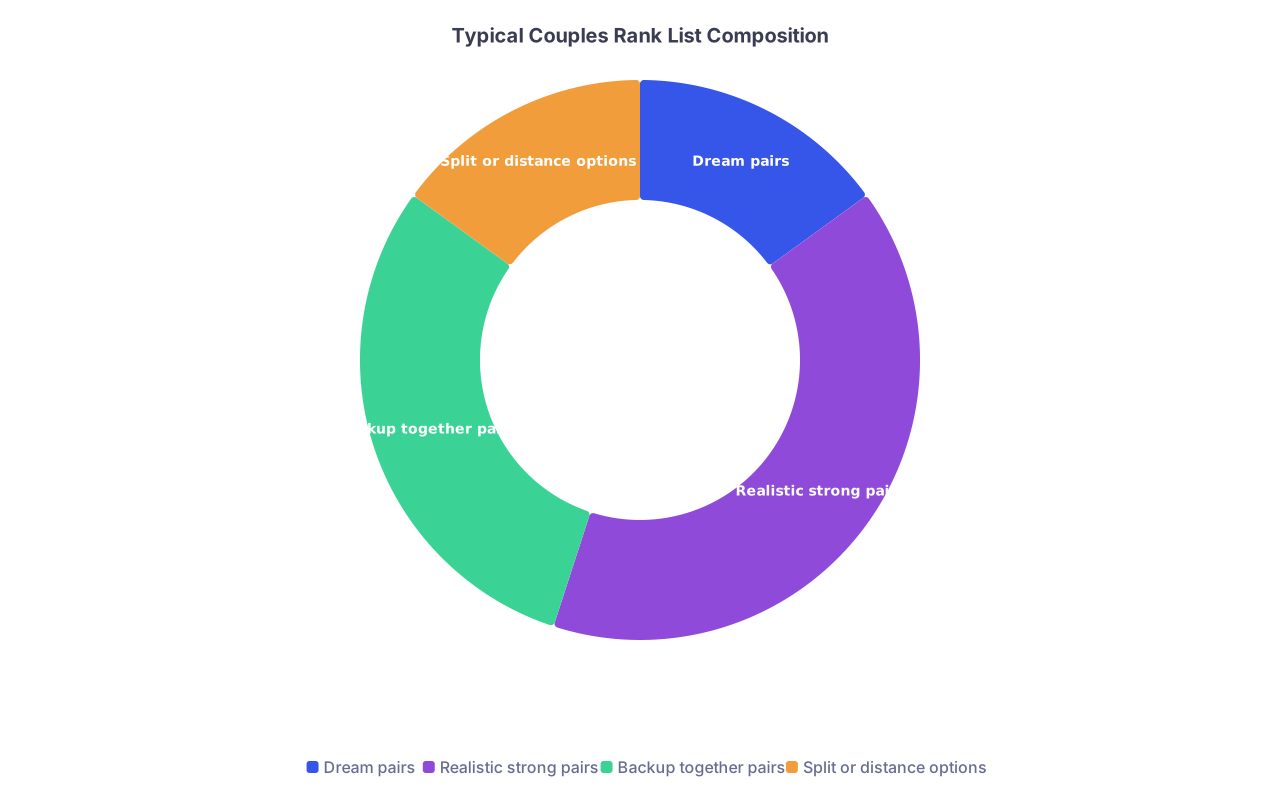
| Category | Value |
|---|---|
| Dream pairs | 15 |
| Realistic strong pairs | 40 |
| Backup together pairs | 30 |
| Split or distance options | 15 |
Where Applicants Miscalculate (And PDs Quietly Shake Their Heads)
Three common disasters I’ve watched from the PD side:
1. Over-inflated sense of your joint market value
You rank only big names and big cities because one of you would be competitive there solo. You ignore what you look like as a pair, especially if one is weaker.
PDs will say things like:
“They ranked us 4th and 6th but had 10 ‘better’ pairs above that. Once the stronger partner gets pulled off the board by a top program, the whole structure collapses.”
2. Too few backup pairs
PDs have seen enough couples crash to be pretty jaded. I’ve heard:
“They had 9 pairs in New York and 2 in the Midwest and nothing else. That’s a self‑inflicted wound.”
No algorithm tweak fixes a thin list.
3. Refusal to acknowledge asymmetry
If one partner is simply in a weaker position—fewer interviews, lower scores, red flags—and you still build a list as if you’re both equally marketable, you’re building on fantasy.
PDs notice this mismatch in interviews: the stronger partner talks like they’re shopping; the weaker partner talks like they’re begging the universe to be kind.
High‑tier PDs are thinking: “We aren’t going to tank our list to solve their problem.”

| Step | Description |
|---|---|
| Step 1 | Start Couples Rank List |
| Step 2 | Target 14 to 18 paired ranks |
| Step 3 | Target 20 to 30 paired ranks |
| Step 4 | Recheck interview counts |
| Step 5 | Build dream pairs first |
| Step 6 | Add realistic strong pairs |
| Step 7 | Add backup together programs |
| Step 8 | Add limited split options |
| Step 9 | Expand backup together list |
| Step 10 | Review risk comfort and certify |
| Step 11 | Both strong and non competitive fields |
| Step 12 | One weaker or competitive specialty |
| Step 13 | Willing to split? |
The One Conversation PDs Assume You’ve Had (But Most Couples Don’t)
Behind closed doors, PDs assume something very simple: by the time you hit “Certify” on your couples list, you’ve had the brutally honest talk about priorities.
In reality? Many couples dodge this until it’s too late.
PDs think you’ve already decided:
- Is staying together the absolute top priority, over program prestige and geography?
- Are you willing to take a lesser program for the weaker partner to land a spot?
- Are you willing to split if one of you gets a dream offer that the other absolutely cannot match locally?
They build their ranks assuming you’ve already made peace with those tradeoffs. The algorithm does not care how awkward your conversations have been.
So you end up with couples who:
- Secretly disagree on how low they’re willing to rank certain places.
- Quietly reorder things individually in the last few days.
- Or let one partner “drive” the list, hoping for the best.
Those are the couples PDs talk about years later in faculty meetings with a kind of weary shrug:
“They never should have couples matched like that. The list was built on wishful thinking.”
FAQs
1. Do PDs actually like couples, or would they rather avoid the hassle?
Depends on the program. Mid‑tier and less flashy locations often like couples because they boost retention and morale. Ultra‑competitive, high‑prestige places mostly see couples as extra complexity with limited benefit. Nobody is re-engineering their entire rank list around you, but some will give you a slight bump if both of you are already desirable.
2. If one of us is clearly stronger, should the stronger person “aim high” and let the weaker one catch up locally?
If you’re not formally couples matching, sure, you can each aim for your ceiling and hope geography works out. The moment you couples match, you need to decide whether the priority is: staying together vs. maximizing the stronger partner’s prestige. Trying to do both is how people end up split or in SOAP. Build the list around your real priority, not your ego.
3. Is it worth emailing PDs to tell them we’re couples matching and love their program?
If you’re both already interviewed and genuinely interested, a short, specific email to the coordinator or PD can help anchor you in their mind as a serious couple. But it only moves the needle at the margins—think small nudges, not huge jumps. Overly dramatic love letters or “you’re my number one” promises to five different programs just make you look unserious.
4. How many pairs is “unsafe” for an average couple in IM + Peds/FM/Psych?
If you’re an average couple in those fields and you have fewer than about 14–15 paired ranks, you’re playing with real risk. That doesn’t guarantee disaster, but I’ve watched too many 8–10 pair lists implode. Most PDs, off‑record, assume smart couples are hitting 18–20+ realistic pairs unless both partners are very strong and geographically flexible.
5. Does the algorithm really “favor the applicant” when couples matching?
For single applicants, yes, meaning it tries to get you your highest possible choice consistent with other people’s choices. For couples, that protection is diluted by the constraint that you move as a unit. The algorithm can’t magically fix a short or unrealistic couples list. If you don’t give it enough viable pairs—especially beyond your dream cities—it simply runs out of places to put you. That’s where people get burned.
Two key points to walk away with:
First, program directors are not building their rank lists to save couples from bad strategy; they’re protecting their programs. If your list is short or delusional, the algorithm will punish you, not them.
Second, a smart couples list is longer, more honest, and more geographically humble than your ego wants. If you want to stay together and actually match, you build for reality, not fantasy.