
It is mid-September. ERAS just opened for programs, and you are staring at your final list: 18 internal medicine programs. Your advisor said you are a “strong candidate,” your classmates told you not to “waste money,” and your spreadsheet looks neat and minimal. You feel oddly proud that you did not go crazy like the people applying to 70+ places.
Fast‑forward to January.
Your phone is quiet. Friends are complaining about “too many interviews.” You are staring at 5 invites. One of them is a reach program that felt cold. Two are prelim only. Your “smart, curated” list just turned into a real problem.
You did not have a weak application.
You had a too‑short list. And that alone can sink you.
Let me be very clear: underapplying is a silent killer of otherwise excellent applications. You will not realize you made this mistake until it is too late to fix.
This is the trap I am trying to keep you out of.
The Biggest Misconception: “Strong Applicants Can Apply Short”
The most dangerous sentence I hear in advising meetings:
“I have a strong application, so I am only applying to 10–15 programs.”
No. Stop. That logic is how people with 250+ Step 2 scores and solid clinical performance end up scrambling in SOAP.
Here is what actually happens:
- You overestimate how “strong” you look in the current cycle, in this specialty, with this year’s volatility.
- You assume holistic review means everyone will see what is great about you.
- You underestimate how brutally random interview selection can be.
- You forget programs are also drowning in qualified applicants and using harsh filters.
Your application is not evaluated in a vacuum. It is evaluated:
- Against your own category (IMG vs US grad, DO vs MD, home vs away).
- In the context of this year’s applicant pool.
- Through messy institutional filtering rules you will never see.
So when you decide, “I am a strong applicant, I will just apply to 12 programs I really like,” what you are really doing is this:
You are betting your entire career on your own ability to predict which programs will like you back.
I have seen that bet fail. A lot.
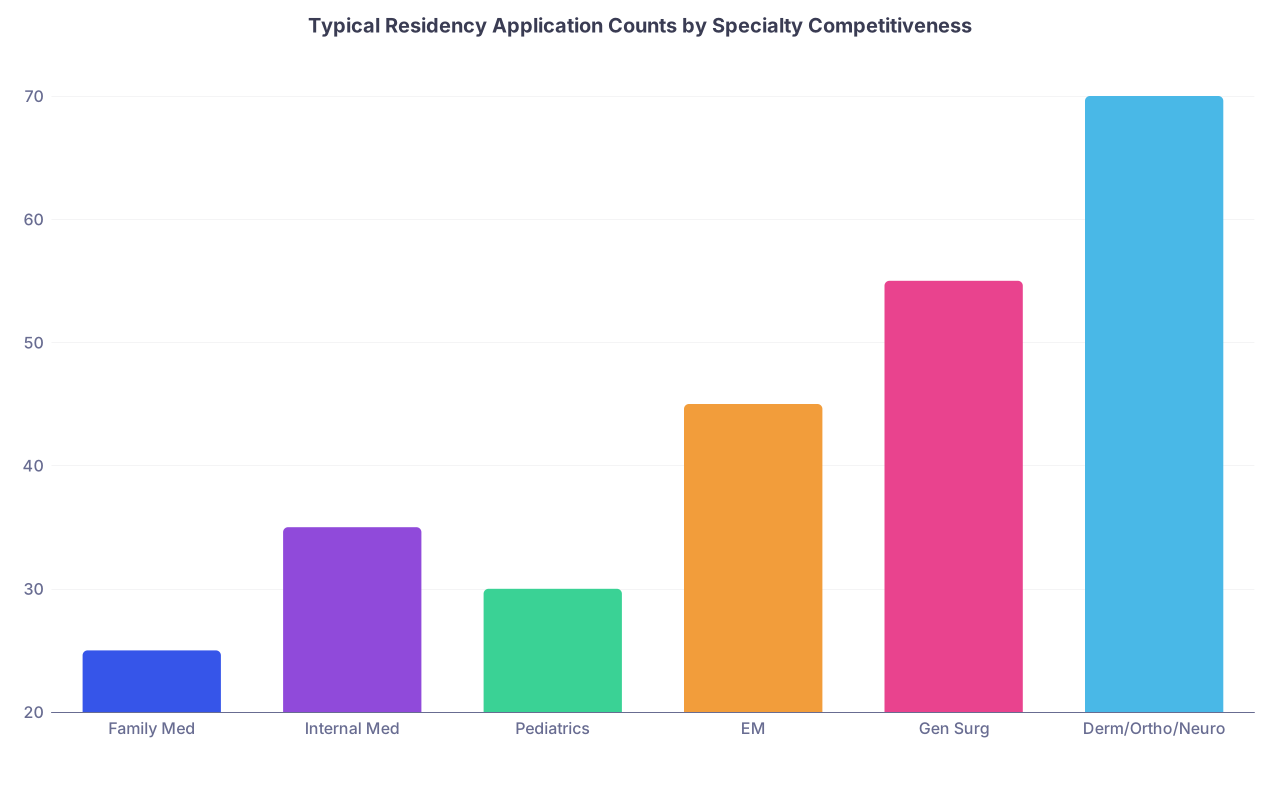
Reality Check: How Many Programs People Actually Apply To
You need some numbers, not vibes.
| Category | Value |
|---|---|
| Family Med | 25 |
| Internal Med | 35 |
| Pediatrics | 30 |
| EM | 45 |
| Gen Surg | 55 |
| Derm/Ortho/Neuro | 70 |
These are rough, but they reflect what I see year after year among applicants who do not want to play roulette with their future:
- Family Medicine:
- Average “safe” range: 20–30 programs for a reasonably strong US grad.
- Internal Medicine (categorical):
- Reasonable: 30–40 for solid candidates.
- 40–50+ if any red flags (low Step, gaps, IMG, limited geographic flexibility).
- Pediatrics:
- Similar to IM: 25–35 baseline, more with risk factors.
- Emergency Medicine:
- Now volatile. 40–50+ is common.
- General Surgery:
- 45–60 for decent US grads. More if scores are mid/low or you are an IMG.
- Highly competitive (Derm, Ortho, Neurosurgery, Plastics, ENT):
- 60–80+ is not extreme. 40 programs can be underapplying.
Underapplying is relative.
For Dermatology, 25 programs is drastically underapplying.
For Family Medicine with serious red flags, 10 programs is borderline suicidal.
The trap is thinking: “But my mentor matched with 15 programs.” That was:
- A different year
- A different specialty climate
- A different Step score environment
- Possibly a home‑program advantage you do not have
You are not applying in 2014.
Why Underapplying Is So Dangerous (Even For Strong Applicants)
Three big reasons people underestimate the risk.
1. Interview Invitations Are Not Linear
Applying to twice as many programs does not always double your interview invites. But applying to too few absolutely caps your upside.
Think about it like this:
- Each program has:
- Their own filters (scores, visa, school, “hidden” preferences).
- Their own randomness (who reads your app, which day, their mood).
- Their own institutional politics (home students, affiliated schools, legacy, internal candidates).
When you underapply, you are shrinking the number of “lottery tickets” you are holding in a process that is already partially random.
What I have seen multiple times:
- Applicant A: 240+ Step 2, strong letters, 1st quartile MSPE, applies to 18 categorical IM programs
- Outcome: 5 interviews, 1–2 realistic ranking options.
- Applicant B: Slightly weaker, 230–235 Step 2, mid MSPE, applies to 40 IM programs broadly
- Outcome: 10–12 interviews, solid rank list, matches comfortably.
Applicant A was “stronger.” Applicant B was smarter. Applicant B matched.
2. Programs Reject You For Reasons You Will Never See
You think programs are evaluating:
- Your scores
- Your letters
- Your personal statement
They are. But they are also quietly filtering:
- Only J‑1 visas
- No visas at all
- No IMGs from certain regions
- US grads only
- Must have Step 2 > [insert arbitrary cutoff]
- No >1 year gap from graduation
- “We do not like applicants from School X after past issues” (yes, this happens)
You will never see half of these rules.
If you apply “short,” you are assuming that the handful of programs you picked:
- Do not silently filter you out
- Actually review you holistically
- Have space after prioritizing their home and affiliate students
That is a lot of assumptions for something as important as where you spend the next 3–7 years.
3. The Match Algorithm Cannot Save You From a Short Rank List
The NRMP algorithm favors applicants if you rank enough programs.
But it cannot give you a match out of thin air.
- If you have:
- 5 interviews → maybe 3–4 usable ranks
- 3 interviews → maybe 2 real options
- 1–2 interviews → you are already in emergency territory
Underapplying hits you upstream: fewer applications → fewer interviews → tiny rank list.
By the time you feel the damage, your ERAS submission is frozen in the past.
How Many Programs Should YOU Apply To? Avoid These Common Errors
Let us go through the most common self‑sabotaging thought patterns.
Mistake #1: “I Only Want to Be In [City/Region], So I Will Apply Narrowly”
Geographic preference is fine. Geographic insistence is not.
You are not buying real estate. You are trying to enter a profession.
Common disaster scenario:
- Applicant: “I will only be happy in New York / California / Chicago.”
- Application: 12 programs, all in NYC or the Bay Area.
- Outcome: Those programs are flooded with 1,000+ applications each. They have plenty of people who have:
- Ties to the area
- Rotated there
- Home school status
- Stellar research at that institution
Your “preference” does not matter to them.
Safer version:
- Heavy geographic preference? Fine.
- But:
- 50–70% of your list can be in the preferred region.
- The remaining 30–50% should be in less saturated areas where your application stands out.
If you insist on “NYC or bust,” understand that “bust” is a real, non‑theoretical outcome.
Mistake #2: “My Advisor Said I Am Competitive, So 15 Programs Is Enough”
Some advisors are excellent. Some are wildly out of date. Some never matched in your specialty.
Underapplying often traces back to one confident sentence from someone with no skin in your game.
You need more than one data point:
- Look at NRMP data for your specialty.
- Talk to:
- A recent grad who matched last year in your specialty.
- Someone with similar stats and background, not the superstar who matched at MGH and applied to 12 places.
If anyone is telling you to apply to under 20 programs in a moderately competitive specialty without:
- A home program
- Stellar metrics
- And serious geographic flexibility
You are being set up for unnecessary risk.
Specialty‑Specific Underapplying Traps
Here is where people get burned the most.
| Specialty Type | Underapplying Danger Level |
|---|---|
| Family Medicine | Moderate |
| Internal Medicine | High |
| Pediatrics | High |
| Emergency Medicine | Very High |
| General Surgery | Very High |
| Highly Competitive (Derm etc.) | Extreme |
Primary Care (FM, IM, Peds)
The trap here is: “These are less competitive, so I can apply to fewer programs.”
Wrong framing.
- They are broad specialties.
- They receive absurd volumes of applications.
- Many have filters you will never see, especially for IMGs.
Underapplying here looks like:
- 10–15 IM programs as an IMG
- 15–20 Peds programs as a US grad with average scores
- 10 FM programs while insisting on a single metro area
For most applicants, a safer minimum for categorical IM or Peds is in the 30s, not the teens. For IMGs, that number often needs to be significantly higher.
Emergency Medicine
EM used to be “apply to 20–25, you are fine.” Those days are gone.
Recent cycles:
- Wild fluctuations in applicant numbers.
- Programs closing.
- Unpredictable interview behavior.
Underapplying in EM now is applying like it is still 2016.
If you are not a top‑tier candidate with robust SLOEs, a home EM program, and a clear backing, 40+ applications is not excessive.
General Surgery and Competitive Surgical Fields
Surgery is brutal for underapplicants.
Patterns I have seen:
- Mid‑range Step, limited research, 20–25 general surgery programs → SOAP.
- 230s–240s, strong letters, but only 20 ortho programs because “my mentor told me to focus on fit” → unmatched.
You do not control “fit.” They do.
For surgery:
- General Surgery:
- 45–60 is common.
- Ortho / ENT / Plastics / Neurosurgery:
- 60–80+ is not aggressive. It is survival.
The Psychology Behind Underapplying (And Why You Are Vulnerable To It)
You are not underapplying because you are stupid. You are underapplying because you are human.
1. Money Anxiety
ERAS is expensive. Flights and hotels are expensive. You are already in debt.
So you tell yourself:
- “I am being financially responsible.”
- “I do not want to throw money at programs I do not love.”
The harsh truth:
The extra $600–$1,000 you might spend on 15–20 more applications is nothing compared to:
- The cost of being unmatched (lost attending income, delay of training).
- The psychological hit of a gap year you did not plan for.
Yes, be thoughtful. No, do not be cheap on the one step that determines if you have a residency at all.
2. Ego and Identity
Underapplying often hides a quiet belief:
“If I apply to a lot of places, it means I am not strong.”
So you apply short to prove (to yourself, to others) that you are “above” the scramble.
That is how strong people lose.
The match does not care about your pride. It cares about probabilities.
3. Fear of Rejection
There is also this:
If you apply broadly and still do poorly, you cannot tell yourself, “Well, I only applied to 12 programs.”
So you keep the list small, because it leaves you a psychological escape hatch.
Do not do that to yourself.
Future you will not care that Present you protected your ego. Future you will care that you have a job.
A Practical Framework: Avoiding the Underapplying Trap
Let me give you a more concrete way to think about this.
Step 1: Be Honest About Your Risk Category
Rough categories:
- Low‑risk (for your specialty):
- US MD, strong Step 2, no fails, honors in core clerkships, strong home support.
- Moderate‑risk:
- US DO, average scores, a minor blemish (one low shelf, pass instead of honors).
- High‑risk:
- Any failed Step
- Old graduate
- Significant gap in training
- IMG (especially non‑US citizen)
- Switching specialties late
If you are high‑risk and thinking about applying to fewer than 30–40 programs in any specialty, you are playing with fire.
Step 2: Use Tiers Thoughtfully
Do not make this mistake: 90% of your list is reach programs.
Better structure:
- 20–30% “reach” (programs above your metrics).
- 40–60% “target” (aligned with your stats and background).
- 20–30% “safer” (community programs, less sought after locations).
The underapplying version:
- 10–15 total programs
- All in trendy cities
- All academic, all well‑known names
Looks good on paper. Fails in reality.
Step 3: Check Your List Against Data, Not Vibes
Use:
- NRMP Program Director Survey
- Past match data at your own school (if shared)
- Conversations with people who matched recently, not 10 years ago
If your planned number of applications is far below what successful peers used in the last 2–3 years, assume you are underapplying unless you have a genuinely exceptional profile.
The Timing Trap: “I’ll Add More Programs Later If I Need To”
Here is another quiet disaster:
You submit to 18 programs. You feel “conservative but okay.”
By late October, you have 2 interviews. Panic hits.
You decide to add 20 more programs.
Reality check using a simple process diagram:

| Step | Description |
|---|---|
| Step 1 | Submit small list on ERAS open |
| Step 2 | Programs download early apps |
| Step 3 | Most interview slots planned |
| Step 4 | You see few invites |
| Step 5 | You add programs late |
| Step 6 | You are in late pile |
| Step 7 | Compete for leftover spots |
| Step 8 | Lower interview yield |
Late applications are weaker applications. Programs:
- Pre‑screen early
- Start sending interview invites quickly
- Often have internal quotas or early favorites
Your late‑cycle additions will not perform as well as if you had included them from the start. Adding programs in October is better than nothing, but it is not a full fix.
Plan up front. Do not rely on “I will adjust later” as your safety net.
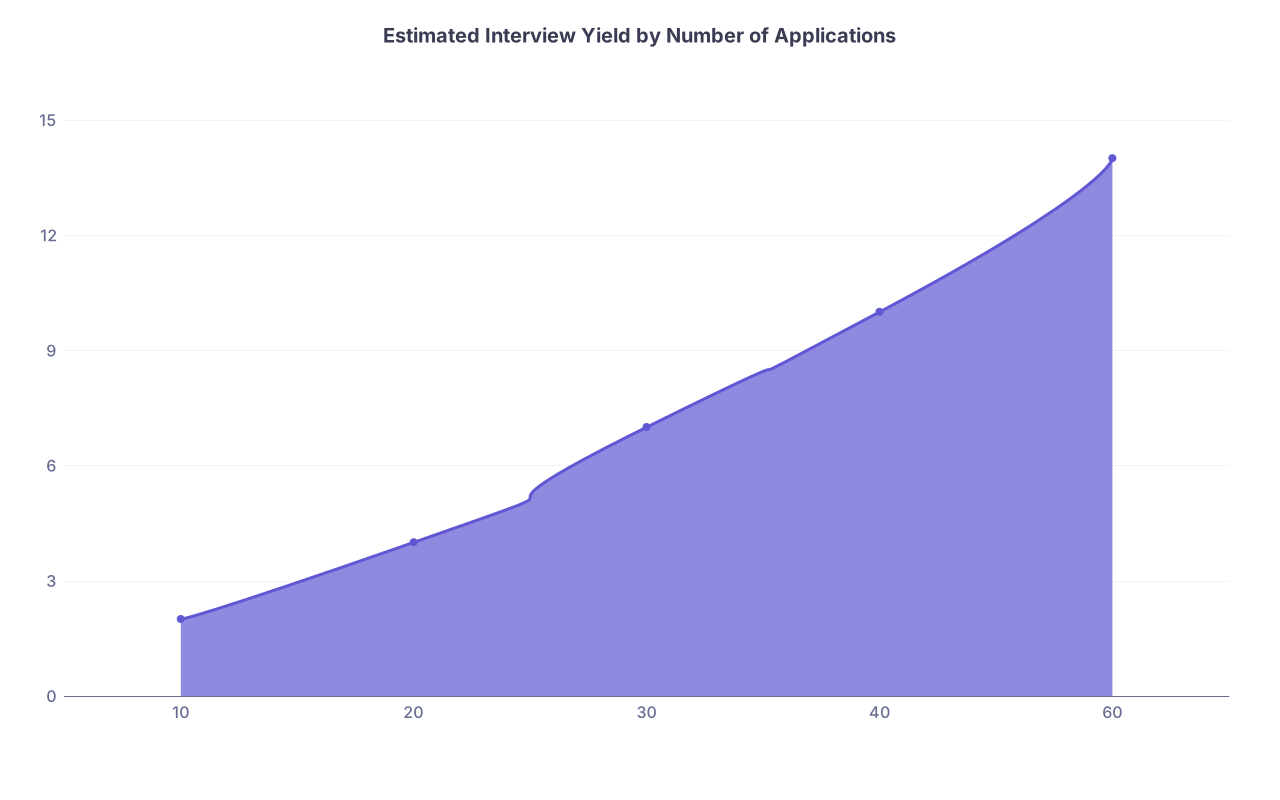
Visualizing The Risk: Short vs Adequate List
| Category | Value |
|---|---|
| 10 | 2 |
| 20 | 4 |
| 30 | 7 |
| 40 | 10 |
| 60 | 14 |
This is not exact math, but the pattern is real:
- 10–15 programs:
- You live in the 2–4 interview range unless you are a superstar or in a very uncompetitive context.
- 30–40 programs:
- More chances to clear arbitrary filters. More programs that see you as a good fit.
- 50–60+:
- Especially important in competitive fields or for higher‑risk applicants.
No one regrets matching “too safely.”
Plenty of people regret applying too narrowly.
A Simple Rule To Keep You Out of Trouble
If you remember nothing else, use this sanity check:
If you would be devastated to go unmatched, do not let your final program list be in the bottom 25% of application counts for people like you in your specialty.
Translated:
- Ask:
- “How many programs did people like me (same degree, similar scores, similar risk factors) who matched last year apply to?”
- Your number should be:
- At least similar
- Preferably a bit higher
Cherry‑picking your superstar friend who applied to 12 places and matched at Hopkins is not data. That is survivorship bias.

FAQ (Exactly 4 Questions)
1. Is it possible to apply to too many programs?
Yes, but it happens far less than people claim. The real constraint is not ERAS application count, it is interview management:
- If you apply to 80+ programs in a less competitive specialty and somehow get 30+ interviews, you will have to cancel many.
- But the people who can “overapply” to that extent are almost always in the small group of highly competitive applicants. That is not most people.
For the majority of applicants, the greater danger is underapplying, not overapplying. The financial cost of extra applications is real, but the career cost of an unmatched year is much larger.
2. How do I know if my current list is too short?
Ask yourself:
- Am I below 20 programs in any moderately competitive specialty (IM, Peds, EM, Surgery) without being an objectively top‑tier applicant?
- Am I applying to only one city or state?
- Is more than 70–80% of my list “reach” or big‑name programs?
- Am I an IMG, DO, or applicant with red flags applying to under 40 programs?
If you answer “yes” to any of these and you would strongly prefer not to SOAP, your list is probably too short.
3. I have strong home program support. Can I safely apply to fewer programs?
Home support helps. It does not guarantee anything.
Programs:
- Sometimes overestimate how many of their own students they will actually rank high
- Have changing needs year to year
- May like you but still rank you below other candidates
You can modestly trim your list if your home program is enthusiastic and historically takes its own students, but you should not bank your entire future on a single institution. Think of home support as a boost, not a safety net that lets you cut your applications in half.
4. What if I truly cannot afford a large number of applications?
Then you must be strategic, not idealistic.
- Prioritize:
- Programs historically open to your profile (IMG‑friendly, DO‑friendly, etc.).
- A mix of academic and community programs, not just prestigious names.
- Regions where your school has placed graduates before.
Cutting from 60 to 35 because of finances is understandable. Cutting from 35 to 12 while telling yourself “I am strong, it will be fine” is the mistake. If money is tight, get outside help with list curation and be brutally realistic about your risk level.
Key points to walk away with:
- Strong applications get destroyed every year by lists that are too short, too narrow, and too aspirational.
- Do not let ego, outdated advice, or money anxiety push you into underapplying. Use data and recent examples from people like you.
- When in doubt, err slightly on the side of more programs, not fewer. The regret of a slightly higher ERAS bill is nothing compared to the regret of an unnecessary SOAP year.