
It’s October 5th. You’re staring at ERAS, finger hovering over “Add Programs.” Your friends are in full panic-buy mode: 80 programs, 100 programs, 120 “just to be safe.” Your credit card is screaming. Your dean says “apply broadly.” Your classmates say “you can’t be too safe.”
Let me tell you what nobody on the official side will say out loud:
There are hard caps inside many programs where your extra application does. not. matter.
Not because you’re not good enough. Because they’ll never even see you.
And no, they’re not going to publish those numbers on the website or admit them on a webinar. But I’ve been in the room when PDs, associate PDs, and coordinators decide who even gets looked at. I’ve heard:
“We’re not reading past 1,200 this year.”
“Filter at 240+ and home / regional preference first. That’ll fill all our invites.”
“Stop at 900, we’re done. The rest auto-reject.”
You need to understand where the real bottlenecks are. Or you’ll waste thousands of dollars sending applications that never had a measurable chance.
Let’s pull the curtain back.
How Programs Actually Decide When to Stop Looking
Here’s the truth: the main constraint is not “how many people apply.” It’s “how many applications can our human beings realistically review.”
Every PD and faculty member has the same story by mid-September:
“I have 4 residents out sick, 18 inpatients, clinic tomorrow, and 3 talks to give. I’m not reading 3,000 applications.”
So they do what busy humans do: they create sharp filters and hard caps.
The unspoken math behind the cutoff
Most medium-to-large programs end up in about the same ballpark for total serious review:
- A typical core program (IM, FM, Peds, Psych) invites about 10–15 applicants per position.
- If they have 12 spots, that’s roughly 120–180 interview invitations.
- To get those 120–180 people, they might truly review 600–900 applications.
After that? They either:
- Never scroll that far,
- Set filters that keep the pool manageable,
- Or stop genuinely reading once they’ve built a full invite list.
Some of them will tell their coordinators flat out: “After we fill the initial 150 interview slots and maybe a 30–40 person waitlist, we’re done.”
So if you’re applicant #1,947 out of 4,300 for that IM program at a big-name place, here’s the ugly reality: there is a non-trivial chance your application is never truly opened by a human decision-maker.
They’ll tell you “we holistically review every application.” I’ve watched them click “Next” 50 times in a row using filters and ignore entire bins of applicants.
The Hidden Filters: Where People Get Cut Before Anyone Thinks About You
Before you even worry about caps, you need to understand filters. Because the cap is applied after they shrink the pool down.
There are 3 big levers programs quietly pull:
- Score / exam filters
- School / citizenship / visa status
- Geography / “fit” flags
Coordinators run these like triage.
Score cutoffs no one will say on Zoom
Older era: Step 1 numeric was the dominant filter. With Step 1 pass/fail, Step 2 CK is now doing that work in a lot of places. Some internal medicine programs will say: “We don’t have hard cutoffs.” Then I watch the associate PD tell the coordinator:
“Filter at 235+ Step 2 for initial review. We’ll go lower only if we don’t get enough from that pool.”
What this means functionally: applicants under that line are invisible on the first pass. Some examples I’ve directly seen:
- A strong Midwest academic IM program:
“US MD: review ≥225 Step 2. US DO: ≥235. IMGs: ≥245.” - A competitive university psych program:
“Filter at 230+ Step 2, remove anyone with >1 fail or remediation flags.” - A large community FM program:
“No official cutoff, but don’t bother sending me anyone under 210 unless they’re from our med school or did an away rotation.”
They will never publish those numbers. But these are exactly the conversations that happen in July and August each year.
The citizenship / visa wall
This one is brutal and rarely transparent.
A surprising number of programs effectively have three piles:
- US MD/DO citizens and permanent residents
- IMGs requiring no visa
- IMGs requiring visa sponsorship
The third group is often capped before any real reading happens. A PD might say:
“We’ll sponsor 2–3 visas max. Let’s review 200 non-US citizens and pick from there.”
Then they apply stiff score cutoffs and often require US clinical experience. So if you’re IMG #937 in their list, and they decided to only even view the top 200 based on filters, you’re done before you started.
Geography and the “home / regional” bias
Another quiet filter: programs will fill a lot of their interview slots with:
- Their own med students (home program bias is real and strong)
- Students from nearby schools in their region
- Students with clear regional ties (address history, spouse, family, etc.)
I’ve watched lists where the first pass reads like:
“Home institution + affiliate schools + nearby state schools. That’s 80 invites already.”
There’s your “cap” before the wider national pool even gets seriously considered.
The Point of Diminishing Returns: When Extra Apps Stop Helping
Now to the question you actually care about: when do more applications stop improving your chance of matching?
Not the sanitized NRMP PDF answer. The real, behind-the-door answer.
The basic curves no one explains properly
Someone in your class probably shared a generic “apps vs match probability” plot. Here’s what those curves ignore: they treat every added program as equal. In the real world, they’re not.
Your first 20 programs are high-yield if you choose them wisely. They’re the ones where:
- Your stats are in range
- Your geography makes sense
- Your interests and their profile actually align
The next 20–30 programs are more of the same: still meaningful.
But the next 40 on top of that? For most applicants, that’s where the true yield collapses. Because now you’re adding:
- Programs where your Step 2 is well below their secret cutoff
- Programs that never seriously consider IMGs / DOs but aren’t explicit about it
- Hyper-competitive “dream” places that will stop reviewing long before they scroll to you
- Totally random locations with no geographic tie, that are flooded with local applicants
Here’s what the real math often looks like behind the scenes:
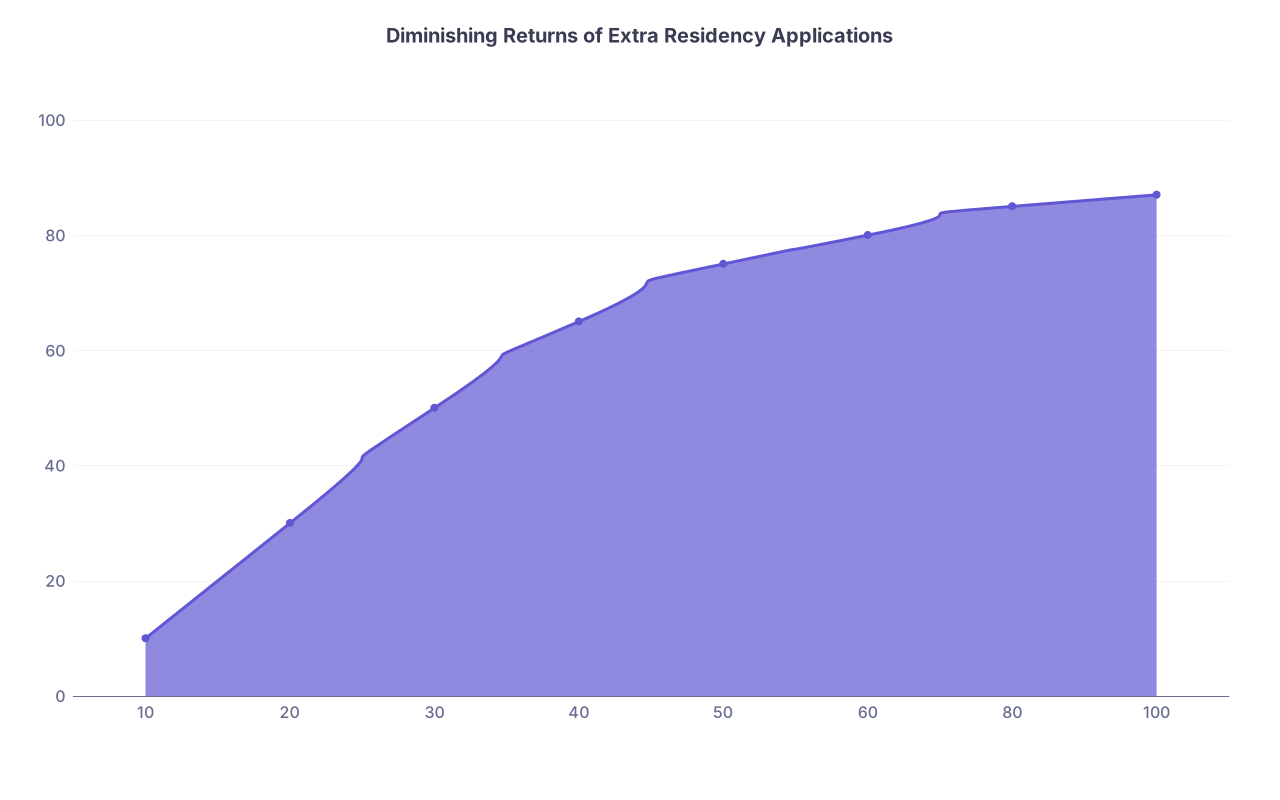
| Category | Value |
|---|---|
| 10 | 10 |
| 20 | 30 |
| 30 | 50 |
| 40 | 65 |
| 50 | 75 |
| 60 | 80 |
| 80 | 85 |
| 100 | 87 |
Interpretation the PD won’t give you:
- Going from 10 → 30 well-chosen programs massively boosts your odds.
- Going from 30 → 60 still helps, but you’re already catching most realistic options.
- Going from 60 → 100 is mainly you feeding ERAS money and adding programs that likely have hard internal caps, filters, or both working against you.
That “87%” at 100 is deceptive. For many of you, that 87% was already ~84% at 60 apps.
The difference? About $1,500 and a lot of brain fog.
Program Caps in Practice: Who Actually Gets Seen
Let me walk you through what selection really looks like at a mid-to-large internal medicine program, because that’s where a lot of this game is most visible.
A typical academic IM program year
- 14 categorical IM spots
- 3 prelim spots
- ~4,000–5,000 applications total
- ~400–600 interviews offered
- Realistically, capacity to truly read maybe 800–1,200 applications
Now, here’s what they actually do:
Home and affiliate school auto-review
All their MS4s and students from closely affiliated schools get looked at. Many get early interview offers.Automatic filters applied
Step 2 cutoff (maybe 220–230 US grads, 235–245 IMGs), no >1 fail, no incomplete apps.Prioritized review groups
- US MDs in-region with decent scores
- Then US DOs and out-of-region US MDs with higher scores
- Then selectively IMGs who clear higher thresholds
Invite list filled early
They fill 70–80% of interview slots from those first 500–800 applications that surfaced after filtering and prioritization.Soft cap hits
The PD looks at the remaining 3,000 “eligible” apps in the ERAS queue and essentially says: “We’re full unless something weird happens. We’ll look again if people decline.”
At this point, if your application is still unopened, your odds of suddenly bubbling up from the bottom of a 3,000-deep list are microscopic unless:
- You’re a clear superstar whose application pings in some search (e.g., unusual research niche),
- Or you have a strong personal connection reaching out on your behalf.
This is where “extra applications” become fantasy. You’re paying for the right to sit in an untouched stack.
Specialty-Specific Caps: Where the Line Really Is
Not all specialties behave the same. Some are flooded beyond reason; others are manageable.
Here’s the unspoken reality across a few buckets.
| Specialty Type | Apps per Program | Truly Reviewed | Interview Invites |
|---|---|---|---|
| Competitive surgical | 400–1,000 | 200–400 | 60–120 |
| Competitive non-surg | 800–3,000 | 500–1,000 | 80–200 |
| Core (IM, FM, Peds) | 3,000–6,000 | 600–1,200 | 120–400 |
| Less competitive niche | 200–600 | 150–400 | 60–150 |
Interpretation:
- In competitive fields (Derm, Ortho, ENT, Plastics), the visible part of the pool is actually a big fraction of total applicants. Most apps get some form of eyeball time or at least a name check.
- In over-subscribed core specialties at big-name places, a huge swath of people never make it through filters plus human time caps.
So when your classmate says, “I applied to 110 IM programs,” what they really did is:
- Apply to maybe 40 they’re actually in range for,
- 20 more where they’re borderline but plausible,
- And another 50+ that will never truly open their file.
The extra 50+ create the illusion of options without actually generating more real interview chances.
Where Applicants Waste the Most Money
There are predictable patterns in how people overspend and hit these hidden caps headfirst.
1. Over-applying to prestige without checking reality
You know the list: MGH, BWH, UCSF, Hopkins, Penn, Duke, Columbia, NYU, Mayo.
These places are absolutely flooded. They have internal caps not just on total reviews, but often on certain categories (IMGs, DOs, non-regional).
I’ve watched:
- DO applicants with 230–235 Step 2 apply to all of these IM programs “just in case.” They never got a glance.
- IMGs with 240s apply to every top-20 academic program. Maybe 1–2 of those schools even consider IMGs seriously in the current cycle.
You don’t need to never reach. But when half your list is made of programs that are practically hard-wired not to see you? That’s not a strategy. That’s denial plus debt.
2. Blindly copying classmates’ numbers
The worst logic on the trail is: “My friend matched with 80 apps, I should do 100 to be safer.”
That ignores:
- Their geography
- Their school prestige
- Their scores
- Their visa needs
- Their research background
I’ve seen solid US MD IM applicants (Step 2 in the 240s, no red flags, ok research) match comfortably after 35–45 well-chosen programs. Their classmates with the exact same profile applied to 90+ and didn’t do any better than they would have at 50. Same match. Double the cost.
3. Spraying at programs that quietly never interview your category
There are programs that:
- Never take IMGs (but don’t say it out loud)
- Rarely rank DOs in certain specialties
- Almost never sponsor visas except in exceptional circumstances
You can infer a lot of this from their resident roster. Many of you don’t bother. You just fire off the app and “hope.”
If their resident list is 30 US MDs, 2 US DOs, 0 IMGs over 6 years, believe their behavior. You are throwing money into a well if you don’t fit that mold and still apply in bulk.
How to Use This Knowledge to Choose Your Number Intelligently
Fine. So programs have hidden caps and filters. What do you actually do with that?
You start by accepting one simple point:
The goal isn’t to maximize applications sent. It’s to maximize realistic interview opportunities.
Here’s a structure I’ve seen work for a lot of people.
Step 1: Build three tiers of programs
Not “reach / target / safety” the way premed advisors talk. More honest:
- Tier A: You are squarely in their usual range and fit their patterns (school type, geography, exam scores).
- Tier B: You’re slightly below or slightly outside their “norm,” but there’s a plausible story.
- Tier C: You’re asking them to go against their usual behavior.
If half your list is Tier C, you’re living in fantasy land. That’s exactly where hidden caps destroy you, because you’re the first group that gets filtered out when they need to shrink the pool.
Step 2: Aim for depth in A and B, not width with C
In many core specialties, a reasonable high yield range is:
- Strong US MD in IM/FM/Peds/Psych: 25–45 programs
- US DO with decent scores, no big red flags: 40–70
- Strong IMG: 60–100, but targeted and realistic, not blind panic
Those are actual ranges I’ve seen work repeatedly, not arbitrary numbers.
Notice where the waste happens: an IMG who already has 80 well-chosen programs adding 40 more that are mostly prestige / historically non-IMG-friendly. That’s where the “cap” effect makes extra applications meaningless.
Step 3: Look at resident rosters like an adult
Go to program websites and count:
- How many DOs?
- How many IMGs?
- How many residents from your region or similar-tier schools?
If you see repeated patterns that exclude people like you, your odds of being the exception are tiny, especially in a cycle where they’re overrun with “on-profile” applicants.
This is exactly where programs use hidden caps. They’ll fill their entire review pool (that 600–1,200 real review window) from the categories they historically prefer. Then you’re never truly in the game.
What This All Means for You, Right Now
You’re about to spend an obscene amount of money on applications, travel, and time. You deserve to know how the system really behaves.
Here are the core truths that are usually kept off the podium slides:
- Many programs have a maximum number of applications they’ll truly review.
- That number is often 600–1,200, regardless of whether they receive 2,000 or 6,000.
- Filters (score, geography, school type, visa) decide who even enters that review pool.
- Extra applications to programs that will never seriously consider your profile are just credit card transactions, not opportunities.
- After some point—often 40–60 realistic programs—your marginal gain in match probability drops sharply, unless your baseline odds are very low.
You don’t need to be reckless. If your application is weaker or non-traditional, you may justifiably push higher numbers. But do it with open eyes. Know that not every extra click on ERAS translates to an extra real shot.
Years from now, you won’t remember the exact number of programs you applied to. You’ll remember whether you acted from informed strategy or blind fear. The system is opaque by design. Now you know where some of the walls really are.
Use that knowledge ruthlessly.