Understanding the Landscape: Anesthesiology Match for DO Graduates
For a DO graduate targeting anesthesiology, program selection strategy is just as important as board scores and letters of recommendation. The anesthesiology residency landscape has become more competitive, and as a DO you must think deliberately about where to apply, how many programs to apply to, and how to build a realistic anesthesia match list that maximizes both match odds and personal fit.
Key Realities for DO Graduates
Single Accreditation System
With ACGME as the unified accreditor, former AOA programs have transitioned or closed. Many categorical anesthesiology programs are historically MD-oriented, but an increasing number are DO-friendly and some have DO leadership or faculty.DO vs MD Considerations
- Some programs still prefer or historically match more MDs, especially “big-name” academic centers.
- Many excellent mid-tier academic and strong community programs welcome DO applicants and match them regularly.
- Osteopathic students may encounter:
- Less familiarity with COMLEX-only scores in some programs
- Preference for USMLE scores at highly competitive sites
- Varying attitudes toward osteopathic training, which you can research via past match lists and program rosters.
Competitiveness of Anesthesiology Anesthesiology has become more competitive over the last decade, with more applicants per position, especially at desirable urban academic centers. As a DO graduate, you should treat anesthesiology as moderately to highly competitive, depending on your profile.
Why Program Selection Strategy Matters Choosing where and how broadly to apply affects:
- Your chance of matching at all
- Your likelihood of matching at a program that fits your goals
- Your financial and time costs during application and interview season
- Your stress level and overall residency experience
A well-crafted program selection strategy helps you balance ambition with realism and personal preference with probability of success.
Step 1: Build Your Applicant Profile Honestly
Before you decide how to choose residency programs in anesthesiology, do a brutally honest assessment of your competitiveness as a DO graduate. Your profile will drive your program selection strategy and inform how many programs to apply to.
Core Components of Your Profile
Board Exams
- COMLEX Levels 1–3:
- Above-average or high scores for DO grads in anesthesiology are a major strength.
- Low or failed attempts must be addressed and managed strategically.
- USMLE (if taken):
- Many anesthesiology programs explicitly note “USMLE required or strongly preferred.”
- If you have both COMLEX and USMLE:
- Consistent performance across both strengthens your profile.
- If one is visibly weaker, highlight the stronger metric in your ERAS materials where possible.
- If you did not take USMLE, do not assume you are barred from the anesthesia match. Many DO-friendly anesthesiology programs accept COMLEX-only; however, your program list must reflect that reality.
- COMLEX Levels 1–3:
Clinical Performance
- Third-year clerkships: honors/high pass in Internal Medicine, Surgery, and critical care rotations carry weight.
- Anesthesiology electives: strong evaluations and narratives matter, especially at institutions where you hope to match (audition rotations).
- Sub-internships in ICU or surgery are viewed positively.
Letters of Recommendation (LoRs)
- At least 2 strong letters from anesthesiologists are ideal.
- A letter from a DO anesthesiologist or leader in osteopathic medicine can be especially helpful for DO graduates.
- A strong ICU or surgery attending letter can complement your anesthesia LoRs.
Research and Scholarly Activity
- Not mandatory for all programs, but for research-heavy academic centers, publications in anesthesiology, critical care, pain, or perioperative medicine are a plus.
- Quality and relevance matter more than raw volume.
Background and Red Flags
- Leaves of absence, course failures, or professionalism issues must be contextualized in your personal statement and interviews.
- Nontraditional paths (prior careers, military, EMS, nursing, etc.) may be viewed very positively if framed correctly.
Categorizing Yourself: Applicant Tiers
To plan a program selection strategy, place yourself in one of these rough tiers (for anesthesiology as a DO):
Highly Competitive DO Applicant
- COMLEX and/or USMLE scores well above national mean
- Honors in most core rotations
- Strong anesthesiology letters
- Some research or scholarly output
- No significant red flags
Solid/Typical DO Applicant
- Scores around or slightly above mean
- Mix of high pass and honors
- Good but not superstar research or extracurriculars
- No serious red flags
Risk-Adjusted DO Applicant
- Scores below mean or one exam failure
- Mixed academic performance or a leave of absence
- Limited exposure to anesthesiology early on
- Strong motivation but higher risk profile
Your tier will influence both how many programs to apply to in the anesthesia match and which types of anesthesiology residency programs are realistic and wise targets.
Step 2: Understanding Program Types and DO-Friendliness
Not all anesthesiology residency programs evaluate DO graduates the same way. As you develop your program selection strategy, categorize programs to avoid wasting applications and to ensure a balanced list.
1. Highly Academic, Research-Intense Programs
Examples: large university hospitals with NIH funding, multiple fellowships, significant bench or clinical research.
Characteristics:
- USMLE often required or heavily preferred
- Historically match more MDs; may have fewer DO graduates on their rosters
- Strong emphasis on academic productivity and top board scores
For DO graduates:
- Best suited for the highly competitive DO applicant, ideally with USMLE and anesthesiology research.
- If you are solid but not stellar, these can be reach programs, but should not make up the bulk of your list.
2. Mid-Tier Academic and Hybrid Programs
These programs are at university-affiliated or regional academic centers with robust clinical training, some research, but less competitiveness than the top-tier names.
Characteristics:
- Often more open to DOs and COMLEX-only, though many still prefer or strongly value USMLE.
- Strong clinical exposure across subspecialties (cardiac, peds, OB, ICU).
- May have a balanced mix of MD and DO residents.
For DO graduates:
- Core of the list for solid/typical DO applicants.
- Still excellent training environments with reasonable chances of matching, especially if prior DO matches are visible.
- Look for programs that explicitly mention accepting COMLEX.
3. Strong Community and Community-Academic Hybrid Programs
Characteristics:
- High-volume clinical exposure, often heavy general OR and regional anesthesia.
- Less emphasis on basic science research; more clinical focus.
- Many are DO-friendly, especially if they have osteopathic heritage, DO leadership, or former AOA roots.
For DO graduates:
- Critical for risk-adjusted applicants and still valuable for solid applicants.
- Often more holistic in reviewing applications and more open to nontraditional backgrounds.
- Some will provide excellent fellowships and job opportunities despite lacking “big name” reputation.
4. Former AOA / Osteopathic-Associated Programs
Many previously osteopathic anesthesiology programs have transitioned to ACGME accreditation.
Characteristics:
- Historically have trained DO residents; institutional culture may be particularly DO-welcoming.
- Program leaders often understand COMLEX scoring and osteopathic training nuances.
For DO graduates:
- Priority targets, especially if you did not take USMLE.
- Check whether their current residents still include DOs; this is a strong signal of DO-friendliness.

Step 3: Researching Programs and Gauging DO-Friendliness
Your program selection strategy hinges on detailed research. Inefficient research leads to wasted applications and missed opportunities.
Where to Look
Program Websites
- Check current resident rosters:
- How many DO graduates?
- Any prior DO chief residents?
- Look for explicit statements about:
- Accepting COMLEX
- USMLE requirements
- Diversity and holistic review
- Review descriptions of case volume, ICU exposure, subspecialty rotations.
- Check current resident rosters:
FREIDA and Other Databases
- Use filters for anesthesiology residency, program size, and region.
- Some directories list whether COMLEX is accepted.
NRMP and Specialty Data
- Review anesthesiology match data for:
- DO match rates
- Average number of applications per matched DO
- Geographic patterns
- Review anesthesiology match data for:
Program Social Media (Twitter/X, Instagram, LinkedIn)
- Program culture, resident life, and hidden DO representation often appear here.
- Virtual open house announcements and Q&A sessions provide direct access for questions.
Networking and Advising
- Talk to:
- Recent DO graduates who matched anesthesiology
- Your school’s anesthesiology advisors
- DO anesthesiologists at your clinical sites
- Ask targeted questions:
- “Which programs seemed especially DO-friendly?”
- “Where did DOs from our school match in anesthesiology recently?”
- “Were there programs that seemed to screen out DOs?”
- Talk to:
Red Flags and Green Flags for DO Applicants
Green Flags:
- Several current DO residents, especially in recent classes.
- Program director or faculty with DO degrees.
- Website or recruitment materials explicitly state COMLEX acceptance.
- Warm, responsive communication when you ask about DO applicants.
- Current residents say, “We have no problem with DO applicants; we love them.”
Red Flags:
- No DO residents in any recent class, despite large program size.
- Website states “Must have USMLE Step 1/2” and says nothing about COMLEX.
- Reports of DOs rarely receiving interviews despite good credentials.
- Language suggesting rigid cutoffs that disadvantage COMLEX-only applicants.
Step 4: Determining How Many Programs to Apply To
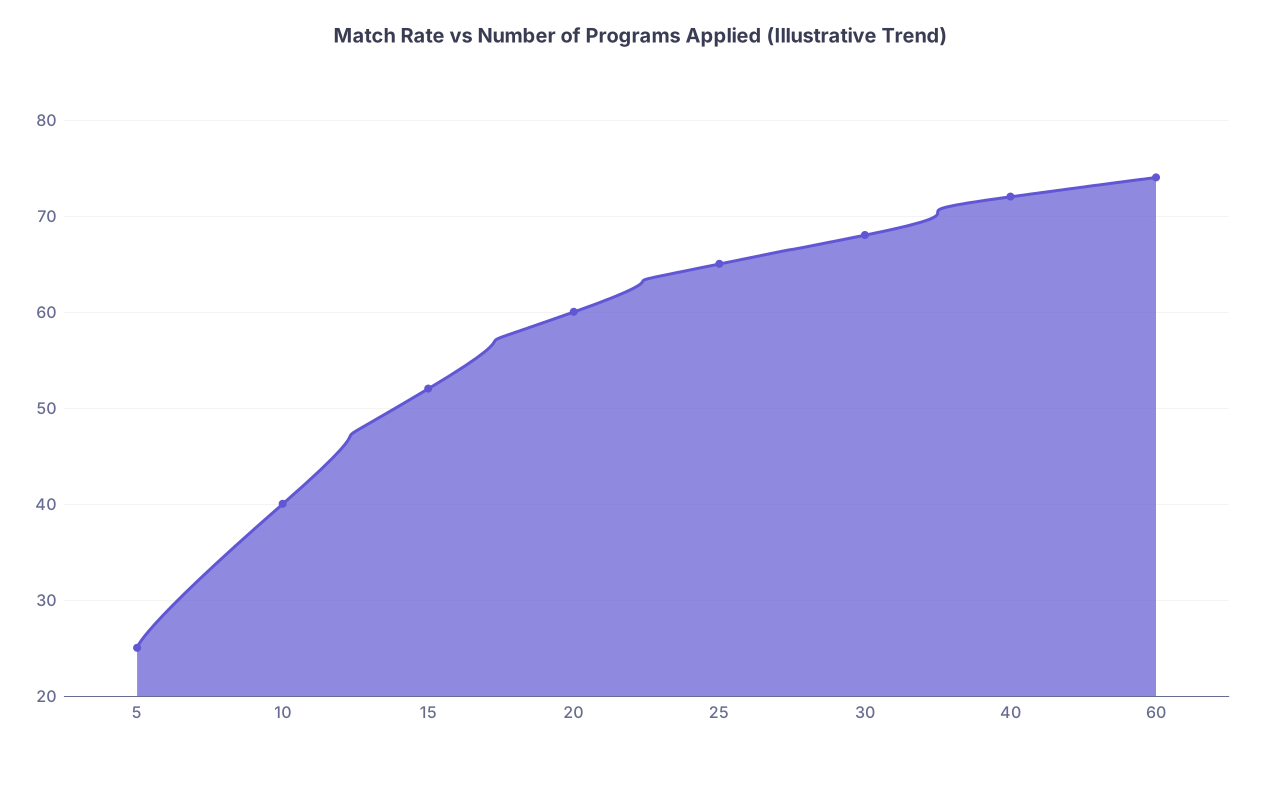
Deciding how many programs to apply to is central to your anesthesiology residency strategy. For DO graduates, this number is generally higher than for MD counterparts, reflecting some residual bias and variability in DO acceptance.
The exact number depends on your tier and risk tolerance, but the ranges below apply to categorical anesthesiology.
General Ranges for DO Applicants in Anesthesiology
Highly Competitive DO Applicant
- Typical range: 25–40 anesthesiology programs
- Rationale:
- You can afford to be more selective.
- Include a mix of reach, mid-tier academic, and strong community programs.
- Example distribution:
- 5–8 reach programs (highly academic, top-tier)
- 15–20 solid mid-tier academic/hybrid programs
- 5–10 DO-friendly community or former AOA programs
Solid/Typical DO Applicant
- Typical range: 40–60 anesthesiology programs
- Rationale:
- Anesthesia is competitive; some programs may filter DOs.
- Casting a wider net increases interview yield.
- Example distribution:
- 5–10 reach
- 20–30 mid-tier academic/hybrid (DO-friendly)
- 15–20 community and former AOA programs
Risk-Adjusted DO Applicant
- Typical range: 60–80+ anesthesiology programs
- Rationale:
- Lower scores or red flags reduce yield.
- You must lean heavily on programs with documented DO acceptance and holistic review.
- Example distribution:
- 3–5 carefully chosen reach programs (if any)
- 20–30 mid-tier programs known to interview DOs
- 30–45 community and former AOA/osteopathic-leaning programs
When to Add a Backup Specialty
For DO graduates with significant risk factors, consider a coordinated backup plan:
- Parallel Planning: Apply primarily in anesthesiology but add a smaller number of programs (<20) in a less competitive field where your profile is stronger.
- Particularly if:
- COMLEX/USMLE scores are significantly below average.
- There are multiple exam failures.
- Advisers express serious concern about your chances in the anesthesia match.
Parallel planning is not a failure; it is a risk management tool.

Step 5: Constructing a Balanced, Strategic Program List
Once you have a sense of how many programs to apply to, build a balanced list that reflects your goals and probabilities.
Stepwise Approach
Define Nonnegotiables
- Geography: regions you must be in (family, spouse’s job, visa issues).
- Program structure: categorical vs advanced + transitional/prelim year.
- Visa sponsorship if you are an IMG/DO graduate needing support.
Create Tiers Within Your List Group programs into approximate tiers based on competitiveness and your fit:
Reach Programs (10–20% of list)
Top academics, extremely popular urban centers, or ultra-competitive locations (e.g., certain coastal cities).
Apply here, but do not overpopulate this tier.Target Programs (50–60% of list)
Programs where your stats and experiences fall near or slightly above their historical averages, with documented DO acceptance.
These should be your main focus for interviews.Safety/Anchor Programs (20–30% of list)
Community programs and DO-heavy or historically osteopathic sites where your profile is clearly competitive.
These provide essential match security.
Verify DO-Friendliness Across Tiers For each tier, verify:
- Presence of DO residents.
- Statement of COMLEX acceptance, if needed.
- Warm response from program leadership when you inquire (e.g., at virtual open houses).
Track Programs in a Spreadsheet Include columns for:
- Program name and location
- Program type (academic, community, hybrid)
- DO-friendliness (high / moderate / low)
- USMLE requirement (yes/no; optional)
- Your tiering (reach/target/safety)
- Notes from residents, advisors, or open houses
Example for a Solid DO Applicant
Target: 50 anesthesiology programs.
- 7 reach (big-name academic centers where you meet minimums but are not clearly above average).
- 25 target (university-affiliated, DO-friendly programs with DO residents).
- 18 safety/community or former AOA programs, heavily DO-oriented.
You might, for example:
- Prioritize the Midwest and Southeast if those regions are known to be more DO-friendly.
- Include a handful of West Coast programs as reaches if you have strong personal ties there.
Step 6: Tailoring Your Application to Anesthesiology Programs
Program selection is only half the story; how you present yourself to those programs matters too.
Personal Statement and Program Signaling
- Make your personal statement anesthesiology-specific, focusing on:
- Patient-centered perioperative care
- Interest in physiology, pharmacology, and critical care
- Experiences in the OR, ICU, or acute care settings
- Do not dwell excessively on osteopathic identity, but own it confidently:
- Briefly highlight how osteopathic principles (whole-person care, MSK/OMM training, primary care emphasis) strengthen your anesthesiology practice, especially in perioperative evaluation and pain management.
If your application system allows program signals (e.g., signals in ERAS):
- Use them strategically on:
- Programs where you have a genuine geographic or personal connection.
- Mid-tier academic or hybrid programs that seem like very good “target” fits.
- As a DO applicant, avoid using all signals on ultra-reach programs only.
Letters of Recommendation
- Aim for 2 letters from anesthesiologists, ideally:
- At least one from a site where you rotated and where the letter writer can comment on direct OR performance.
- One from a DO anesthesiologist or academic leader if possible.
- The third letter can be from:
- ICU, surgery, or medicine faculty who can highlight your critical thinking and teamwork.
Explaining COMLEX vs USMLE
If you are COMLEX-only:
- Ensure that score reports are uploaded correctly and easily accessible.
- Be prepared to briefly explain your decision not to take USMLE, if asked:
- Focus on the fact that COMLEX is a rigorous, widely recognized licensing exam and that your performance reflects your readiness.
- Avoid sounding defensive.
Step 7: After Applying – Refining Strategy for Interviews and Ranking
Once applications are out, continue refining your anesthesia match strategy.
Managing Interview Invitations
- Track invitations:
- Which types of programs are responding (academic, community, former AOA)?
- Are DO-friendly programs indeed offering more interviews?
- If you have a low interview yield early:
- Consider sending targeted, concise update emails or letters of interest, especially to programs where you have a real connection.
- Ask your advisors whether contacting programs on your behalf is appropriate.
Interview Mix and Match Security
As a DO anesthesiology applicant, aim for:
- At least 10–12 interviews for a reasonably high chance of matching.
- More if you are risk-adjusted or have multiple red flags.
If you end up with:
- 15–20+ interviews:
You are in a strong position. Focus on ranking by genuine fit, not just prestige. - 6–9 interviews:
You remain in contention but must rank all programs you interviewed at, unless there is a severe, clear dealbreaker. - Fewer than 6 interviews in anesthesiology:
Discuss with advisors whether to bolster your backup specialty plan or consider the SOAP.
Constructing Your Rank List
When building your rank list:
- Always rank in true order of preference (assuming you would be willing to train at each program).
- Do not game the system by ranking a “safety” first just because you think they like you more.
- As a DO graduate, recognize:
- Some DO-friendly community programs will give you superb clinical training and fellowship opportunities.
- “Prestige” does not always correlate with the best fit for your personality, learning style, or long-term goals.
FAQs: Program Selection Strategy for DO Graduates in Anesthesiology
1. As a DO graduate, do I need to take USMLE for anesthesiology residency?
Not strictly, but it expands your options. Many anesthesiology programs accept COMLEX-only, especially DO-friendly and formerly osteopathic programs. However, some highly competitive and historically MD-focused programs still require or strongly prefer USMLE. If you are early in your training and committed to anesthesiology, taking USMLE Step 1 and 2 can make your program selection strategy more flexible. If you are already COMLEX-only, focus on programs that explicitly accept COMLEX and have matched DOs recently.
2. How many anesthesiology programs should I apply to as a DO?
For most DO graduates:
- Highly competitive DO: ~25–40 programs
- Solid/typical DO: ~40–60 programs
- Risk-adjusted DO: ~60–80+ programs
Your exact number depends on board scores, clinical record, and red flags. The goal is to secure enough interviews (ideally 10–12+) for a safe anesthesia match, while balancing cost and burnout considerations.
3. How can I tell if a program is truly DO-friendly?
Look for:
- DO residents in current and recent classes.
- DO faculty or leadership.
- Website or FREIDA notes stating COMLEX acceptance.
- Positive feedback from DO residents or recent DO graduates.
- Reasonable response when you ask about DO applicants at open houses.
If a large program has zero DOs, requires USMLE, and offers vague answers about DOs, it may not be DO-friendly, and you should treat it as a reach or skip it.
4. Should I prioritize prestigious academic programs or DO-friendly community programs?
Balance both according to your profile and goals. For a DO graduate:
- Include some prestigious or highly academic programs if you are competitive and interested in academic careers.
- Make DO-friendly mid-tier academic and strong community programs the backbone of your list, especially if you are a solid/typical or risk-adjusted applicant.
Ultimately, match security and training quality should take priority over name recognition. Many DO anesthesiologists from community or regional academic programs obtain competitive fellowships and excellent jobs.
By understanding your own profile, researching DO-friendly anesthesiology residency programs, and building a deliberate, balanced application list, you can create a program selection strategy that maximizes your chances of a successful osteopathic residency match in anesthesiology—without sacrificing personal fit or long-term career goals.