
Most applicants are doing their advanced vs categorical mix completely backwards. And they are wasting interviews because of it.
You are not just deciding “how many programs to apply to.” You are deciding how many different matches you are trying to pull off at the same time. If you do prelim + advanced incorrectly, you can rank 80 programs and still end up unmatched.
Let me break this down specifically.
1. First principle: you are in two Matches if you apply advanced
If you apply to advanced positions (e.g., Derm, Rad Onc, Neuro, Anesth, Radiology, some Neuro, PM&R), you are effectively in two overlapping but separate games:
- The advanced specialty Match
- The PGY‑1 (prelim or TY or categorical) Match
These are linked in the algorithm but not in your risk. You can:
- Match advanced and fail to match a PGY‑1
- Match prelim/TY and fail to match advanced
- Match categorical somewhere else and have the advanced rank list become irrelevant
- Fail on both sides
Most students underestimate that risk. They think: “I’m ranking advanced programs with integrated prelims, so I’m safe.” No. You are only safe if:
- The program offers true categorical positions (PGY‑1 + PGY‑2 bundled) or
- Your supplemental PGY‑1 list is deep enough and appropriately paired
You are juggling three numbers:
- Number of advanced applications
- Number of prelim/TY applications
- Number of true categorical applications (in the same or different specialty)
You optimize by making those three numbers proportional to your risk profile, not equal to each other and not equal to your friends’.
2. Categorical vs advanced vs prelim: clean definitions that actually matter
Residency websites muddy this. ERAS filters do too. Let’s strip it down.
Categorical (C)
You match once, you start as PGY‑1 and progress in the same program through completion. Example: categorical Internal Medicine, categorical General Surgery, categorical EM.
Risk of “partial match” = essentially zero, because there is no separate PGY‑2 position.Advanced (A)
You match into PGY‑2 and above. You must also match (or otherwise secure) a PGY‑1 year. Example: Dermatology, Radiology, Anesthesia (in many places), PM&R, some Neuro.Preliminary (P)
One‑year PGY‑1 in IM or Surgery, not guaranteed continuation. Often designed for advanced specialties’ interns, but also used by unmatched folks biding time.Transitional Year (TY)
One‑year broad PGY‑1, often cushier than pure prelim IM or Surgery, but much more competitive.
Some programs muddy this by saying “advanced with linked prelim.” That usually means:
- They will automatically link you to their own prelim year if you match there, but
- You must still rank them properly as a supplemental list and you should not assume those linked prelim seats cover all risk
The only truly low‑risk scenario is a categorical position.
3. Risk profiles: where you land on the spectrum
Now the part students gloss over: your risk category determines not only how many total programs to apply to, but how to divide categorical vs advanced vs prelim.
Use this rough risk stratification. Be honest with yourself.
| Risk Level | USMD | US DO | IMG |
|---|---|---|---|
| Low | 25–40 | 40–60 | 70–90 |
| Moderate | 40–60 | 60–80 | 90–120 |
| High | 60–80 | 80–110 | 120–160 |
Those are total program counts for one specialty family (e.g., advanced + prelim + backup categorical in another specialty), not per subtype.
The more advanced‑heavy your plan, the more those numbers need to be on the higher side, because your effective “chance to fully match” is the product of:
- Probability of matching advanced, and
- Probability of matching an acceptable PGY‑1
Miss either and you are scrambling.
4. Core strategy: think in complete training bundles, not raw program counts
Here is the mindset shift that prevents disaster:
Stop counting “I applied to 70 programs.”
Start counting “How many distinct complete pathways to board eligibility did I give myself?”
A complete pathway is either:
- One categorical program (IM categorical at Program X = 1 pathway)
- Or one advanced spot + one realistic PGY‑1 plan that you would actually accept
So if you apply to:
- 30 advanced Radiology programs
- 25 prelim IM programs
- 5 TY programs
You have not given yourself “60 shots.” You have given yourself:
- At best, ~30 advanced pathways, each of which is constrained by whether you can plug in one of those 30 PGY‑1 slots in a way you find acceptable.
If you only ranked 10 of those prelims high enough to tolerate them in a bad city, that is not 25 prelims. That is 10 usable ones.
You must align three numbers:
- Advanced interviews you are realistically competitive for
- Number of prelim/TY spots you would actually tolerate if your advanced match is successful
- Backup categorical pathways if the whole advanced project fails
If those three do not line up, your “total numbers” are misleading.
5. Concrete scenarios and numbers: what actually works
Let us walk through the patterns I see over and over. These are the types of applicants sitting in my office in November with 11 interviews or 2 interviews or 25 scattershot invites.
Scenario A: USMD, mid‑tier, applying Diagnostic Radiology (advanced) + prelims, no backup
Profile:
- USMD, Step 2 CK 245, average clinical grades, minimal red flags
- Applying Radiology advanced at mid‑range programs
- No IM categorical backup
- Willing to live in most regions, not ultra‑picky
What usually happens when they do it wrong:
- 30 advanced Rads applications
- 10 prelim IM
- 5 TY
- Total = 45 programs; applicant thinks that is “enough”
Result:
8–10 advanced interviews
3–4 prelim/TY interviews
Rank list ends up thin: 10 advanced, 4 prelim/TY. If the algorithm pairs them suboptimally, they risk:
- Matching advanced in a city where they have no prelim; or
- Matching prelim only; or
- Not matching at all
What a safer strategy looks like:
- Advanced Rads: 40–50 programs
- Prelim IM/TY: 20–25 programs
- Optional: 10–15 categorical IM as a parallel list
Approximate interview expectations (not guaranteed, but realistic):
- Advanced: 10–14 interviews
- Prelim/TY: 8–12 interviews
- Categorical IM: 4–8 interviews (if applied broadly)
That gives:
- 10–14 advanced pathways, each potentially matched with 8–12 PGY‑1 options
- A legitimate categorical IM backup if Rads collapses
Key takeaway: the PGY‑1 number should usually be at least half of your advanced applications, and often closer to 60–70%, unless you have large integrated programs that guarantee a linked prelim.
Scenario B: DO applicant, moderate scores, Anesthesiology advanced + IM categorical backup
Profile:
- US DO, COMLEX decent, Step 2 CK ~235, no major red flags
- Applying Anesthesia advanced
- Smartly adding IM categorical as backup
Wrong pattern I see:
- 50 Anesthesia advanced
- 5 prelim IM
- 0 TY
- 15 IM categorical
- Total = 70, but the distribution is skewed
Why this is risky:
- With moderate stats as a DO, advanced invites may be limited (say 6–8)
- Only 5 prelims is nowhere near enough if they match one of those advanced programs
- The IM categorical backup is fine, but if they match Anesthesia and no prelim, they are in trouble
More rational distribution:
- 35–40 Anesthesia advanced
- 15–20 prelim IM
- 5–8 TY (if willing to move more)
- 20–25 IM categorical
Total ~75–90, but notice:
- The prelim/TY number is now roughly 50–70% of the advanced applications
- The IM categorical backup is worth something on its own; ~20–25 is a real chance to match
In practice, I feel a DO applicant at this level is under‑applying if they keep totals below ~80.
Scenario C: IMG applying Neurology (mixed advanced and categorical)
Neurology complicates things because some programs are categorical, some are advanced.
Profile:
- IMG, Step 2 CK ~240, some US letters, mixed clinical exposure
- Targeting Neurology in any region
- No separate backup specialty
Let us say the programs break down like this in their target universe:
- 40 categorical Neuro
- 25 advanced Neuro
- 20 prelim IM that historically accept IMGs
How they often misfire:
- Apply to all 25 advanced
- Apply to only 8 prelims
- Apply to 25 categorical
- Total = 58, but the coupling is weak
Smarter:
- Categorical Neuro: 40
- Advanced Neuro: 25
- Prelim IM: 15–18 (those that have taken IMGs)
Total = 80–83
Why?
- The advanced vs prelim ratio becomes ~1.0–1.2:1, rather than 3:1
- If they get 5 advanced interviews and 5–7 prelims, they actually have a coherent PGY‑1 plan
- Categorical Neuro interviews stand alone and protect them from partial match problems
IMGs in particular overvalue raw number of advanced applications and undervalue PGY‑1 depth. I have seen IMGs match advanced Neurology in a decent city and scramble for a prelim because they had 3 prelim interviews, all in ultra‑competitive urban centers.
6. How many prelim/TY programs do you need?
This is where almost everyone underestimates. They think: “Prelims are easy, no one wants them.” False. The nice prelims and TYs are often more competitive relative to their size.
Let me be blunt.
If you are doing any advanced specialty and are not in the top tier, you want something like:
- USMD, low risk:
- Prelim/TY = at least 0.4–0.6 × number of advanced applications
- USMD/DO, moderate risk:
- Prelim/TY = at least 0.6–0.8 × advanced
- DO/IMG, higher risk:
- Prelim/TY = close to 1:1 with advanced applications
So if you apply to 40 advanced programs and you are moderate risk, 25–30 prelim/TY should not scare you. That is normal.
And then within those:
- Try to include at least 5–10 “less sexy” prelims: mid‑sized community hospitals, less trendy cities, not all “Boston / NYC / Bay Area / Chicago university” prelims
- TYs should be treated like another advanced specialty in terms of competitiveness; do not count them as guaranteed safeties
7. Categorical backup: when and how much?
There is macho pressure to “commit” to the competitive field and not apply to a backup. That is how you end up in SOAP with a 250.
Let me be clear: For many advanced specialties, a categorical backup is rational, not cowardly.
Common advanced specialties that should seriously consider a categorical backup:
- Dermatology → IM or FM or even categorical prelim/TY‑heavy strategy
- Diagnostic Radiology → IM or prelim + willingness to reapply
- Anesthesia → IM/FM backup for moderate to high risk profiles
- PM&R → IM/FM sometimes, depending on competitiveness and visa status
- Radiation Oncology → IM often makes sense as backup now, given contraction of the field
General guideline:
- If your specialty is in the top half of competitiveness (per NRMP data and Step distributions), and you are anything other than “clearly above average” for that field, you likely benefit from 15–30 categorical backup applications.
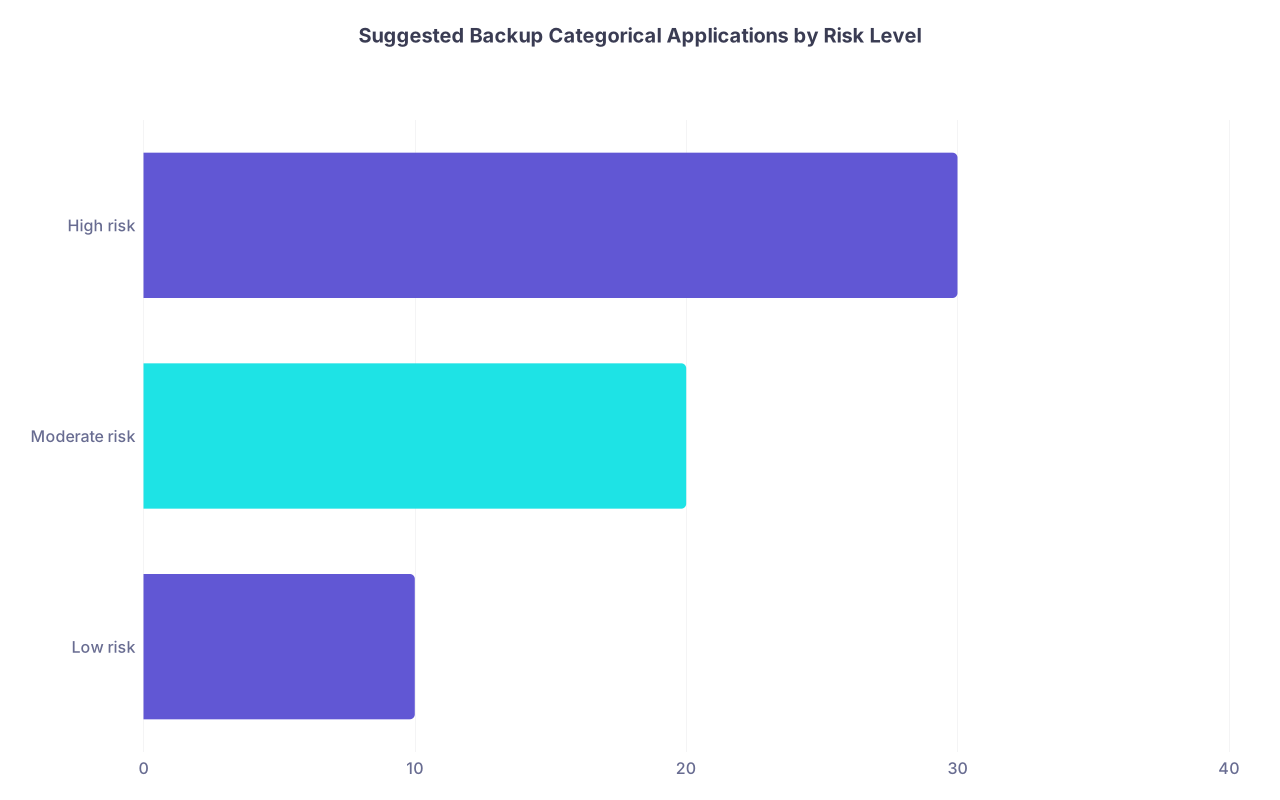
| Category | Value |
|---|---|
| Low risk | 10 |
| Moderate risk | 20 |
| High risk | 30 |
What that looks like:
- 35–45 advanced in your dream specialty
- 20–25 prelim/TY
- 15–25 categorical backup in a safer specialty
Yes, that can push your total toward 80–90+ programs. For a significant number of applicants, that is appropriate.
8. How to actually structure the rank list so the numbers work for you
The Match algorithm supports:
- Primary rank list (categorical + advanced)
- Supplemental/linked PGY‑1 lists for each advanced program
Where applicants mess this up:
- They do not rank enough prelims under each advanced program
- They only list “nice” prelims under top advanced programs, leaving no realistic options
- They forget to create a separate, long, independent prelim-only list (if they are willing to do a standalone prelim even without an advanced match)
A more disciplined approach:
For each advanced program you would genuinely attend, attach a deep supplemental list of prelim/TY programs that you would accept with that site. Depth here matters. 8–15 is common for moderate risk.
Then create a separate generic PGY‑1 rank list (for matching into prelim/TY alone), only including programs you are willing to attend even if you do not match the advanced slot.
If you have a categorical backup specialty, that sits on the primary list after your advanced options.
In practice:
Rank positions in this order (typical):
- Advanced + linked prelim combinations ranked top to bottom
- Categorical backup positions (IM, FM, etc.)
- Standalone prelim/TY positions (if you would prefer that over going unmatched and SOAPing)
The exact order inside those categories is personal, but the structure stops you from accidentally “wasting” a decent advanced match because there is nothing under it.
9. Worked example: optimizing total numbers across advanced + prelim + categorical
Let us do one complete case. USMD, borderline competitive, applying Anesthesiology advanced with IM backup.
Profile:
- Step 2 CK 238
- Pass on Step 1
- Mostly High Pass in clerkships, one Pass in Surgery
- 1 home Anesthesia rotation + 1 away
- No major red flags
Here is how I would not let them apply:
- 25 advanced Anesthesia
- 8 prelim IM
- 0 TY
- 10 categorical IM
- Total 43
That is a high‑risk pattern. Now a more appropriate plan:
Target totals:
- Advanced Anesthesia: ~40–45
- Prelim IM: ~20
- TY: ~5–7
- Categorical IM: ~20
Say we end up with:
- 42 advanced
- 22 prelim
- 6 TY
- 21 categorical IM
Total = 91 programs.
This looks insane to the uninitiated. But functionally:
- They probably get 10–13 Anesthesia interviews
- They get 8–12 prelim/TY interviews
- They get 6–10 IM categorical interviews
Rank strategy:
- For their top 8–10 Anesthesia programs, attach 8–15 prelim/TY options each (some repeated across them)
- Rank IM categorical programs below those advanced+prelim combos
- Then, for last‑ditch insurance, rank a few standalone prelims at the very bottom
This applicant now has:
- Realistic advanced + PGY‑1 pathways
- A decent chance to simply match IM categorical and have a stable career if Anesthesia falls through
- Less need to SOAP in panic
They are using the high program count intelligently rather than just spamming one category.
10. When can you reduce total program numbers?
Not everyone needs to hit 80+ applications. Some of you genuinely can be more conservative.
You can trim total numbers if:
- You are a USMD with strong metrics for your specialty (Step 2 CK clearly above that specialty’s matched median, strong clinical performance, good letters, maybe home program in that field)
- Your specialty has plenty of categorical spots (e.g., categorical IM, FM, Peds, Psych, many EM programs)
- You are flexible on geography
In that setting:
- A USMD aiming for categorical IM alone might be fine with 25–40 programs.
- A USMD applying Neurology where the majority are categorical could consider 30–45.
But once you introduce advanced positions with high competition and a separate PGY‑1, the safe lower bound rises quickly.
11. Common tactical mistakes that wreck otherwise decent applications
Let me list the predictable ways people sabotage themselves:
Under‑applying prelims/TYs
Applying to 30+ advanced and 5 prelims. This is the most common and the most fixable.Geographic arrogance
Limiting prelims to 2 cities because of a partner or family. Then matching advanced somewhere else and having no PGY‑1.Reality‑blind TY lists
Treating TYs as safeties. The cushy community TYs in good metros are shark tanks. You need real prelim IMs in the mix.No categorical backup with obvious risk factors
225 Step 2 CK, derm application, zero backup. This is not bold; it is reckless.Unbalanced program tiers
Applying to 40 advanced programs, all of them big name university centers, with no mid or lower tier community options where your profile actually fits.Not coordinating letters and personal statements with backup specialty
You send three Anesthesia letters and an Anesthesia‑focused personal statement to IM categorical backup programs. Some will still interview you. Many will not.
12. Practical steps to decide your actual numbers
If you want a concrete workflow, do this on a blank sheet or spreadsheet:
Define your primary specialty and whether it is mostly categorical or advanced.
Assign yourself to low / moderate / high risk for that specialty based on NRMP charts by Step 2 CK and your context.
Choose a target range for total applications based on your category and grad type (see earlier table). Example: USMD, moderate risk → 40–60 baseline, then adjust up if you are doing advanced + prelim + backup.
For advanced‑heavy plans, allocate:
- 45–60% to advanced
- 25–35% to prelim/TY
- 15–30% to categorical backup (if indicated)
For primarily categorical specialties (IM, FM, Peds, Psych for many applicants):
- 70–90% categorical in core specialty
- Optional 10–30% in a second, slightly safer specialty if you are high risk
Reality‑check against your budget and bandwidth. If your ideal is 100 programs but you can pay for 70, cut intelligently: drop some reach advanced programs first, not the backup categorical or prelims.
Here is a snapshot way to think about distribution:
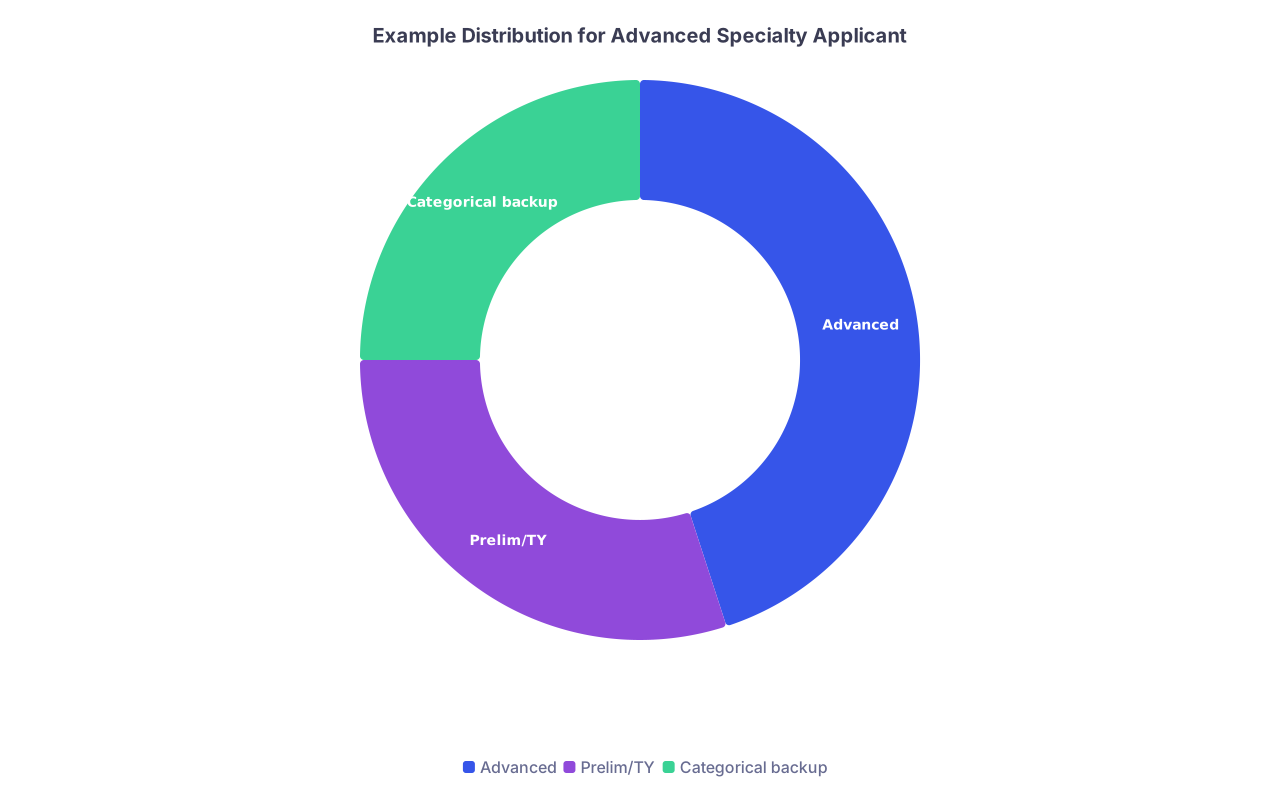
| Category | Value |
|---|---|
| Advanced | 45 |
| Prelim/TY | 30 |
| Categorical backup | 25 |
That is roughly what I end up recommending for many moderate‑risk advanced‑specialty applicants.
FAQ (exactly 6 questions)
1. If a program says “advanced with linked prelim,” do I still need to apply to separate prelims?
Yes, in almost all cases. “Linked” usually means that if you match the advanced spot and rank their prelim high, the algorithm will pair them. It does not guarantee that you will get their prelim if it is very limited or competitive. You still need independent prelim/TY applications to protect yourself, especially in other geographic regions.
2. How many interviews do I need in an advanced specialty and in prelims to feel reasonably safe?
Broad rule of thumb: for most core specialties, ~10–12 interviews in a single list confers a high likelihood of matching there. For advanced + prelim pairs, I get nervous if I see fewer than 8 advanced and 8 prelim/TY. You can match with fewer, but the risk climbs sharply. If you have 10+ advanced and 10+ prelim/TY plus a backup categorical with 6–8 interviews, your risk is significantly lower.
3. Should I rank categorical backup programs above or below advanced + prelim combinations?
If your true preference is to do the advanced specialty rather than the backup, you should rank advanced+prelim combinations higher. The Match algorithm is preference‑based. Only rank a categorical backup above an advanced combo if you genuinely would prefer that categorical path over being in that advanced program with that PGY‑1.
4. Are prelim Surgery spots interchangeable with prelim IM for advanced specialties?
Not always. Many advanced specialties accept either IM or Surgery prelims, but some have preferences specified in their program requirements. Also, prelim Surgery is often more malignant and less flexible than prelim IM or TY. If you do not specifically need a surgical prelim, IM prelims and TYs are usually more humane and acceptable to a broader list of advanced programs.
5. If I am strong for my advanced specialty, can I cut back more on prelims instead of on advanced programs?
You can trim a bit, but you should not gut the prelim list. Even strong advanced candidates can find themselves in an unexpected geographic region where their prelim options are thin. I might allow a truly strong USMD in, say, Anesthesia to have prelim/TY = roughly 40–50% of advanced applications rather than 60–80%. I would not drop to 10 prelims for 40–50 advanced.
6. Does applying to a categorical backup specialty hurt my chances in the competitive advanced specialty?
In practice, rarely. Programs do not have a unified view of your entire ERAS application list. Anesthesia programs do not see which IM programs you applied to. The “lack of commitment” argument is mostly culture and ego. The only real risk is if your letters and personal statement are so obviously split that neither side feels you are serious. If you keep your application materials tailored and coherent, a categorical backup is almost always a net benefit, not a liability.
Bottom line:
- Stop counting raw applications; count complete training pathways that get you to board eligibility.
- If you apply advanced, your prelim/TY numbers must be real, not an afterthought; 1:1 with advanced is often appropriate for higher‑risk profiles.
- Categorical backups are strategic tools, not signs of weakness. If your risk is anything above low, you should at least model what your numbers look like with a serious backup in place.