
Most applicants doing prelim + advanced completely underestimate the math. And they get burned for it.
You are not applying to “a list of prelims and a list of advanced programs.” You are building pairs. And the number of viable pairs determines whether you match or scramble.
Let me walk you through the actual math, not the hand-wavy “apply broadly” nonsense.
1. The Core Problem: You’re Matching Pairs, Not Single Programs
For prelim + advanced (especially TY/prelim + advanced anesthesiology, radiology, derm, ophtho, neurology, PM&R, rad onc), your risk is not just “Do I match somewhere?” but:
- Match advanced, no prelim → catastrophic
- Match prelim, no advanced → annoying but survivable
- Match both → success
- Match neither → catastrophic
The NRMP algorithm does not “know” you want a linked pair. It only knows your rank list. So your insurance policy is the size and structure of three things:
- Number of advanced programs applied to
- Number of prelim/TY programs applied to
- Number of plausible combinations you can rank
Notice that word: plausible. A TY in Vermont and an advanced derm in Los Angeles are technically combinable. In real life, most people will not rank that. Geography, spouse, kids, money – they cut your effective combinations drastically.
So we need to quantify what most people treat as vibes.
2. The Matching Math: Independent Probabilities and “Effective Pairs”
Let me break this down simply.
At a high level, for your personal risk, the world looks like this:
- Probability you match to some advanced spot = P(A)
- Probability you match to some prelim/TY = P(P)
If these were independent (they are not fully, but close enough for risk thinking), then:
- Probability match both = P(A) × P(P)
- Probability match advanced only = P(A) × (1 − P(P))
- Probability match prelim only = (1 − P(A)) × P(P)
- Probability match neither = (1 − P(A)) × (1 − P(P))
Your actual target is:
Keep P(match advanced only) as close to zero as you can tolerate.
Why? Because “advanced-only” is the disaster scenario: you now have a PGY‑2 job with no PGY‑1, and you are begging for SOAP spots or hoping programs will flex start dates.
That means for any given advanced probability P(A), you must drive P(P) high enough that:
P(A) × (1 − P(P)) ≈ acceptably small.
If you say “I can tolerate a 5% chance I end up advanced-only”, then:
P(A) × (1 − P(P)) ≤ 0.05
Rearrange:
1 − P(P) ≤ 0.05 / P(A)
P(P) ≥ 1 − 0.05 / P(A)
So if you are relatively strong and think your chance of some advanced spot (A) is ~0.8:
P(P) ≥ 1 − 0.05 / 0.8 = 1 − 0.0625 = 0.9375
You need a prelim/TY match probability of about 94% to hold your disaster risk (advanced-only) at 5%.
That is the conceptual bar. Now — how many applications and interviews does that actually mean?
3. Translating to Real Numbers: Interviews vs Match Probability
NRMP gives you the clue but not the full answer.
The NRMP Charting Outcomes data show roughly:
For mid-competitive advanced specialties (neuro, PM&R, anesth)
8–12 interviews → >90% chance of matching somewhere in that specialtyFor prelim/TY medicine or surgery
7–10 interviews → usually >95% match rate in some prelim/TY (if you are not toxic on paper)
There is variation by Step score, class rank, visa status, etc. I am simplifying to get you a working rule:
- 10+ interviews in a category → ~90–95%+ chance of a match in that category
- 5–7 interviews → moderate risk (20–40% not matching in that category)
- ≤4 interviews → high risk of no match in that category
So the real decision is not “How many programs?” but “How many interviews am I likely to generate with my application flood?”
You can think of it in two layers:
- Applications → Interviews
- Interviews → Match probability
Your application count is a crude lever to force enough interviews to get your match probability up.
4. Application Yield: How Many Programs Needed per Interview?
This is where people crack. They assume their yield (apps → interviews) in prelim is the same as advanced. It is not.
Typical rough yields (for an average US MD with non-red-flag application):
Advanced in a mildly competitive field (anesth, PM&R, neuro):
- 10–15% yield: 10–15 apps per interview
Advanced in more competitive (radiology, ophthalmology, some derm prelim situations):
- 5–10% yield: 10–20+ apps per interview
Prelim medicine:
- 15–25% yield: 4–7 apps per interview
Prelim surgery:
- 10–20% yield: 5–10 apps per interview
TY (transitional year):
- 5–15% yield: 7–20 apps per interview (people underestimate how competitive TYs are)
If you are DO, IMG, visa‑requiring, low Step, or with red flags, drop those yields further.
Let’s clearly lay some typical scenarios in a table so you can see the tension.
| Program Type | Typical Yield (US MD) | Apps per Interview (midpoint) |
|---|---|---|
| Advanced Anesth | 10–15% | ~8–10 |
| Advanced Radiology | 5–10% | ~12–20 |
| Prelim Medicine | 15–25% | ~5–7 |
| Prelim Surgery | 10–20% | ~6–10 |
| Transitional Year | 5–15% | ~8–20 |
Those are not formal NRMP numbers. They are the ranges I see when residents show me their spreadsheets.
5. Concrete Example: Middle‑of‑the‑Pack US MD in Anesthesia
You are:
- US MD
- Middle third of class
- Step 2 CK ~245
- No failures, average LORs
- Applying Anesthesiology (categorical + advanced) + prelim med
You want:
- Good shot at anesth (P(A) ≥ 0.9)
- Disaster risk (advanced-only) ≤ 5%
Step 1: How many anesth programs?
Assume:
- Your yield in anesth ~12% (1 interview per ~8–9 apps)
- You want 10–12 interviews to be ~90–95% likely to match somewhere in anesth
Call the target:
- 11 interviews × (8.5 apps/interview) ≈ 94 programs
Round up to 100 anesth applications. Many people in this profile are doing exactly that right now.
Step 2: How many prelim medicine programs?
You want P(P) ≈ 0.94 or higher from the earlier math.
Translation: roughly 8–10 prelim interviews.
Assume prelim medicine yield ~20% (1 interview per 5 apps) because med prelims are a bit friendlier:
- Target 9 interviews × 5 apps/interview = 45 prelim med programs
If you add a few prelim surgery or TYs (say 10 more total), you might:
- Hit 55 prelim/TY applications → ~9–11 interviews
That probably gets you:
- P(A) ≈ 0.9–0.95
- P(P) ≈ 0.9–0.96
Let’s plug worst case into our disaster formula with P(A)=0.9, P(P)=0.9:
- P(advanced only) = P(A) × (1 − P(P)) = 0.9 × 0.1 = 0.09 → 9%
Too high if your personal tolerance is 5%. To push that down, you either:
- Increase P(A) (more advanced apps / interviews)
- Increase P(P) (more prelims / interviews)
- Or both
Say you push P(P) to 0.96. Then:
- P(advanced only) = 0.9 × 0.04 ≈ 3.6%
Now you are in the 3–4% disaster zone. Much better.
What does P(P) ≈ 0.96 look like in practice? Typically:
- 10–12 prelim/TY interviews for a decent applicant
Working backwards at 20% yield → 50–60 prelim applications.
This is how you end up with the common pattern: 80–120 advanced + 40–70 prelim/TY applications.
6. When Advanced Is Ultra‑Competitive (Radiology, Derm, Ophtho)
Now let’s do a slightly uglier case.
You are:
- US MD, slightly above average
- Step 2 ~252
- Applying advanced radiology + prelim TY/medicine
Radiology yield might be more like 8–10% given current competitiveness.
You want:
- 11–13 rads interviews to be reasonably safe
Assume 9% yield → ~11 interviews needs:
- 11 × (1/0.09) ≈ 122 apps
Most people in this world are sending 120–150 radiology applications. That is not hysteria, that is math.
Now prelim/TY:
You absolutely cannot afford to match advanced only in rads. That is a nightmare scenario.
Let us aim more aggressively: disaster risk (advanced-only) ≤ 3%
Assume you succeed in P(A) ≈ 0.9 again. Then:
0.9 × (1 − P(P)) ≤ 0.03 → (1 − P(P)) ≤ 0.033 → P(P) ≥ 0.967
That usually means 11–13 prelim/TY interviews for a typical US MD. Working backwards:
- Prelim medicine: 20% yield → need ~55–65 apps for ~11–13 interviews
- TY: maybe 10% yield → need ~40 apps for 4 interviews
A balanced strategy:
Apply to ~60 prelim med + 30–40 TY + a handful of prelim surg.
Total prelim/TY apps: about 90–100.
Is that painful on ERAS fees? Yes. Is it cheaper than a year off when you match advanced only and scramble for a PGY‑1? Also yes.
7. Geography: The Silent Killer of Your Effective List Size
Everything so far assumed all prelims and advanced programs can be combined into realistic pairs. That is fantasy.
You are not commuting from a prelim in New Jersey to an advanced program in Seattle. So your effective combinations are constrained by:
- Region (Northeast vs South vs Midwest vs West)
- Major metro vs rural
- Family/spouse constraints
- Your own sanity
Think of it this way:
You have:
- 12 anesth interviews across the country
- 9 prelim medicine interviews, also scattered
On paper, you could rank dozens of combinations. In reality, your rank list often looks like:
- Rational clusters:
- Boston + Providence + Hartford
- Chicago + Milwaukee
- Texas cluster
- West Coast cluster
Inside each cluster, you can freely mix prelim and advanced. Across clusters, you probably will not.
So the combinatorial explosion (A × P) is fake. Approximate your effective pairs as:
Sum over regions [ (#advanced interviews in region) × (#prelim/TY interviews in region) ]
If that total number of plausible pairs is small, you are under-covered even if your raw interview counts look big.
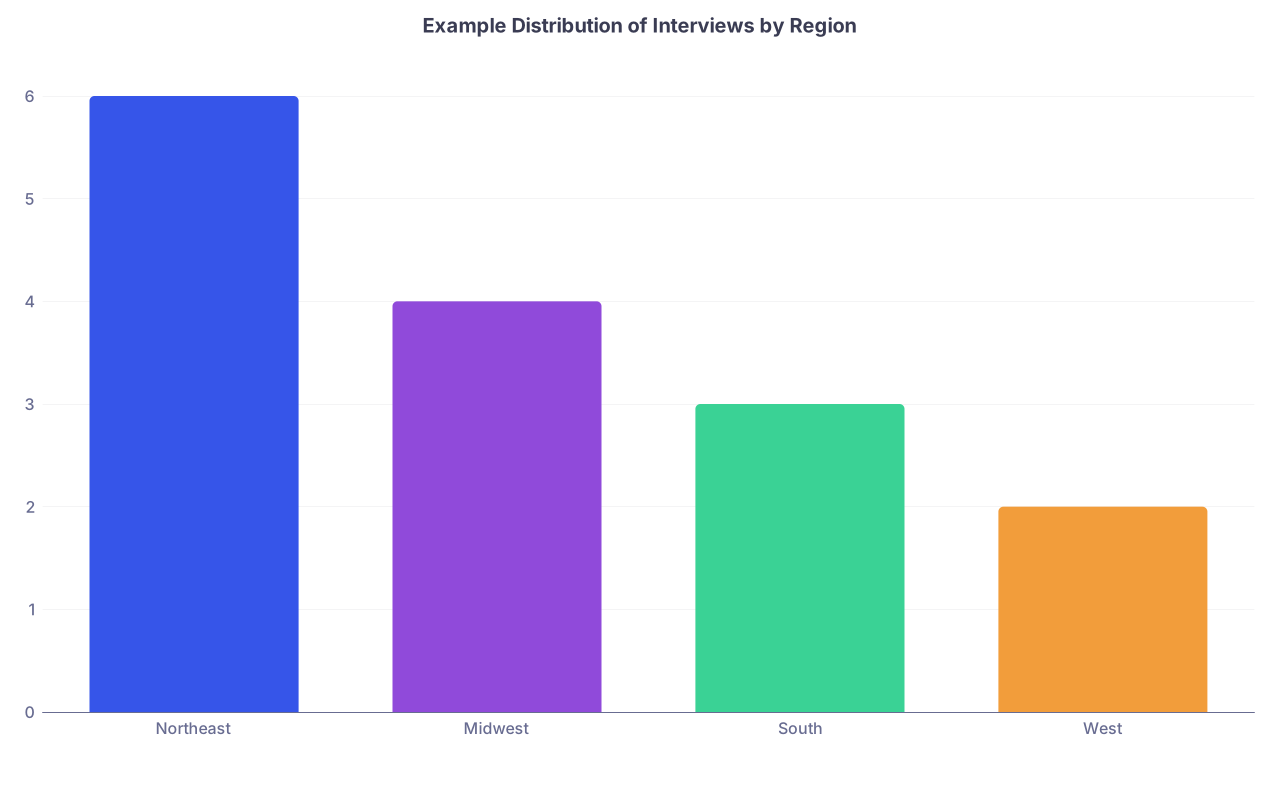
| Category | Value |
|---|---|
| Northeast | 6 |
| Midwest | 4 |
| South | 3 |
| West | 2 |
In that example, suppose prelims are distributed:
- Northeast: 4
- Midwest: 3
- South: 1
- West: 1
Your plausible pairs:
- NE: 6 × 4 = 24
- Midwest: 4 × 3 = 12
- South: 3 × 1 = 3
- West: 2 × 1 = 2
Total: 41 plausible pairs. That is healthy.
But if your prelims are mostly in the South and your advanced are mostly in the West and Northeast, your number of realistic pairs could drop below 10, even though you “have a lot of interviews.”
That is how people get surprised on Match Day.
8. How to Decide Your Actual Application Numbers
Let me condense this into a process rather than shouting numbers.
You want a deliberate choice, not panic-clicking “select all” in ERAS.
Step 1: Brutally categorize yourself
Where do you really fall?
- Top‑tier: 260+ Step 2, AOA, strong research, good letters
- Mid‑tier: 235–255, no major red flags
- Risk tier: <230, DO/IMG, visa required, exam failures, big gaps
Your yield predictions depend on this.
Step 2: Set explicit targets
For advanced:
- Top‑tier: target 8–10 interviews
- Mid‑tier: target 10–12
- Risk tier: target 12–15
For prelim/TY:
- Everyone: target at least 8 interviews
- If advanced is competitive or your app is not stellar: push for 10–12 prelim/TY interviews
Step 3: Estimate your yield and back-calc apps
You can do this as a quick spreadsheet:
| Category | Target Interviews | Estimated Yield | Apps Needed |
|---|---|---|---|
| Advanced Anesth | 11 | 12% | ~90–100 |
| Prelim Med | 9–10 | 20% | ~45–50 |
| Prelim Surg/TY | 2–3 | 10% | ~20–30 |
Total apps: 155–180.
Yes, that is a lot. But those are common numbers in recent cycles.
Step 4: Check your disaster math
Once you choose your targets, sanity-check:
- If I hit my target advanced interviews, am I likely ≥90% to match advanced?
- If I hit my target prelim/TY interviews, am I likely ≥95% to match prelim/TY?
Then:
P(advanced only) ≈ P(A) × (1 − P(P))
If that number is >5–7%, either you are braver than I am, or you need more prelim/TY coverage.
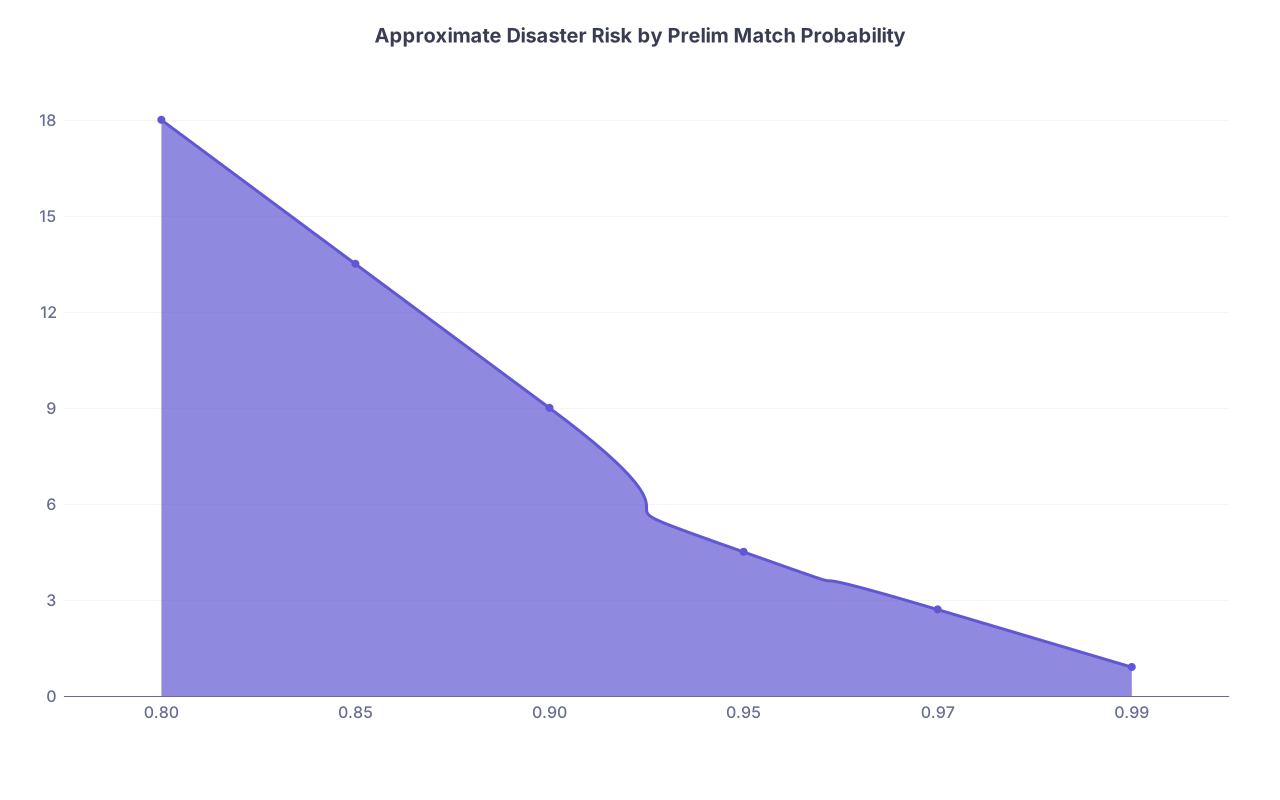
| Category | Value |
|---|---|
| 0.80 | 18 |
| 0.85 | 13.5 |
| 0.90 | 9 |
| 0.95 | 4.5 |
| 0.97 | 2.7 |
| 0.99 | 0.9 |
(Here I assumed P(A)=0.9 for illustration. You can see why P(P) needs to be very high.)
9. Special Situations: Assumptions That Get People Burned
Some common “I thought I’d be fine” scenarios I see every year.
Scenario A: “I am couples matching, so the math is different.”
Yes, and usually worse. You now are correlating two people’s match probabilities across geography. Your effective combinations drop.
Rule of thumb: couples doing prelim + advanced should increase both advanced and prelim application counts by 20–30% compared to a solo applicant of similar competitiveness.
If you thought 100 advanced + 60 prelim was enough solo, couples may need:
- 120–130 advanced each
- 70–80 prelim/TY each
- And extra attention to geographic clustering
Scenario B: “I am applying categorical and advanced in the same field.”
Example: anesthesia categorical + anesthesia advanced + prelim medicine.
Fine. But do not count categoricals as “prelim equivalents.” A categorical spot replaces the need for a prelim only if you match into it. Until then, every advanced spot you rank still needs a prelim/TY behind it.
Your math then is:
- Probability you get some categorical = P(C)
- Probability no categorical but an advanced = (1 − P(C)) × P(A)
You only need the prelim/TY to cover that second group. If your categorical list is solid (e.g., 8–10 interviews), your prelim risk is lower and you may accept slightly fewer prelim apps. Still, people overestimate how many categoricals they will actually rank highly.
Scenario C: “I only applied prelims in one city because my partner is there.”
I get the life reason. But do the math.
If you match advanced but not prelim in that one city, what is your plan? Is your advanced program likely to help you find an outside PGY‑1? Will they let you defer a year?
Sometimes the answer is yes. Often the answer is “we cannot guarantee that.” If the answer is uncertain, your disaster risk just went up. You should expand prelim geography or reconsider advanced geography.
10. Rank List Strategy: Maximizing Your Pairs
Applications and interviews just give you raw material. The rank list is where you turn that into actual probability.
You want:
- As many reasonable prelim+advanced pairs as possible near the top of your list.
- Only then, pure advanced alone, only if you are willing to scramble for a PGY‑1 if necessary.
A simple conceptual structure:
- Rank all your best same‑city or same‑region pairs first
- Then rank best advanced + “less ideal but acceptable” prelims next
- Only after that, rank unsafe advanced‑only options (if you truly accept that risk)
- Then pure prelim-only options (safety net year while you reapply)
A lot of people accidentally stick high‑prestige advanced programs above safer pairs with more realistic prelim options, because prestige blinds them. That is not strategy. That is ego.
A flowchart helps you think it through:

| Step | Description |
|---|---|
| Step 1 | List advanced programs by preference |
| Step 2 | Group by region |
| Step 3 | List prelims by region |
| Step 4 | Create all high quality pairs |
| Step 5 | Consider expanding prelim geography |
| Step 6 | Rank best pairs at top |
| Step 7 | Add remaining advanced only if risk acceptable |
| Step 8 | Add prelim only programs last |
| Step 9 | Same region pairs exist |
11. Cost vs Risk: Where to Stop Adding Programs
At some point you will ask, “Is adding 20 more prelims really worth it?”
Let’s quantify roughly.
You are at:
- P(A) ≈ 0.9
- P(P) ≈ 0.9
So P(advanced only) ≈ 9%.
You add enough prelim apps to bump P(P) up to 0.96:
- New P(advanced only) ≈ 0.9 × 0.04 = 3.6%
That is a 5.4 percentage point drop in disaster risk.
If that requires 20 extra prelim apps at, say, $26 each (ERAS tiered pricing), you are paying about $520 to reduce the odds of a catastrophic future problem by ~5%. Many people would pay that in a heartbeat if it were a tangible insurance policy.
This is not an argument for infinite applications. It is an argument for deliberate tradeoffs:
- If you are going into a field where advanced-only is truly catastrophic (rads, derm, ophtho), you push harder on prelim apps.
- If your field commonly helps with off‑cycle PGY‑1 solutions (some anesth programs do), maybe you tolerate slightly higher risk.
Know which world you live in before you skimp.
12. Quick Heuristics by Applicant Type
Let me give you blunt, non-sugarcoated ballparks. These are general; reality will vary, but they are better than the vague advice you will get on Reddit.
Assuming prelim medicine + some mix of prelim surg/TY:
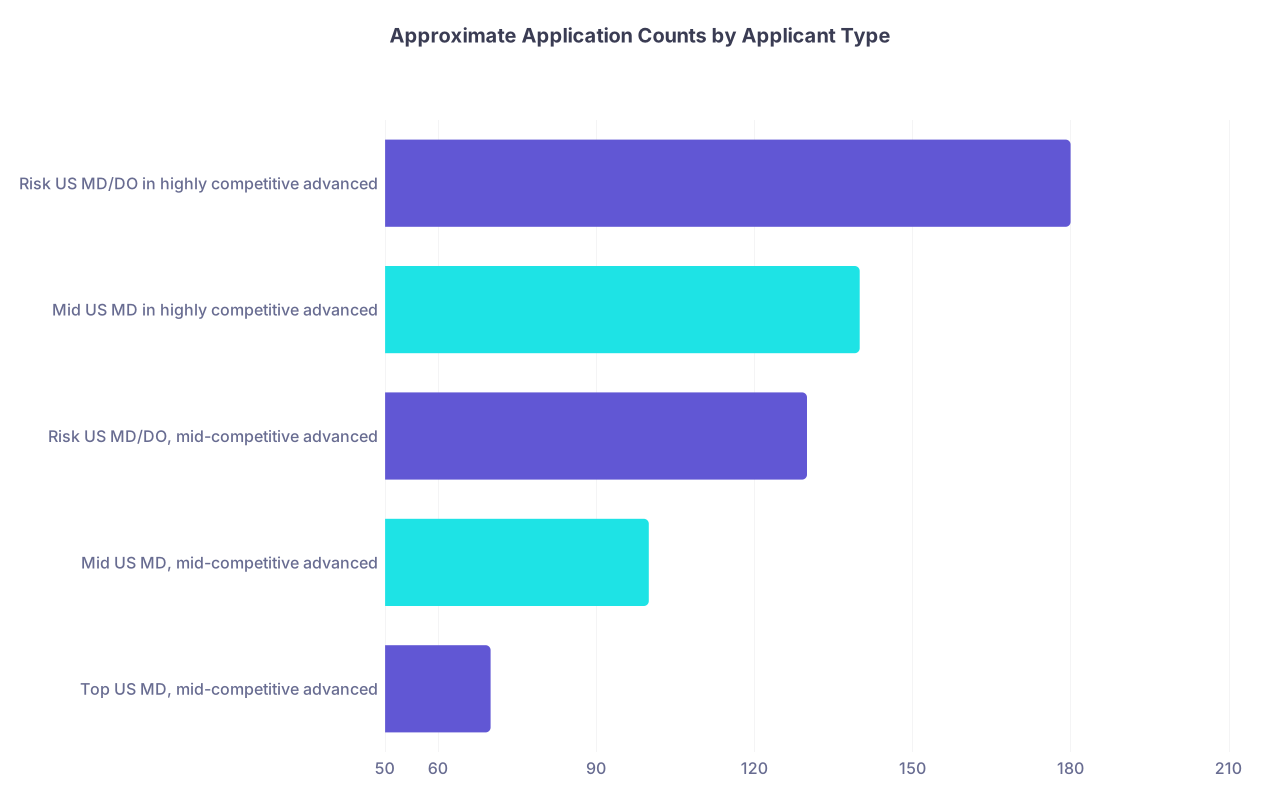
| Category | Value |
|---|---|
| Top US MD, mid-competitive advanced | 70 |
| Mid US MD, mid-competitive advanced | 100 |
| Risk US MD/DO, mid-competitive advanced | 130 |
| Mid US MD in highly competitive advanced | 140 |
| Risk US MD/DO in highly competitive advanced | 180 |
Interpretation (for prelim/TY, not total):
Top US MD, mid-competitive advanced (anesth, neuro, PM&R):
- Advanced: ~60–80
- Prelim/TY: ~30–40
Mid US MD, mid-competitive advanced:
- Advanced: ~80–110
- Prelim/TY: ~50–70
Risk US MD/DO, mid-competitive advanced:
- Advanced: ~110–140
- Prelim/TY: ~70–90
Mid US MD, highly competitive advanced (rads, maybe some regions of ophtho):
- Advanced: ~120–150
- Prelim/TY: ~70–90
Risk US MD/DO, highly competitive advanced:
- Advanced: ~150–200
- Prelim/TY: ~90–120
If those numbers seem high, remember: the penalty for under‑applying is a lost year. The penalty for over‑applying is a few thousand dollars. I know which one hurts more five years from now.
13. Summary: How to Not Be the “Advanced‑Only” Horror Story
Let me strip it down.
- You are not just matching programs. You are matching a pair: advanced + prelim/TY.
- Your goal is not just P(match advanced) high. It is P(match advanced only) low.
- That disaster probability is P(A) × (1 − P(P)). For most people, it is higher than they think.
- You control P(A) and P(P) mainly through application numbers → interviews → rankable pairs.
- Geography chops your combinations down; you must think in regions, not just raw counts.
If you respect that math and build your lists using explicit targets, your chance of waking up on Match Day with an advanced spot and no PGY‑1 goes way down.
FAQ (Exactly 5 Questions)
1. Do I really need 10+ prelim interviews if my advanced list is strong?
If your advanced probability is high (say ≥90%), you still need a very high prelim probability to avoid advanced‑only. For most applicants, that translates to at least 8–10 prelim/TY interviews. Below that, your disaster risk is larger than you think.
2. Can I treat categorical positions as “replacing” prelim spots for this math?
Only partially. Categorical spots reduce how many advanced-only outcomes you care about, but until you actually match categorical, every advanced program still needs a prelim or TY behind it. Use categorical interviews as a buffer, not as a reason to under‑apply to prelims.
3. How should IMGs or DOs adjust these numbers?
Assume lower yield (fewer interviews per 10 applications) and plan to overshoot on both advanced and prelim by at least 20–30% compared to a similarly credentialed US MD. If your school’s advising office tracks interview data, use that instead of guessing.
4. What if money is a serious limit and I cannot afford hundreds of applications?
Then you must narrow geographically and by program tier while still trying to hit interview targets. Apply selectively to realistic programs, lean harder on your home and affiliated hospitals, and accept that your risk may be higher. But do not solve cost by cutting prelims to almost zero; that is exactly where people get trapped.
5. Are TY programs worth the extra hassle compared to prelim medicine?
TYs are often more competitive and have lower yield. They are worth it if you truly value the lifestyle or structure and are willing to pay with extra applications. For pure risk management, prelim medicine programs generally give you better odds per application of securing a PGY‑1, especially as a backup layer.