
The dirty secret is this: when a program director sees that you applied to 80+ programs, they don’t think, “Wow, this applicant is serious.” They think, “This person is either terrified, unfocused, or not competitive enough to be selective.”
Let me walk you through what really happens on our side of the screen when your name shows up on 80 different program lists.
How Program Directors Actually See Your 80+ Applications
Here’s the first reality students never truly grasp: program directors do not sit with your application in isolation, lovingly reading every line. We see you in context. In piles. In spreadsheets. In filters.
Most programs start with some version of this:
- Filter by Step 1/COMLEX 1 (if they still look).
- Hard cut on Step 2 CK / COMLEX 2.
- Then they sort by “number of applications submitted” or “number of programs applied to.”
Yes, that last one is visible. They can see if you blanketed the country.
How do they see it? It’s not a big red flag icon, but it’s in the ERAS metadata and analytics. PDs see “average applications per applicant this year” across their specialty, and they talk. At meetings. On Zoom calls. On those PD listservs you’ll never see. You get comments like:
- “This year everyone applied to 70+.”
- “We’re getting kids applying to 100+ programs, it’s out of control.”
- “If they’re applying to 100, they’re not serious about us.”
Behind closed doors, here’s the honest reaction to someone who applied to 80–100+ programs:
- You’re scared you won’t match.
- You don’t really know what you want.
- You’re probably not tailoring anything.
Do they automatically tank your application for that? No. But it colors how they interpret everything else.
If your application is strong, they’ll shrug and say, “Alright, they panicked, whatever.”
If your application is borderline, your 80+ list reinforces the narrative: “This person’s trying to brute-force the Match.”
That’s not the story you want.
Why Mass Applying Makes You Look Worse Than You Think
Most students think the math is simple: more programs = more chances = safer. That’s applicant math. Director math is different.
PDs know that someone who applies to 80+ programs almost never has genuine interest in 80 programs. You aren’t writing 80 tailored messages. You aren’t researching 80 teaching styles or call schedules. You’re spamming.
I’ve listened to PDs scroll through lists on Zoom and say things like:
- “Yeah, this guy applied to every program in the state and half the country.”
- “She clearly just hit ‘select all’ for our region.”
- “He’s never even been to this part of the country, no ties, no signal, nothing — he’s just spraying applications.”
Mass applying signals desperation more than “strong interest.” And in a competitive specialty, desperation is expensive.
Now, combine that with something else we actually see: interview hoarding.
We know applicants like you are booking 18–25 interviews “just in case,” then canceling late. We see it every year. Some PDs have data: “This applicant got 20+ invites and came to 12.” The resentment is real.
One PD at a mid-tier IM program said it bluntly in a meeting: “These kids apply to 70 programs, hoard 20 interviews, and then ghost us two days before. And the weaker applicants who needed that spot never get it.”
That frustration doesn’t help you. It leads to more aggressive screening. More emphasis on numbers. Less benefit of the doubt for the 80+ applicant.
The Unspoken Thresholds: When Your Number Raises Eyebrows
There is no official policy that says, “If you applied to X programs, we do Y.” But patterns emerge. Here’s the rough, quiet consensus I’ve heard from faculty and PDs in several specialties.
| Total Programs Applied | How PDs Commonly Interpret It |
|---|---|
| 10–25 | Very selective, confident, often strong applicant |
| 30–45 | Normal, thoughtful range for most specialties |
| 50–70 | Mild anxiety, maybe some risk factors in the file |
| 80–100 | High anxiety, likely weaker metrics or no focus |
| 100+ | Panic mode, brute-force strategy, not truly selective |
Are there exceptions? Of course. An IMG trying to break into US residency may need 80+. A DO student shooting for a highly competitive specialty may rationally overshoot.
But if you’re a US MD with reasonably competitive stats applying to core specialties (IM, FM, Peds, Psych, etc.) and you hit 80–100+? Directors make assumptions. And not flattering ones.
That doesn’t mean they blacklist you. It means your volume number becomes another faint piece of evidence about how confident the market is in you.
The Psychological Story Your Application Number Tells
Program directors are not just reading your metrics. They’re reading your behavior.
When they see 80+ programs, they mentally connect that to:
- Your personal statement: Is it generic, full of clichés, could be sent anywhere?
- Your geographic spread: Coast to coast with zero pattern or ties?
- Your signals (for specialties that use them): Did you throw signals at 5 reaches and then still apply to 100 total?
- Your letters: Are they vague and lukewarm, suggesting your home faculty didn’t think you’d have an easy match?
I sat in a rank meeting where the PD literally said:
“Look, he applied to 95 programs, his Step 2 is 216, and his personal statement could have been written by ChatGPT. This is a kid who knows he’s in trouble and is praying for volume.”
Everyone in the room nodded. That one line framed his entire application.
Now flip it.
We had an applicant who applied to 28 programs in a competitive specialty, had strong scores, a clear geographic focus, and a very specific narrative: ties to the region, clear subspecialty interest, concrete reasons for that style of training.
The PD’s take: “If he only applied to 28 and still seems this relaxed, he’s probably getting interviews at the big names. Let’s not lose him.”
Same file quality, different application strategy, totally different room energy.
Your number is part of your story. Apply like someone who expects to be wanted, not like someone praying to sneak in anywhere.
Specialty-Specific Reality: Where 80+ Makes Sense and Where It Doesn’t
Let’s strip the emotion out of it for a moment and talk actual risk.
Here’s the internal mental chart PDs are holding, whether they say it out loud or not.
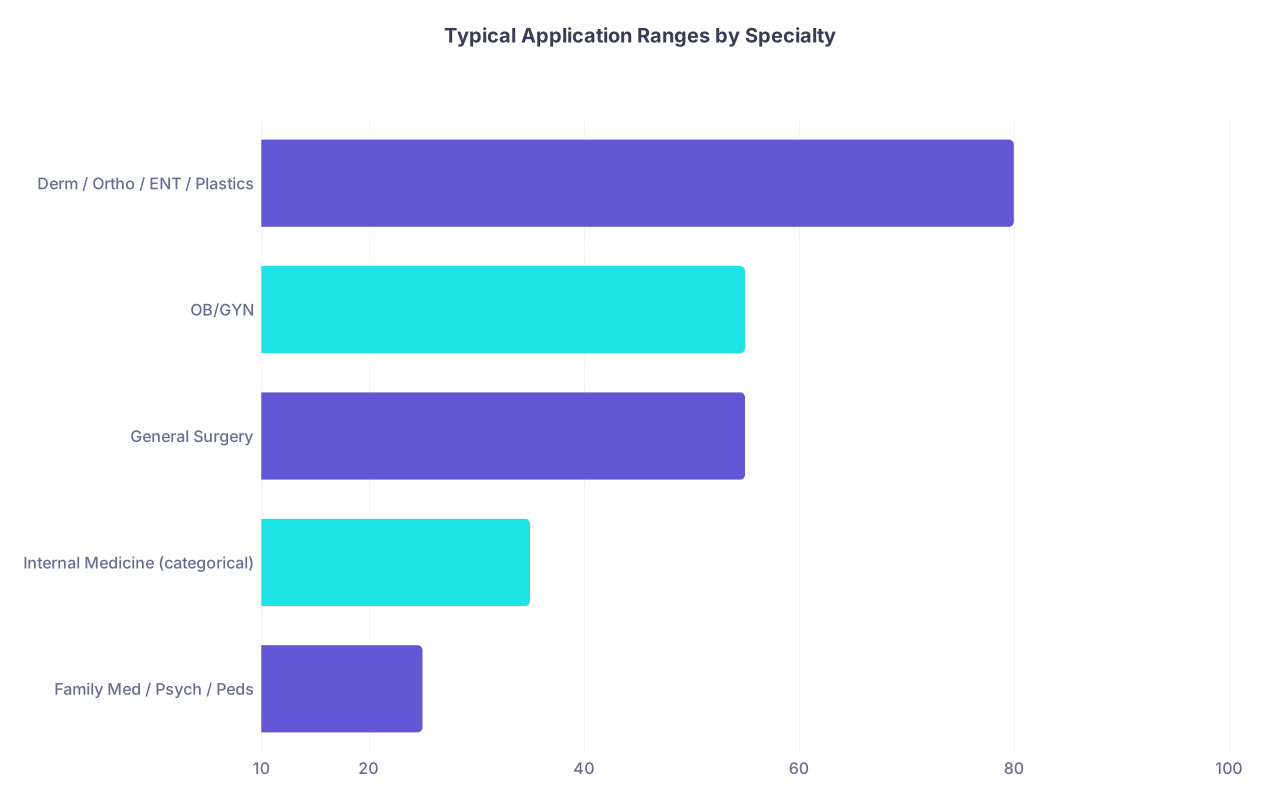
| Category | Value |
|---|---|
| Family Med / Psych / Peds | 25 |
| Internal Medicine (categorical) | 35 |
| General Surgery | 55 |
| OB/GYN | 55 |
| Derm / Ortho / ENT / Plastics | 80 |
This is typical, not prescriptive, but it matches what a lot of PDs expect to see in a sane market. When they see someone wildly outside these informal bands, they start asking why.
- Applying to 80+ family medicine programs as a US MD? That screams either serious performance issues or zero advising.
- Applying to 80+ general surgery programs with mid-range stats? That’s not crazy, but it frames you as anxious.
- Applying to 80–120 derm/ortho/ENT/plastics programs? That’s actually closer to the norm for non-superstar applicants.
PDs talk about this in their specialty meetings. They know the game. They also know who is playing it smart vs blindly.
What really separates you is not the absolute number. It’s the relationship between your competitiveness and your application volume.
If your scores, grades, letters, and CV put you in the top third, but you apply like you’re bottom quartile, PDs sense that mismatch. And they start wondering what you or your advisors know that they don’t.
The Hidden Cost: You Look Less Genuinely Interested
Program directors are not stupid. They know most applicants are playing the numbers. But they still crave one thing: people who actually want their program.
When you apply to 80+ places, you make it harder to convince anyone that you actually care about them specifically. Especially if you don’t do the extra steps.
Here’s how this plays out.
Applicant A applies to 38 programs in the Midwest, writes a couple of program-specific paragraphs in emails, attends virtual open houses for 5–8 of them, and has some pattern that makes sense geographically or academically.
Applicant B applies to 92 programs across the entire US. No regional pattern. Doesn’t show up to virtual events. Sends zero tailored communication. Same stats as A.
When it comes down to the 15th interview slot, who looks like a better bet to rank them highly? Applicant A. Every time.
PDs think in terms of yield. They don’t want to waste interview slots on people who will rank them #17 and then complain about call schedule.
An 80+ list silently whispers: “You’re one of many. I’ll go wherever gives me a spot.” That’s fine for you. Less fine for them.
How Many Programs Should You Actually Apply To?
You want numbers. Fine. I’ll give you real ranges, then I’ll tell you how PDs judge within them.
Assume you’re a US MD or DO, reasonably competitive (no catastrophic failures, maybe a few warts), and aiming for one of the common specialties. Roughly:
| Applicant Profile | Core Specialties (IM/FM/Peds/Psych) | Surgical (Gen Surg, OB) | Very Competitive (Derm/Ortho/ENT/Plastics) |
|---|---|---|---|
| Strong (top third) | 20–30 | 35–45 | 50–70 |
| Middle of the pack | 30–40 | 45–60 | 70–90 |
| Weaker metrics / red flags / IMG | 40–55 | 60–80 | 90–120+ |
Are there exceptions? Yes. But if you’re blowing these numbers away as a US grad without major issues, you’re not being “strategic.” You’re signaling insecurity.
Program directors respect applicants who apply within a sane range for their profile. It suggests you:
- Understand the competitiveness landscape.
- Have at least some self-awareness of your strengths/weaknesses.
- Are going to rank rationally and not play weird games in February.
When you wildly overshoot, PDs may not consciously dock you, but your number nudges you mentally closer to the “panic applicant” category.
What PDs Say Quietly About 80+ Applicants
Let me give you a few verbatim-style comments I’ve actually heard in selection meetings or PD chats:
From an IM APD:
“Every year I see people applying to 70+ categorical IM programs with a 255 Step 2 and AOA. Why? That tells me either their dean’s office is useless or they’re incapable of hearing, ‘You’re going to be fine.’”
From a surgery PD:
“If someone applies to 90 programs and they’re from a decent med school with solid letters, I assume there’s some personality or professionalism concern that got back to them. You don’t apply that widely unless someone told you you’re in trouble.”
From a psych PD:
“Overapplying doesn’t make me not rank you. But if I see that plus a generic PS and no regional ties, and we’re debating the last couple of interview slots, I’ll pick the one who at least looks like they could actually end up here.”
Notice the pattern. Overapplying doesn’t usually kill you. It just makes you less attractive when compared to someone equally qualified who appears focused and intentional.
And that’s how most decisions are actually made: not “good vs trash” but “among ten decent people, which five do we bet on?”
The Smart Way to Avoid Looking Desperate (Even If You Apply Broadly)
Sometimes you really do need a large application list. Maybe you’re an IMG. Maybe you switched specialties late. Maybe your scores are significantly below average. Fine. Then your job is to not look like a headless chicken.
Here’s what impresses PDs much more than your raw count:
Clear geographic logic.
Even if you apply to 70 programs, if they cluster in, say, the Midwest and East Coast where you have actual ties, that reads differently than chaotic national scatter.Consistent narrative.
Your personal statement, experiences, and letters reinforce a coherent story. Not “I love academics!” in your PS and then 60 community programs with no academic track.Evidence of interest.
Showing up to a virtual open house, sending a short, specific email, or mentioning a program’s unique feature in a PS paragraph says, “You’re not just checkbox #64 on my ERAS list.”Signals used intelligently (where applicable).
Signaling five places, applying to 100, and then never interacting with those five? That looks unserious. Signaling five, applying to a rational number beyond them, and clearly favoring those programs in your actions? That helps.
You can apply to more programs without acting like a mass-applicant. The number is one data point. How you behave with that number is what PDs remember.
The Behind-the-Scenes Fatigue: Why Overapplication Hurts Everyone
You also need to understand the emotional climate on the other side.
Program leadership is tired.
Tired of sifting through hundreds of applications from people who will never consider them seriously. Tired of watching strong but not perfect applicants get buried because they applied too late or too chaotically. Tired of seeing interview slots wasted on people who no-show or clearly rank them low.
That fatigue breeds cynicism:
- “They applied to 95 programs; they don’t care about us.”
- “We’re just their safety.”
- “They’re going to bolt for their home region if they get an offer.”
And when PDs get cynical, they cling harder to easy filters: Step scores, school reputation, class rank, research numbers. Which hurts the very people mass-applying was supposed to protect: borderline or non-traditional applicants.
You’re operating in that environment, whether you acknowledge it or not.
If you behave like just another panicked, overapplying candidate, you blend into the noise. If you apply like someone with a plan, you stand out.
A Concrete Way to Decide Your Number (That PDs Respect)
Here’s the strategy that actually makes sense and looks good from the PD side.
First, be brutally honest about your competitiveness:
- Are you top third, middle, or bottom of your specialty’s typical applicant pool?
- Any red flags: failures, gaps, professionalism issues, late specialty switch, weak letters?
Then:
- Start with a baseline number for your specialty and profile (use the ranges above).
- Adjust that number by +10–15 if:
- You’re an IMG with no US connections.
- You’re switching into a more competitive specialty late.
- You have a significant exam failure.
- Stop well before 80 unless:
- You’re in a very competitive specialty with clear risk factors, and
- You have a plan to show genuine interest to at least 20–30 of them.
Finally, look at your list and ask:
“Would a rational PD, looking at my stats and this list size, see me as thoughtful or anxious?”
If your honest answer is “anxious,” tighten it up.
The Bottom Line: What PDs Really Think About Your 80+ List
Here’s what all this boils down to.
First, applying to 80+ programs is not an automatic death sentence. But it’s almost never a flex. For many US grads in core specialties, it quietly tells program directors that you don’t believe in your own file.
Second, PDs are reading much more than your scores. They see your application volume, your geographic scatter, your signals, your PS tone, your behavior around interviews. When those all line up with “panic,” you slide down the mental priority list, even if no one says it out loud.
Third, the applicants who look the best from the inside are not the ones who carpet-bomb ERAS. They’re the ones who apply within a sane range for their profile, show coherent preferences, and act like they expect to match — not like they’re begging to be let in anywhere.
Apply broadly if you must. Just do not let your number tell a story you’d be embarrassed to say out loud.