
The most dangerous mistake in residency applications is not underapplying. It is drowning yourself in interviews you never needed.
Most applicants are terrified of “too few” programs. Very few are honest about the cost of “way too many” interviews: missed sleep, sloppy prep, burned bridges, and sometimes a worse Match than if they had done less but done it well.
You are not just managing numbers. You are managing your brain and your body through the most consequential 4–5 months of your training.
Let us make sure you do not torch both.
The Hidden Cost of “More Interviews Is Always Better”
Everyone tells you: “Apply broadly. Take every interview. You never know.” That sounds safe. It is not.
Here is what actually happens when you say yes to everything.
- You start the season excited and grateful.
- By mid-November, your calendar looks like a deranged game of Tetris.
- By late December, you are answering “Tell me about yourself” with the enthusiasm of a sedated sloth.
- In January, your rank list is built on vibes and survival, not clarity.
Burnout from interview overload is not theoretical. I have watched it derail otherwise strong applicants who:
- Showed up late to virtual interviews because they were bouncing between time zones and rotations.
- Mixed up program names and said “Thank you so much, I have always wanted to train at [wrong hospital].”
- Forgot basic stories from their own applications because they were running on 4 hours of sleep and three Starbucks runs.
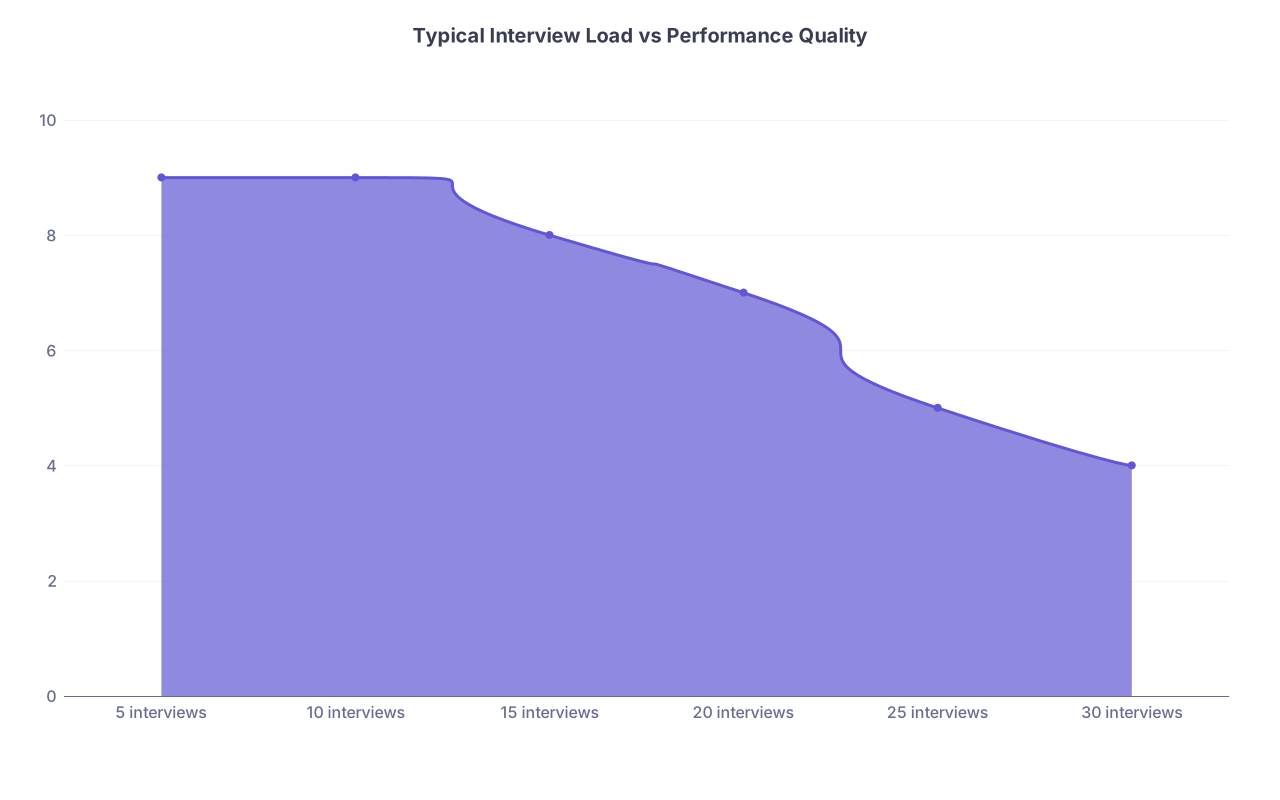
| Category | Value |
|---|---|
| 5 interviews | 9 |
| 10 interviews | 9 |
| 15 interviews | 8 |
| 20 interviews | 7 |
| 25 interviews | 5 |
| 30 interviews | 4 |
Call this what it is: cognitive overload. After a certain point, every extra interview decreases the quality of all the others.
The big myth: “More interviews = higher chance of matching”
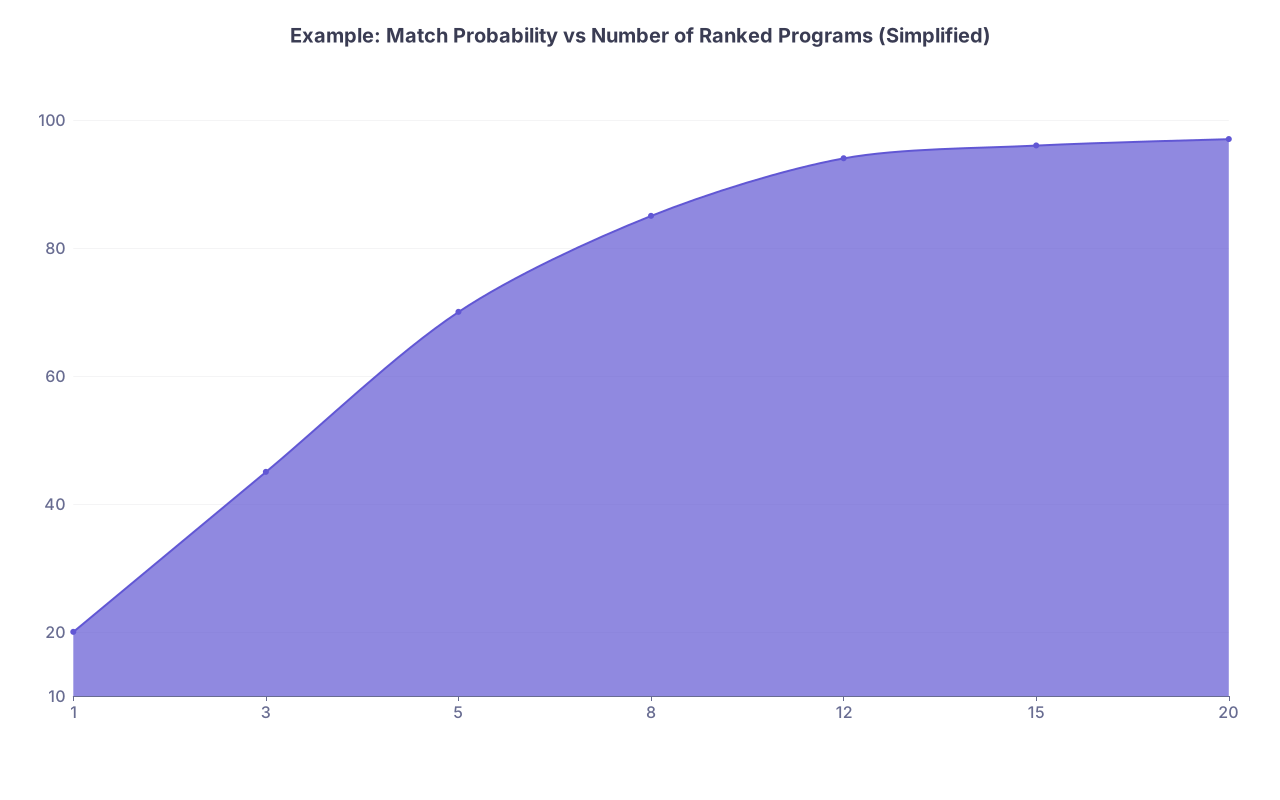
That is only half true. Yes, if you have very few invites, adding more helps your odds of matching somewhere. But once you cross a certain threshold, the returns flatten hard.
The NRMP data have made this clear for years:
- For many non-ultra-competitive specialties, around 10–12 ranked programs gives you a very high chance of matching.
- After about 15–18 ranks, the curve is almost flat for most applicants. You are trading time and sanity for tiny gains.
The mistake is not aiming for enough interviews. The mistake is mindlessly hoarding them long after you hit the point of diminishing returns.
How Many Interviews Is “Too Many”? A Sanity Framework
You want a clean rule? There is not one universal number. But there are red flags where “prudent” turns into “self-sabotaging.”
1. Understand your true target, not your fear target
You are not trying to:
- Attend every interview you receive.
- Prove to yourself you were “competitive enough” everywhere.
You are trying to:
- Generate a rank list long enough to match safely.
- Preserve enough energy to present your best self at the programs that matter.
Rough, conservative targets for ranked programs (not invites) if you are an average-strength candidate:
| Specialty Type | Safer Rank List Length |
|---|---|
| Very competitive (Derm, Ortho, ENT, PRS) | 15–20+ |
| Moderately competitive (EM, Anes, Rads) | 12–16 |
| Primary care (IM, FM, Peds) | 10–14 |
Now back-calculate interviews:
- Most people rank the majority of places they interview at.
- If you want 12–15 ranks, 15–18 interviews is usually plenty unless you have red flags.
If you are scheduling more than:
- 20+ interviews for most core specialties
- 25–30+ even for highly competitive fields
…you had better have a very good, data-based reason. “I am anxious” is not a reason. It is a warning sign.
2. The scheduling test: if your calendar looks like a flight controller’s monitor, you are overdoing it
Look for these practical red flags:
- You have more than 3 interviews in a week for several weeks in a row.
- You are booking back-to-back days without a buffer for:
- Flight delays
- Post-call fatigue
- Actual life tasks (laundry, food, breathing)
Once you are hitting 4–5 interviews a week repeatedly, you have crossed from “busy” into “unsustainable” for most humans.
3. The mental state test
You have too many interviews scheduled if:
- You feel dread, not excitement, when a new invite arrives.
- You are unable to prepare meaningfully for any single program.
- You are reusing the same generic answers because there is no time to tailor anything.
- You are losing track of which program is which.
When you catch yourself thinking, “I do not even care where I end up anymore, I just need this to be over,” that is interview burnout speaking. And it shows on Zoom.
The Most Common Overloading Mistakes (And How To Avoid Them)
Here is where people get themselves in trouble.
Mistake 1: Accepting every single interview invite “just in case”
The logic: “I can always cancel later.” Reality: many never cancel, or they cancel too late, damaging their reputation and hurting other applicants.
Why this backfires:
- You block dates that could have gone to someone else.
- You create a bloated schedule you are too scared to prune.
- You show up unprepared to lower-priority programs and make a poor impression.
Do this instead:
- Triage within 24–48 hours of receiving the invite.
- Sort programs into:
- Group A: Strongly interested, good fit, realistic options.
- Group B: Neutral interest, backup options but still acceptable.
- Group C: Places you would rank very low or maybe not at all.
- Confirm A’s quickly. Slot in B’s strategically. Be honest with yourself about C’s.
If you know you would not move to a location under almost any scenario, stop pretending that interview is “insurance.” It is just stress.
Mistake 2: Ignoring your specialty’s actual Match data
I see this every year: IM applicant with solid Step scores, no major red flags, and 25 internal medicine interviews “because I heard IM is getting more competitive.”
This is lazy fear-based planning. The NRMP publishes real numbers. Use them.
| Category | Value |
|---|---|
| 1 | 20 |
| 3 | 45 |
| 5 | 70 |
| 8 | 85 |
| 12 | 94 |
| 15 | 96 |
| 20 | 97 |
The curve is not linear. Once you reach the mid-teens, your probability barely moves with each extra program.
Do this instead:
- Look up the most recent NRMP Charting Outcomes and Program Director Survey for your specialty.
- Note:
- Median number of contiguous ranks for matched vs unmatched.
- Score ranges and research expectations.
- Set a rational target:
- For IM with average stats: maybe 12–15 ranks.
- For Derm with average stats: maybe 18–22+ ranks.
Then aim your interview count to comfortably exceed those rank targets, not triple them out of panic.
Mistake 3: Failing to downgrade as your interview season unfolds
What kills people is not their initial yes. It is their refusal to revise.
Common pattern:
- Early October: “I will take every interview; I am grateful for all opportunities.”
- Late November: “I already have 18 interviews but I feel wrong canceling any.”
- January: “Why did I fly across the country for three programs I knew I would never rank top 10?”
You should be updating your plan every 1–2 weeks of the season:
- Track:
- How many interviews you have completed.
- How many you feel good about ranking.
- Once you hit your safer rank threshold + a small buffer, you can:
- Start being more selective accepting new invites.
- Proactively cancel lower-interest interviews with plenty of notice.
This is not arrogance. It is protecting your bandwidth so you can actually perform at the places that matter most.
Mistake 4: Destroying your clinical performance during interview season
Here is the part almost no one talks about: your interview overload does not just hurt your interviews. It hurts your rotations.
I have watched students:
- Scramble out of inpatient rounds to sit in a hallway for a Zoom interview.
- Show up post-call, fried, and try to be “charming” in a virtual social.
- Turn their sub-internship into a half-commitment because they disappeared for 5 interviews that month.
Program directors notice. Your home institution notices. Letters get weaker. Final evals get more critical.
Do this instead:
- Cluster interviews on:
- Electives that are lighter.
- Dedicated interview or vacation blocks if your school has them.
- Hard limit during high-intensity rotations (ICU, surgical sub-I):
- Aim for no more than 1–2 interviews per week in those months.
- If you cannot do that, strongly consider:
- Moving a sub-I earlier.
- Swapping schedules.
- Or cancelling lower-value interviews to preserve your reputation where people actually know you.
You cannot afford to trade one sleepy, disengaged month on a critical rotation for three mediocre interviews at programs you will rank 15–20 anyway.
Mistake 5: Treating every interview like a blind first date
When you overload interviews, prep becomes shallow by necessity. That leads to the classic red flags interviewers complain about:
- Applicant clearly has the same generic answer for “Why our program?”
- Confuses features of two different hospitals.
- Asks questions that show they did not even skim the website.
That is not “tired applicant behavior.” That is “overcommitted applicant behavior.”
Your goal is not to survive a gauntlet. Your goal is to:
- Show a few dozen people, in detail, why you fit their environment.
- Leave enough mental space after each day to reflect and take real notes.
If your schedule makes thoughtful preparation impossible, you are overbooked. Period.
A Practical Way To Choose Which Interviews To Keep
You need a ruthless, honest filter. Here is a framework that works.

Step 1: Define your non-negotiables
Before the invites hit, write down:
- Locations you would actually live (not fantasy).
- Deal-breakers:
- No categorical spots
- No exposure to your desired fellowship
- Toxic reputation you trust
- Chronic underwork or overwork cultures (yes, both exist)
If a program falls below your basic non-negotiable line, you decline or later cancel it. You are not “wasting an opportunity.” You are preventing self-sabotage.
Step 2: Score programs quickly
You do not need a 20-column spreadsheet. Use a simple 1–3 scoring system on:
- Location happiness potential
- Training quality / case mix
- Fit for your career goals (fellowship, academic vs community)
- Gut feel (from current residents, prior rotations, vibes)
Then:
- 3’s: High priority
- 2’s: Medium priority
- 1’s: Low priority
As your completed interview count grows and your “definitely rank” list fills up, start cutting from the bottom.
Step 3: Set a hard upper limit on total interviews
Decide in advance:
- “I will not attend more than X interviews total.”
- “I will not schedule more than Y interviews in any single week.”
For most core specialties:
- X might be 15–20.
- Y might be 3 (very occasionally 4 with buffers).
When you hit your cap, any new invite forces a trade:
- Add one, drop one.
This is how you protect yourself from death-by-yes.
Recognizing Interview Burnout Before It Wrecks Your Match
You cannot avoid a problem you refuse to name. Interview burnout has a pretty consistent look.

Psychological signs
Watch for:
- Numbness: You stop feeling excited about any particular program.
- Irritability: You snap at friends or co-students about small scheduling issues.
- Cynicism: You start saying things like “All these programs are the same anyway.”
- Avoidance: You stop prepping because “What is the point, I am just repeating myself.”
Physical signs
- Constant fatigue, even after days off.
- Headaches on or before interview days.
- Trouble sleeping before or after interviews.
- Reliance on caffeine just to sound coherent during socials.
Behavioral signs that interviewers actually see
- Flat affect, even when talking about “passions.”
- Vague answers that could apply to any program.
- Inconsistent or scattered narrative about your goals.
- Cameras off whenever someone “allows optional” video during socials.
Once you see these, your job is not to “push through.” Your job is to cut load:
- Cancel the least important upcoming interview with at least a week’s notice.
- Build at least 1 full rest day between heavy interview weeks.
- Shorten prep for low-priority programs and expand it for your top ones.
You protect your best opportunities by admitting you cannot be at 110 percent for 25 days straight. No one can.
Virtual vs In-Person: The Trap That “It Is Just Zoom” Creates
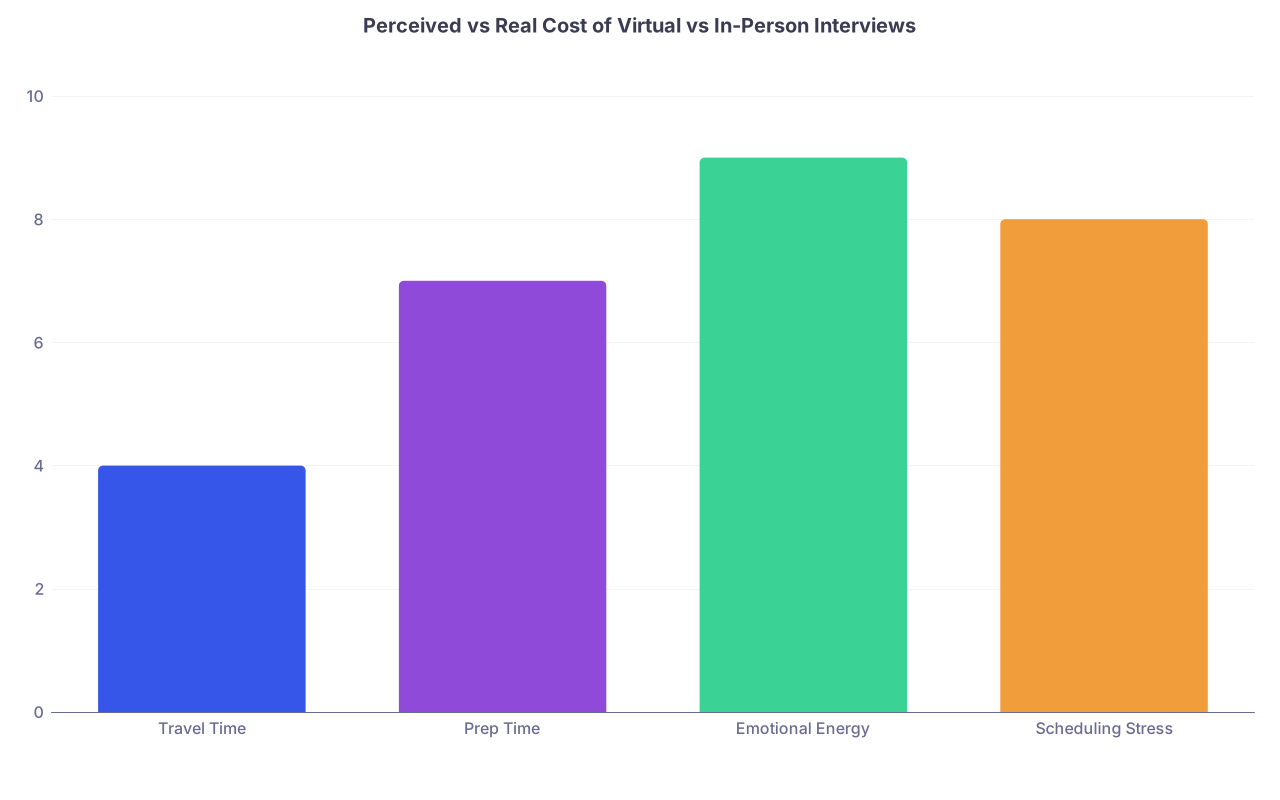
Virtual interviews trick people into overscheduling because travel is not the bottleneck anymore.
The problem is that energy, not geography, is your limiting resource.
| Category | Value |
|---|---|
| Travel Time | 4 |
| Prep Time | 7 |
| Emotional Energy | 9 |
| Scheduling Stress | 8 |
People think:
- “No flights, I can do 5 interviews this week.”
- “I can even interview post-call; it is just Zoom.”
Then they:
- Log on from a hospital call room, visibly exhausted.
- Have family members walking behind them because they did not stabilize their home setup.
- Sound robotic because they are repeating the same script 6 times in 10 days.
Virtual interviews still require:
- Solid internet and tech checks.
- Space to decompress after emotionally intense sessions.
- Time to review each program and your notes.
You cannot jam them together like back-to-back lectures and expect full engagement. If anything, virtual formats demand more deliberate pacing because screen fatigue is brutal.
A Sample Balanced Interview Season
To make this concrete, here is what a reasonable schedule might look for a typical IM applicant with a decent application.
| Week Range | Number of Interviews | Comment |
|---|---|---|
| Weeks 1–2 | 2–3 total | Early, high-priority |
| Weeks 3–6 | 2–3 per week | Core interview stretch |
| Weeks 7–8 | 1–2 per week | Tapering, more selective |
| Weeks 9–10 | 0–1 per week | Only top late invites |
Notice what this is not:
- It is not 4–5 interviews per week for 6 weeks.
- It is not taking every single late January low-interest invite “just in case.”
By end of Week 8 in this setup, they might have:
- Completed 14–16 interviews.
- Realistically plan to rank 12–15.
- Preserved some energy and clarity for rank list decisions.
Now compare that with the common disaster pattern:
- 5 interviews one week, 4 the next, 3 the next.
- Travel or changing time zones layered on top.
- Chronic under-prep for all of them.
One of those paths leads to solid, clear ranks. The other leads to “whatever, just move this one up two spots” at 2 a.m. the night before rank list certification.
Protecting Your Future Self on Rank List Day
Everything about avoiding interview overload comes down to one question:
Will your February self thank your October self for the way you spent your energy?
If you do this right, by the time you write your rank list, you should:
- Remember specific details about your top 8–10 programs.
- Recall resident vibes, culture, and red flags without rereading every note.
- Feel that you gave your best authentic impression at the programs you care about most.
If you do this wrong, you will:
- Scroll through 20+ programs that all blur together.
- Struggle to distinguish between “seemed fine” and “probably not a fit.”
- Realize that your best performances were at random mid-tier places because you were too exhausted at your top choices.
Your job now is to protect that future clarity.

The Bottom Line: How Many Is Too Many?
Three truths to walk away with:
There is such a thing as too many interviews. Once you have enough to generate a solid rank list for your specialty, additional interviews give sharply diminishing returns and sharply increasing burnout.
Overloading interviews can hurt your Match. Fatigue, poor prep, and weak performance at your top-choice programs will do more damage than skipping a few low-yield backups ever would.
You must actively manage, not passively accept. Set interview caps, regularly reassess your schedule, and be willing to cancel lower-priority interviews early and respectfully to protect your time, energy, and clinical performance.
If you remember nothing else: your goal is not to attend the most interviews. Your goal is to be fully present and at your best for the right ones.