
What happens when you interview at 15 programs, rank only your “top 8,” and then watch Match Week blow up your entire plan?
Let me be blunt: ranking fewer programs than you interviewed is one of the most avoidable, self‑inflicted wounds in the residency process. People still do it every single year. I have watched otherwise strong applicants—with perfectly decent interviews—scramble into SOAP or go unmatched because they decided they were “too good” for some programs and left them off the list.
You are thinking about how many programs to apply to. Good. Now you also need to think about how many to rank. Because the second mistake often cancels out all the effort of the first.
The Core Truth You Are Ignoring
The Match does not care how many interviews you had. It only cares how many programs you rank and where you place them.
Programs will rank many more applicants than they have spots. Applicants will often rank fewer programs than they interviewed at. That disconnect harms you, not them.
Here is the non‑negotiable truth:
If you interviewed somewhere and you could tolerate doing residency there, it should be on your rank list.
Not “love.” Not “dream program.” Tolerate. Workable. Adequate training, acceptable living situation, no obvious deal‑breaker. If it meets that bar, leave it on.
The people who get burned are the ones who confuse “not my favorite” with “unacceptable.”
Why Applicants Wrongly Cut Programs From Their Rank List
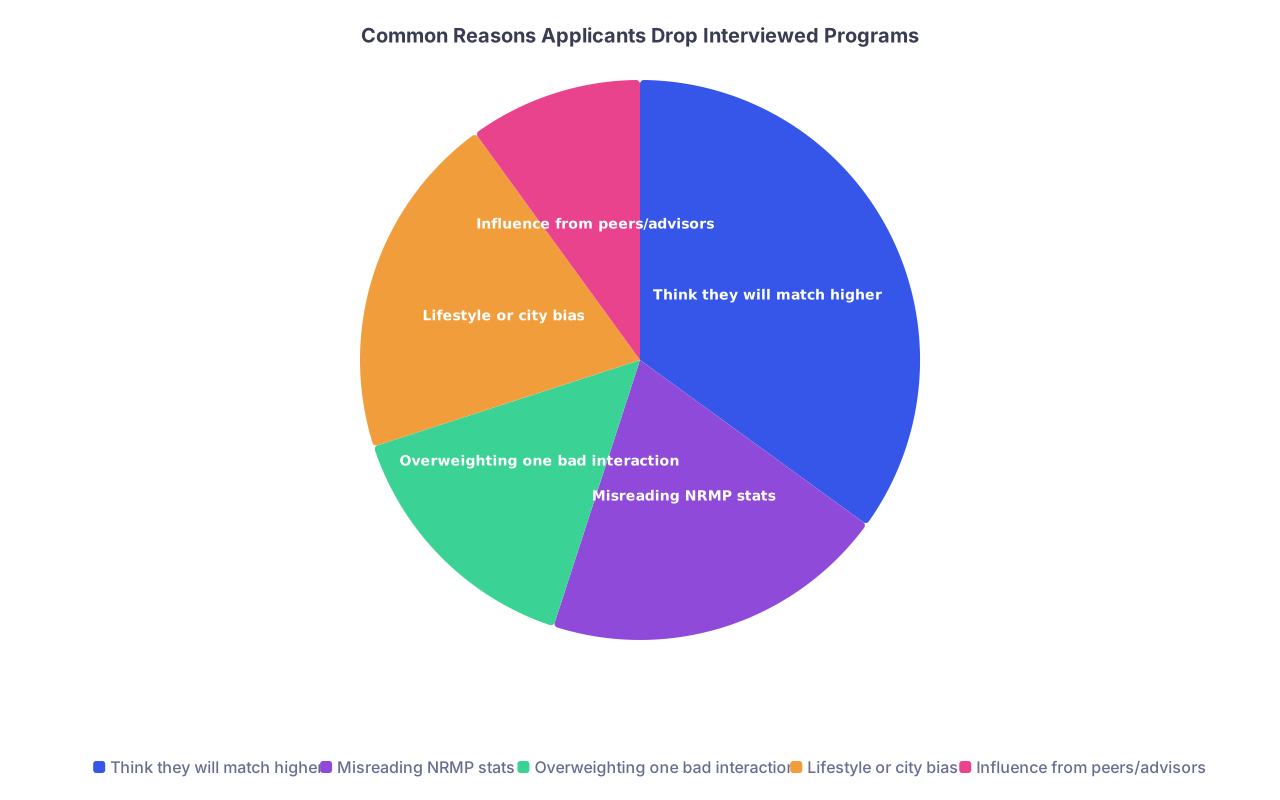
| Category | Value |
|---|---|
| Think they will match higher | 35 |
| Misreading NRMP stats | 20 |
| Overweighting one bad interaction | 15 |
| Lifestyle or city bias | 20 |
| Influence from peers/advisors | 10 |
I hear the same justifications every year. Different students, same mistakes.
1. “I Had Enough Interviews, I’ll Definitely Match”
This one is deadly.
Example: An internal medicine applicant interviews at 12 categorical programs. Their advisor once said “8–10 ranks is usually enough.” So they rank 9. They drop 3 “safety” programs because they did not like the call room or the city felt “too small.”
On Match Monday: Unmatched. Then SOAP chaos.
Why this thinking is wrong:
- NRMP data are probabilities, not guarantees. “95% chance” still means 5 out of 100 people get burned.
- Your competitiveness is not static. If your Step 2 dropped, your late letters were weak, or your interview skills were mediocre, those “enough” interviews might not be enough for you.
- You cannot see program rank lists. You have no idea how they internally scored you.
Assuming “enough” is how people end up with a $300k medical degree and no PGY‑1 position.
2. Misreading NRMP “How Many Ranks Do I Need?” Charts
You have probably seen those NRMP graphs: “Number of contiguous ranks vs. match rate.”
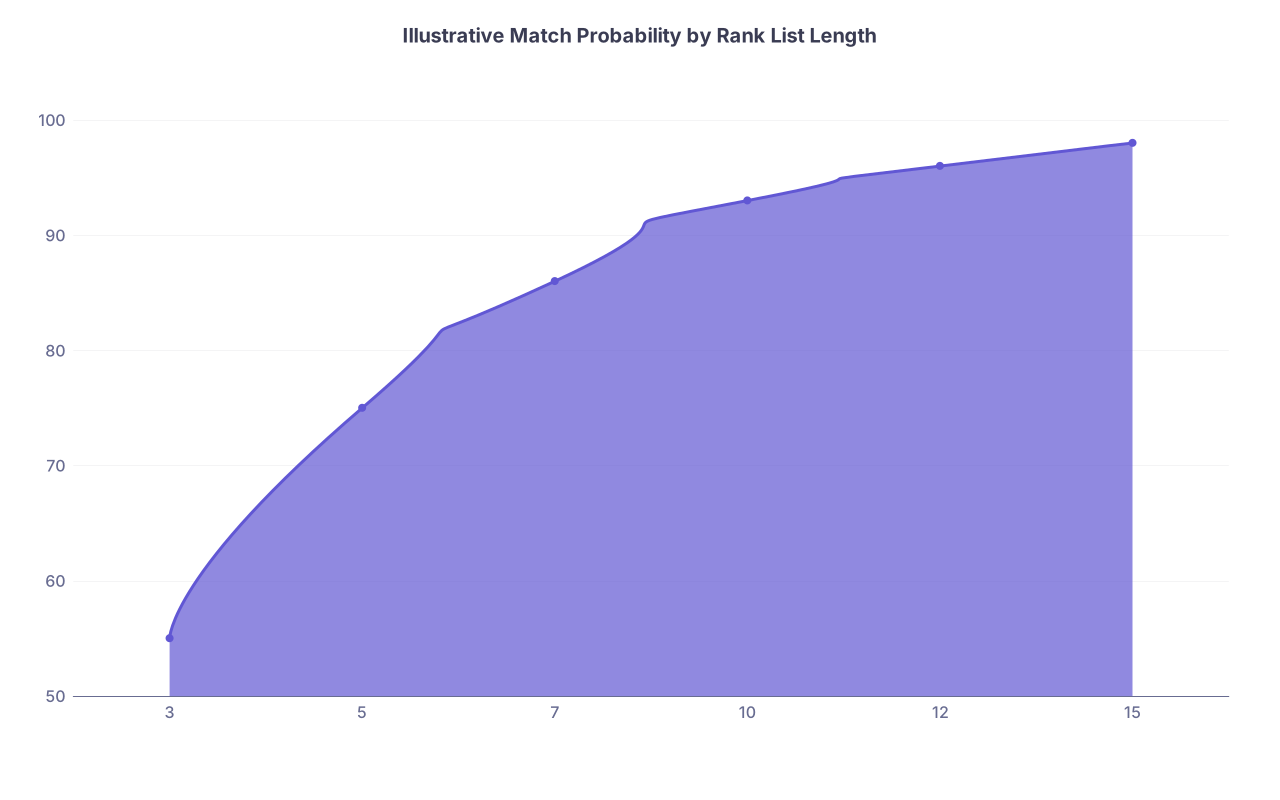
| Category | Value |
|---|---|
| 3 | 55 |
| 5 | 75 |
| 7 | 86 |
| 10 | 93 |
| 12 | 96 |
| 15 | 98 |
Those charts are useful. They are also routinely abused.
Common misinterpretations:
- “Above 10 ranks, it flattens out, so more ranks don’t help.” Wrong. The curve flattens statistically. For you as an individual, going from 10 to 14 can absolutely be the difference between matching and SOAP.
- “People with 10 ranks have a 90+% match rate, so I’m basically safe.” No. Someone is in the 5–10% who do not match. You are not magically exempt.
- “I interviewed at 15, so if I rank my top 10, I’m fine.” That logic ignores competition. Programs may rank heavily from home school, couples match, or visa‑requiring applicants, pushing you lower.
Those charts are population‑level, retrospective, and do not see your specific weaknesses, red flags, or mis‑aligned application narrative.
3. Overreacting to One Bad Moment
You interviewed at a program. One resident made a snarky comment. The PD seemed rushed. The lunch was awkward. Suddenly you are saying, “I’d rather go unmatched than go there.”
No, you would not.
I have watched unmatched applicants try to “SOAP up” into programs far worse than the ones they arrogantly deleted from their lists. The bar drops fast when the alternative is “no residency at all.”
Ask yourself:
- Were there structural red flags? Chronic ACGME citations, malignant culture reported by many people, consistent duty hour abuse?
Or - Did you just have a weird 20‑minute interaction over Zoom?
Those are not equivalent.
4. Peers + Ego + Groupthink
This one is subtle and nasty.
You hear classmates say:
- “Everyone from our school matches into mid‑tier or better, I would never rank [Community Hospital X].”
- “That program is a backup’s backup.”
- “People only go there if they did not get in anywhere else.”
So you swallow that and quietly pull those programs off your list.
Then on Match Day, some of those same classmates end up very grateful to have matched at the exact type of “backup’s backup” program they trashed in October.
Your ego does not train your patients. Your ego does not pay your rent. It certainly will not rescue you from going unmatched.
5. Overweighting Geography or Lifestyle… Pre‑Match
This one hurts, because geography matters. Support systems matter. But here is the mistake: using geography as an elimination weapon instead of a ranking tiebreaker.
“I will not rank anywhere more than 4 hours from family.”
Fine—if you can emotionally and financially live with an unmatched outcome.
What you should ask instead:
- Is doing residency a plane ride away worse than not doing residency at all this year?
- Would I truly prefer SOAP into a lower‑tier program in a better city over a solid program in a less desirable location that I already interviewed at?
Most people, when honest and under pressure, will answer no.
Location is a valid factor—for ordering your list, not for chopping it to the bone.
How the Match Algorithm Actually Works (And Why It Hates Your Overconfidence)

| Step | Description |
|---|---|
| Step 1 | You rank programs |
| Step 2 | Programs rank applicants |
| Step 3 | Match algorithm runs |
| Step 4 | Temporarily assigned there |
| Step 5 | Try next program on your list |
| Step 6 | Final match |
| Step 7 | Can you match at top choice |
| Step 8 | Program full and prefers someone else |
The NRMP algorithm is “applicant‑favorable.” People repeat that like a magical incantation. They forget the other half: the algorithm can only favor you based on the rank list you actually submit.
A simplified version of what the algorithm does for you:
- It tries to place you at your first choice.
- If that program cannot or will not take you, it tries your second.
- Then your third. Then your fourth. Until you run out of programs.
If you only give it 7 programs when you had 14 interviews, you are simply telling the algorithm, “If these 7 do not want me, stop trying. I would rather go unmatched than consider the other 7.”
The algorithm is literal. It believes you.
That is the core blunder: using your rank list to make emotional statements instead of strategic decisions.
When It Is Reasonable to Leave a Program Off
You should not rank every place no matter what. There are legitimate reasons to completely exclude a program. But the threshold needs to be high.
I would not rank a program if:
- There is credible, consistent evidence of severe mistreatment or abuse.
- The program is on probation or had serious recent accreditation issues that are unresolved.
- The training is so weak that graduating residents struggle to get jobs or fellowships.
- The location or culture poses a real safety risk to you or your family (not just “this city is boring”).
If a program is truly unacceptable, do not rank it. But be honest: most places students drop are not disasters. They are just not exciting.
Quick sanity check
Before you delete a program from your list, answer this out loud:
“If I do not match this cycle, I am okay with spending a year reapplying, losing income, explaining an unmatched year, and paying for another whole application season… instead of attending this program.”
If you hesitate, leave it on the list.
How Many Programs Should You Rank If You Interviewed at X?
Number of interviews ≠ number of ranks. Interviews are your opportunities. Ranks are your actual chances.
General rule from someone who has watched this for years:
If you interviewed there and it is not categorically unsafe or unacceptable, you rank it. Period.
For most people that means:
| Number of Interviews | Recommended Programs to Rank |
|---|---|
| 5 | 5 (all of them) |
| 8 | 7–8 |
| 10 | 9–10 |
| 12 | 11–12 |
| 15+ | 13+ (ideally all workable) |
People get in trouble when they start shaving off the bottom 20–40% “because my stats are strong.”
You do not know how the field will behave this year. Some cycles are brutal for reasons no one predicted—Step 1 pass/fail, sudden interest spike in a specialty, new school classes pumping more applicants into the pool.
The safest default: Rank every program where you could see yourself functioning and growing as a physician.
Stories You Do Not Want To Recreate
Let me walk you through a few very real patterns I have seen.
The “Too Good For Community” Applicant
- Step 1: 240s (back when it had numbers), decent research, mid‑tier MD school.
- Specialty: Internal medicine.
- Interviews: 14 total—mix of big‑name academic and solid community programs.
- Rank list: Only 9. Cut 5 “lower‑tier” community programs.
Outcome: Unmatched. They had several near‑misses at academic places that preferred home students or couples. They end up scrambling into a preliminary medicine year in a less desirable location than several of the programs they deleted.
What they told me mid‑SOAP: “I would kill to have that community program back on my list.”
The “Geography Or Bust” Applicant
- IMG, strong scores, wanting family medicine.
- Interviews: 10, across multiple states.
- They refuse to rank anything outside of two specific states near family.
- Final rank list: 5 programs.
Outcome: Unmatched. SOAP yields a position in a state they refused to rank initially. They accept it anyway because the alternative is losing an entire year.
Again, their own words later: “I should have just ranked them in the first place. This is literally where I am ending up.”
The “One Bad Interview Day” Overreaction
- US MD student applying psych.
- Interviews: 11.
- One program: Zoom day with technical issues, felt “cold,” did not click with the residents.
- Drops it from the list out of frustration.
Outcome: Matches low on their list. Fine. But when the schedule gets released, their program sends them for 4 months of off‑site rotations at… that dropped program’s hospital. Same city, same call rooms, same culture they tried to avoid.
The universe has a sense of humor.
How This Ties Back To “How Many Programs Should You Apply To”
You can apply to 60 programs, get 10 interviews, and still end up unmatched if you sabotage the back end of the process by under‑ranking.
Application strategy and rank strategy go together:
- Applying broadly increases your potential options.
- Ranking broadly turns those options into actual safety nets.
You need both.
If you are worried you applied to too few programs, your margin for error is already thinner. That means you can afford even less “selective arrogance” when ranking.
Conversely, if you applied broadly, cast a wide net, and spent thousands of dollars and many weekends on interviews, it is frankly irrational to throw away half of those options because of mild preferences.
Your main goal in this phase is not “maximize prestige at all costs.” It is “secure a position that will train me and keep my career moving.”

A Simple, Safe System To Build Your Rank List
If you want a concrete method that avoids most of these traps, use this:
- Start with every program you interviewed at.
- Remove only those with serious, well‑documented red flags (abuse, accreditation jeopardy, non‑negotiable safety issues).
- Divide the rest into:
- Group A: Places you would be happy at.
- Group B: Places you would be okay with.
- Group C: Places you would tolerate but not love.
- Now rank within those groups by preference: A first, then B, then C.
- Do not delete Group C. They are your insurance policy.
Ask yourself one last time:
“If I completely remove Group C and I end up unmatched, will I honestly believe this was a smart trade?”
If the answer is no, keep them.

| Step | Description |
|---|---|
| Step 1 | All interview programs |
| Step 2 | Remove truly unsafe |
| Step 3 | Sort into A happy |
| Step 4 | Sort into B ok |
| Step 5 | Sort into C tolerate |
| Step 6 | Final rank list A then B then C |
The Psychological Trap: “But I Don’t Want To Feel Like I Settled”
This is the real driver under all the rationalizations.
Students hate the idea of ending up somewhere “lower” than what their stats or peers suggest. So they unconsciously manipulate their rank list to protect their ego: “If I only rank these top programs, then if I do not match, it is because the system is broken, not because I ‘settled.’”
That is emotional self‑protection. It is also career self‑sabotage.
Residency is not high school college lists. It is a professional bottleneck. There is no bypass lane. You either get through or you do not.
Plenty of residents at supposedly “lesser” programs graduate strong, match into excellent fellowships, and have great careers. Plenty of unmatched graduates spend years trying to claw their way back into the system, with each passing year making it harder.
You can process your ego later. Right now you need a job.

Red Flags That You’re About To Underrank Yourself
You are at risk of making this mistake if:
- You start sentences with “I would rather go unmatched than…” about anything that is not safety or abuse.
- You are using phrases like “backup’s backup,” “beneath me,” or “I’m too competitive for that program.”
- You are hiding your true rank list plans from advisors because you know they would call it risky.
- You are more focused on how your match will look on social media than what will actually train you well.
If any of this feels uncomfortably familiar, good. Fix it now.
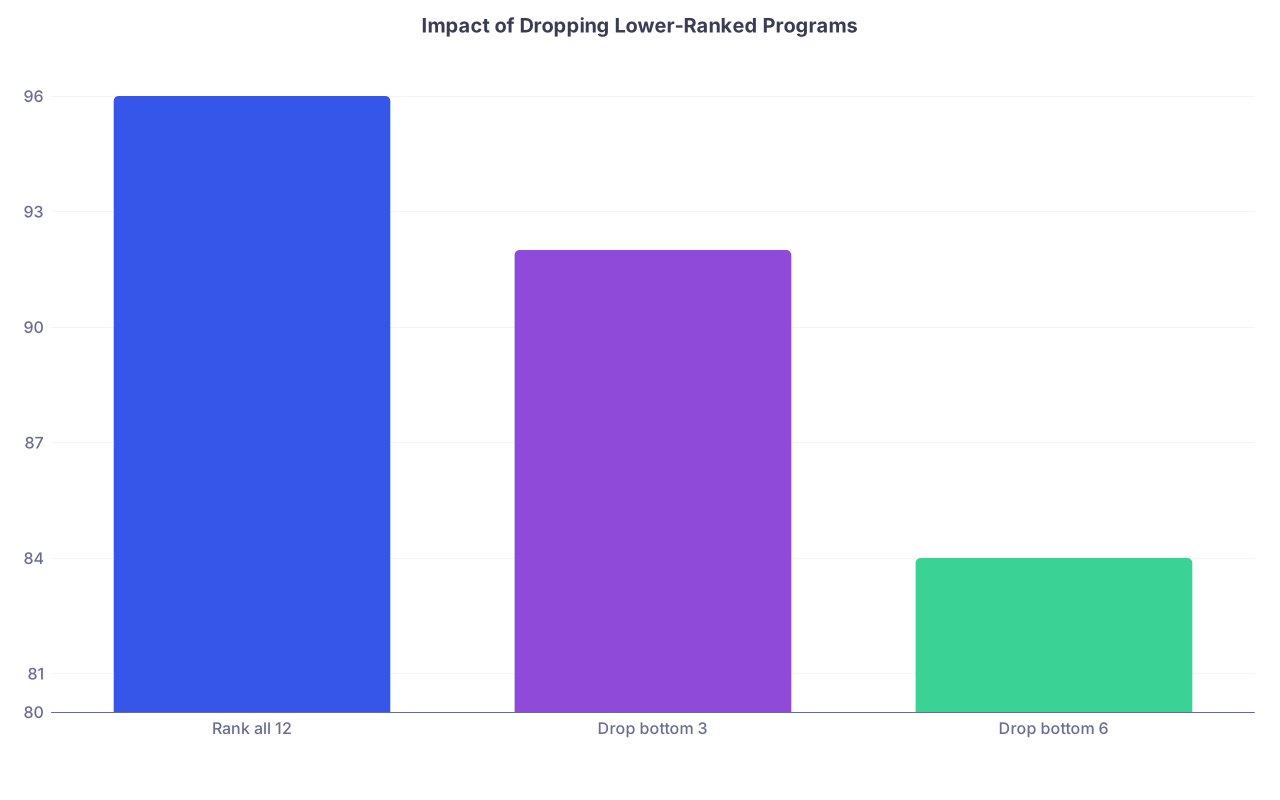
| Category | Value |
|---|---|
| Rank all 12 | 96 |
| Drop bottom 3 | 92 |
| Drop bottom 6 | 84 |
Those numbers are illustrative, but the pattern is real: every program you drop that you could live with nudges your personal odds downward. For no gain.