
The way most applicants set their ERAS list is financially reckless.
Not bold. Not ambitious. Reckless. And the people who suffer for it are not the ones giving you the “just apply broadly” advice. It is you, your credit card, and your future self trying to dig out of unnecessary debt during intern year.
Let me walk you through the mistakes that quietly drain thousands of dollars from residency applicants every year—and how to avoid becoming one more “I spent $4,000 on ERAS and still matched at my home program” story.
The Core Problem: Confusing Fear With Strategy
Most people do not build an application list. They build a fear list.
“I am worried about not matching, so I will apply to everything.”
“I heard derm is impossible, so my adviser said 100+ programs is 'normal'.”
“My friend did 80 IM programs and matched, so I should too.”
None of those are strategies. They are emotional reactions masquerading as planning.
Here is the trap:
- You overestimate how much more “safe” extra applications make you.
- You underestimate how quickly ERAS fees snowball.
- You forget that interviews, not applications, are the actual bottleneck.
So you end up spending thousands to send your file to programs that will never look at it, in cities you would never move to, in specialties you are not truly committed to.
That is ERAS budget blindness.
Mistake #1: Ignoring the Brutal ERAS Fee Structure
If you cannot quote the ERAS fee tiers for your specialty, you are already in danger.
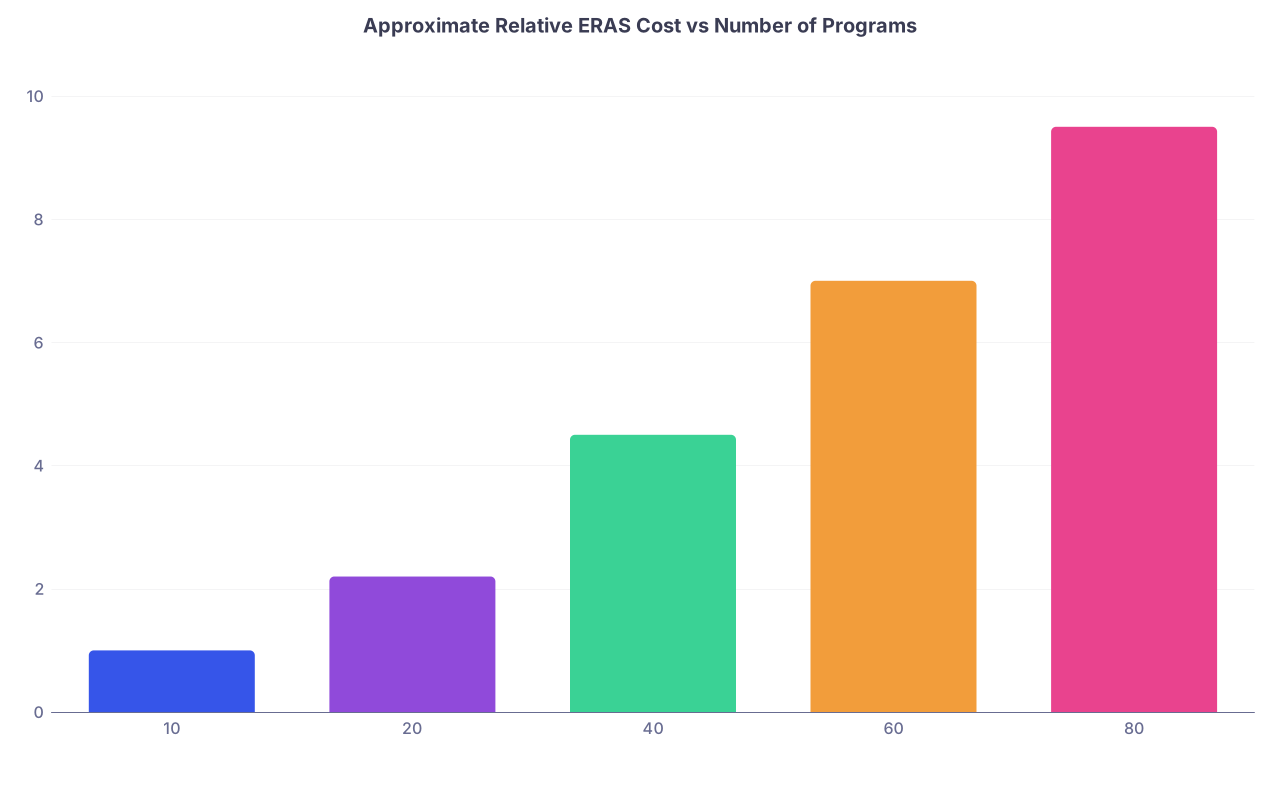
The cost per program does not scale linearly. It punishes volume. Here is a simplified version so you see the shape of the problem (numbers are approximate and change slightly year to year, but the pattern holds):
| Program Count Tier | Approx. Cost per Program | Total Tier Cost |
|---|---|---|
| 1–10 | Low | Modest |
| 11–20 | Higher | Noticeable |
| 21–30 | Higher again | Getting painful |
| 31+ | Very high | Explosive |
The first 10 programs are relatively cheap. After that, each additional block of 10 gets more expensive. By the time you are past 40–50 programs, you are paying premium prices for marginal benefit.
To make this painfully clear:
| Category | Value |
|---|---|
| 10 | 1 |
| 20 | 2.2 |
| 40 | 4.5 |
| 60 | 7 |
| 80 | 9.5 |
Those numbers are relative, not dollars. But you get the idea. Doubling your programs does not double your cost. It can easily triple or quadruple it.
The mistake:
Building a list by asking, “Where else could I possibly apply?” instead of, “Given this fee structure, which programs are actually worth paying for?”
Before you add a single program, you should know:
- Your hard budget ceiling (not the fantasy number, the real one).
- The fee inflection points where costs jump.
- What you will have to give up later (interview travel, moving costs, paying interest) if you blow your budget now.
If all you have is “I just hope it works out,” you are budgeting like a first-year with a new credit card. And ERAS is happy to profit from that.
Mistake #2: Copy-Paste Application Numbers Without Context
“I heard you need 80+ programs for internal medicine if you are not AOA.”
“Everyone in my class applying EM is doing 60.”
“The seniors last year said ‘50 minimum’ for anesthesia.”
I have heard all of these. I have also seen people with those exact numbers match to their top 5 programs—and dozens of unused applications rotting in ERAS.
The dangerous habit is this: using someone else’s raw program count without asking what made that number appropriate for them.
At minimum, you must factor in:
- Specialty competitiveness
- Your competitiveness in that specialty
- Program distribution (how many realistic targets exist)
- Geography constraints (couples match, family, visa issues, etc.)
To see how badly a one-size-fits-all number can mislead you:
| Specialty Type | Competitive Examples | Typical Range (avg applicant) |
|---|---|---|
| Ultra-competitive | Derm, Ortho, ENT | 60–90+ |
| Moderately competitive | EM, Anesthesia, Rad Onc | 40–70 |
| Broad-access specialties | IM, FM, Peds, Psych | 20–50 |
| Highly geography-limited | Neuro, PM&R (in some areas) | 30–60 |
Those are ranges, not prescriptions. The mistake is grabbing the upper end (or beyond) automatically.
If you are an above-average internal medicine applicant applying to 80+ IM programs “just in case,” you are not being strategic. You are being scared. And you are paying handsomely for that fear.
Mistake #3: Treating All Applications as Equal
I see this constantly: a spreadsheet with 70 programs, sorted alphabetically, no notes in the “fit” or “priority” columns, and when I ask, “Would you actually go to all of these?” the person hesitates.
If you would not realistically rank a program above “move back home and scramble into a prelim year,” why are you paying to apply there?
You are not just wasting money. You are also:
- Diluting your ability to research programs properly
- Writing generic, forgettable personalized messages / communications
- Building fake safety that collapses the second you actually get an interview there and realize you hate the place
You need hard categories:
- High priority / dream programs – You would be thrilled to train there.
- Solid fits / realistic targets – Good training, realistic match chances.
- True safeties – You would go if you had to, and you would still get decent training.
- Never programs – Places you know in your gut you do not want.
The mistake is flooding ERAS with category 4 because you cannot tolerate seeing a shorter list. That is emotional clutter that costs hundreds of dollars.
A “never” program should not be on your ERAS list. Not at #60. Not at #120. Not at all.
Mistake #4: Ignoring the Real Bottleneck: Interviews, Not Applications
Here is the quiet reality almost nobody tells pre-residents:
There is a hard upper limit to how many interviews you can realistically attend and rank. Past that, more applications give you no added benefit.
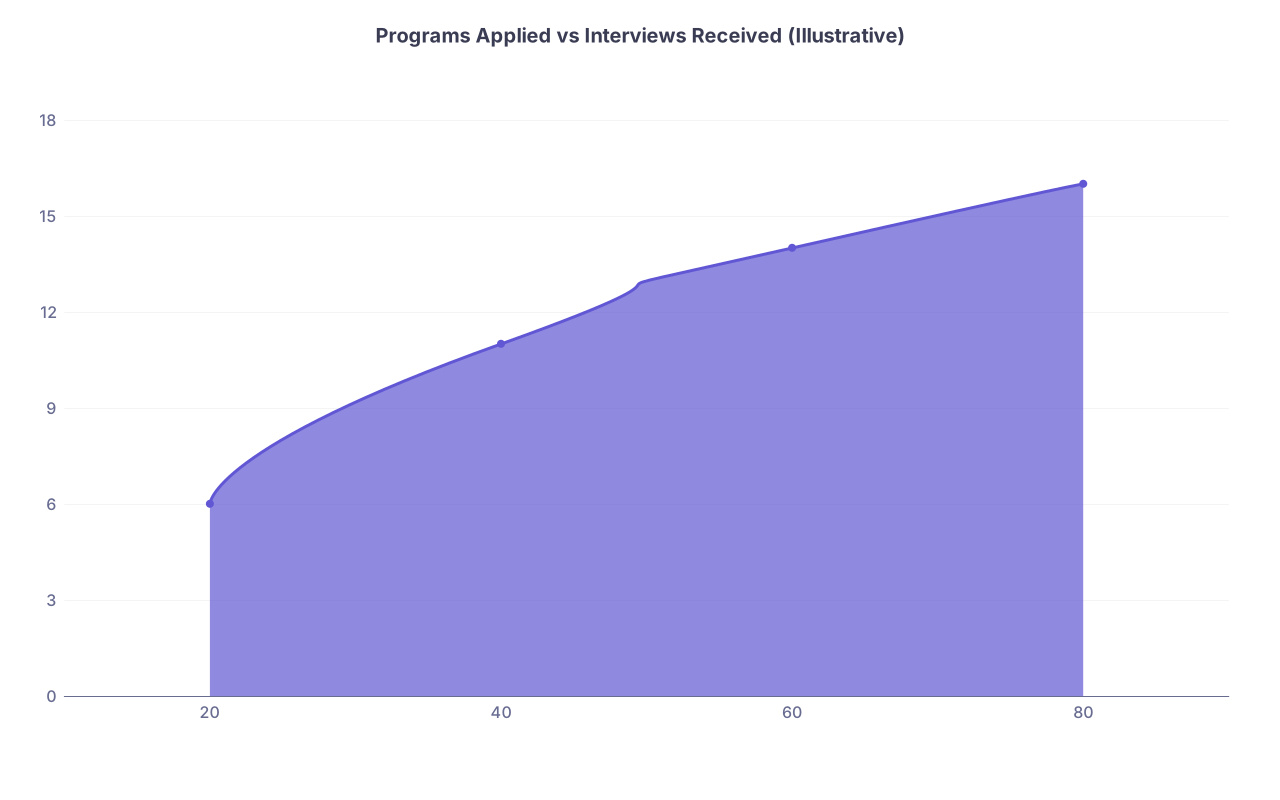
Look at a typical pattern for many mid-range applicants (yes, there are exceptions):
- Apply to 30 programs → Receive 8–12 interview invites
- Apply to 60 programs → Receive 12–18 interview invites
- Apply to 90 programs → Receive 15–20 interview invites
The return on extra applications flattens brutally. You are not tripling your odds by tripling your programs. You are usually just paying more to receive the same 10–15 serious invitations.
Here is a stylized version of what this looks like:
| Category | Value |
|---|---|
| 20 | 6 |
| 40 | 11 |
| 60 | 14 |
| 80 | 16 |
Again, not exact data. But I have seen this curve enough times to be comfortable saying: the slope falls off fast.
The second part of the bottleneck: interview fatigue and time.
Most people can handle:
- 10–15 interviews: tiring but doable
- 15–20: exhausting, performance starts to slip
- 20+: brutal, especially if travel is involved (even with virtual, the prep drains you)
So tell me: why are you paying for 90 programs if your realistic maximum ranked list will be built from 10–18 interviews?
Your real job is not to spray your application into the void. It is to:
- Get enough quality interviews (not infinite)
- Show up prepared and sharp to those interviews
- Rank realistically
Past that, your ERAS application count is just burning cash.
Mistake #5: No Data-Driven Self-Assessment Before Setting a Number
I am always wary when someone says, “I plan to apply to 70 programs,” before I have seen:
- Their Step 2 CK score (or COMLEX equivalent)
- Their clinical grades / MSPE language
- Research or lack thereof (for specific specialties)
- Any red flags: leaves, failures, professionalism notes
- Their geographic flexibility
If you set your number before you evaluate those inputs, you are guessing. And usually overcompensating.
You need a brutally honest read on where you sit relative to successful applicants in your specialty:
- Above-average, average, or below-average?
- Any major red flags or only minor concerns?
- Strong ties to a region or truly open nationwide?
Here is a very rough decision outline many people skip:

| Step | Description |
|---|---|
| Step 1 | Assess Competitiveness |
| Step 2 | Start with lower range |
| Step 3 | Start with mid range |
| Step 4 | Start with higher range |
| Step 5 | Adjust for geography |
| Step 6 | Check against real budget |
| Step 7 | Cut lowest priority programs |
| Step 8 | Finalize target number |
| Step 9 | Above, Average, Below |
| Step 10 | Over budget? |
Most people skip straight from A to “Apply to as many as I can stomach.” That is not strategy. That is panic.
Mistake #6: Pretending Interviews Are Free
Applications are not your only cost. You know this, but under stress people act like ERAS fees exist in a separate universe from the rest of their finances.
They do not.
Your full match-year financial load includes:
- ERAS application fees
- NRMP registration
- USMLE transcript fees
- Interview expenses (even “virtual” has opportunity cost, lost moonlighting, etc.)
- Away rotations (if applicable)
- Moving costs after Match
- Deposit and first month’s rent at your new location
When you overspend on applications, you steal from every one of those later buckets.
I have seen people forced to:
- Decline good interviews because they could not afford the travel (back when in-person was dominant)
- Move into terrible housing because their credit card was already maxed from ERAS
- Put basic moving expenses on high-interest debt because they were still paying off the application surge
If your ERAS cost plan does not include a global view of the whole cycle, you are setting yourself up to pay for this year’s anxiety with next year’s misery.
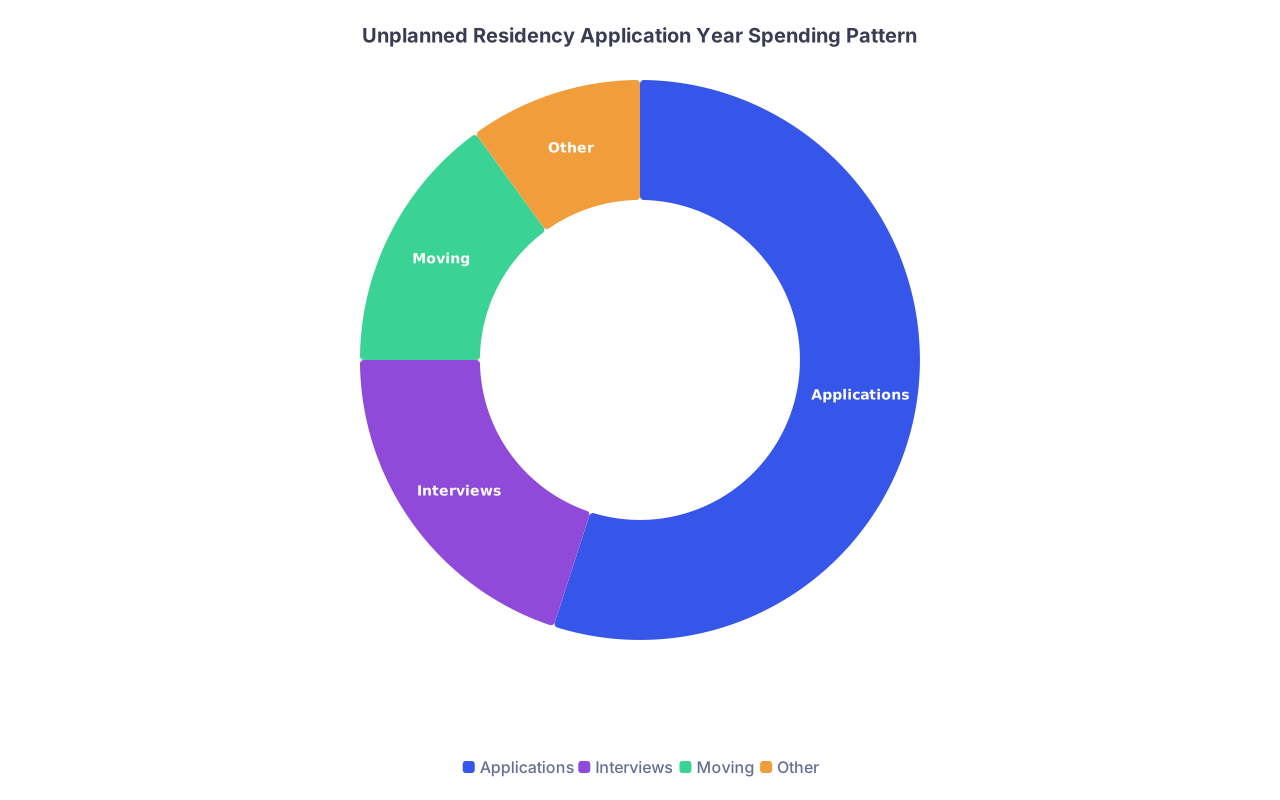
Here is how many people actually allocate their money (subconsciously):
| Category | Value |
|---|---|
| Applications | 55 |
| Interviews | 20 |
| Moving | 15 |
| Other | 10 |
Compare that to what would be smarter for many applicants:
- Slightly fewer applications
- More capacity to attend every worthwhile interview
- Enough left for a non-disastrous move
Mistake #7: Failing to Use Tiers and Hard Cutoffs
The people who spend the most are usually the ones who treat their list as one undifferentiated blob. Everything feels “kind of necessary.”
You need tiers. And you need a guillotine.
A simple method I have seen work:
Decide your absolute max budget first. In dollars, not vibes.
Estimate how many programs that buys in your specialty, given current ERAS pricing.
Build three lists:
- Tier 1: Must-apply programs (top choices, strong fit, realistic odds)
- Tier 2: Reasonable targets (okay fit, decent odds)
- Tier 3: True safeties (you would actually attend, not fantasy safeties)
Fill your budget with Tier 1 first, then Tier 2, then Tier 3—in that order.
Stop when the money runs out. Not when your anxiety runs out. The money.
You will be tempted to sneak in “just 5 more” at the bottom. I have watched those 5 become 15 in real time while someone “justifies” each click.
That is how people go from a defensible 40 applications to a 78-program mess.
You want a rule like this written down:
“Once I hit X programs, I am done unless I receive a new piece of information that objectively changes my risk profile (failed exam, broken couples match plan, sudden geographic restriction). Anxiety alone is not a reason.”
Mistake #8: Treating Reapplicants and Red Flags Like Simple Multipliers
If you are a reapplicant or have a significant red flag, you do need a wider net. But the default reaction—“Just double the number of programs”—is lazy and expensive.
The real work is targeting, not simply scaling:
- Identifying programs historically friendly to IMGs, DOs, or remediation stories
- Avoiding programs that openly state they filter by Step 1/2 or class rank thresholds you do not meet
- Prioritizing places where you have genuine connections: alumni, faculty, prior rotations
You can spend a fortune applying to 120 programs that will auto-screen you out based on one numeric filter.
Or you can spend less, apply to 60 where you cleared the basic bar, and actually be read.
The mistake is thinking volume alone overcomes a red flag. It does not. Volume just makes your rejection more expensive.
Mistake #9: No Mid-Season Reality Check
Another flavor of ERAS budget blindness: you set one giant number in September and then never revisit your plan as data comes in.
By late October or early November, you will have real signals:
- How many interviews you have
- What tier those programs fall in
- Whether your original risk assessment was too optimistic or too pessimistic
You should be asking:
- “Given the interviews I already have, do I still need maximum-volume backup applications in a second specialty or extra programs?”
- “Is it smarter to save now so I can afford every single interview that arrives later?”
Many people do the opposite: they panic early, over-apply, then when the bills come due, they do not have the flexibility to respond adaptively.
Build a checkpoint into your calendar:
By a specific date, you review your invites and adjust your behavior. That may mean not adding more programs. Resisting the urge to spray late-season applications that almost never lead to interviews is its own form of discipline.
Mistake #10: Forgetting That Future You Has To Pay This Back
There is a nasty cognitive trick that happens in med school and residency: “Everything is temporary, I will make real money later, so what is another $800?”
Intern-year you will not find this funny.
That extra $800–$1,500 on ERAS:
- Sits on high-interest credit cards
- Compounds while you are too busy to deal with it
- Compounds again when you tack moving and furnishing costs on top
- Turns into real, annoying monthly payments that follow you for years
ERAS is not the only thing you will overspend on if you train yourself that anxiety justifies every financial decision. It just happens to be one of the earliest and most predictable tests.
You are establishing habits:
Do I respond to fear by buying more? Or do I respond to fear by clarifying my strategy, tightening my criteria, and spending intentionally?
The money is not just about this year’s Match. It is about the kind of physician—and adult—you are training yourself to be.
Practical Guardrails To Avoid ERAS Budget Blindness
Let me be very concrete. If you want to stay out of the worst traps:
- Write your budget number first. In dollars, not programs.
- Estimate your realistic application count from that budget, then sanity-check it with someone who knows your specialty.
- Sort your program list into hard tiers and only pay for category 1–3, never 4 (“never programs”).
- Do a mid-season review once invites are rolling, and stop adding low-yield programs out of panic.
- Protect interview and moving money like it is sacred. Because it is.
If you need a mental test, use this:
If a program emailed you tomorrow and said, “We guarantee you will never train here,” would your life actually be worse?
If the answer is no, you probably do not need to pay them for the privilege of ignoring your application.
Open your ERAS spreadsheet—or start one if you have not—and do this right now: highlight every program you know, honestly, you would never attend unless absolutely forced. Count them. Then delete them and watch your projected cost drop.