
Everyone copying their friend’s program list size is playing residency roulette with their future.
You are not your classmate with the “I’m applying to 85 programs in EM, should be safe right?” text. Yet I see this every year: smart students doing something remarkably lazy and dangerous—basing their number of applications on what the group chat is doing.
Let me be blunt:
“X worked for my friend” is one of the worst decision tools you can use for residency applications.
This is not a vibe-based exercise. It is a risk-management problem.
The First Big Mistake: Treating Application Count Like a Social Norm
Here is how the disaster usually starts:
- Someone posts: “My advisor said 60 IM programs is enough.”
- Another: “Derm people are doing 80–100.”
- Group chat: panic.
- You: “Ok I will do…60 too? I guess?”
That is copy-paste thinking. And it is dangerous for a few reasons.
1. Your baseline risk is not the same
I have watched students with:
- 230-ish Step 2 scores
- One small poster
- One mediocre letter from a rushed away rotation
…apply to the same number of programs as a classmate who had:
- 260+
- Multiple strong home letters
- Publications
- A chair who knows half the PDs in the specialty
Those two people do not live in the same risk universe. Using the same application count for both is malpractice.
2. People lie and people omit
Your friends rarely tell you the full picture:
- They say: “I applied to 40 IM programs.”
- They do not say: “My PI called three PDs personally and my Step 2 is 258.”
Or:
- They say: “My advisor said 45 is plenty.”
- They do not say: “I am AOA at a top‑10 med school and my spouse is an attending here so I am basically not moving.”
You see the number. You do not see the context. That is how people get burned.
3. Specialty competitiveness is not flat
Surgery ≠ Psychiatry ≠ Dermatology ≠ Family Medicine.
Using a friend’s number from a completely different specialty is absurd, but it happens constantly.
I once watched a student applying Psychiatry match with 18 applications and another going into Ortho nearly go unmatched with 75. They had both “copied” numbers from someone in another specialty years before.
Stop pretending all specialties obey the same math. They do not.
The Numbers Problem: Copy-Pasting Ignores Actual Risk Data
You cannot avoid risk if you refuse to look at it.
Here is what you should be thinking about instead of “my friend did 50”:
| Factor | Safer Profile Example | Higher-Risk Profile Example |
|---|---|---|
| Step 2 CK | 250+ | < 230 or multiple attempts |
| School | US MD, strong match history | US DO / IMG with weaker pipeline |
| Specialty | FM, Psych (non-urban only) | Derm, Ortho, Plastics, ENT |
| Red Flags | None | LOA, professionalism, failed exam |
| Geography Flexibility | “Anywhere” | “Only Northeast / only 1 city” |
Now, here is where people go wrong: they ignore this entire table and default to what the loudest person in their group message is doing.
To drive this home, imagine this distribution:
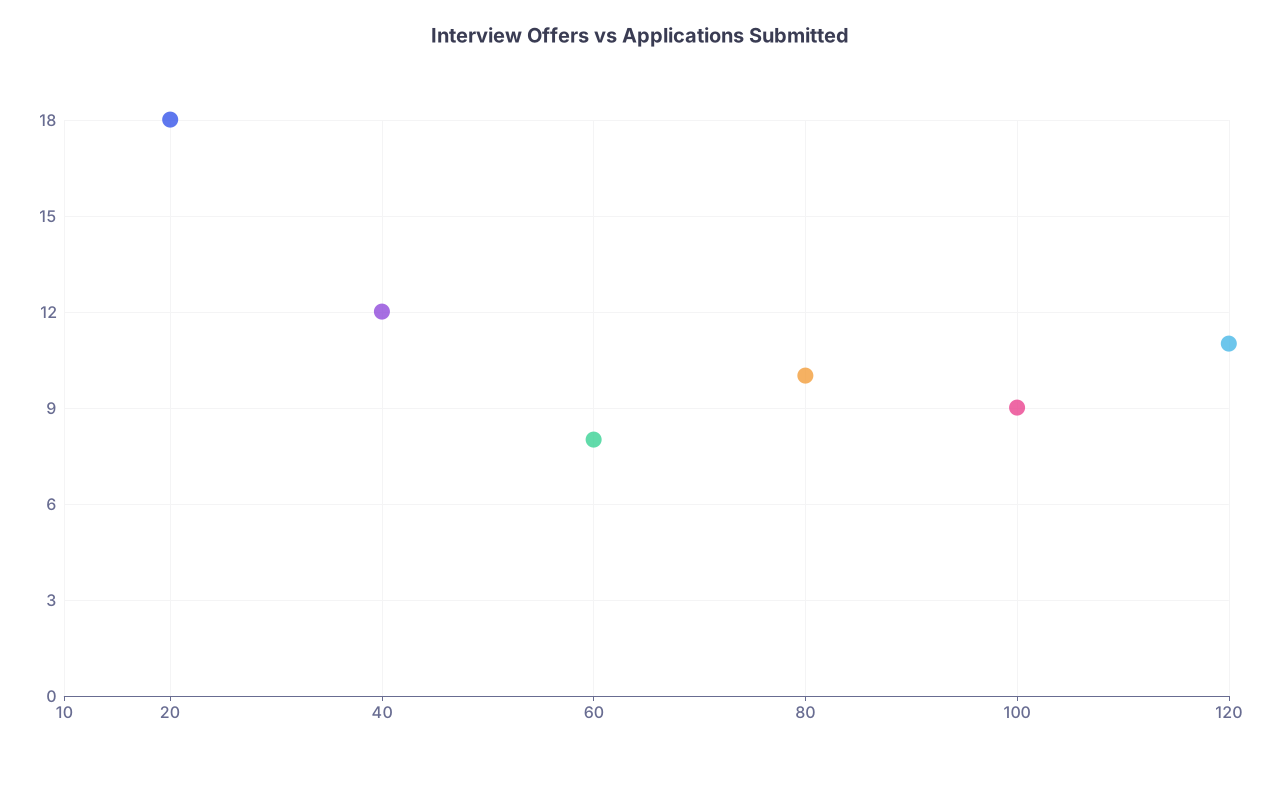
| Category | Value |
|---|---|
| Applicant A | 20,18 |
| Applicant B | 40,12 |
| Applicant C | 60,8 |
| Applicant D | 80,10 |
| Applicant E | 100,9 |
| Applicant F | 120,11 |
You will notice:
- More applications does not always mean more interviews.
- Some people get many interviews with fewer applications because their profile is strong and well‑targeted.
- Others blast out 100+ and still barely hit safety.
Yet everyone in the chat sees “people are doing 80–100” and thinks that must be the right number.
It is not “the” number. It is just a number.
The Hidden Costs: What Blindly Matching Counts Actually Costs You
People love to talk about “more is safer.” They conveniently ignore what “more” steals from you.
1. Financial burn
Applications are not theoretical points. They are dollar signs.
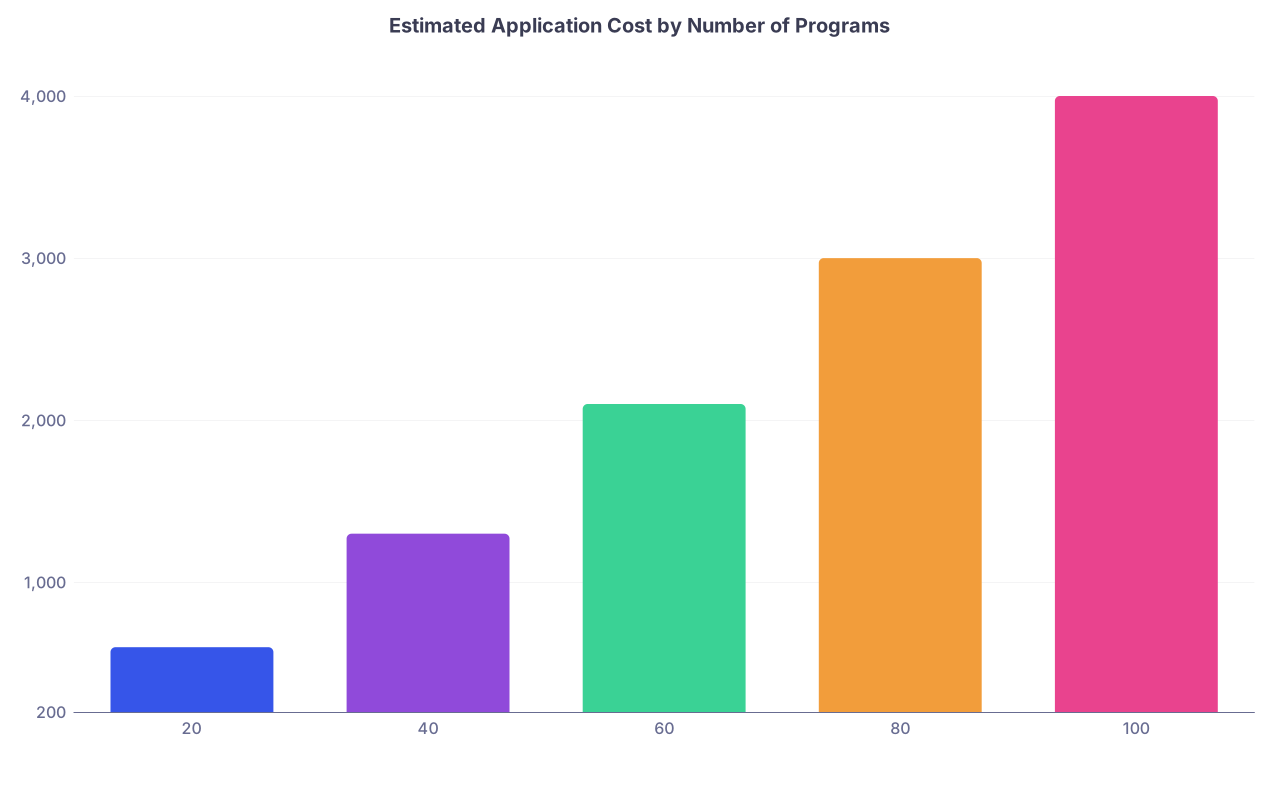
| Category | Value |
|---|---|
| 20 | 600 |
| 40 | 1300 |
| 60 | 2100 |
| 80 | 3000 |
| 100 | 4000 |
This is the ballpark for a single specialty once you include:
- ERAS fees
- NRMP fees
- Extra document fees
- Interview travel if in‑person (or time off if virtual)
When you mindlessly copy your friend’s “90 programs just to be safe,” you might be lighting $1000–$2000 on fire for no real improvement in outcome.
2. Time tax and quality drop
Every program you apply to generates:
- Emails
- Portals
- Surveys
- Potential supplemental questions
- Possible interview invites you need to triage
Your attention is a finite resource.
Once people push into the 80–100+ application range in a single specialty, these patterns show up:
- They miss interview invites that expire after 24–48 hours
- They double-book and then cancel late (PDs remember those)
- They cannot properly research programs, so interviews sound generic and weak
- They are exhausted by January and start phoning it in
You are not a machine that can process 90 potential interview pipelines with equal care. Copying counts from someone with a different stamina, schedule, or support system is reckless.
3. Emotional fallout and panic spirals
Here is the part nobody wants to admit.
If you:
- Apply to “only” 40 because your superstar friend did 40
- Then watch them get 20 interviews and you get 5
You will panic. You will catastrophize. You will second-guess everything.
On the flip side:
- If you copy someone’s 100+ program blitz
- Then spend months buried in emails and portals
- And still get a modest number of invites
You feel like you failed, even if you are actually on par for your profile.
Copying application counts guarantees you will compare outcomes in all the wrong ways. That comparison is brutal and usually unfair to you.
The Context People Conveniently Ignore
I have sat in too many advising meetings that start like this:
“My roommate matched EM last year. He applied to 55. I am thinking of doing 55.”
Then you start asking questions:
- Did your roommate dual apply?
- Was he at a top‑tier EM-heavy school with a home department?
- Did he have away rotations at name-brand hospitals?
- What was his Step 2? AOA? Prior degree? Military background?
The student shrugs: “Not sure. But 55 worked for him.”
This is how you walk yourself into trouble.
Key contextual differences that make “same count” nonsense
Institution and pipeline
- Some schools are feeders into certain specialties. PDs trust their evals and letters. Their students can safely apply to fewer.
- Others are unknown to many programs. Those students often need a wider net.
Letter strength and connections
- Your friend’s department chair might be on a first‑name basis with half the PDs in a region.
- Your strongest letter might be from a community physician whom nobody on the committee has ever met.
Those are not equal situations, no matter what the ERAS screen looks like.
-
- “I am from this region, did undergrad here, med school here, and did an away here” is very different from:
- “I just kind of like the city.”
Your friend who is a local with family in the area can sometimes get away with fewer applications in that region. You may not.
-
- Failed Step attempt
- LOA
- Unexplained gap
- Awkward professionalism note buried in a dean’s letter
Your friend may have none of these. You might have one. That alone can justify a very different strategy.
The Dual-Apply Trap: Copying Counts Across Two Specialties
Another dangerous variant: you are dual applying, your friend is not.
I keep seeing this:
- Friend: Single specialty, 60 programs, matches fine.
- You: Dual applying, 60 in each specialty, think you are doing “the same thing” but safer.
Wrong.
Dual applying changes everything:
- You split your signal: PDs can tell you are not fully committed.
- You split your time: Two interview trails, two sets of preps.
- You split your letters and messaging.
If you copy a single-specialty friend’s program count for each of your two specialties, you might:
- Burn out
- Run out of money
- Fail to give your safer specialty enough attention
Or the opposite: overwhelm your “backup” specialty list with low‑yield apps that do not change your odds much but drain your resources.
A Saner Way: Building Your Number from Your Data
You want a rule? Fine. Here it is:
Do not pick a number until you have taken yourself seriously enough to do a short, honest risk assessment.
Step 1: Identify your real risk tier
Rough rule of thumb (not gospel, but better than friend math):
- Lower risk
- Strong Step 2 relative to your specialty
- No red flags
- Home program in specialty, strong letters
- Flexible geography
- Moderate risk
- Slightly below-average Step 2
- Some minor concerns (weak clinical comments, limited research where expected)
- Some geographic constraint
- Higher risk
- Below the typical Step 2 range
- IMG/DO for highly competitive specialty
- Red flags, big gaps, or poor institutional pipeline
- Very narrow geography
Then align your starting application count to that reality, not your friend’s reality.
Step 2: Align with actual specialty data, not rumors
Look at:
- Recent NRMP Charting Outcomes
- Program fill rates by applicant type
- Your own school’s match list in that specialty
- What your specialty advisor says for your profile
Then ask:
- Am I near the stronger or weaker end of successful applicants in this specialty?
- How many programs did people like me (on paper) typically need?
This is where an honest advisor is worth far more than five anxious friends.
The “Too Few” vs “Too Many” Problem: Both Sides Are Dangerous
People love to worry about under-applying. They ignore the risks of over-applying.
Too few: the obvious danger
- Not enough interviews to comfortably rank 12+ programs in most specialties.
- If anything goes wrong—one bad letter, one unlucky interview streak—you have no cushion.
- You can end up in SOAP or unmatched while having been “almost competitive.”
You do not want to sit in a SOAP room thinking, “I shaved 15 programs off my list because my roommate said 35 was enough.”
Too many: the hidden danger
- Application fatigue leads to poor performance in interviews.
- You fail to stand out anywhere because your personal statement is generic, your prep thin.
- You waste time researching programs that were never realistic or never truly desirable.
- You may end up ranking places you actively dislike, just because you interviewed there.
Over-applying also has a subtle psychological effect: it makes you feel like you are doing something powerful and proactive, when actually you are just clicking “submit” repeatedly while ignoring the harder work of tailoring and preparation.
Copying a huge number from a friend because it soothes your anxiety is not strategy. It is avoidance.
Practical Guardrails: How Not to Copy-Paste Yourself into Trouble
You want something actionable. Here are guardrails that keep you from making the classic errors.
Never choose a number in a vacuum or based solely on classmates.
Your starting point must include: your scores, your school, your specialty, your geography, your red flags, and your letters.Force yourself to justify each 10-program jump.
Ask: “What specific risk does adding these 10 programs hedge against?” If you do not have a clear answer, you are just copying other people’s fear.Do not use the highest number you hear as your benchmark.
There is always someone applying to 100+ programs. That does not mean you should chase that number.Do not use the lowest number that worked for someone as your benchmark either.
You are not the one outlier who matches Ortho with 28 applications from a mid‑tier school. Stop fantasizing.Once you pick your range, stop polling the group chat.
I have watched solid plans get torched in October because someone panicked after hearing “others” are applying to more. Do not let other people’s anxiety hijack your strategy.
The Real Red Flag: When Your Only Reason Is “Everyone Else Is Doing It”
If your primary justification for your application count sounds like:
- “That is what my friends are doing.”
- “Class above us did around that.”
- “Someone on Reddit said 60 is fine.”
Then your plan is weak. Full stop.
The people who match reliably every year are rarely the ones shouting their numbers in the hallway. They are the ones who:
- Knew where they stood
- Accepted their real risk profile
- Built a list size aligned with that reality
- Prepared well for the interviews they did get
They did not outsource their strategy to the noisiest person in the group chat.
If You Remember Nothing Else
Keep these three points:
- You cannot safely copy someone else’s program count without copying their entire profile—and you cannot.
- Under- and over-applying are both dangerous; “more” is not automatically safer if it dilutes your effort and drains your resources.
- A rational application number starts from your actual risk factors and specialty data, not from what your friends are doing.
If your gut choice of “how many programs” is based on mimicking someone else, stop. Recalculate. Your match is too important to leave to copy‑paste logic.