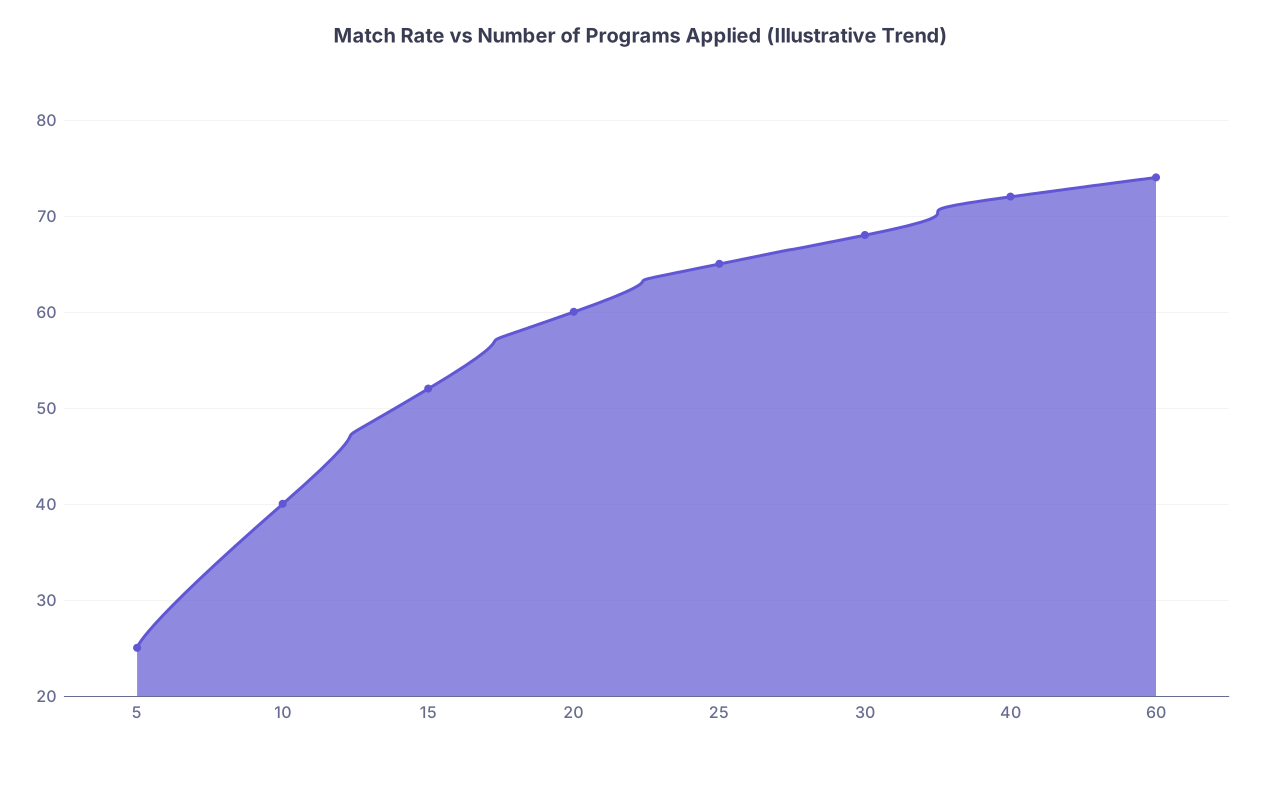
Selecting residency programs in Pediatrics-Psychiatry (often called Triple Board when it includes pediatrics, adult psychiatry, and child & adolescent psychiatry) is uniquely challenging. The specialty is small, the training pathways are complex, and there is limited data compared with larger fields. A thoughtful program selection strategy will protect you from both under- and over-applying, while positioning you to match at a place where you will actually thrive.
This guide walks you through how to choose residency programs, how many programs to apply to, and concrete steps to build a smart, personalized program selection strategy for peds psych residency and Triple Board training.
Understanding the Pediatrics-Psychiatry/Triple Board Landscape
Before you can design an effective program selection strategy, you need a clear picture of what “Pediatrics-Psychiatry” actually includes and how the programs are structured.
What is “Peds Psych Residency” in Practice?
In the U.S., there are a few main training configurations relevant to Pediatrics-Psychiatry:
Triple Board Programs (Pediatrics / Psychiatry / Child & Adolescent Psychiatry)
- Duration: 5 years
- Board eligibility:
- Pediatrics
- General Psychiatry
- Child & Adolescent Psychiatry
- Structure: Integrated, rotating blocks across all three disciplines throughout the five years, with a strong developmental and systems focus.
Pediatrics + Psychiatry via Sequential Training
- Examples:
- Complete a traditional Pediatrics residency (3 years) → then Child & Adolescent Psychiatry fellowship (2 years)
- Or complete Psychiatry (4 years) → then Child & Adolescent Psychiatry fellowship (2 years) with strong pediatric/consult emphasis.
- You won’t usually find this labeled as “peds psych residency,” but these pathways can lead to similar career outcomes focused on pediatric mental health.
- Examples:
Combined Pediatrics–Psychiatry (Non-Triple Board)
- Very rare and often program-specific; some institutions build custom training sequences or joint tracks. These are outliers but worth investigating if you have a strong geographic preference.
When applicants say “peds psych residency,” they usually mean Triple Board. This article focuses on Triple Board programs and strategies that also translate well to related combined training plans.
Why Program Selection Strategy Matters More in a Small Specialty
Peds psych and Triple Board programs:
- Are few in number (dozens, not hundreds)
- Have small class sizes (often 1–3 residents per year)
- Vary dramatically in:
- Degree of true integration among the three fields
- Institutional culture and “home base” identity
- Clinical emphasis (inpatient vs outpatient, consultation-liaison, developmental-behavioral, etc.)
- Faculty expertise and presence of Triple Board–trained mentors
In a small specialty, every choice is magnified:
- A single program on your rank list can represent ~10–20% of all available spots.
- Each interview is more time-intensive, often involving meetings with leaders across three departments.
- The culture fit and long-term career alignment matter even more because you’re committing to a specific niche for five formative years.
This is why a deliberate, research-based program selection strategy is essential.
Step 1: Clarify Your Goals and Non-Negotiables
Before you open ERAS or browse program websites, spend intentional time clarifying what you want from residency. Otherwise, you will default to chasing prestige or geography without a clear strategy.
Define Your Career Vision—Even if It’s Fuzzy
You do not need a fixed, detailed 20-year plan. But for peds psych residency and Triple Board training, you should at least define broad directions:
Ask yourself:
Do I see myself primarily as:
- A clinician (outpatient, inpatient, or hybrid)?
- A subspecialist (e.g., autism, neurodevelopmental disorders, eating disorders, somatic symptom disorders, foster care/trauma)?
- An academic physician (research, education, health policy)?
- A systems leader (medical director, integrated care, collaborative care models)?
Where do I want most of my clinical identity to sit:
- More pediatrician-like (primary care, medically complex kids, developmental/behavioral pediatrics)?
- More psychiatrist-like (psychopharmacology, psychotherapy, inpatient units, CL-psych)?
- Truly hybrid, moving across child medical and psychiatric settings?
What populations or systems excite me most?
- Medically complex children with neurodevelopmental conditions
- Child & adolescent inpatient psychiatry
- Emergency psychiatry and crisis systems
- School-based mental health
- Foster care, juvenile justice, and trauma systems
- Rural/underserved communities
- Integrated pediatric primary care mental health
Write down a brief “career intention” paragraph. For example:
“I want to be a Triple Board-trained physician who works in an academic children’s hospital, leading integrated medical-psychiatric care for medically complex and neurodiverse children, with time for teaching and systems-improvement projects.”
This kind of clarity will guide how to choose residency programs that truly support your trajectory.
Identify Your Non-Negotiables
Next, distinguish between must-haves, strong preferences, and nice-to-haves. Consider:
Location & Lifestyle
- Must be within driving distance of partner/family
- Urban vs suburban vs rural
- Cost of living
- Weather, commute, support systems
Training Structure
- Strong, well-integrated rotation schedules vs more siloed training
- Adequate exposure to:
- Pediatric inpatient wards
- Intensive care environments
- Child psychiatry inpatient and outpatient
- Consultation-liaison services
- Resident autonomy and graduated responsibility
- Call schedule and duty hour culture
Program Culture
- Psychological safety and approachability of leadership
- Support for resident wellness and mental health
- Diversity, equity, and inclusion (DEI) commitment
- Attitude toward combined training (celebrated vs tolerated)
Mentorship & Academic Opportunities
- Availability of Triple Board–trained faculty
- Child psychiatry, developmental-behavioral pediatrics, and psychology faculty with aligned interests
- Research or QI infrastructure
- Support for conference attendance (AACAP, PAS, etc.)
Putting these on paper keeps your program selection strategy anchored to your values rather than rankings or hearsay.

Step 2: Research Programs Strategically, Not Randomly
Once you know your goals and non-negotiables, you can start mapping the actual program landscape in a methodical way.
Build a Master List of Peds Psych/Triple Board Programs
Use:
- ERAS/NRMP lists under combined training or Triple Board
- Program websites (search “[Institution] Triple Board program”)
- Specialty organizations:
- American Academy of Pediatrics (AAP)
- American Academy of Child & Adolescent Psychiatry (AACAP)
- Advice from:
- Your home pediatrics and psychiatry departments
- Prior Triple Board or combined residents from your school
Create a spreadsheet with columns such as:
- Program name / Institution
- City, state, region
- Program size (total Triple Board residents, per class)
- Home base (children’s hospital vs psych department vs balanced)
- Notable strengths (e.g., autism center, CL-psych, DBP)
- Academic vs community tilt
- Call structure for peds and psych
- Program director and coordinator contacts
- Gut impression / notes
Evaluate Training Fit Using Concrete Criteria
For each program, dig deeper than its name and location. Consider:
1. Integration & Identity
- How is the 5-year schedule arranged?
- Are rotations integrated every year, or front-loaded in peds then psych, etc.?
- Do residents feel like “members” of all three departments or outsiders to all?
- Are there Triple Board–trained faculty in leadership positions?
- Is the program seen as:
- A core part of the institution’s mission, or
- A peripheral experiment?
Red flag: Program websites that barely mention Triple Board, list no dedicated leadership, or lack current resident profiles.
2. Clinical Breadth and Depth
Assess:
- Pediatric exposure:
- High-volume children’s hospital?
- NICU/PICU exposure?
- Primary care pediatric continuity clinics?
- Psychiatry exposure:
- Dedicated child & adolescent inpatient units?
- CL services embedded in pediatrics?
- Outpatient clinics with diverse diagnoses and treatment modalities?
- Unique strengths:
- Eating disorders
- Autism and neurodevelopmental clinics
- Integrated behavioral health in primary care
- Trauma-focused or foster care clinics
- Cross-cultural psychiatry or global health
Match these to your career intention paragraph.
3. Academic and Career Development
For applicants interested in academic or leadership careers:
- Are there structured research pathways?
- Do residents present at conferences regularly?
- Are there faculty doing impactful work in areas you care about:
- Integrated care models
- Developmental psychopathology
- Neuroscience and development
- Health services research in pediatric mental health
- Does the program have an established track record of graduates going into:
- Academic roles
- Leadership positions
- Niche subspecialties?
If your goal is non-academic clinical work, look instead for:
- Strong, diverse clinical exposure
- Ease of job placement in your desired regions or practice settings
- Alumni network in community and hospital-based roles
Step 3: How Many Programs to Apply to in Triple Board and Peds Psych
The question of how many programs to apply is anxiety-provoking in every specialty, and even more so when the field is small. There is no magic number, but there is a structured way to decide.
Factors That Drive Application Volume
- Competitiveness of the Field
- Triple Board and peds psych are niche but not uniformly hyper-competitive.
- Small numbers of spots per program mean variability year to year.
- Applicants often self-select, so the average applicant is usually highly motivated with a strong narrative.
- Your Individual Profile
Consider:
- Academic performance (Step/COMLEX scores, clerkship grades)
- Strength of letters, especially from pediatrics, psychiatry, and child psychiatry
- Meaningful exposure to peds psych or child mental health (electives, research, advocacy)
- Red flags or nontraditional routes (leaves of absence, specialty changes, etc.)
- Geographic constraints (e.g., must stay in one region vs geographically flexible)
- Number of Available Programs
- The total pool of Triple Board programs is limited; you simply cannot apply to 50 distinct Triple Board programs because they don’t exist.
- You may be deciding whether to:
- Apply broadly to all or nearly all Triple Board programs, and
- Add traditional pediatric or psychiatry programs as a parallel plan.
A Practical Framework for “How Many Programs to Apply”
For most applicants:
If Triple Board is your clear top choice, and you are geographically flexible:
- Apply to essentially all Triple Board programs unless there are strong reasons not to (e.g., irreconcilable geographic issues, clear cultural misfit).
- Depending on your risk tolerance, supplement with:
- A modest number of categorical pediatrics programs, and/or
- A modest number of categorical psychiatry programs with strong child focus.
If you must remain in one region or city:
- Identify every Triple Board or relevant combined program in that region.
- Add a larger number of categorical programs in pediatrics and/or psychiatry to ensure you have enough interview opportunities near home.
- Your total application count may actually be similar to or higher than national averages because your geographic filter is tight.
If your application has significant risk factors (failed exams, major academic concerns) and you still want to aim for Triple Board:
- Apply to all Triple Board programs.
- Add a broad set of categorical pediatrics and/or psychiatry programs spanning a range of competitiveness.
- Lean heavily on your advisors to calibrate reach vs safety programs.
A typical total application range (Triple Board + categorical) might look like:
Strong, geographically flexible applicant:
- All Triple Board programs (e.g., 10–15 depending on year)
- 10–15 categorical programs (peds or psych)
- Total: ~20–30
Applicant with geographic restrictions or moderate risk:
- All Triple Board programs within reasonable distance
- 15–25 categorical programs
- Total: ~25–40
Numbers fluctuate with national trends, but the program selection strategy principle remains:
Use categorical programs to support your Triple Board goals, not to scattershot apply without a plan.

Step 4: Prioritizing and Finalizing Your Program List
Once you have a long list of potential programs, you need a plan to narrow, prioritize, and personalize it.
Create Tiered Categories
Segment your list into rough tiers:
Top-Fit Triple Board Programs
- Strong alignment with your career goals and non-negotiables
- Reasonable geographic and lifestyle fit
- Positive early signals (responsive program coordinator, clear website, active current residents)
Secondary but Viable Triple Board Programs
- Acceptable but not ideal geography or culture
- Solid training but fewer program strengths that match your niche interests
- Serve as important diversification in your application strategy
Categorical Safety Net Programs
- Pediatrics and/or psychiatry programs where you could see yourself for residency
- Aim for a mix of more and less competitive options
- Preference for institutions with strong child mental health infrastructure
Within each tier, sort by your personal priority: location, reputation, clinical strengths, or some combination.
Balance Idealism and Realism
Some applicants struggle with:
- Guilt about including “safety” categorical programs because it feels like a backup.
- Fear that applying to both Triple Board and categoricals will look unfocused.
In reality:
- Many successful Triple Board residents applied to both and clearly articulated in interviews:
- Why Triple Board is their first choice, and
- How they would still build a peds psych–focused career pathway through a categorical route if needed.
- Programs understand risk management and respect thoughtful planning.
Your job is not to perform single-mindedness; your job is to secure training that leads you to your ultimate career goals, potentially via more than one possible route.
Use Direct Contact Strategically
As you narrow your list:
- It is reasonable to email program coordinators or directors to:
- Confirm that the program is accepting applicants this cycle (programs occasionally pause).
- Ask clarifying questions not answered on the website (e.g., “Do Triple Board residents have access to the autism center clinic?”).
- Be concise and professional; avoid overselling yourself or pressuring for special consideration.
Positive, respectful communication can give you insight into responsiveness and program culture, which is invaluable for finalizing your list.
Step 5: Evaluating Programs During Interviews and Beyond
Your program selection strategy doesn’t end when you submit ERAS. The interview process will refine your understanding of fit and may even alter your priorities.
Key Questions to Ask on Interview Day
Focus on questions that reveal how Triple Board residents actually live, learn, and are supported:
- How integrated do Triple Board residents feel within pediatrics, psychiatry, and child psychiatry?
- Who are the core Triple Board champions and mentors?
- How is scheduling and call managed across the three disciplines?
- Can residents pursue specific interests (e.g., autism, complex care, CL, psychopharm) in all three areas?
- What do graduates typically do after training? Where are they now?
Ask current residents:
- How is your work-life balance across the five years?
- What surprised you about this program—good and bad?
- Have you ever felt pulled between departments or identities? How does leadership handle that?
- Would you choose this program again?
Watch for Culture Clues
During virtual or in-person visits, pay attention to:
- How faculty speak about Triple Board residents:
- As invaluable bridges? Or as scheduling challenges?
- How residents across pediatrics and psychiatry interact:
- Collegial and collaborative? Or siloed?
- Whether leaders know residents personally and show genuine investment in their growth.
Culture is often the deciding factor when programs seem similar on paper.
Refining Your Rank List: Strategy, Not Sentiment Alone
Once interviews are over:
- Revisit your career intention and non-negotiables.
- Reassess each program through that lens, not through isolated interview-day impressions.
- Consider:
- Long-term training value (clinical skills + professional identity)
- Supportive mentoring environment
- Personal sustainability over 5 years (wellness, family, financial, social)
For many applicants, the best rank list reflects a mix of heart and head:
- #1–3: Where you felt you would truly thrive and grow into your envisioned physician.
- Middle: Programs that are clearly solid and would allow you to reach your goals with some adaptation.
- Lower: Programs that are acceptable but have compromises you’d only accept if necessary.
Putting It All Together: A Sample Program Selection Strategy
To illustrate, here’s a hypothetical example.
Applicant: Alex, MS4, interested in integrated care for children with neurodevelopmental disorders; geographically flexible but prefers East Coast; strong academic record, moderate research, no red flags.
Program selection strategy:
Clarify goals
- Future career: Academic children’s hospital, integrated developmental–psychiatric care.
- Non-negotiables: Strong autism/neurodevelopmental resources, supportive Triple Board culture, access to research mentorship.
Build list
- Identify all Triple Board programs nationally.
- Highlight those with major children’s hospitals and neurodevelopmental clinics, especially on the East Coast.
- Identify 10–15 categorical pediatrics and psychiatry programs with strong child mental health and developmental pediatrics presence.
Apply
- Submit applications to:
- ~12 Triple Board programs (all available plus a few with strong fit).
- 7–8 categorical pediatrics programs.
- 7–8 categorical psychiatry programs with strong child focus.
- Total: ~25–30 applications.
- Submit applications to:
Interview and rank
- During interviews, Alex prioritizes programs with:
- Triple Board-trained mentors
- Autism center or developmental clinics
- Reports of strong integration across departments
- Rank list:
- Top: Triple Board programs with clear neurodevelopmental strengths and culture fit.
- Middle: Other Triple Board programs.
- Bottom/tail: A select group of categorical pediatric and psychiatry programs with strong child mental health infrastructures.
- During interviews, Alex prioritizes programs with:
This approach balances ambition (Triple Board first) with realism (categorical routes that still support the same ultimate career).
Frequently Asked Questions
1. Will applying to both Triple Board and categorical programs hurt my chances?
No, not if you present a coherent narrative. Many applicants apply to both and match successfully in Triple Board. In your personal statement and interviews:
- Clearly articulate why Triple Board is uniquely suited to your goals.
- Explain that, if you match categorically, you would still pursue a pediatric-psychiatric career via:
- Child & adolescent psychiatry fellowship
- Integrated care roles
- Developmental-behavioral pediatrics or related tracks
Programs respect well-thought-out contingency planning.
2. How do I decide between Triple Board and a traditional pediatrics or psychiatry path?
Ask yourself:
- How important is being board-certified in all three (pediatrics, psychiatry, child & adolescent psychiatry) vs primarily one?
- Do you want continuous integration of medical and psychiatric training, or are you comfortable with sequential training?
- How much do you enjoy:
- General pediatric medicine?
- Systems-level work across medical and psychiatric settings?
- Are you prepared for a demanding 5-year combined curriculum with frequent role transitions?
If your passion is primarily psychiatric, especially psychotherapy and complex psychopharmacology, a traditional psychiatry → child fellowship track may suffice. If you’re driven to sit at the interface of pediatric medicine and child psychiatry, Triple Board may be the better fit.
3. What if my school doesn’t have a Triple Board program or strong child psychiatry presence?
You can still be a competitive applicant. Strategies include:
- Seek electives in:
- Child & adolescent psychiatry
- Developmental-behavioral pediatrics
- Pediatric consult-liaison psychiatry (if available)
- Engage in related research or QI:
- Pediatric mental health screening
- Integrated care initiatives
- Behavioral health in primary care
- Attend or present at regional or national conferences (e.g., AACAP, local pediatric/psychiatry meetings).
- Request away rotations at institutions with strong child psych or Triple Board faculty if feasible.
- Ask your pediatric and psychiatry mentors to connect you with colleagues at Triple Board institutions for guidance and potential mentorship.
4. How can I tell if a program genuinely values Triple Board residents?
Look for:
- Presence of Triple Board–trained core faculty and leaders.
- Clear, detailed information on the website about:
- Curriculum structure
- Sample schedules
- Resident profiles and alumni outcomes
- Evidence that Triple Board residents:
- Hold leadership roles (Chief resident, committees)
- Are featured in departmental news or recognized for accomplishments
- During interviews, notice:
- How faculty describe the program’s goals for Triple Board training.
- Whether they discuss Triple Board as central to their mission or as a side project.
- How current residents talk about being supported (or not) when schedules/expectations conflict across departments.
If Triple Board residents seem invisible, overburdened, or marginalized, that program may not be the right fit—no matter how prestigious the institution.
Thoughtful program selection is as important as any test score or letter of recommendation. By grounding your strategy in your long-term vision, understanding the Triple Board and peds psych landscape, and making deliberate choices about how many programs to apply to and which ones, you set yourself up not only to match—but to thrive in a program that truly fits the physician you’re becoming.