As a US citizen IMG (international medical graduate), your program selection strategy is one of the most powerful levers you control in the Match. You can’t change where you went to school, but you can be smart and strategic about where you apply. This often makes the difference between matching and going unmatched.
Below is a comprehensive guide tailored specifically to American students studying abroad and US citizen IMGs, covering how to choose residency programs, how many programs to apply to, and how to build a realistic, data-driven program selection strategy.
Understanding the US Citizen IMG Landscape
Before you decide how many programs to apply to or which ones to choose, you need to understand the context you’re applying in.
Why being a US citizen IMG is unique
You sit between two worlds:
- You share citizenship and language advantages with US MD/DO graduates (no visa needed).
- You share training and perception challenges with non-US IMGs (school reputation, clinical exposure, exam performance expectations).
Program directors often see:
- Variable clinical preparation among IMGs
- Limited familiarity with many international schools
- Concerns about documentation, communication, and system knowledge
However, as a US citizen IMG, you have several strengths:
- No visa sponsorship barrier – a major plus over non-US IMGs
- Often better cultural and language fit with US health systems
- Increasing numbers of US citizen IMGs successfully matching each year
Your strategy is to leverage your advantages (citizenship, English fluency, any US clinical experience) and mitigate perceived risks (school, lack of home program, limited US letters) through smart program selection.
Data realities you must keep in mind
While numbers change yearly, consistent trends hold:
- US citizen IMGs can and do match in all major specialties, but:
- They match at lower rates than US MD/DOs
- Match rates are highest in primary care fields (IM, FM, peds, psych) and lower in highly competitive or procedural specialties (derm, ortho, ENT, plastics, neurosurgery, etc.)
As a US citizen IMG, you should:
Use NRMP’s Charting Outcomes in the Match, Program Director Survey, and Match Data to see:
- IMG match rates by specialty
- Score ranges of matched US citizen IMGs
- How many programs applicants applied to and ranked
Be brutally honest about:
- Specialty competitiveness
- Your step scores and clinical profile
- Your realistic ceiling and floor
This realism is not about settling; it’s about avoiding an “all or nothing” strategy that leaves you unmatched.
Clarifying Your Priorities Before Building Your List
A strong program selection strategy starts with your personal and professional priorities. As an American studying abroad, the pull of "going home" can be strong, but emotion alone cannot guide strategy.
Step 1: Define your non-negotiables
Ask yourself:
- Visa needs:
- As a US citizen IMG, you do not require sponsorship. This is a major advantage, but still confirm programs accept IMGs.
- Geographic must-haves:
- Must you be in a certain state or region (e.g., for spouse job, children, family support)?
- Are there regions you absolutely will not consider?
- Specialty flexibility:
- Is there only one specialty you are willing to pursue this cycle?
- Are you open to a backup specialty (e.g., IM vs neuro, FM vs psych)?
Write down 3–5 non-negotiables. These will be your guardrails.
Step 2: Clarify your “nice-to-haves”
These are preferences, not requirements, such as:
- Academic vs community-based setting
- Size of program (small, medium, large)
- Research opportunities or fellowships
- Patient population (rural vs urban, underserved, particular language needs)
- Proximity to airports or major cities
Distinguishing non-negotiables from preferences is essential. Many unmatched US citizen IMGs effectively treat “nice-to-haves” as hard rules and unconsciously self-eliminate from programs they could have matched at.

How Many Programs Should You Apply To as a US Citizen IMG?
This is one of the most common and high-stakes questions: how many programs to apply to.
There is no single magic number, but there are evidence-based ranges and principles you can use.
Key principles for deciding application volume
IMGs need a higher volume of applications
Program directors are more selective with IMGs. For many specialties, US citizen IMGs who matched:- Often applied to more programs than US MD/DO counterparts
- Often needed more interviews to secure a match
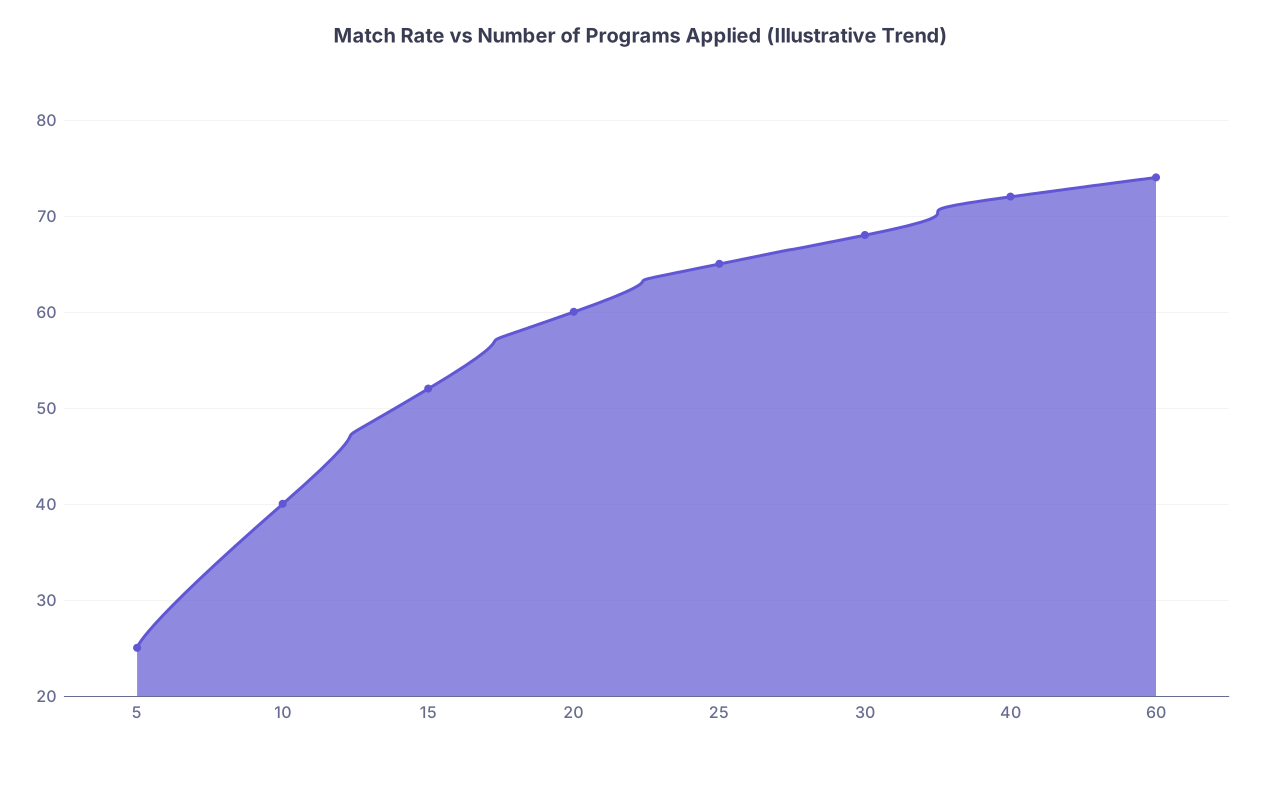
Diminishing returns are real
After a certain point, additional applications:- Rarely translate into significantly more interviews
- Cost time and money you could invest in better application quality
Interviews, not applications, predict matching
Historically, most successful candidates need around:- 10–12+ interviews in internal medicine / family medicine / pediatrics / psych
- More for very competitive specialties
- Fewer may be enough if your application is strong and specialty is less competitive—but as a US citizen IMG, aim high on interview count.
Suggested application ranges by competitiveness
These are general guidance ranges for US citizen IMGs. Your actual number depends on your scores, failures, clinical experience, and red flags.
Assuming you have no major red flags (no multiple failures, no professionalism issues):
Highly competitive specialties
(Derm, ortho, neurosurgery, ENT, plastics, integrated IR, etc.)- Realistically, these are extremely challenging as a US citizen IMG.
- If you proceed, combine:
- 40–60+ applications in the target specialty, plus
- A robust backup specialty (often 40–70+ applications)
- You must have exceptional scores, research, and connections.
Moderately competitive specialties
(Diagnostic radiology, anesthesiology, emergency medicine, neurology, OB/GYN, some university-based IM programs)- Typically: 50–80 applications
- If your profile is borderline (low scores, limited USCE): push toward the higher end or add a backup specialty.
Less competitive / IMG-friendlier specialties
(Internal medicine, family medicine, pediatrics, psychiatry, pathology in some regions)- Many US citizen IMGs: 60–100 applications
- If you have:
- High scores and strong USCE: 50–70 may suffice
- Average scores and modest USCE: 70–90
- Low scores or red flags: 90–120+ (especially if limited USCE or no home rotation in the US)
These ranges may sound high, but for an American studying abroad, this is often the reality of risk management in the Match.
Adjusting for your profile
Increase your application volume if you have:
- Step 1 or Step 2 CK failure or low pass
- No US clinical experience or only observerships
- Older YOG (years since graduation, e.g., >5 years)
- Limited or weak letters from US faculty
- A highly competitive specialty choice
- Need to stay in a small geographic area
You can slightly decrease volume if you have:
- Very strong scores and no failures
- Robust US clinical experience (sub-internships, hands-on electives)
- Several strong US letters, especially from known institutions
- Strong research or home institution connections to specific programs
Building a Data-Driven Program Selection Strategy
Once you have a sense of how many programs to apply to, the next step is choosing which programs. This is where your program selection strategy becomes critical.
Step 1: Identify IMG-friendly programs
As a US citizen IMG, your first filter must be IMG friendliness, not prestige.
Use:
- FREIDA (AMA database)
- Program websites
- NRMP data
- Past match lists from your school
- Dedicated IMG forums, spreadsheets, and match support groups
Look for:
- Programs that routinely accept IMGs or US citizen IMGs
- Current or recent residents from Caribbean, Canadian, UK, or other international schools
- Explicit statements that they welcome IMGs (and differentiate US citizen from non-US IMGs regarding visas)
Red flags that a program may not be IMG-friendly:
- “We only consider graduates from LCME or AOA accredited schools”
- “US MD/DO graduates only”
- “Graduation date within X years and US MD/DO requirement”
- No IMGs visible in current or recent residency classes
Your first-pass list should be primarily programs that actually interview US citizen IMGs.
Step 2: Apply realistic filters
Once you have your large pool of IMG-friendly options, filter them by:
Geography
- Start broad. Don’t eliminate an entire region because of reputation or climate.
- Narrow only for true non-negotiables (spouse job, immigration, caregiving responsibilities).
Graduation year requirements
- Many programs require graduation within 3–5 years.
- Check if they specifically state a YOG limit; if you’re older, prioritize those with no hard cutoff.
US clinical experience requirements
- Some programs require:
- X months of US clinical experience
- Letters from US faculty
- If you don’t meet the bar, deprioritize or exclude.
- Some programs require:
Score thresholds
- Some programs explicitly state minimums for Step scores.
- If you’re just under the threshold, you may still consider a few—but don’t build your list around long-shots.
Step 3: Tier your list (reach, target, safety)
A balanced list is central to a strong program selection strategy. Categorize programs into:
Reach programs
- Slightly above your profile
- Maybe more academic or lightly IMG-friendly
- Roughly 15–25% of your applications
Target programs
- Well-aligned with your scores and experiences
- Historically take US citizen IMGs with similar profiles
- Should be the majority: ~50–60%
Safety programs
- Strongly IMG-friendly
- Accept many IMGs, including those with lower scores or older YOG
- May be less desired locations, smaller hospitals, or community-based
- ~20–30% of your applications
Example (Internal Medicine, US citizen IMG with average scores and 1–2 US rotations):
- Total: 80 programs
- 15 reaches (more academic, larger cities, higher average scores)
- 45 targets (solid community programs with some IMGs)
- 20 safeties (very IMG-friendly, smaller cities, less competitive states)
This structured approach dramatically reduces the risk of an overly top-heavy list that leads to disappointment.

Special Considerations and Examples for US Citizen IMGs
Example 1: American studying in the Caribbean, aiming for Internal Medicine
Profile:
- Step 1: Pass on first attempt
- Step 2 CK: 228
- 2 months US core rotations + 1-month sub-I in IM
- YOG: current year
- No major red flags
Strategy:
- Specialty: Internal Medicine primary; no backup
- Application volume: 80–90 programs
- Focus:
- Community-based IM programs with known Caribbean grads
- Programs without strict Step 2 cutoffs above 230
- Mix of mid-sized cities and smaller communities
- Tiers:
- 15 reaches: Some university-affiliated community programs, more urban
- 50 targets: Community programs with several Caribbean IMGs
- 15–25 safeties: Smaller towns; heavily IMG-friendly states (e.g., some in Midwest, South)
Example 2: US citizen IMG older graduate, aiming for Family Medicine
Profile:
- Step 1: Pass
- Step 2 CK: 215
- YOG: 6 years ago
- Some clinical work abroad, 1 US observership
- Strong commitment to underserved care
Strategy:
- Specialty: Family Medicine with a possible backup in Psychiatry
- Application volume:
- FM: 80–100 programs
- Psych: 40–60 programs (if used as backup)
- Focus:
- Programs without strict YOG cutoff
- Programs emphasizing underserved and community care
- States with historically higher IMG acceptance (e.g., NY, NJ, some Midwest states, some Southern programs)
- Tiers:
- Larger safety pool (IMG-heavy community FM programs, smaller regions)
- Extra step:
- Directly emailing programs indicating interest and explaining clinical activity since graduation.
Example 3: US citizen IMG targeting a moderately competitive specialty (Neurology) with IM backup
Profile:
- Step 1: Pass
- Step 2 CK: 240
- Strong neurology research project, 2 US neurology electives
- YOG: current year
Strategy:
- Primary: Neurology
- Backup: Internal Medicine (at programs with neurology departments when possible)
- Application volume:
- Neurology: 50–70 programs
- IM: 40–60 programs
- Focus:
- Neurology programs with a history of taking IMGs
- IM programs where residents have matched into neuro fellowships or advanced positions
- Benefit:
- Overlap geographical regions to reduce logistical complexity and strengthen regional “story.”
Practical Tips to Optimize Your Program Selection Strategy
1. Use spreadsheets and tracking tools
Create a detailed spreadsheet with columns such as:
- Program name and location
- IMG-friendly? (Y/N/# of IMG residents)
- Visa requirements (even if not needed, indicates openness to IMGs)
- YOG cutoff
- Minimum Step score (if stated)
- US clinical experience required
- Notes on your fit (rotations, research, interests)
- Tier (reach/target/safety)
This helps you make rational, not emotional decisions.
2. Cross-check your list with actual residents
Whenever possible:
- Visit program websites and look at current residents:
- How many IMGs?
- Any US citizen IMGs?
- Are there grads from schools similar to yours (Caribbean, UK, etc.)?
Programs that have never had IMGs are long-shots for you as an American studying abroad, even if they don’t explicitly ban IMGs.
3. Be cautious with prestige chasing
“Top” programs (brand-name academic centers) are often:
- Less IMG-friendly
- Expect higher scores and stronger research profiles
- Have large domestic applicant pools
As a US citizen IMG, you may include a small number of aspirational programs, but your core list should be centered on fit and realistic opportunity, not name recognition.
4. Don’t over-restrict geography
Geographic restriction is a luxury more often afforded to US MD/DOs. For US citizen IMGs:
- Overly narrow geographic focus = fewer interviews
- Programs in less popular states may be more IMG-welcoming and yield more opportunities
Unless you truly cannot move, keep at least 3–4 regions in play.
5. Reassess after interview invitations start
As the season progresses:
- Track how many interviews you are receiving and from what “tier” of programs.
- If you are getting very few invites:
- Double-check for additional open programs or newly accredited programs
- Consider reaching out directly and expressing interest (politely and professionally)
- Use information on which programs show you interest to update your expectations for future cycles if needed.
Frequently Asked Questions (FAQs)
1. As a US citizen IMG, can I be competitive for non-primary care specialties?
Yes, but you must be even more strategic and realistic. For moderately competitive fields (e.g., anesthesiology, neurology, diagnostic radiology), you will need:
- Strong Step 2 CK score and no major red flags
- Some specialty-related experiences (research, electives, letters)
- A robust backup plan (typically IM or FM with enough applications)
For very competitive specialties (derm, ortho, neurosurgery, etc.), the pathway exists but is rare for US citizen IMGs, and often involves exceptional academic metrics, research, and mentorship.
2. How many programs should I apply to if I’m only applying to one specialty?
If you are limiting yourself to one specialty, and you are a US citizen IMG, lean toward a higher volume within that field:
- Primary care specialties (IM, FM, peds, psych): often 70–100+ programs, depending on your profile.
- Moderately competitive specialties: typically 50–80+ programs.
Your exact number should factor in your scores, USCE, YOG, and any other strengths/weaknesses. When in doubt, err on the side of more applications, as long as you can still submit tailored, polished materials.
3. Do I need a backup specialty as a US citizen IMG?
A backup specialty is strongly recommended if:
- Your primary specialty is moderately or highly competitive
- You have below-average scores or a failure
- You are geographically restricted
For IM or FM as primary specialties, some US citizen IMGs can go without a backup if their profile is strong and application list is broad and IMG-friendly. However, a backup specialty can still reduce risk, especially in uncertain cycles.
4. Should I apply to programs even if they don’t explicitly mention IMGs?
You can, but cautiously. If a program:
- Has no history of IMGs in recent classes
- States preference for US MD/DO grads
- Provides no information about IMGs
It is likely a low-yield application for you as a US citizen IMG. It may be worth including a small number of such programs in your reach tier (e.g., due to geography or special interest), but your core strategy should favor programs that have already opened doors to IMGs.
By grounding your decisions in data, self-awareness, and a structured program selection strategy, you significantly increase your chances of success as a US citizen IMG. The goal is not just to find “any” residency, but to secure a position where you can grow, learn, and build the career you’ve been training for—while respecting the realities of your unique path as an American studying abroad.