US citizen IMGs who are American studying abroad often feel caught between two worlds: you share citizenship and cultural familiarity with US-trained applicants, but you carry the added complexity of an international medical degree. When it comes to program selection strategy for emergency medicine residency, your approach needs to be more intentional, data-driven, and realistic than most.
This guide walks through a structured, practical plan tailored specifically for US citizen IMG applicants to Emergency Medicine (EM): how to choose residency programs, how many programs to apply to, and how to build a smart EM match list that balances ambition with safety.
Understanding Your Position as a US Citizen IMG in EM
Before you decide where and how many programs to apply, you need to understand how program directors (PDs) view US citizen IMGs in Emergency Medicine.
How EM Programs Categorize Applicants
Residency programs typically think in broad buckets:
- US MD seniors
- US DO seniors
- US citizen IMGs (American studying abroad)
- Non-US citizen IMGs
You, as a US citizen IMG, are often viewed more favorably than non-US citizen IMGs, particularly at community and some university-affiliated community programs, because:
- You don’t require visa sponsorship.
- You are generally more familiar with the US healthcare system and culture.
- You are more likely to have US clinical experience and letters.
However, you are still categorically different from US MD/DO seniors, especially for highly academic or top-tier EM programs.
General Competitiveness of Emergency Medicine for IMGs
Emergency Medicine has become more competitive over the last decade, though recent trends (e.g., occasional unfilled spots) mean the market is fluctuating. For US citizen IMGs, key realities include:
- Fewer EM programs are truly IMG-friendly compared to IM or FM.
- Many academic EM programs strongly prefer US MD/DO students from their own or peer schools.
- Community-based EM programs and university-affiliated community programs are more likely to interview and rank IMGs.
- A strong application can absolutely match into EM, but you must be strategic and broad.
Honest Self-Assessment: Where Do You Stand?
Your program selection strategy starts with a clear-eyed assessment of your profile:
Key factors:
- USMLE/COMLEX scores (Step 1, Step 2 CK)
- EM-specific experiences (EM rotations, SLOEs)
- US clinical experience (especially in EM)
- Gaps in training or red flags
- Language and communication skills
- Geographic flexibility
You can think of yourself (roughly) in three strength tiers:
- Stronger US Citizen IMG EM Applicant
- Step 2 CK ≥ 240
- Step 1: Pass on first attempt (or 235+ if numeric)
- 2+ strong SLOEs from US EM rotations
- No fails, no major gaps, decent research or leadership
- Typical/Moderate US Citizen IMG EM Applicant
- Step 2 CK ~225–239
- Step 1: Pass / or ~220–234 if numeric
- 1–2 SLOEs, solid US EM rotations
- Maybe some minor weaknesses but no major red flags
- At-Risk US Citizen IMG EM Applicant
- Step 2 CK < 225 or one or more exam failures
- Limited or no SLOEs
- Limited US clinical EM experience
- Gaps in training, repeated years, professionalism issues
Your tier should guide both how many programs to apply to and which types of programs to prioritize.
Building a Data-Driven Target List: Where Can You Realistically Match?
Once you understand your profile, you can begin to build an EM program list using a structured, research-based approach.
Step 1: Identify IMG-Friendly EM Programs
Not all EM programs are created equal in their openness to IMGs. Your initial task is to identify where IMGs have actually matched.
Use these tools and strategies:
FREIDA (AMA)
- Filter by: “Accepts IMGs” or “J-1 visa sponsorship” (if they sponsor visas, they usually consider IMGs).
- Look at current residents on program websites to see if any are IMGs.
Program Websites & Resident Profiles
- Scan resident bios for:
- Caribbean schools, non-US universities, or schools you recognize as international.
- Phrases like “graduated from [non-US university]” or “Caribbean medical graduate.”
- If you see no international grads over 3–5 years, that program is likely not IMG-friendly.
- Scan resident bios for:
NRMP/NRMP Charting Outcomes (when available)
- Look for data on IMGs matching into EM, average scores, and characteristics.
Networking
- Talk to senior students or recent grads from your school who matched EM.
- Ask which programs interviewed them and how they perceived program attitudes toward IMGs.
Create a spreadsheet and categorize programs as:
- Appears IMG-friendly
- Possibly IMG-neutral
- IMG-unfriendly / very unlikely
Step 2: Classify Programs by Type and Competitiveness
Within EM, think of programs in broad types:
Highly Academic / Tertiary Care / Prestigious University Programs
- Big-name institutions, Level 1 trauma centers, heavy research.
- Typically prefer US MD/DO from well-known schools.
- Often low IMG representation.
University-Affiliated Community Programs
- Community hospital-based with academic ties.
- Solid training, often more open to IMGs, especially US citizens.
- May have a mix of US grads and some IMGs.
Community-Based EM Programs (Non-University)
- More service-oriented, less research-heavy.
- Often more pragmatic about applicant pool.
- Frequently the best entry point for US citizen IMGs.
New or Newer Programs
- Recently accredited or in early years of development.
- Often actively recruiting broadly, including IMGs, to fill spots.
- Less prestige but can offer solid clinical training.
Tag each program in your spreadsheet:
- A = Highly academic, IMG-skeptical
- B = University-affiliated community, moderately IMG-friendly
- C = Community, commonly or clearly IMG-friendly
- N = New / recent program
Your core US citizen IMG EM strategy should be built around B, C, and N programs, with a limited number of A programs as long shots.

How Many EM Programs Should a US Citizen IMG Apply To?
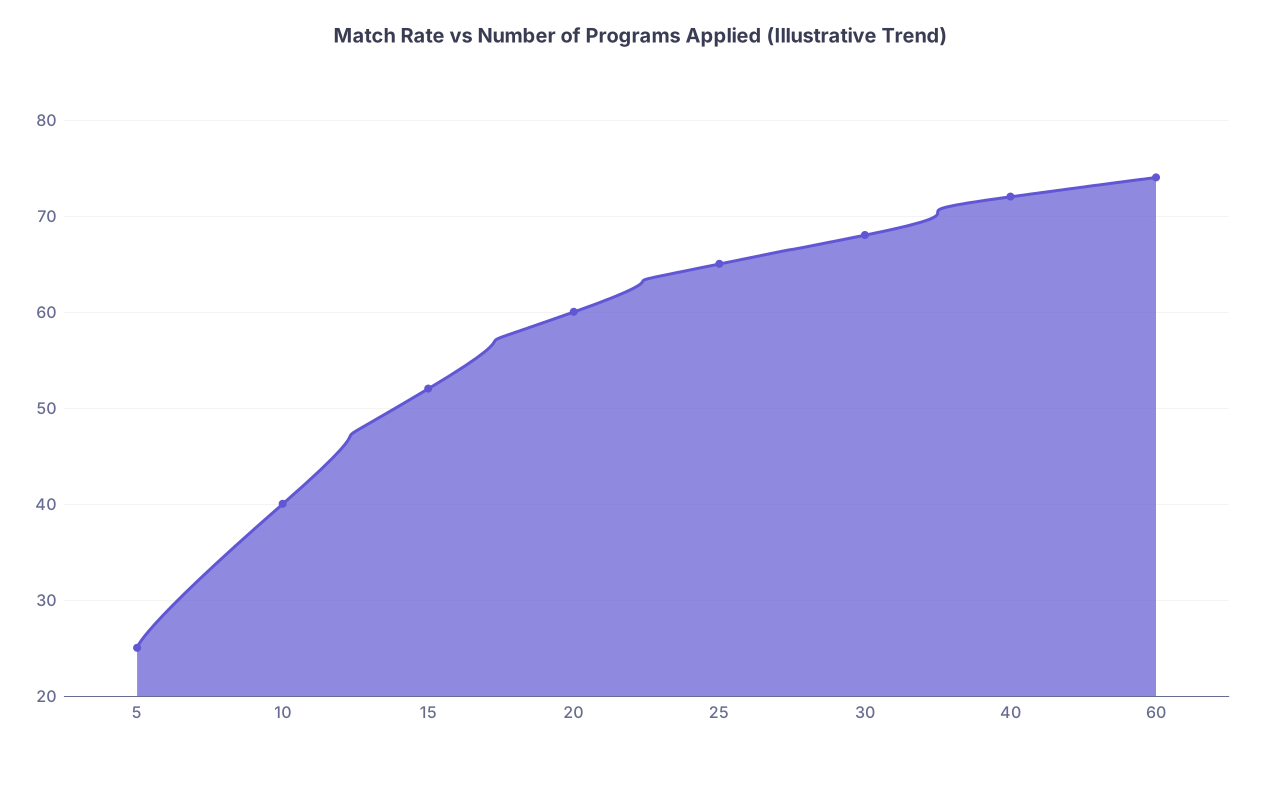
This is where anxiety spikes: how many programs to apply to in EM as a US citizen IMG?
There’s no single magic number, but we can outline reasonable ranges based on your profile.
Baseline Principles
- You’re competing in a specialty that is moderately competitive and selectively IMG-friendly.
- Your “safety programs” are not truly safe—every EM program is competitive to some degree.
- More applications don’t automatically equal more interviews if your list is poorly targeted.
- You must balance financial cost, time, and realistic interview capacity with match security.
Suggested Application Ranges
These ranges assume you are applying EM as your primary specialty. If you’re also applying a backup specialty (e.g., IM), your EM numbers may adjust down slightly.
Stronger US Citizen IMG (Competitive Profile)
- Recommended EM applications: 45–65 programs
- Program mix:
- 5–10 “reach” academic programs (Type A) that are at least somewhat IMG-tolerant.
- ~20–30 university-affiliated community programs (Type B) with a track record of taking IMGs.
- ~15–25 community or newer programs (Type C/N) that clearly accept IMGs.
Why this range? You’re competitive enough to get solid interest but still face systemic IMG bias at many academic centers.
Typical/Moderate US Citizen IMG
- Recommended EM applications: 60–80 programs
- Program mix:
- 5–8 reach academic programs max (Type A).
- 25–35 university-affiliated community programs (Type B).
- 25–40 community and new programs (Type C/N).
Here, your strategy should emphasize breadth and IMG-friendly environments over prestige.
At-Risk US Citizen IMG
- Recommended EM applications: 80–110+ programs
- Program mix:
- 0–5 very selective academic programs only if they have clear IMG history and something uniquely favorable (e.g., your home rotation).
- 30–40 university-affiliated community programs that take IMGs regularly.
- 50–70+ community and new programs with explicit IMG acceptance.
If your aim is EM at all costs, you need a very wide net. However, you should strongly consider a backup specialty.
How Many Interviews Do You Need to Safely Match in EM?
While numbers vary by year, most advisors consider:
- 10–12 EM interviews: generally reasonable chance to match.
- 12–15+ EM interviews: much safer zone.
- <8 EM interviews: significant risk of not matching in EM.
As a US citizen IMG, your goal should be to secure at least 10–12 EM interviews. Your program selection strategy is really about maximizing your probability of reaching that interview number.
Choosing Programs Intelligently: Filters, Priorities, and Dealbreakers
Once you know approximate application numbers, the next step is how to choose residency programs in a way that’s both realistic and aligned with your goals.
Step 1: Define Your Personal and Professional Priorities
These factors should guide your list:
Geography
- Are you tied to a specific region (family, partner, visa issues—not for you as a citizen, but other life reasons)?
- Are you willing to go anywhere in the US for solid EM training?
- Historically, some regions (Midwest, South) are more IMG-friendly than others (e.g., very competitive Northeast metros, parts of California).
Program Type
- Do you strongly prefer academic medicine and research?
- Or are you comfortable with a primarily clinical, community-focused program?
Lifestyle/Shift Volume
- Level 1 trauma centers vs smaller community EDs.
- High-acuity inner-city vs more mixed suburban populations.
Career Goals
- Fellowship aspirations (toxicology, ultrasound, critical care, etc.).
- Academic vs community practice post-residency.
Write down:
- Top 3 non-negotiables
- 3–5 preferences (but not dealbreakers)
- 3 things you’re flexible on
This will help you avoid applying indiscriminately while still staying broad.
Step 2: Program Filters That Matter for US Citizen IMGs
When evaluating each EM residency, pay particular attention to:
IMG History
- Do they currently have IMGs, especially US citizen IMGs?
- Do they list IMG requirements? (e.g., “no more than 2 years since graduation,” “no exam failures,” etc.)
- If they’ve never had an IMG, file as a reach or avoid unless there is a strong special connection.
USMLE Score Expectations
- Some programs explicitly list cutoffs (e.g., Step 2 CK ≥ 230).
- If you’re significantly below posted cutoffs, your chances are very low unless there’s a strong mitigating factor.
SLOE Requirements
- Many EM programs prefer or require at least 1–2 SLOEs.
- If you lack SLOEs, prioritize programs that explicitly say they’ll consider non-SLOE letters or that are IMG-heavy (they may be more flexible).
Year of Graduation
- Some programs limit to “within 3–5 years of graduation.”
- If you graduated earlier, focus on programs that do NOT list strict YOG limits.
Visa Policies (Even if You Don’t Need One)
- Programs that sponsor visas are often more accustomed to IMGs overall.
- As a US citizen IMG, you piggyback on this openness even though you don’t need sponsorship.
Step 3: Using a Tiered List to Balance Risk
For each program on your spreadsheet, assign a personal probability tier:
Tier 1 (High Realistic):
- IMG-friendly, consistent IMG history.
- Your scores at or above their averages.
- Geography and profile fit are good.
Tier 2 (Moderate Chance):
- Some IMG presence or neutral.
- Your stats near but not clearly above their benchmarks.
- Maybe in a more competitive city or region.
Tier 3 (Reach):
- Rarely or never takes IMGs.
- Very competitive academic reputation.
- You’re below typical US MD averages but still meet minimums.
A reasonable distribution for a typical US citizen IMG:
- ~50% Tier 1
- ~30–40% Tier 2
- ~10–20% Tier 3
This structure keeps your list ambitious but grounded.

Practical Tactics to Boost Your EM Match Odds as a US Citizen IMG
Even the best program selection strategy works better when your application is optimized. Here are targeted ways to strengthen your EM candidacy while you’re building your list.
1. Maximize High-Quality EM Rotations and SLOEs
For EM, Standardized Letters of Evaluation (SLOEs) are critical.
Priority order:
- SLOE from an ACGME-accredited EM program where you did an away rotation.
- SLOE from another EM academic or community program.
- Chair/PD letter from EM if SLOE not possible.
- Non-EM letters (IM, surgery, etc.) only as supplements.
Ideal:
- 2 SLOEs from US EM rotations.
If you don’t have this yet: - Target IMG-friendly programs that also offer audition rotations, then apply there and to similar programs.
2. Craft a Clear, EM-Focused Personal Statement
Your personal statement should:
- Explain convincingly why Emergency Medicine.
- Address the US citizen IMG story briefly but confidently (e.g., why you trained abroad, what you learned).
- Reassure PDs about:
- Clinical readiness
- Communication skills
- Teamwork and resilience
Avoid:
- Over-explaining or apologizing for being an IMG.
- Generic “I like variety and adrenaline” language without specific examples.
3. Use a Smart Geographic Strategy
For many US citizen IMGs, the best opportunities lie in:
- Midwest
- South
- Some parts of the Mountain West
- Smaller cities and more rural-adjacent areas
Highly saturated urban areas (e.g., Boston, San Francisco, Manhattan) are often heavily dominated by US MD/DO applicants and may be poor return on investment for the typical IMG, except as a small subset of your reach list.
Think about:
- Prior connections: where you grew up, went to college, or have family.
- Willingness to go to “less popular” locations, which often translates into more openness to IMGs.
4. Consider a Parallel or Backup Plan
If your profile is at-risk or you’re very anxious about matching:
Parallel Application Strategy:
- Apply EM plus a backup specialty (e.g., IM, FM, transitional year).
- Use separate personal statements and letters tailored to each.
- Prioritize EM interviews but maintain enough backup interviews to have a safe ranking list.
SOAP Contingency:
- Familiarize yourself with the Supplemental Offer and Acceptance Program.
- Have an updated CV and backup PS ready in case you need to pivot.
A backup strategy doesn’t mean you’re not committed to EM; it means you’re being pragmatic about the EM match realities for US citizen IMGs.
Putting It All Together: A Sample Program Selection Strategy
To make this concrete, consider three fictional US citizen IMG applicants and how they might build their lists.
Applicant 1: “Alex” – Strong Profile
- US citizen, Caribbean grad
- Step 2 CK: 245, Step 1: Pass on first try
- 2 SLOEs from solid university-affiliated EM programs
- No gaps, strong communication skills
Strategy:
- Apply to 60 EM programs:
- 8 academic (Type A) with some IMG presence.
- 25 university-affiliated community (Type B).
- 27 community/newer programs (Type C/N).
- Geographic focus: Midwest and South, with targeted reaches in larger cities where Alex has ties.
Goal: 12–15 EM interviews.
Applicant 2: “Brianna” – Typical Profile
- US citizen, Eastern European med school
- Step 2 CK: 230, Step 1 numeric: 220
- 1 SLOE from a community EM program, 1 strong IM letter
- No exam failures, but a 1-year gap for family reasons
Strategy:
- Apply to 70 EM programs:
- 5 academic with explicit IMG acceptance.
- 30 university-affiliated community.
- 35 community/new programs, focusing on IMG-heavy regions.
- Add 15–20 IM programs as parallel backup.
Goal: 10–12 EM interviews, plus backup IM options.
Applicant 3: “Carlos” – At-Risk Profile
- US citizen, Caribbean grad
- Step 2 CK: 217, Step 1 failed once then passed
- Limited EM rotations, only 1 EM letter (not a formal SLOE)
- Graduation 3 years ago, some US observerships
Strategy:
- Apply to 100+ EM programs, heavily skewed to community/new and explicitly IMG-friendly.
- Apply simultaneously to a large number of IM or FM programs as backup.
- Focus away rotations or short-term observerships on EM programs known to consider IMGs with red flags.
- Prepare early for the possibility of SOAP or fully transitioning to backup.
Goal: Obtain as many EM interviews as possible but be realistic; ensure a robust backup match plan.
FAQs: Program Selection Strategy for US Citizen IMG in Emergency Medicine
1. As a US citizen IMG, can I realistically match into Emergency Medicine?
Yes, many US citizen IMGs successfully match into emergency medicine residency each year, especially at community and university-affiliated community programs. Your chances depend on:
- Competitiveness of your metrics (Step scores, SLOEs).
- Quality of EM-specific experience.
- Breadth and targeting of your program list.
- Willingness to apply broadly and be geographically flexible.
Applying with a thoughtful program selection strategy dramatically increases your odds compared with applying randomly or too narrowly.
2. How many EM programs should I apply to if I’m only willing to live in certain regions?
Geographic restriction is a major limiting factor. If you narrow to just one or two highly competitive regions (e.g., only Northeast big cities), you:
- Shrink the number of IMG-friendly programs.
- Compete with a heavy concentration of US MD/DO seniors.
If you must restrict your geography, you should:
- Max out applications within that area, especially IMG-friendly programs.
- Strongly consider a parallel backup specialty.
- Be prepared that your probability of matching EM may be lower than if you were geographically flexible.
3. Should I include very prestigious academic EM programs on my list as a US citizen IMG?
Yes—but sparingly and intentionally. It’s reasonable to devote 5–10% of your applications to these “reach” programs, especially if:
- Your scores and SLOEs are strong.
- You have a clear connection (e.g., you rotated there, you have a mentor there, or your undergrad is from that institution’s region).
However:
- Do not fill your list predominantly with highly academic programs that rarely take IMGs.
- Use data: current residents, IMG history, and explicit policies should drive decisions.
4. If I don’t get many EM interview invitations early, should I apply to more programs mid-season?
Late-season applications can help a little, but they’re not as effective as a strong initial application wave. Still, if:
- Your early interview numbers are significantly below expectations (e.g., <5 interviews by late October/early November),
- And there are still programs accepting applications,
You can:
- Add additional community and new programs in less competitive regions.
- Email programs where you have strong ties, politely expressing interest.
However, the best approach is to start with an appropriately large, well-targeted list on day one rather than relying on last-minute expansions.
For a US citizen IMG committed to EM, the path is navigable—but only if you take program selection seriously. Use data to identify IMG-friendly programs, apply to an appropriate number of programs, prioritize community and university-affiliated sites, and stay flexible with geography and backup plans. With a structured strategy, you can transform uncertainty into a realistic road map toward a successful EM match.