
The panic advice that “IMGs must apply to 200+ programs” is lazy, fear‑driven, and only half true.
There is a kernel of reality here. Many unmatched IMGs under‑apply. But the blanket “just apply everywhere” mantra wastes thousands of dollars, burns you out, and often does not move your match odds nearly as much as people think—especially once you cross a certain threshold.
Let’s walk through what the actual NRMP and ERAS data show, and where the fear‑based mythology starts to take over.
Where the “200+ Programs” Myth Comes From
This line doesn’t come from nowhere. It usually comes from one of three places:
- The IMG who applied to 250 programs, got 4 interviews, matched, and now thinks 250 is the magic number.
- The forum culture of “better safe than sorry” mixed with survivorship bias.
- A misreading of NRMP’s Charting Outcomes in the Match and their Application Behavior reports.
I’ve heard versions of this in hospital cafeterias and WhatsApp groups:
- “Bro, my senior applied to 230 IM programs and only got 3 interviews, you should do at least 250.”
- “If you’re an IMG you’re not competing with Americans; you’re competing with other IMGs on spam.”
- “Programs filter by number of applications—if they see you applied everywhere, they’ll take you more seriously.” (This one is just fiction.)
The mindset is understandable: if every rejection stings, sending 200+ apps feels like “buying more lottery tickets.”
But residency is not a lottery. And ERAS is not a casino.
What the Data Actually Shows About Diminishing Returns
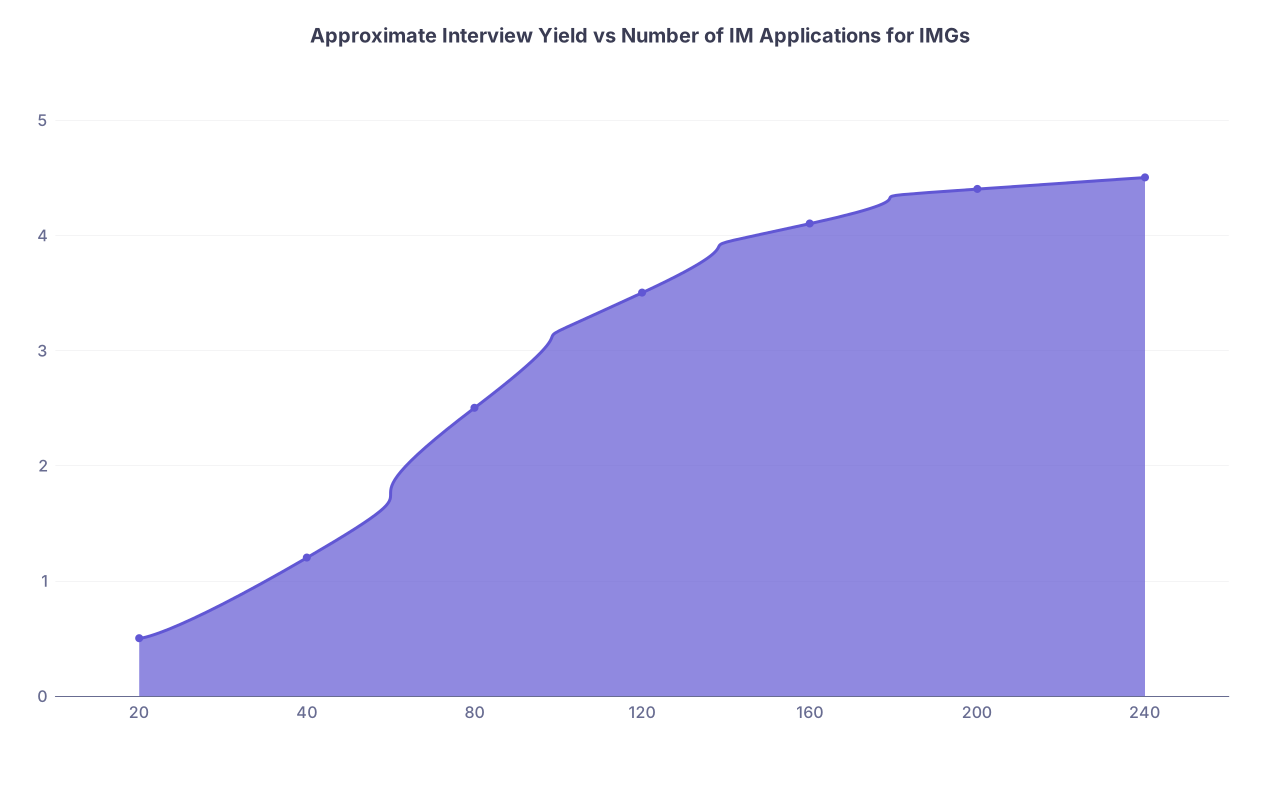
The NRMP and AAMC have quietly been telling you the truth for years: more applications help up to a point, and then the curve flattens hard.
For IMGs, the curves are shifted—you generally need more applications than US MDs. But they are still curves with diminishing returns, not straight lines marching upward forever.
Here’s a synthetic but realistic illustration based on patterns from NRMP/AAMC data and program behavior for categorical Internal Medicine (one of the most IMG‑friendly specialties):
| Category | Value |
|---|---|
| 20 | 0.5 |
| 40 | 1.2 |
| 80 | 2.5 |
| 120 | 3.5 |
| 160 | 4.1 |
| 200 | 4.4 |
| 240 | 4.5 |
You see the problem.
- Going from 20 → 80 applications roughly 5x your interviews.
- Going from 80 → 160 maybe adds 1.5–2 more interviews.
- Going from 160 → 240 adds almost nothing for many applicants.
The steep part of the curve is at the beginning. The “200+ or bust” advice pretends the slope is constant. It is not.
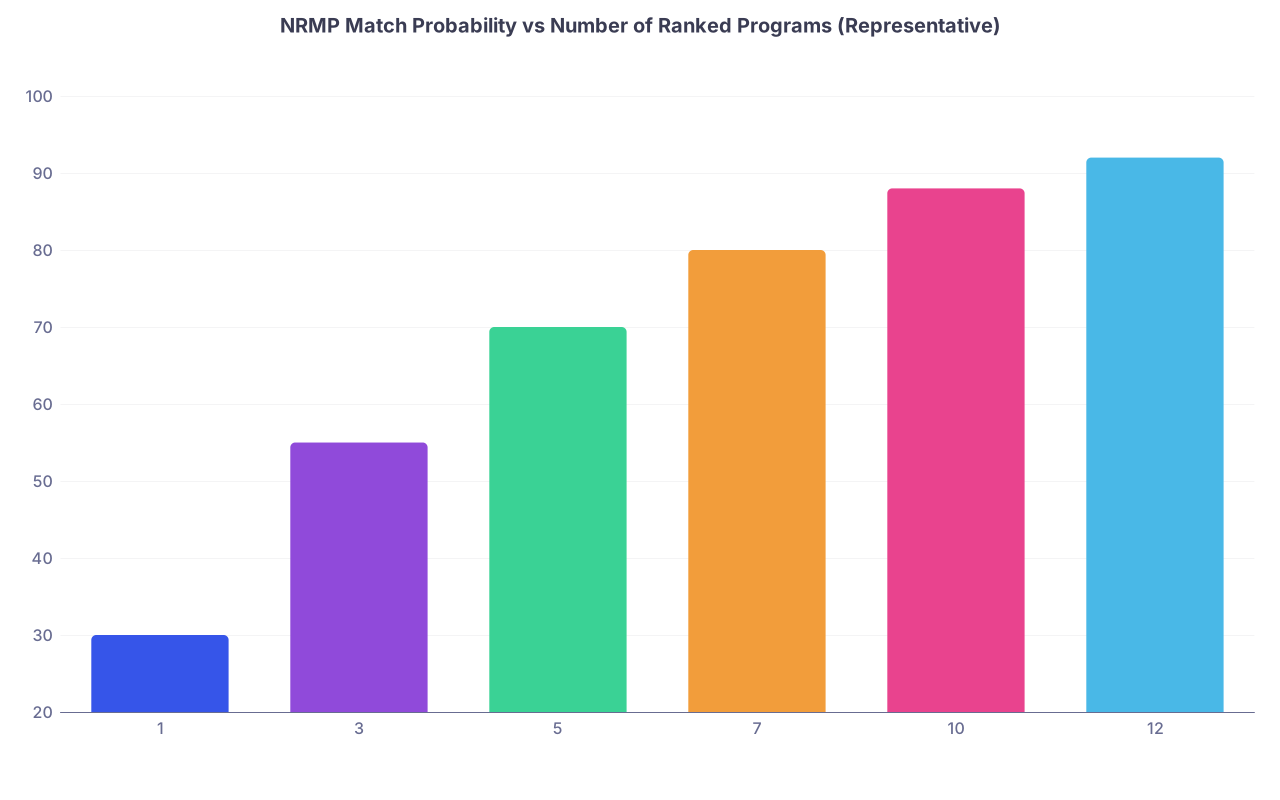
Now, how many ranked programs does it actually take to have a high chance of matching?
| Category | Value |
|---|---|
| 1 | 30 |
| 3 | 55 |
| 5 | 70 |
| 7 | 80 |
| 10 | 88 |
| 12 | 92 |
Key point: your match probability is driven by how many programs you rank, not how many you spam with primary applications.
To rank 10–12 programs, most IMGs will need somewhere around 8–15 interviews, depending on specialty and competitiveness. That is where thoughtful volume helps. But if your first 120–160 reasonably chosen applications already yield 8–12 interviews, those extra 80 “panic” applications are just ERAS donations.
The Hidden Cost: Money, Time, and Signal
Let’s talk cost because people hand‑wave it away like it’s Monopoly money.
| Number of Programs | Additional Cost (USD) |
|---|---|
| 60 | ~$1,100 |
| 100 | ~$1,900 |
| 150 | ~$3,000 |
| 200 | ~$4,300 |
| 250 | ~$5,600 |
These are ballpark but directionally accurate under the current ERAS fee schedule. For many IMGs, $2,000 is not pocket change; $5,000 is brutal.
And it’s not just money.
- You cannot realistically research 200+ programs meaningfully.
- You cannot write tailored messages or demonstrate any real interest to 200+ places.
- You drown your own signal in your noise. To a PD who glances at your file, you look like exactly what you are: someone who clicked “select all” on a spreadsheet.
Programs are not stupid. A Caribbean grad who applied to 260 programs in IM, FM, psych, and peds is not read as “motivated”; they’re read as “desperate and unfocused.”
So How Many Programs SHOULD IMGs Apply To?
Here’s the hard answer: you don’t get a magic number; you get a range that depends on your profile and specialty.
But we can be a lot more precise than “200+ for everyone.”
Let’s break by two specialties IMGs flock to: Internal Medicine (IM) and Family Medicine (FM), and rough applicant tiers.
I’m assuming Step 1 is pass/fail now but using Step 2 CK as a proxy, plus recency and red flags.
| Profile Type (IMG) | IM Programs | FM Programs |
|---|---|---|
| Strong: Step 2 ≥ 245, fresh grad, no gaps, USCE | 80–120 | 50–90 |
| Mid: Step 2 230–244, ≤3 years since grad, some USCE | 120–160 | 80–120 |
| At-risk: Step 2 < 230, >3–5 years since grad, or gaps/red flags | 160–220 | 120–180 |
Notice what is not here: “300 programs” or “apply to every single listing in ERAS.”
Reality check:
- A strong IMG in IM rarely needs more than 120–140 well‑targeted programs to generate enough interviews.
- A mid‑tier IMG in IM probably wants 120–160, skewing more toward community, mid‑tier university‑affiliated, and IMG‑friendly.
- A high‑risk IMG might justify going above 180 in IM, but even then, blasting 250+ mostly non‑IMG‑friendly places is just emotional spending.
Could there be rare edge cases where 220+ makes sense? Sure:
- Very old YOG (≥7–8 years) trying a last serious attempt.
- Significant red flags (failures, major leaves of absence) but improved trajectory.
- Very narrow geographic restriction combined with a weak profile.
But that’s not 80% of people. That’s the exception the forums turn into the rule.
The Targeting Problem: Most IMGs Waste Half Their List
The bigger problem is not “too many applications,” it’s “too many garbage applications.”
Apply to 200 programs with this breakdown:
- 40% places that have never taken IMGs
- 30% ultra‑competitive university programs that barely take low‑tier US grads
- 20% back‑up specialty you wrote a half‑hearted personal statement for
- 10% actual IMG‑friendly, realistic programs
You didn’t apply to 200 programs. You applied to maybe 20.
This is where evidence beats fear.
You should be doing things like:
- Checking program websites and recent resident photos to see how many IMGs and what type (US‑IMG vs non‑US IMG).
- Looking at historical match lists from your own school or similar IMGs.
- Using NRMP’s “Interactive Charting Outcomes” and AAMC data to see Step 2 distributions and fill rates.
- Tracking red flags: “US clinical experience required,” “no visa sponsorship,” “no IMGs in last 3 years” and weighting those accordingly.
If your list of 150 programs has 100+ that have not taken a non‑US IMG in the last 3–5 years, your issue is not volume—it is fantasy.
Specialty Matters: IM vs FM vs Psych vs Everything Else
The “200+” panic comes mostly from IMGs applying to IM, FM, and psych. Outside of those, the bottleneck is so severe that volume barely helps.
Some reality:
- Internal Medicine: Most common IMG specialty. Application volume helps a lot up to 120–160 realistic programs. Beyond that, you’re mostly scraping at the margins.
- Family Medicine: More IMG‑friendly, more positions. Many FM programs are desperate for people who actually want FM. Strategic 80–120 apps often outperform blind 200+ apps with a generic IM‑leaning story.
- Psychiatry: Increasingly competitive. Here, 120–180 targeted apps may be justified for mid/weak profiles, but psych programs care heavily about fit, interest, and red flags. Spraying 250 apps without tailored content is a clown move.
- Neurology / Path / PM&R / Pediatrics: Very dependent on specific program cultures and visa policies. For most IMGs, 80–140 targeted apps is the sweet spot—beyond that, returns fall steeply.
- EM, Derm, Ortho, Plastics, ENT, Urology, Neurosurgery: For non‑US IMGs, these are nearly closed shops. You don’t “solve” those odds by clicking 200 times instead of 60. You solve them (if at all) with research years, networking, and a unicorn‑level application.
The myth treats all specialties the same. The data absolutely does not.
The VISA and YOG Reality You Can’t Ignore
Here’s where most spreadsheet‑warriors conveniently go silent: visa and YOG filters.
Programs use hard filters:
- No visa sponsorship
- Only J‑1, no H‑1B
- YOG cutoff (e.g., within 3 or 5 years)
- No attempts on USMLE
If you’re a 2014 grad needing H‑1B, and you “apply to 220 programs” without screening out:
- No visa
- J‑1 only
- YOG ≤ 5 years
…you probably just flushed half your applications instantly. The PD literally never sees your file.
I’ve watched IMGs obsess over 10‑point differences in Step 2, then casually ignore that 60% of their list doesn’t sponsor their visa type.
So the correct sequence is:

| Step | Description |
|---|---|
| Step 1 | Define Specialty |
| Step 2 | Check Visa Needs |
| Step 3 | Filter Programs for Visa |
| Step 4 | Filter for YOG and IMG History |
| Step 5 | Estimate Needed Interviews |
| Step 6 | Set Application Range |
| Step 7 | Refine Personal Statements and Emails |
Volume comes after filtering, not before.
When More Applications Actually Do Make Sense
Let me be clear: I’m not telling you to be “conservative” for the sake of it. Under‑applying kills IMGs every year.
There are scenarios where pushing toward the higher end—180–220—does make rational sense:
- You have Step 2 < 225 but no fails, plus ≥5 years since graduation.
- You need an H‑1B and you’ve already aggressively filtered for H‑1B friendly sites.
- You’re double‑applying to two related specialties (e.g., IM + Neurology) and you’re genuinely willing to match either.
- You come from a non‑recognized or brand‑new school with sparse match history.
Even then, the right move is a tiered list:
- Core: 60–100 programs where your profile matches their usual IMG intake.
- Stretch: 40–60 programs a bit above your stats but still historically IMG‑friendly.
- Reach / experimental: another 20–40 where something about your profile or story gives you at least a plausible angle.
Not 220 copies of the same Hail‑Mary.
How to Decide Your Number Without Lying to Yourself
You want an actual decision rule? Use something like this:
- Define your realistic target: how many interviews you probably need to feel comfortable.
- Most IMGs matching categorical IM/FM: 8–12 interviews.
- Look at comparables: ask recent grads with similar stats/YOG from your school what they:
- Scored
- Applied to
- Got (interviews and match result)
- Based on that, set a base range:
- Strong profile: 80–120 in IM‑friendly specialties.
- Mid: 120–160.
- At‑risk: 160–220.
- Build a first‑pass list, then run harsh filters:
- Remove no‑visa or wrong‑visa.
- Remove clearly non‑IMG programs.
- Remove programs with clear YOG cutoffs that exclude you.
- See what’s left. If after honest filtering you’re still low (e.g., only 70 realistic IM programs), you can:
- Add another specialty (FM, psych, prelims, etc.) or
- Expand geography or tolerance for less‑desirable locations.

This is strategic overkill, not blind panic.
The Psychological Trap: Fear Masquerading as Strategy
The “200+ or bust” mindset is comforting because it feels like control. You can press submit 220 times and tell yourself you’ve “done everything.”
In reality, it’s the opposite of control. It’s surrender. You hand the process over to randomness instead of facing the uncomfortable work:
- tightening your story so it matches your chosen specialty,
- hustling for real US clinical experience and strong letters,
- reaching out to programs where you have even a small connection,
- ruthlessly pruning your list based on actual outcomes, not wishful thinking.
I’ve seen IMGs with 90 targeted applications get 10 interviews and match happily. I’ve seen others with 230 applications get 2 interviews and go unmatched because they refused to confront that their specialty choice was delusional for their profile.
The difference wasn’t ERAS fees. It was honesty.

Years from now, you will not remember whether you sent 140 or 210 applications. You’ll remember whether you were brave enough to stop acting out of fear and start acting based on what the evidence—and your own situation—actually demanded.