
The belief that a research-heavy CV means you can safely apply to fewer residency programs is wrong. Not “sometimes wrong.” Systematically, repeatedly, statistically wrong.
Let me be blunt: research is a strong asset, especially for competitive specialties. But it is not an all-access pass that lets you cut your program list in half and still feel safe. Every year, I see applicants with 10+ publications and big-name mentors open their ERAS dashboards in January and realize they outsmarted themselves right into a weak interview season.
You’re not special enough to beat the math. Neither am I. The data doesn’t care how pretty your PubMed search results look.
Let’s walk through what actually happens, grounded in NRMP data, not hallway mythology.
The Myth: “With Strong Research, I Can Apply Narrowly”
The script usually sounds like this:
“I’ve got:
- 12 publications (5 first-author),
- a research year at a big-name institution,
- strong letters from well-known PIs.
So I don’t need to shotgun 80–100 programs like everyone else. I’ll just apply to 30–40 of the top places that ‘fit’.”
I’ve heard versions of that from MD/PhDs, AOA students, even people with K-award level mentors. I’ve also watched too many of them match lower than expected. Or not match at all.
Here’s the uncomfortable truth: residency selection is not a linear reward system for research productivity. It is a noisy, biased, risk-averse process where research is one piece of a cluttered puzzle. Programs do not say, “Oh, 15 pubs? Great, we’ll overlook the rest and guarantee an interview.”
They might say, “Impressive. Still have 60 other similar applicants. Still only 12 interview slots.”
What the Data Actually Shows
Let’s pull this out of the realm of vibes and into numbers.
The NRMP’s “Charting Outcomes in the Match” and “Program Director Survey” are the closest thing you have to X-ray vision on this process.
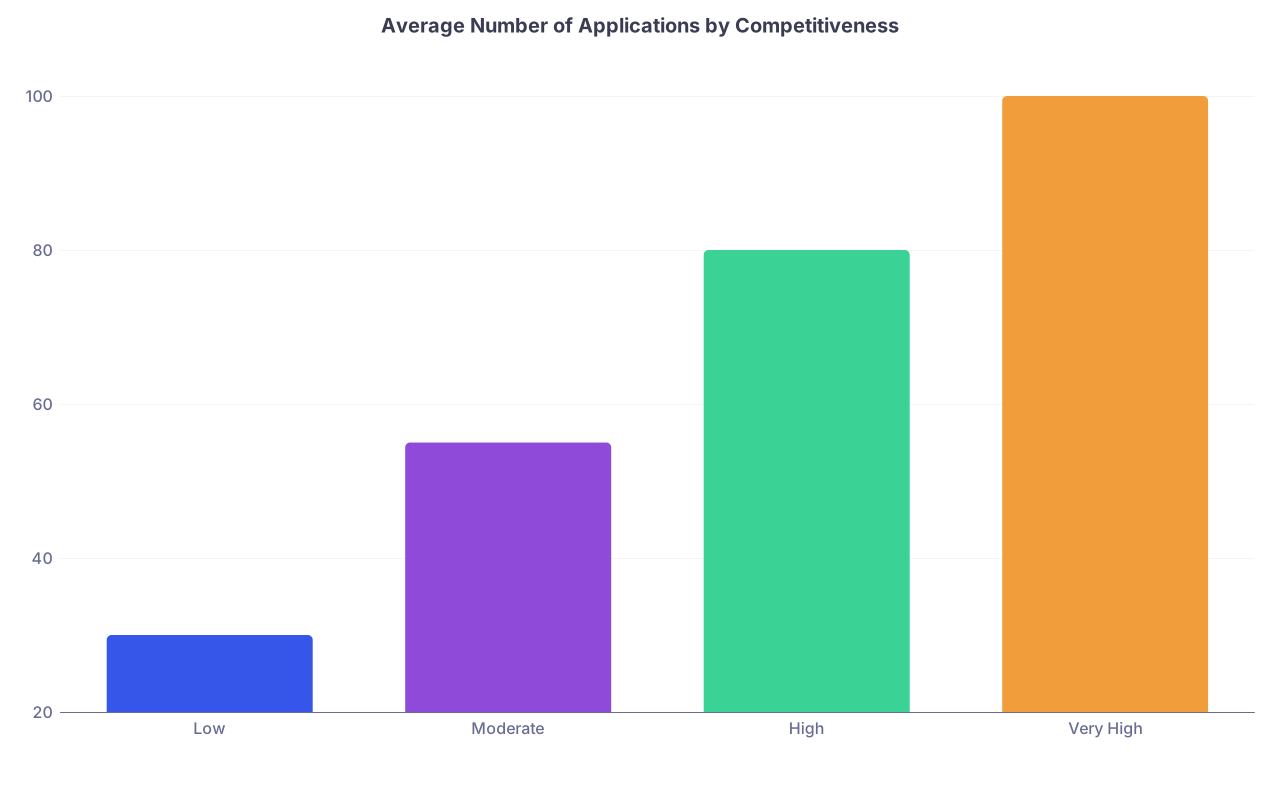
| Category | Value |
|---|---|
| Low | 30 |
| Moderate | 55 |
| High | 80 |
| Very High | 100 |
These are rough categories, but you get the idea:
- Low- to moderate-competitiveness fields (FM, psych, peds for strong US MDs) often see successful applicants applying to 25–50 programs.
- Highly competitive fields (derm, ortho, ENT, plastics, rad onc, IR, neurosurgery, integrated vascular, etc.) often see successful candidates applying in the 60–100+ range.
Now, here’s the punchline: those numbers are not dramatically lower for research-heavy applicants. MD/PhDs, high-publication applicants, and research-year folks do not apply to only 10–20 programs and magically get 20 interviews.
And when you look closely at the PD Survey, the top factors for granting interviews are still things like:
- USMLE/COMLEX scores (or pass/fail + Step 2 CK),
- grades in core clerkships,
- perceived fit,
- letters from known faculty,
- school reputation.
“Demonstrated interest in research” shows up. But it isn’t at the top of the list for most specialties. Often it’s mid-tier. In some fields, it’s basically a tiebreaker.
Where Research Helps — And Where It Doesn’t
Research is not useless. That’s another dumb myth, just in the opposite direction. The truth is more nuanced.
Research tends to matter in three main ways:
Screening for academic-leaning programs or subspecialty tracks
Programs with a strong academic identity—think major university hospitals—do look more favorably at applicants with robust research backgrounds. They want future faculty, not just competent clinicians.Within-tier differentiation
Among a pool of similar applicants (similar school, scores, grades), research can be the difference between “interview” and “no thanks.” It’s a multiplier in context, not a force field.Long-term career trajectory
If you want fellowships at research-heavy institutions or a physician-scientist role, your research CV absolutely matters. For that long game, it’s huge. But that’s not the same as “I can apply to 15 residencies and be safe.”
Where research does not save you:
- From Step 2 CK that’s significantly below a program’s usual range
- From poor clinical evaluations or weak letters
- From being at a school with little name recognition where programs have zero data on how grads perform
- From regional bias, visa limitations, or programs overwhelmed by applicant volume
Program directors aren’t sitting around saying, “We usually want 15+ Step 2 points above the national mean, but this applicant has 8 case reports and 2 poster presentations. Let’s ignore our filters.” That fantasy lives mostly in applicant group chats.
The Interview Math You’re Actually Up Against
You don’t need philosophy here. You need probabilities.
Imagine you’re applying in a competitive specialty with a reasonably strong profile:
- Solid Step 2 (or equivalent),
- Top-third of class,
- Strong research (let’s say 8–10 pubs, some first-author),
- Good letters, no glaring red flags.
You might think: with this, my “hit rate” (applications → interviews) will be huge. Maybe 40–50%.
In reality, it’s usually nowhere near that. Because:
- Many programs are flooded with similar applicants.
- Filters knock you out before a human ever reads your research section.
- You don't always have regional or institutional connections.
- Some programs pre-select on tiny stuff: home region, couples match issues, class size quotas.
A more realistic “good” interview rate for competitive specialties might sit in the 15–25% zone even for very strong applicants.
So if you apply to 30 programs with a 20% hit rate, that’s about 6 interviews. That might be enough in some specialties. In others, it’s flirting with disaster.
Now, if you applied to 70 programs with that same hit rate? You’re looking at ~14 interviews. That’s the difference between “I’m obsessing over SOAP scenarios” and “I’m choosing between multiple reasonable fit options.”
This is why your fancy research CV doesn’t justify a tiny program list. The multipliers are too small, the noise is too high, and the stakes are too large.
The Research-Heavy Applicant’s Trap
I’ve seen a very specific, very predictable pattern:
- Student spends a research year (or two) at a big-name institution.
- Stacks up 10–20 pubs, some in good journals.
- Absorbs the local culture where everyone assumes their place is the center of the universe.
- Senior residents casually say things like, “With your CV, you’ll be fine; you don’t need to apply everywhere.”
- Mentor says, “No need to apply to mid-tier community programs; focus on strong academics.”
- Applicant applies to 25–35 mostly top-heavy programs.
- January arrives. 3–6 interviews. Panic.
What went wrong?
Not the research. The strategy.
They confused research prestige with market coverage. They optimized for ego and perception instead of risk management.
They bought into the story that they were so differentiated by research that they no longer needed volume. The market disagreed.
Specialty Differences: Where Research Really Moves the Needle
Some specialties care a lot about research. Some pretend they do, but actually do not. Others barely care at all.
| Specialty | Research Impact on Interview Chances | Typical Application Volume* |
|---|---|---|
| Dermatology | Very High | 70–100+ |
| Plastic Surgery | Very High | 60–90 |
| Neurosurgery | High | 50–80 |
| Internal Med (academic-aimed) | Moderate–High | 30–60 |
| Family Med | Low | 15–30 |
*For strong US MD/DOs; weaker profiles or IMGs often need more.
Look carefully at that third column. Even in derm, plastics, neurosurgery—where research genuinely matters—the recommended application volume for successful applicants is still not “20 programs and chill.”
So if you’re in a research-sensitive field and you actually have strong research, that probably buys you:
- A better shot at interviews at academic programs.
- Slightly higher hit rate within your range.
It does not buy you that much reduction in how many places you apply to without adding unnecessary match risk.
Geographic and Name-Brand Bias: Your Research Doesn’t Cancel It
Another thing applicants underestimate: geography and institutional familiarity.
Programs have very clear tendencies:
- They take lots of their own medical students.
- They favor their region.
- They disproportionately interview applicants from schools they know—or schools that historically send them reliable residents.
That means if you’re from a lesser-known school, your research is fighting uphill against unfamiliarity. If you’re applying to a region where your school has no track record, same issue.
You might think, “But I rotated there and did research with them.” Good. That helps. But it helps at that one place, not across an entire region.
I’ve seen people with monster research CVs get 3 interviews in a region simply because their home institution had no pipeline there and they applied too narrowly.
A Saner, Data-Respecting Strategy
I’m not saying you need to apply to 100 programs just because you did a research year. That’s another form of lazy thinking. The right question isn’t “How few can I apply to now that I have research?” but:
“What program list size gives me a reasonable margin of safety given my entire profile, not just my PubMed page?”
You factor in:
- Step 2 CK (or equivalent) relative to your specialty’s matched medians.
- Class rank or narrative evals.
- School reputation and historical match patterns.
- IMG vs US MD/DO status.
- Visa issues.
- Geographic flexibility.
- Red flags (remediations, leaves, failures).
Then you treat research as a modest, positive adjustment. Not as a license to cut your list in half.
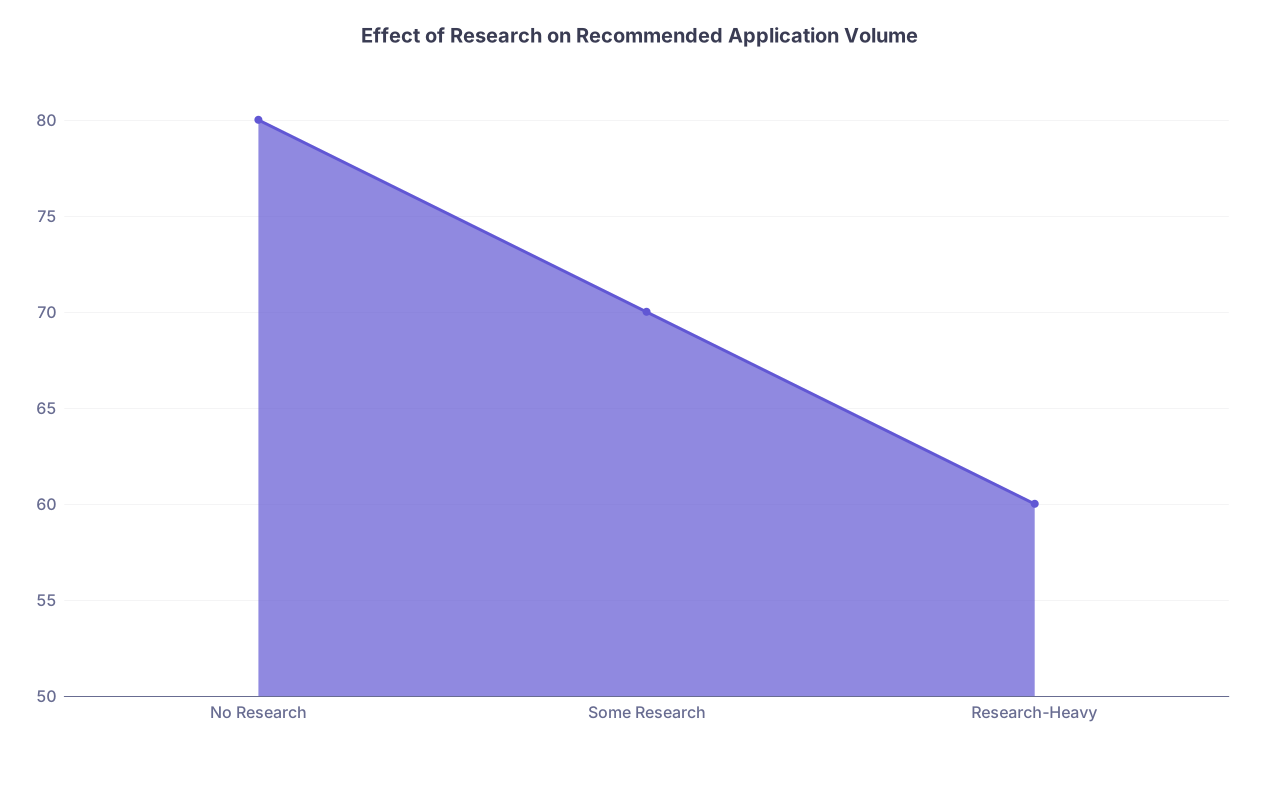
| Category | Value |
|---|---|
| No Research | 80 |
| Some Research | 70 |
| Research-Heavy | 60 |
That’s roughly how I’d think about it in very competitive specialties: maybe research takes you from 80 programs to 60. Not from 80 to 25.
Process Reality: Programs Can’t Even See All Your Brilliance
One more inconvenient detail: your research is often not evaluated in the nuanced way you imagine.
- Many programs use automated or semi-automated filters first. If you do not pass those, nobody cares how elegant your methods section was.
- When programs are drowning in 800+ applications, faculty skim your CV. They might register “multiple pubs; some first-author,” but they’re not rating journal impact factor vs h-index.
- Your name may be buried among many co-authors. Unless a PD personally knows your mentor and trusts their word, the signal is weaker than you’d like.
So yes, that research helps. But it helps within a chaotic system where a lot of decisions are made on quick heuristics. You don’t design your risk strategy around the assumption that every reviewer will give your CV a 5-minute deep read.
Visualizing the Application Funnel
Here’s a simple view of why volume still matters, even when you’re strong.

| Step | Description |
|---|---|
| Step 1 | Applications Submitted |
| Step 2 | Filtered by Scores and Criteria |
| Step 3 | Programs Review Remaining Files |
| Step 4 | Interview Offers |
| Step 5 | Rank Lists |
| Step 6 | Match Outcome |
Research mostly acts between C and D. It does almost nothing for you at stage B if filters kill you early, and it cannot rescue you from a too-small A at the very start.
That’s why “I have a research-heavy CV, so I’ll apply to fewer programs” is backward. You’re choosing to shrink A and then praying C–D saves you. The math is stacked against that choice.
Common Counterarguments (And Why They Fail)
“I know someone with 15 pubs who applied to 25 programs and matched derm at a top place.”
Of course you do. Outliers exist. The problem is when you confuse their story with a replicable strategy instead of statistical luck plus unreported variables (home program advantage, insane Step 2, institutional name, mentor calling PDs, etc.).
“But my mentor said I’d be over-applying if I went beyond 40 programs.”
Your mentor may be brilliant clinically and scientifically. That doesn’t mean they’ve read the PD Survey or understand match probability curves for current cycles. Many of them matched in a totally different era with fewer applicants and fewer bottlenecks.
“I don’t want to waste money applying to programs I’d never seriously attend.”
That’s fair, and there’s a limit where more is just noise. But almost every unmatched research superstar I’ve seen thought half the programs they didn’t apply to were below them… right up until SOAP.
Quick Reality Check: Are You That Outlier?
If you’re going to act like research frees you from broad applications, ask yourself a brutal question:
Would a detached outside observer, looking only at:
- your scores,
- your school,
- your clinical record,
- your letters,
- your geography constraints,
conclude that you’re in the very top few percent of applicants nationally in your specialty?
If the answer is anything short of “yes, obviously,” then you don’t get to behave like an outlier.
You’re playing in the same probabilistic mud as everyone else. Research just gives you slightly nicer shoes.
Key Takeaways
- A research-heavy CV helps, but it does not justify a drastically smaller program list in competitive specialties. The data does not support that fantasy.
- Research mainly improves things within tiers and at academic programs; it does not reliably beat filters, geography, or a too-small application pool.
- Build your application strategy around overall risk and probabilities, not ego or anecdotes. Treat research as a modest positive factor, not a golden ticket.