
Step scores are a terrible one-variable compass for deciding how many residency programs to apply to. People keep pretending they are not. They are.
You’ve probably heard some version of this:
“Step 1 250+? You’re safe with 20–30 programs.”
“Below 220? Better apply to 100+ or you’re not matching.”
That advice sounds confident. It’s also lazy, decontextualized, and directly contradicted by what the NRMP data actually show.
Let me walk through why “Step score → program count” is not just wrong but actively harmful, and what a sane, evidence-based approach looks like instead.
The Ugly Truth: Step Score Explains Only Part of Match Odds
Programs love scores. Applicants obsess over scores. But when you look at the NRMP data, scores are one piece of a multi-variable puzzle—not the decision rule.
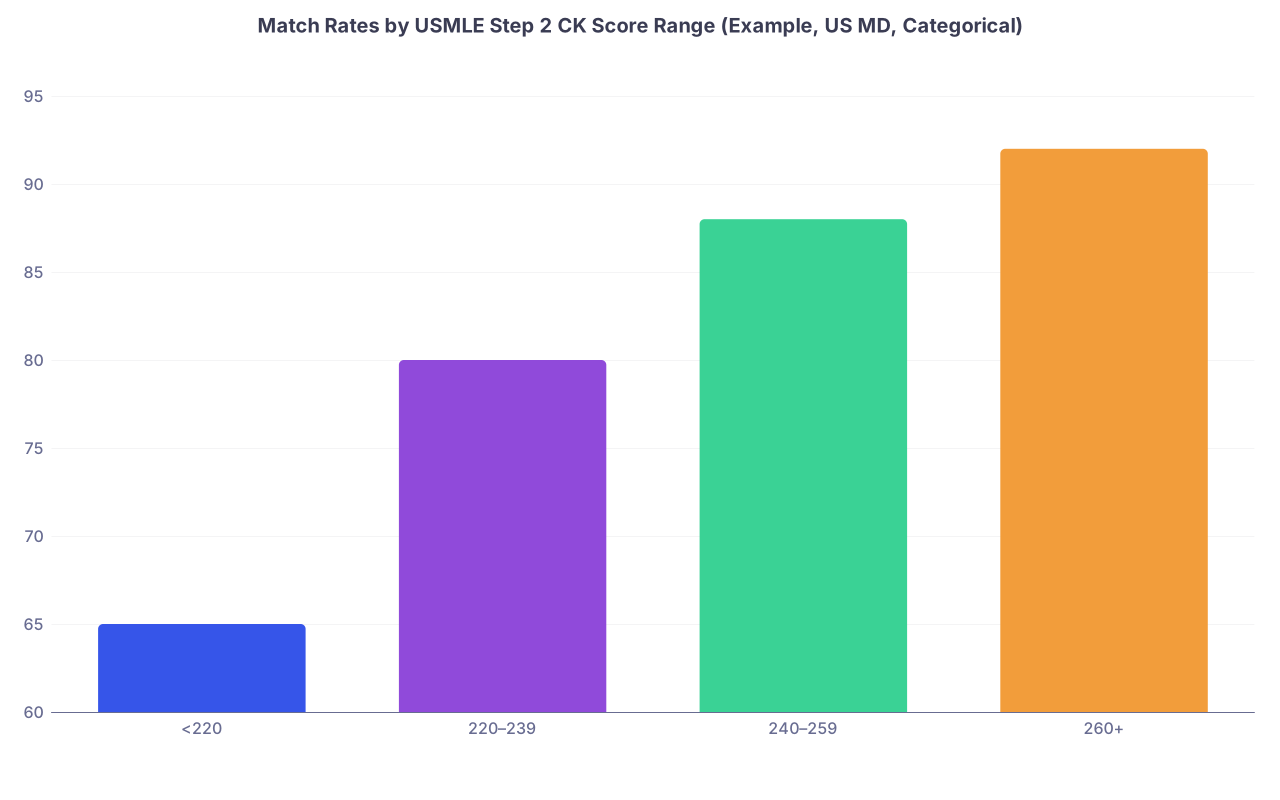
| Category | Value |
|---|---|
| <220 | 65 |
| 220–239 | 80 |
| 240–259 | 88 |
| 260+ | 92 |
Those numbers are roughly in line with recent NRMP Charting Outcomes–type trends across several specialties: higher Step 2 CK = higher match rate. No surprise.
But here’s what actually matters: even in the “good” ranges, people don’t match. And in the “bad” ranges, people do.
Most people who get burned aren’t failing because their Step is 4–6 points too low for some magical cutoff. They’re failing because they misjudge how much everything else besides Step affects their odds:
- School type (US MD vs DO vs IMG)
- Specialty competitiveness
- Geographic constraints
- Red flags (failures, leaves, professionalism issues)
- Research, AOA, class rank, letters
- And yes, raw application behavior: which and how many programs they apply to
The myth says: “I have a 250, so I only need to apply to X programs.”
The data say: performance is probabilistic and multifactorial, not guaranteed.
You are not a Step score with legs. Programs know that. You should too.
Why “High Score = Fewer Apps” Backfires
I’ve seen this play out over and over.
Student with a 252 in internal medicine, US MD, middle-of-the-road school. Advisers: “You’re in great shape. Apply to 25, mostly upper-tier university programs. You’re fine.”
Result: 5–6 interviews. Enough to match? Statistically, probably. Guaranteed? Not remotely.
The NRMP Program Director Survey shows a nasty bias: programs use scores heavily for screening, but once you pass the threshold, they start caring about other things—fit, letters, school, research, away rotations.
In other words: your 250 doesn’t buy you a free pass. It just makes it more likely your file is opened.
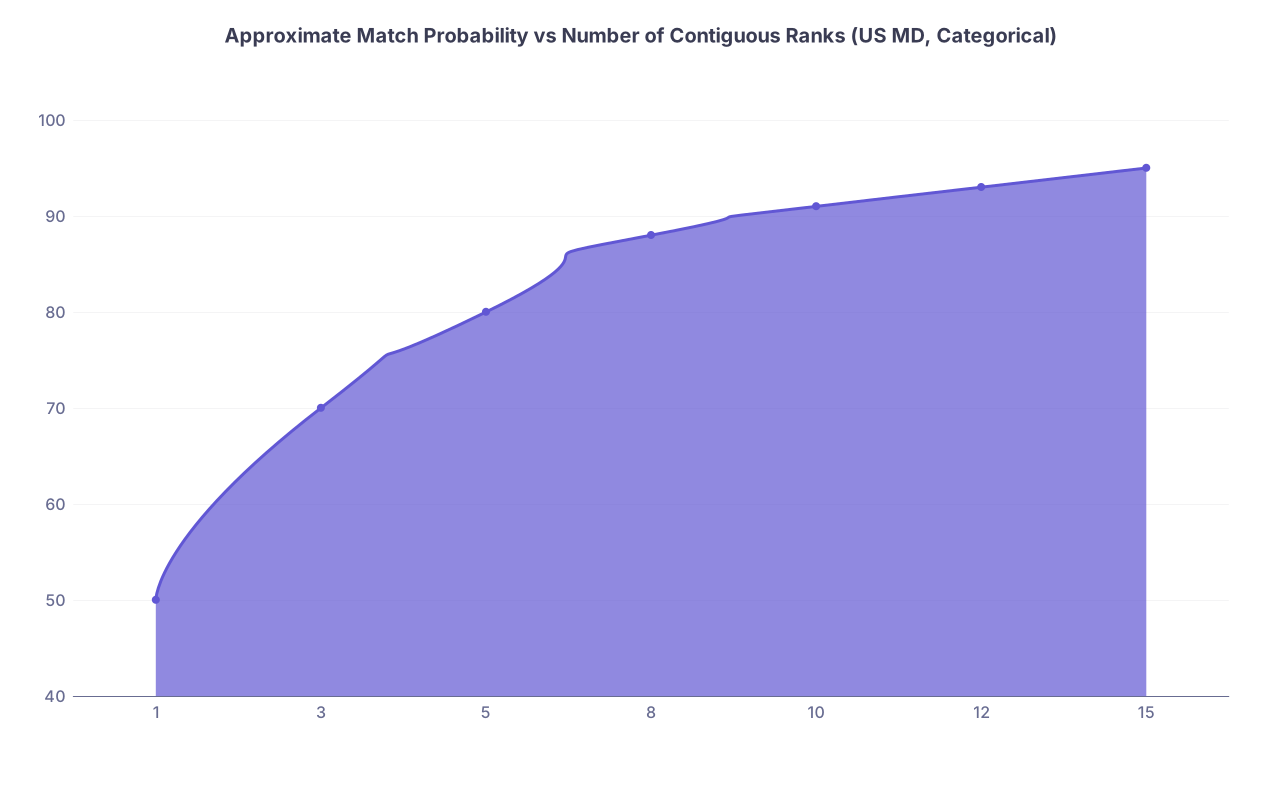
Now look at how match probability changes with number of contiguous ranks (a decent proxy for “enough interviews”). This is where overconfidence kills people.
| Category | Value |
|---|---|
| 1 | 50 |
| 3 | 70 |
| 5 | 80 |
| 8 | 88 |
| 10 | 91 |
| 12 | 93 |
| 15 | 95 |
You want to be in that 10–12 interview neighborhood for most core specialties as a US MD, and often higher as DO/IMG or in competitive fields. That’s what protects you. Not a raw Step score.
The “high score, few apps” logic is fragile because it treats a stochastic process like it’s deterministic. A single bad interview season. A few programs with internal candidates. One lukewarm chair letter. Suddenly your “safe” plan looks idiotic.
You don’t buy certainty with a score. You buy odds. And then you still need volume—to an extent—to convert those odds into something tolerably safe.
The Overreaction: “Low Score? Spam Every Program”
On the other side, you’ve got the panic response: “My score’s weak, so I must apply to 100+ programs or I’m doomed.”
This is just the same Step-obsessed thinking in reverse. Still wrong.
Here’s what scorched-earth application strategy actually does:
- Destroys your wallet (people easily spend $3,000–$7,000 on ERAS alone)
- Dilutes your effort on program-specific signals and quality materials
- Creates a false sense of “safety” while ignoring the real problem
For low- or borderline-score applicants, the match-killing move is usually misalignment, not purely low numbers.
US MD with 220 Step 2 aiming at dermatology, applying to 120 derm programs? That is not strategy. That’s denial.
DO with 215 Step 2, 50 applications to university EM programs in regions that don’t take many DOs? Same problem.
You cannot compensate for a bad target list with raw volume. At some point, each additional application has sharply diminishing returns. One more program in a tier that doesn’t take your profile adds almost no real probability of matching.
You get more leverage from fixing these variables:
- Target tier and program type
- Specialty choice (backup or dual apply)
- Geographic flexibility
- Program type mix (community vs big academic vs hybrid)
Than you do from bumping applications from 60 → 100 blindly.
What Actually Drives How Many Programs You Need
Now we get to the actual useful part. There is a structure here. It’s just not “Step score → number of apps.”
Think of it as a multi-factor risk calculation. Step is one factor. Here are the others that matter just as much, often more.
1. Specialty Competitiveness and Your Profile
An IMG with a 250 applying to neurosurgery is not remotely in the same risk category as a US MD with a 250 applying to family medicine.
Here’s a rough comparison, assuming solid but not superstar overall profiles:
| Specialty Category | Example Fields | Safer Target Interview Count |
|---|---|---|
| Very competitive | Derm, PRS, NSG, ENT | 15–20+ |
| Competitive | Ortho, Rad Onc, Urology | 12–15 |
| Mid-competitive | EM, Anes, Gen Surg | 10–12 |
| Less competitive | IM, Peds, FM, Psych | 8–10 |
Those numbers are interviews, not applications. How many applications you need to generate that many interviews depends on your risk factors:
- US MD vs DO vs IMG
- Home program advantage
- Research volume vs specialty norms
- Red flags (USMLE failures, course failures, leave of absence)
You try to back-calculate: with your profile, how many applications will typically result in 10–12 interviews in your field?
That’s the real question. Not “I have a 242, how many apps?”
2. School Type and Training Environment
The unspoken hierarchy matters.
US MD at a mid-high tier school with strong departmental support? You can sometimes safely apply to fewer programs if everything else is aligned.
DO or IMG, even with a strong Step 2, in a competitive specialty? You almost always need more applications than your US MD peers. Programs filter on school type—often automatically—especially in saturated fields.
I’ve watched DO students with 245+ get fewer invitations in EM or anesthesia than US MDs with 232. Same specialty, same region, same year.
If you ignore this and cling to Step as your guiding star, you under-apply and pay for it.
3. Geography: The Hidden Killer
This might be the most underestimated variable.
If you say, “I must stay in California” or “Northeast only” or “this 3-city triangle because of family,” you are immediately a higher-risk applicant, regardless of your Step.
You restrict the supply of realistic programs. That forces you either to:
- Accept more risk with fewer total potential interviews, or
- Compensate by applying broadly within that region and maybe dual applying
I’ve seen 250+ applicants in IM get crushed in California because they treated it like applying nationally. Programs in saturated markets are flooded with high-scorers and weird local politics.
Score won’t save you from geography.
4. Your Application Quality and Signaling
The more “average” your Step, the more important your other signals become:
- Letters from known faculty in the field
- Away rotations and how hard you were vouched for
- Clear, coherent story in your personal statement and experiences
- Evidence you actually understand the specialty (and aren’t applying impulsively)
This matters directly for program count because a strong, coherent application is more efficient.
A sloppy, generic app might need 80+ submissions to generate 10 interviews. A strong, well-aligned app might produce that from 40–50, in the same specialty and with the same Step score.
So yes, there is a point at which adding applications is just trying to brute force your way around a mediocre file.
How to Actually Decide Your Program Count (Without Worshiping Step)
You want something more concrete. Fair.
Here’s an approach that doesn’t make Step the dictator but still respects it.
Step 1: Decide your risk tolerance
Be honest: are you okay not matching and trying again? Most people are not. If you’re not, you need to bias toward safety.
If you’re a reapplicant, married to a specific region, or switching specialties late, you should act like you’re high-risk even with a decent Step.
Step 2: Classify your risk profile, not just your score
Look at yourself across these dimensions:
- Specialty category (very competitive → less competitive)
- School type (US MD vs DO vs IMG)
- Red flags (Step fails, leaves, professionalism issues)
- Geography constraints (nationally open vs 1–2 regions vs single state)
- Application strength (research, letters, clinical comments, clerkship performance)
If you’re “average or worse” on more than two of those, you’re a moderate-to-high-risk applicant regardless of your Step.
Moderate-to-high risk → more programs. Low risk → you can safely trim, but not recklessly.
Step 3: Use data, not vibes, for baseline numbers
Look at NRMP’s Charting Outcomes and Program Director Survey for your exact combo (US MD vs DO vs IMG, specialty, score band). Look at:
- Average number of applications and interviews for matched vs unmatched
- Typical score ranges and match rates
Then treat the “matched” application/interview numbers as a minimum, not a ceiling.
If matched IM US MDs at your score range average 40 apps and 12 interviews, that’s not permission to apply to 25. That’s your warning not to go below those numbers unless you have powerful offsetting factors (home program with strong support, unique connections, etc.).
Step 4: Adjust up or down based on everything except Step
Then tweak:
- Upward if: DO/IMG, red flags, restricted geography, no home program, late specialty change
- Downward (a little) if: strong home program that likes you, broad geography, no red flags, exceptional letters/network
Notice what I’m doing: Step informs where you sit in the competitiveness landscape, but it does not dictate program count alone. It’s one dial on the board.
Why the Step-Only Myth Persists
Two reasons: laziness and ego.
It’s seductive to compress a messy, multidimensional problem down to a single number. Advisers like rules of thumb. Students like validation. Programs like pretend-objective filters.
So you get idiotic lines like:
- “240+, you’re fine with 30.”
- “Below 220, apply everywhere.”
Nobody bothers to ask: What specialty? Which school? Any fails? Are you geographically boxed in? Are you applying to the right tier? What did your actual letters say?
If someone is advising you purely based on Step cutoff logic, they haven’t read the NRMP reports closely. Or they’re too busy to tailor advice. Or they’re stuck in their own training-era anecdote bubble.
Either way: that’s not strategy. That’s superstition with a numerical costume.
The Bottom Line
Three points, then you can close the tab:
Step score is one factor among many. It shifts your odds but does not, and should not, single-handedly determine how many programs you apply to.
Under-applying with a high score and over-applying with a low score are just two sides of the same bad logic: treating a probabilistic, multi-factor process like it’s a simple function of one exam.
A rational program count comes from your overall risk profile—specialty competitiveness, school type, red flags, geography, and application quality—with Step as one dial, not the dictator.
Use the data. Not the Step-score folk wisdom floating around your class GroupMe.