
The way most students decide how many programs to apply to is backwards. You’re obsessing over “safe vs risky” specialties when the game is actually “how risky are you in the eyes of programs in this specific cycle?”
Let me tell you what faculty say when you’re not in the room:
“We don’t mind that they applied broadly. We mind when they apply stupidly.”
This entire “safe vs risky specialty” thing is half myth, half misunderstood statistics. I’ve sat in meetings where a PD shrugs and says, “FM applicant with 70 applications? They either have bad advising or a story.” And I’ve heard the same PD say, about a borderline Derm applicant: “He applied to 110 programs and still may not have enough.”
The unspoken rule is this: the more competitive the specialty, the less forgiving the math—and the more you need to understand how programs actually screen and invite.
Let’s pull back the curtain.
The Real Meaning of “Safe” vs “Risky” Specialties
“Safe” and “risky” are lazy shorthand. Faculty don’t use those words. They talk about:
- Fill rates
- Interview yield
- Applicant-to-spot ratios
- And whether your profile is above, at, or below the bar for that field.
You call it “safe.” We call it: “We have more spots than truly competitive applicants.” Think FM, IM (non-IMG-heavy markets), Peds, Psych in many regions.
You call it “risky.” We call it: “We have far more qualified applicants than spots.” Derm, Ortho, ENT, Plastics, Urology, IR, Rad Onc, increasingly EM in certain markets, and yes, competitive IM programs and Anesthesia in desirable cities.
Here’s the real dynamic nobody spells out:
The same Step score, research record, and MSPE can make you “solid” in one specialty and “borderline” or “dead in the water” in another.
So the application count shouldn’t be “Derm = 100, FM = 20.” It should be:
“For my numbers, my school, my gaps… how much statistical cushion do I need?”
But people love fixed numbers, so let’s give some ranges—then I’ll tell you how PDs interpret them.
How Many Programs: The Quiet Benchmarks PDs Actually Use
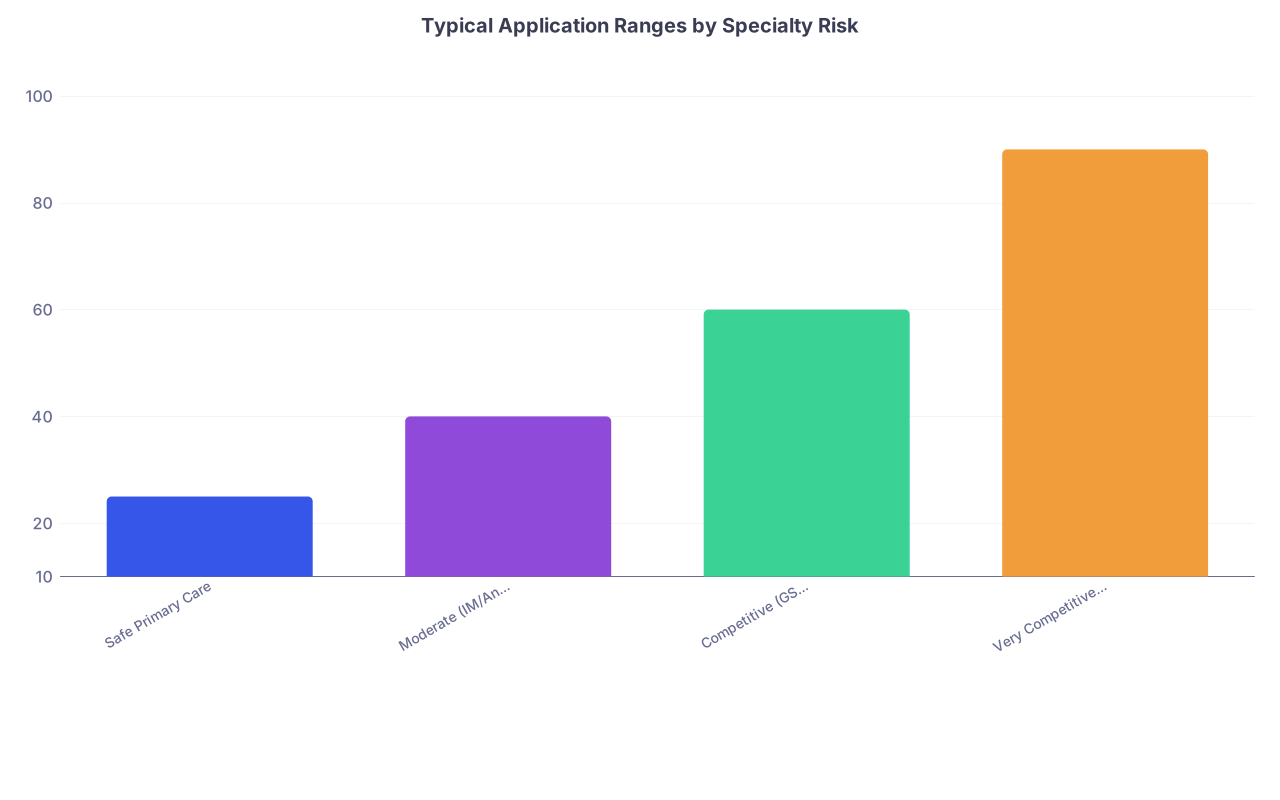
| Category | Value |
|---|---|
| Safe Primary Care | 25 |
| Moderate (IM/Anes) | 40 |
| Competitive (GS/EM) | 60 |
| Very Competitive (Derm/Ortho/ENT) | 90 |
Before we go specialty by specialty, you need one blunt truth:
Programs do not count how many places you applied to. They do count how many realistic interviews you’re likely to get.
When we sit in selection meetings, the conversation isn’t, “She applied to 80.” It’s, “She’s a mid-range candidate. If she’s smart, she’ll target 40–60 and end up with 12–15 interviews, which is enough to match.”
A few quiet benchmarks most PDs have in their head:
- 10–12 solid interviews in a non-ultra-competitive field → odds strongly in your favor.
- 12–15 in competitive but not insane fields → usually safe.
- 15–18 in ultra-competitive fields → still not guaranteed, but survivable.
- Below 8 in basically anything → we start to worry for you.
Now let’s break it into three buckets: “safe,” “moderate,” and “risky” — not by vibe, but by how we actually treat your file.
“Safe” Specialties: The Illusion of Security and How Overapplying Burns You
We’re talking about: Family Medicine, Internal Medicine (community, non-elite), Pediatrics, Psychiatry in many regions, some Path and PM&R depending on year.
These are fields where:
- A large portion of applicants match.
- A decent number of positions go unfilled in the Match and are filled in SOAP.
- Programs are used to seeing huge ranges in applicant quality, from stellar to barely passing.
So why do PDs roll their eyes when they see someone applied to 70 FM programs with above-average stats?
Because we know two things:
- You’re either panicking or getting bad advice.
- Your interviews will cluster anyway. You physically can’t attend 25 interviews in one specialty and still function.
Here’s the unspoken framework most of us use in “safe” fields:
- Strong applicant (good Step 2, no red flags, home program support, decent LORs): should be fine with 15–25 well-chosen programs.
- Average applicant (mid 220s–230s Step 2 if still numeric; “Pass” first try if P/F; average grades): target 25–35.
- Below-average / some concerns (low Step 2, failed Step, major gap, weak school reputation, no home program): 35–45, but targeted, not sprayed randomly.
The trick? In “safe” areas, “how many” matters less than “which ones.”
Your risk in these specialties is not under-applying; it’s applying too broadly and signaling confusion. I’ve heard Psych PDs say, “This applicant applied to 60 Psych programs and a handful of FM. I do not believe they actually want Psych.”
And yes, that matters. PDs don’t want to rank someone highly who’s clearly hedging with an entirely different field.
Moderate Risk: Internal Med (Academic), Anesthesia, EM, General Surgery
This is where people screw up the most.
You treat these like “safe” because they aren’t Derm. But the file review process is ruthless enough that the wrong strategy can sink you.
We’re talking:
- Internal Medicine at academic or big-name programs
- Anesthesiology (especially coastal or city-heavy programs)
- Emergency Medicine (volatile market, still competitive in many desirable locations)
- General Surgery (wider range than people realize, but overall competitive)
Here’s how PDs quietly categorize you in these:
- Above their usual range: you’re fishing for prestige. Fine. You still need enough mid-tier and community places to pad interview counts.
- Right in their sweet spot: you’re their bread-and-butter candidate. These are your core target programs.
- Below their range: you might get a courtesy look if you’re local, have a connection, or a story. Otherwise, auto-screen.
What do application numbers look like behind closed doors? Something like this:
| Profile Type | Safe Specialty | Moderate Specialty | Risky Specialty |
|---|---|---|---|
| Strong | 15–25 | 35–45 | 60–80 |
| Average | 25–35 | 45–60 | 80–100 |
| Below-average/RedFlag | 35–45 | 60–80 | 100+ |
Are these exact? No. But they’re a very close approximation to what midline PDs quietly recommend to their own borderline students.
The unspoken rules in moderate-risk fields:
Region matters more than you think.
A mid-tier IM applicant applying to 20 big-name coastal academic programs and 10 random Midwest community sites will be in trouble. You need clusters of realistic options in at least 2–3 regions.You must anchor your application with programs that actually match your stats.
PDs absolutely compare your Step, school, and LOR patterns to their current residents. If you’re below their usual profile, you’re reaching. One or two reaches per region is fine. Ten per region is wasted money.“Backup specialty” is noticed, but not always punished.
I’ve been in ranking meetings where someone says, “He also applied to FM, but his letter from our anesthesiologist is strong. He clearly wants Anes.” Strong specialty-specific commitment can override your backup game if you’re otherwise competitive.
Truly Risky: Derm, Ortho, ENT, Plastics, Urology, IR, Neurosurgery, Rad Onc
This is where naïve optimism dies.
Applicants in these specialties routinely underestimate how many applications they need and misunderstand how programs actually filter them.
Let’s be explicit:
- Application numbers of 80–120 are normal here.
- No, programs don’t think “Wow, that’s desperate.” They think, “That’s the reality this year.”
- The limiting factor isn’t how many you apply to; it’s how many will even glance at you after automated filters.
In private rooms, faculty say things like:
“Anyone below our Step 2 cut-off never hits my desk.”
“We start with AOA + 250+ or strong home letters, then work down until we fill our interview slots.”
“He’s a nice candidate, but with only 40 applications in Ortho, he’s not going to get enough interviews.”
That last one is the killer. We know you’re dead in the water before you do.
For risky specialties, here’s the real conversation:
- Strong candidate (top quartile scores, strong research for that field, home program, strong letters, no red flags): 60–80 targeted applications.
- Average for that specialty (still usually above the med school mean): 80–100.
- Below-average / coming from low-prestige school / IMG / red flags: 100–120+, plus a serious backup specialty strategy.
And yes, we know you’re pairing specialties. The Derm + IM combo. Ortho + Gen Surg. ENT + Gen Surg. Urology + General Surgery prelim. We see it every year.
The mistake is not applying to a backup. The mistake is thinking:
“I’ll apply to 45 Derm and 30 IM as my safety and that’ll be fine.”
Inside voice from faculty? “That’s not enough Derm apps for an average candidate, and 30 IM is not nearly wide enough if Derm fails and their IM profile is just okay.”
The Hidden Variable: How Programs Actually Screen Applications
You cannot talk about “how many programs” without understanding how we throw most applications away in the first pass.
We use:
- Hard filters: US grad vs IMG, Step failures, Step 2 below a threshold, incomplete application.
- Soft filters: home state, home school, AOA status, research in our field, known letter writers, geographic ties.
Then there’s the ugly truth: many programs auto-sort by Step score and then work down until they fill X interview slots.
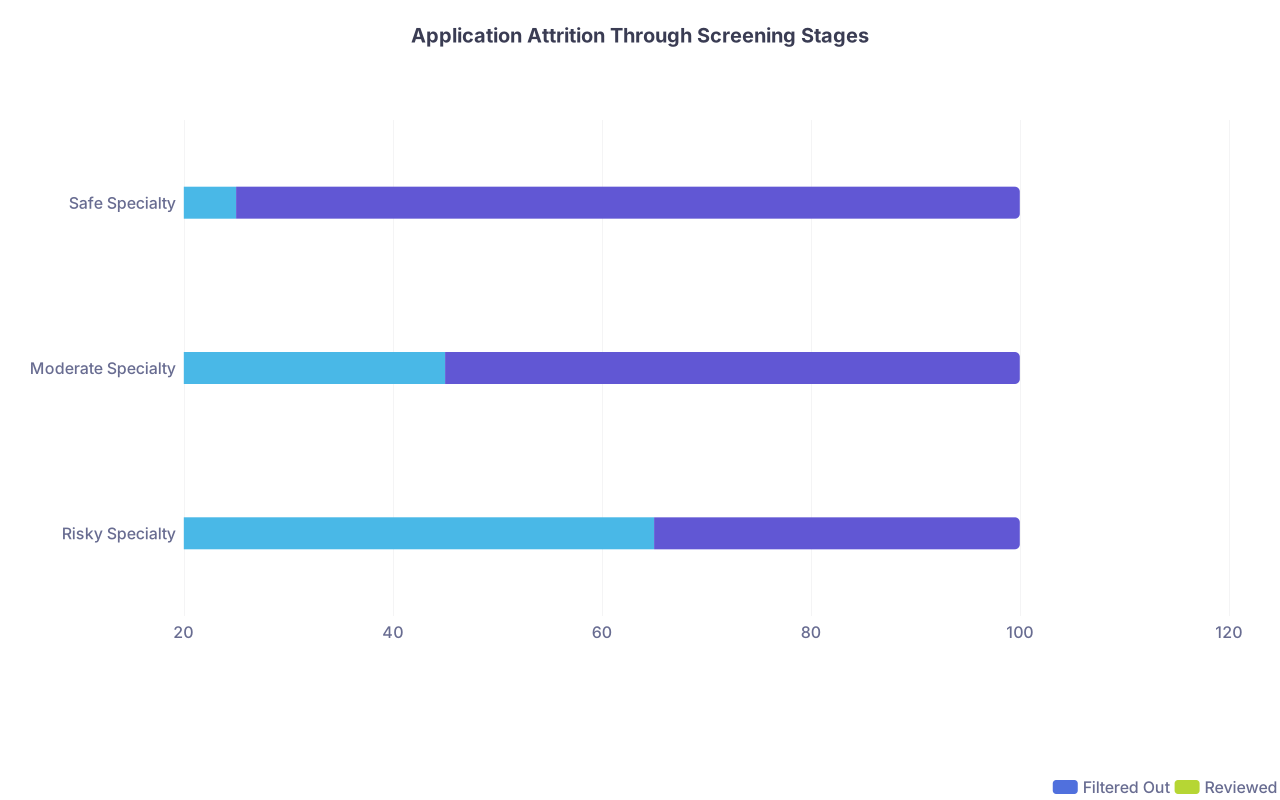
| Category | Filtered Out | Reviewed |
|---|---|---|
| Risky Specialty | 65 | 35 |
| Moderate Specialty | 45 | 55 |
| Safe Specialty | 25 | 75 |
What this means for you:
- In risky fields, a huge fraction of your applications never truly get read.
- In moderate fields, you might be read but not seriously discussed if you’re slightly below range.
- In safe fields, more of your apps at least get a glance, but they still triage by perceived fit and interest.
So your personal risk isn’t “Derm is risky.” It’s:
“How many of the programs I applied to will actually see me as viable enough to offer an interview?”
That’s why application numbers balloon in competitive fields. You are compensating for the fact that a big chunk of your apps are functionally dead on arrival.
Dual Applying: The Game Behind the Game
Here’s what actually happens behind closed doors when we see someone dual applying.
A hypothetical:
- MS4 applies to 85 Ortho programs and 45 General Surgery programs.
- Ortho PDs see: high commitment to their field. No one blinks at 85 apps.
- Gen Surg PDs see: “Ortho primary, we might be the backup.” Some care; many do not, especially if your Gen Surg letters are real and your story checks out.
Another:
- MS4 applies 40 Derm, 30 IM.
- Derm PDs think: “40 Derm is underpowered unless they’re a star.”
- IM PDs think: “Are we their backup? And did they apply widely enough to IM to realistically match if Derm goes poorly?”
The quiet rule from people who’ve watched this for years:
If your primary is truly risky, your backup must be treated like a primary in terms of numbers.
Not 20–30 “just in case” programs. More like 40–60 realistically ranked options for IM/FM/Gen Surg.If your primary is moderate-risk and your backup is safe, you can scale back the backup a bit if your profile is solid. But you still need enough volume to produce 10+ interviews.
Programs don’t formally punish dual applicants. They do, however, screen for genuine interest through:
- Whether you did an away rotation in that specialty
- Whether your personal statement is generic or clearly for them
- Whether your letters are from faculty in that field
- Whether your interview answers reflect that this field is your actual plan, not your consolation prize
If you sound like you’re settling for them at the interview? That’s when your dual-applicant status hurts you.
Geographic Reality: The Part Students Always Underestimate
PDs know geography is the silent killer of otherwise good application strategies.
I’ve watched students do this:
- “I applied to 50 Anesthesia programs, I’m safe.”
Then we look: 40 are California, Northeast, and big-name coastal places. Ten are random Midwest. No South, no community-heavy regions.
On paper they “applied broadly.” In reality, they went narrow—just over a big number.
Programs absolutely know which regions are oversaturated. We see the pile of apps from California students who don’t want to leave the time zone. We also see smart applicants who say, “Fine. I’ll go wherever I match.”
If you’re not top-tier for your specialty, your “broad” strategy must include:
- Community and mid-tier academic programs in multiple regions.
- At least one or two regions that are not the obvious most competitive (California, NYC, Boston, Seattle, Denver, etc.).
There’s an unspoken respect we have for the applicant who clearly means it when they say, “I’ll go anywhere to train.” Their program list shows it.
How Faculty Quietly Advise Their Own Students
Let me show you how this conversation really sounds with an honest advisor when doors are closed.
Student: “I want Derm. I was middle of my class, 242 Step 2, some research but nothing first-author. How many programs?”
Faculty (if they’re blunt): “You’re on the lower end for Derm. You need 90–110 programs plus a real IM backup. For IM, don’t be cute—40–50 programs, mostly mid-tier and community, or you risk not matching anywhere.”
Another:
Student: “I want IM, maybe cards eventually. Step 2 is 250, good letters, some research. How many?”
Faculty: “You’re strong. You’re not obligated to apply to 60 programs. If you’re okay matching at a solid program anywhere, 25–30 well-selected places is fine. If you’re prestige-chasing, then 40–45 with a mix of aspirational and realistic.”
And a painful but common one:
Student: “I failed Step 1 once but passed Step 2, want Anesthesia. How many?”
Faculty: “You must outwork the failure with volume and targeting. 70–90 Anes programs, heavy on community and places with a track record of taking red flags. Also strongly consider a parallel backup like IM with at least 40 programs.”
This is the conversation too many schools sugarcoat. They’ll tell you: “Apply broadly.” They won’t say the quiet part: “Broadly for you might mean 100+ in Ortho or 25 in FM.”
Strategy, Not Panic: Building Your List Like a Grown-Up
If you want an actual method, not vibes, do this:
Define your risk profile for that specialty.
Where do your stats, school, and experiences land compared with matched residents at typical programs? Be brutally honest.Pick your risk bucket: safe, moderate, or risky specialty.
Not based on rumor; based on NRMP data and what recent grads from your school have done.Use the ranges as a starting skeleton (from the table above), then adjust up if:
- You’re below-average for that field
- You have location constraints
- You’re coming from a lesser-known school or IMG route
- You have red flags (failures, leaves, professionalism issues)
Check that you have enough “realistic” programs.
Do you actually have 20–30 places where your numbers are at or above their typical matched resident profile? If not, widen or lower your target tier.Make sure each program sees a believable story.
A generic, recycled personal statement and mismatched letters scream “spray and pray.” For risky fields you cannot afford that.