
The common advice to “apply to as many residency programs as you can” is reckless. It quietly wrecks your wallet, your sanity, and sometimes your Match.
If you’re telling yourself “I’ll just shotgun 80+ programs to be safe,” you’re walking straight into one of the most expensive, draining, and misunderstood traps in the residency application process.
Let me walk you through how overapplying backfires, how many programs you actually need, and the subtle ways this mistake can haunt you all year.
The Myth: “More Applications = More Safety”
Here’s the lie that keeps getting recycled on forums and in group chats:
“If 30 programs is safe, then 60 is safer, and 80 is bulletproof.”
No. There’s a steep point of diminishing returns, and beyond that, you’re mostly burning:
- Money
- Time
- Emotional bandwidth
- Reputation (yes, really)
And you know what I’ve seen over and over? The person who applies to 80–100 programs:
- Still panics about not enough interview invites
- Still ends up attending 10–15 interviews
- Still doesn’t feel “safe” until Match Day
- Often matched at a place they could have gotten with half the applications
You’re not buying safety. You’re buying stress.
To really see how bad the mismatch can be:
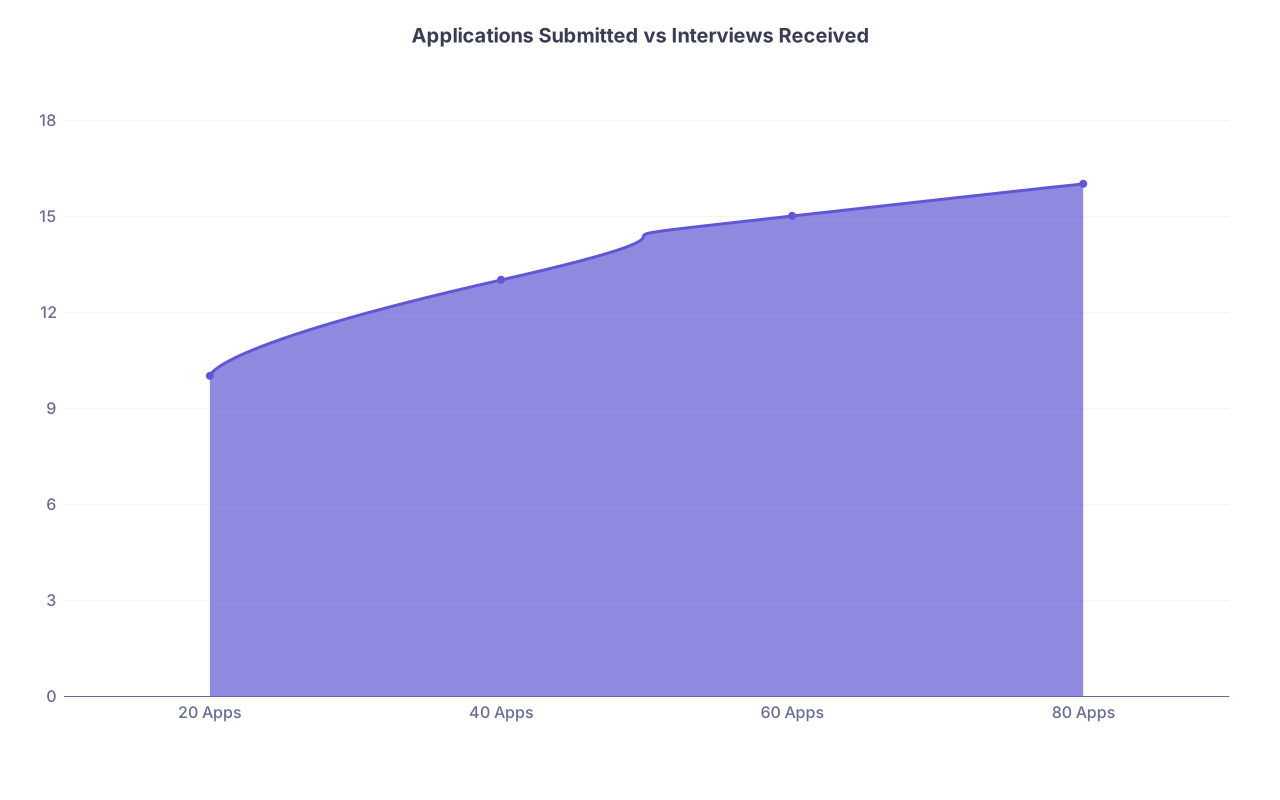
| Category | Value |
|---|---|
| 20 Apps | 10 |
| 40 Apps | 13 |
| 60 Apps | 15 |
| 80 Apps | 16 |
That’s the reality for a lot of applicants: doubling your applications does not double your interviews. You just double your workload and cost.
The Hidden Costs of Overapplying (That Hurt More Than the Money)
Yes, it’s expensive. But the real damage isn’t just your credit card statement.
1. You Destroy Your Own Personalization
Programs can smell a generic application. They might not say it out loud, but I’ve watched PDs scroll through personal statements and say, “This is the same fluff I’ve seen 50 times today.”
When you apply to 70+ programs, here’s what usually happens:
- You write one generic personal statement and send it to everyone
- You barely tweak ERAS experiences or “most meaningful” entries
- You don’t research programs deeply enough to understand their priorities
- Your communication becomes robotic and forgettable
So instead of 35–40 well-targeted, resonant applications, you send 80 “meh” ones. Programs don’t reject you because you’re bad. They reject you because you look like you don’t care about them specifically.
Overapplying almost forces you into generic territory. And generic gets filtered out.
2. You Ruin Your Own Interview Season
Everyone thinks the problem is “not enough interviews.” That’s only half the story. Overapplying creates the opposite problem too: too many scattered interviews you can’t handle.
Here’s what I’ve watched students do:
- Apply to 70+ programs
- Get 18+ interview invites across multiple states/time zones
- Overbook their schedule because “more interviews = more safety”
- Show up to interviews exhausted, poorly prepared, and mentally checked out by mid-season
Result? Mediocre interviews. Sloppy answers. Forgetting which program has which features. PDs can tell when you mixed them up with another program two interviews ago.
Your bandwidth is not unlimited. If you’re constantly on Zoom, on planes, on pre-interview socials, and trying to keep up with rotations or sub-Is, your performance drops.
Overapplying sets you up for:
- Shallow prep for each program
- Poor follow-up emails (or none at all)
- Zoom fatigue that shows in your face and voice
- Confusing programs’ names, locations, or tracks in real time
That doesn’t scream “top candidate.” It screams “overbooked and unfocused.”
The Financial Trap No One Calculates Honestly
Plenty of people say, “Yeah, ERAS fees add up.” But most do not actually do the math. Then they’re shocked in October when the credit card bill hits.
Let’s break it down very simply:
| Scenario | # Programs | ERAS Fees* | Est. Interview Costs** | Total Approx. |
|---|---|---|---|---|
| Targeted List | 35 | $700–800 | $1,000–1,500 | $1,700–2,300 |
| Aggressive | 60 | $1,500–1,700 | $2,000–3,000 | $3,500–4,700 |
| “Panic Apply” Scenario | 80 | $2,200–2,500 | $3,000–4,500 | $5,200–7,000 |
* Rough ballpark; ERAS uses tiered pricing.
** Travel costs lower with virtual interviews, but not zero—time off, hotels for hybrid, etc.
If you’re taking out extra loans or leaning on family to do this, you should be damn sure you’re getting something meaningful in return. With overapplying, you usually don’t.
And here’s what’s really insidious: applicants often don’t cut back on interviews when they should because “I already spent so much on applications, I might as well go.”
That’s sunk-cost thinking. And it drags you deeper.
How Many Programs Should You Apply To?
You’re not going to like this answer if you came here wanting a magic number. There isn’t one. But there are smart ranges and dumb ranges.
Here’s the key principle:
You need enough applications to secure a solid number of interviews (usually 10–15 for most fields) — not “as many as possible.”
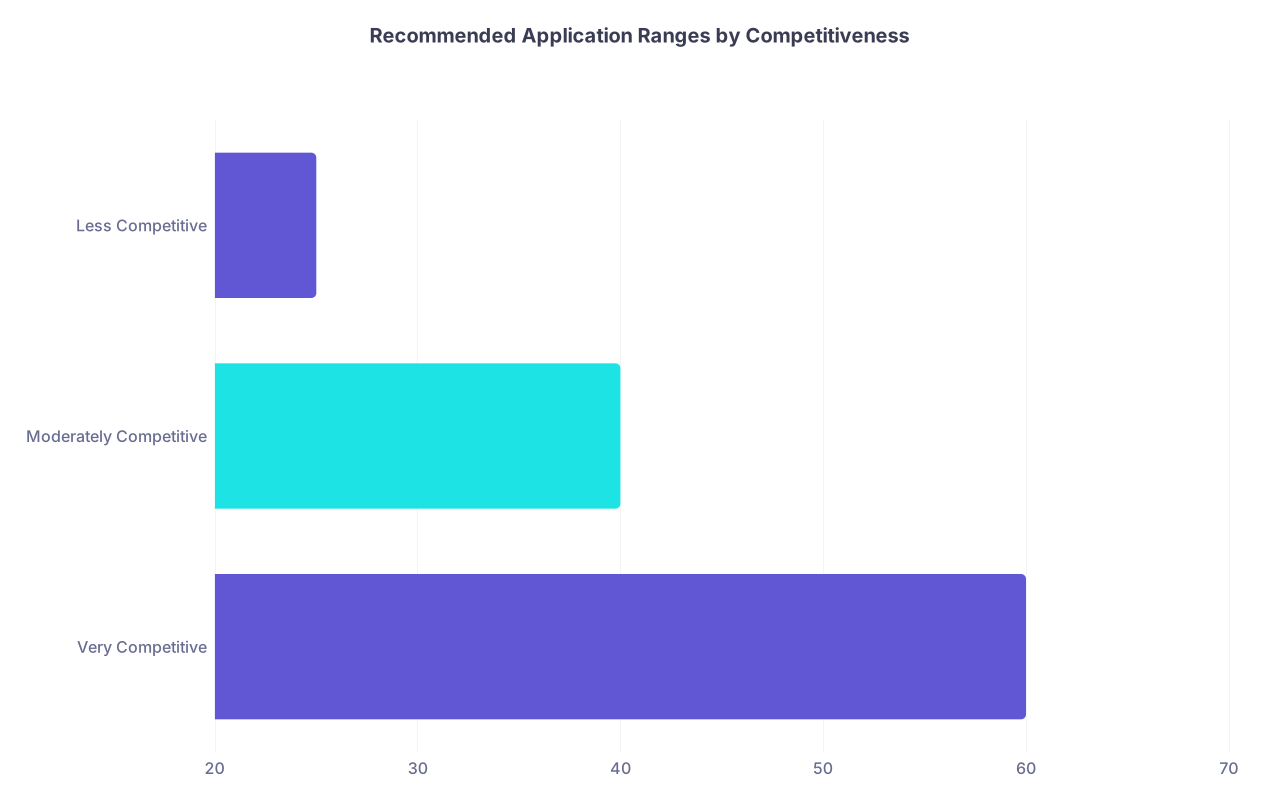
| Category | Value |
|---|---|
| Very Competitive | 60 |
| Moderately Competitive | 40 |
| Less Competitive | 25 |
Let’s put that into more practical buckets. These are ballpark ranges for a US MD with roughly average stats for the specialty:
| Specialty Type | Rough Range (US MD, avg app) |
|---|---|
| Less competitive (FM, IM, Peds) | 20–35 programs |
| Mid competitive (EM, Neuro, Psych, OB) | 30–45 programs |
| More competitive (Anes, Rads, Ortho, Derm, Plastics, ENT, Urology) | 45–70+ depending on profile |
Who should consider the upper ends or going beyond?
- US-IMGs and non-US IMGs
- Applicants with red flags (fails, long gaps, no letters in specialty)
- People switching specialties late in the cycle
- DO students aiming at very competitive fields with weak home support
But even then, applying to 90+ programs is often a sign of poor strategy, not “prudence.”
If you’re thinking of crossing 60+, I’d ask you this bluntly:
Is your problem a numbers issue or a strategy issue?
Because I’ve seen:
- Someone with 35 well-chosen programs and 15 interviews
- Someone with 75 random programs and 8 interviews
Guess who matched more confidently?
The Strategic Backfire: You Look Unfocused
Programs can’t see your entire application list, but the way you apply and communicate exposes your lack of strategy.
Some ways overapplying leaks through:
Incoherent geographical story
You say in one interview, “I’m absolutely committed to staying in the Midwest near family,” but you also applied to programs in New York, California, Texas, and Florida. If they dig even a little, your story falls apart.Mixed specialty attempts
Yes, some people dual-apply. But if your letters and personal statement are sloppily split between two fields (e.g., half IM, half EM) and you apply widely to both, neither side feels like your real priority.Program directors talk
They don’t have a shared spreadsheet of your apps, but they do talk informally. When they all get the same generic emails or see you appear exhausted or disinterested, word spreads. Especially in smaller specialties.
Overapplying often reflects panic and lack of clarity. That bleeds through in your file and in your interviews.
Time Is Your Scarcest Resource — Overapplying Wastes It
Money is painful. Time is deadly. You never get it back.
Think through what 60–80 applications really means in work:
- Program research
- Individualized emails to PDs or coordinators (if you do them right)
- Tracking requirements, deadlines, special statements
- Scheduling and rescheduling interviews
- Attending meet-and-greets, socials, and open houses
It snowballs.

| Step | Description |
|---|---|
| Step 1 | Make Program List |
| Step 2 | Research Each Program |
| Step 3 | Write Tailored Materials |
| Step 4 | Submit Applications |
| Step 5 | Track Invites |
| Step 6 | Schedule Interviews |
| Step 7 | Prepare For Each Program |
| Step 8 | Attend Interviews |
Now multiply that cycle by 80 programs vs 35. Same brain. Same time. Same burnout.
Here’s the subtle damage:
- You have less time to actually prepare for each interview
- You cut corners on researching program culture, resident life, call schedule
- You show up with shallow questions that impress no one
- You fail to follow up properly with your top-choice places
You’re spreading yourself like peanut butter over too much toast. Super thin. No substance.
The Psychological Damage: Anxiety in Disguise
Overapplying is often anxiety dressed up as “being safe.”
You tell yourself:
- “Everyone else is applying to 60+”
- “I can’t risk not matching”
- “More is better than less; I’ll sort it out later”
What really happens:
- You check email and ERAS compulsively all season
- You get a flood of rejections from programs you never had a realistic shot at anyway
- Each rejection chips away at your confidence
- You struggle to be your best self in the interviews that actually matter
I’ve seen students spiral because they got 25 rejections in two weeks. But if we’re honest, many of those programs were:
- Regions they had no ties to
- Places way above their Step/COMLEX or class rank profile
- Hyper-competitive university programs while they had zero research
Those rejections weren’t surprising. But they still hurt. And the anxiety they create absolutely bleeds into your interview performance.
Better Approach: Targeted, Tiered, And Thoughtful
If you want to avoid the overapplying trap, you don’t just “pick a smaller number.” You build a smarter list.
Here’s the structure that actually works and does not burn your life down:
Know your realistic competitiveness
Compare your Step/COMLEX scores, class rank, research, and letters to recent matched applicant data for your specialty. Not what a friend did five years ago.Build a tiered list
Roughly:- 20–30% “reach” programs
- 40–50% solid target programs
- 20–30% “safer” or more community-based programs
Limit geographic drift
Don’t apply in 12 completely unrelated regions unless you have ties or strong reasons. Anchor yourself to 2–4 main regions and then strategically expand.Protect your time for interviews
Before you send applications, decide:- How many interviews you can reasonably prep for and attend well
- At what point you’ll start declining lower-priority invitations
If you don’t pre-decide this, you’ll say yes to everything out of fear—and drown.
Red Flags You’re About to Overapply
If any of these sound like you, stop and reassess:
- “I don’t really know which programs I like yet, so I’ll just apply broadly and figure it out later.”
- “I don’t have time to research programs deeply, I’ll just mass apply this weekend.”
- “I heard someone with lower stats applied to 80 and matched, so I should too.”
- “I’ll apply everywhere now and worry about interviews if and when they come.”
These are not strategies. They’re panic responses.
And yes, sometimes people panic-apply and still match fine. Survivorship bias is loud on Reddit. You don’t hear as much from the people who spent $6,000, burned out, and still ended up at a place they could have matched with half the chaos.
Use Data Without Letting It Scare You Stupid
ERAS and NRMP data are useful. But misreading them is one of the big reasons people overapply.
You’ll see charts showing “average number of applications per matched applicant” and lose your mind. You’ll see 60, 70, 80+ and think that’s what you need.
But look carefully at trends:
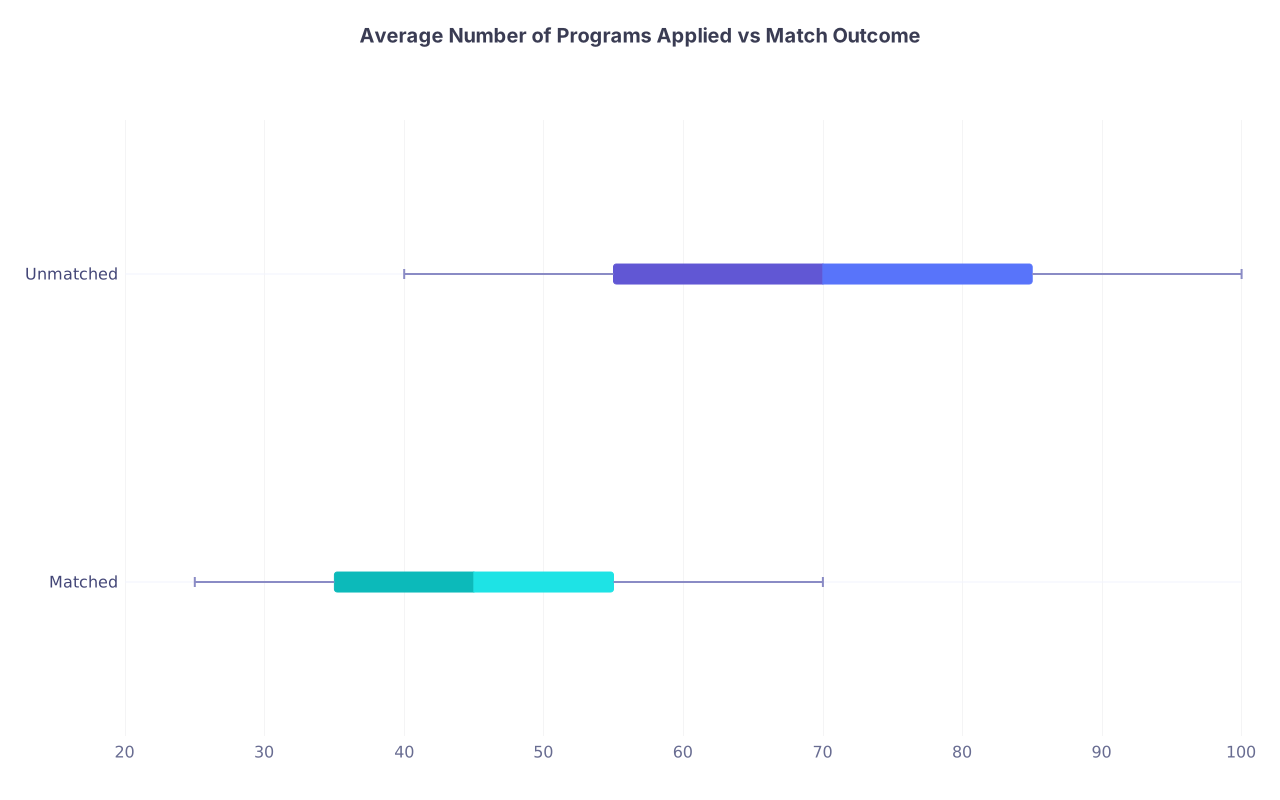
| Category | Min | Q1 | Median | Q3 | Max |
|---|---|---|---|---|---|
| Matched | 25 | 35 | 45 | 55 | 70 |
| Unmatched | 40 | 55 | 70 | 85 | 100 |
What that kind of distribution often shows:
- Matched applicants cluster around a middle range
- Unmatched applicants tend to apply even more — because they’re already worried about their competitiveness
So just seeing “unmatched people applied to 80+ programs” doesn’t mean 80+ is safer. It might mean weaker applicants are throwing more applications at the wall, unsuccessfully.
Don’t copy their panic. Learn from their mistake.
FAQ: Overapplying to Residency
1. Is there ever a situation where applying to 80+ programs actually makes sense?
Rarely. Maybe if you’re an IMG or have multiple red flags applying to a moderately competitive or very competitive specialty, and your advisor explicitly recommends that range based on recent outcomes at your school. But even then, I’d pair that with a backup specialty or a research year consideration—not blind panic-applying 100 programs with no strategy.
2. What’s a reasonable minimum number of programs to apply to?
For most US MD/DO applicants in less competitive fields (FM, IM, peds, psych), dropping below ~20 programs is usually unwise unless you’re an absolute superstar with strong home program support. For mid-competitive fields, I’d be nervous if you’re under ~25–30. Below that, you’re not being efficient—you’re being reckless in the opposite direction.
3. How many interviews do I actually need to feel reasonably safe?
For most core specialties, aiming for about 10–12 solid interviews puts you in a decent position. For ultra-competitive fields (derm, plastics, neurosurgery), people often feel safer with even fewer because the match numbers are different, but those applicants are highly curated. Instead of chasing 20+ interviews, focus on making the 10–15 you get as strong as possible.
4. If I already overapplied this year, what can I do now?
Stop compounding the mistake. Prioritize:
- Identify top 15–20 programs you’re genuinely interested in and focus prep on them
- Be willing to decline low-priority interviews once you have enough
- Protect your time and energy so your actual interviews are strong
You can’t un-send applications, but you can avoid letting the flood of interviews wreck your performance and mental health.
5. My classmates are applying to way more programs than I am. Am I underapplying?
Not automatically. Classmates lie, flex, or leave out key context (like being an IMG, having a failed exam, or dual-applying). Compare yourself to actual NRMP data and your advisor’s guidance, not the loudest voice in your group chat. If your numbers, school reputation, and experiences align with typical matched applicants and your list is thoughtfully built, you’re probably fine—even if someone else is panic-applying to 80.
Key points to walk away with:
- Overapplying does not guarantee safety; it often buys you stress, generic applications, and weaker interviews.
- A targeted, realistic list in the right range for your specialty and profile beats a panicked 70–100 program blast every time.
- Protect your money, your time, and your mental bandwidth—those are your real competitive advantages in the Match, not sheer application volume.