
The way you build your program list sends a louder signal than half your personal statement. Program directors are reading it, interpreting it, and sometimes judging you for it—even if nobody ever tells you that out loud.
Let me walk you through what actually happens behind closed doors when we look at your list size, your mix of programs, and where you chose to apply or not apply. Because overapplying and underapplying are both real problems—but not for the reasons you think.
What PDs Actually See From Your “List”
Here’s the first secret: we do not see your entire ERAS list in one tidy document. But we absolutely infer it.
We see:
- Where else you interviewed (because you tell us, because other faculty talk, and because residents gossip).
- Which programs you rotated at and did not apply to.
- Your geographic pattern.
- Your letters and who they’re from (and where they’re not from).
- Your interview cancellations and the timing of them.
That gives us a surprisingly clear picture of how you built your list, and whether you were realistic, strategic, or just panicked and clicked “apply all.”
I’ve sat in rank meetings where an associate PD said, “She applied everywhere—she’s aiming higher than us, this is a backup” based on her interview schedule. I’ve also heard, “He didn’t even apply to the community program down the street with his numbers? He thinks he’s too good for them. Might not fit here either.”
You’re being read. Not just your CV. Your judgment.
Overapplying: What It Looks Like From Our Side
Overapplying is not simply “applying to too many programs.” It’s applying widely and sloppily in a way that screams, “I don’t understand my risk profile, or I don’t respect anyone’s time.”
Let me spell out how we pick up on that.
The telltale signs of an overapplicant
We notice certain patterns:
- Applications from you to programs that obviously don’t fit your profile (e.g., 215 Step 2 applying to every hyper-academic top-10 IM program in the country).
- Generic personal statement sent to every program, including ones where the mission is clearly at odds with what you claim to want.
- Preinterview behavior: mass emails asking generic questions, “Dear Program Coordinator, to whom it may concern,” copy-pasted.
- Mid-season: you schedule an interview and then cancel 72 hours later, repeatedly, as “better” invites come in.
We know roughly how many places you applied because we see the noise. The random, uncalibrated reach applications. The scattershot geography. The way your story doesn’t match your list.
Here’s what that makes us think.
How PDs interpret overapplying
First, we assume anxiety. Not a dealbreaker, but it colors how we read you.
Second, we question your insight and self-assessment. If your profile is mid-tier and you have 15 top-10 interviews plus 10 community ones, fine—your application is strong and the market confirmed it. But if we see you on our schedule and know you’re also interviewing at several programs way out of your realistic range, we read that as you being either wildly optimistic or oblivious to tiers.
And yes, tiers exist. People pretend they don’t in public. They do in private.
Overapplying also affects your behavior:
- You’re tired and flat on interview day number 18.
- You ask generic questions because you haven’t researched the program.
- You mix up our program with another on screen. That happens. A lot.
Faculty pick up on it immediately: “This person is on auto‑pilot. We’re program number 12 of 20. Will they actually come?” That can drop you on the rank list.
The more insidious piece: PDs sometimes assume chronic indecision and poor planning. I’ve seen PDs say, “He clearly just blanketed 80 programs. I’d rather take the applicant who applied more carefully and really wants to be here.”
Is that always fair? No. Does it happen? Yes.
Underapplying: How It Quietly Sinks Applicants
Underapplying doesn’t usually look arrogant from our side; it looks naïve. Or sometimes self-sabotaging.
The typical version is the student with:
- No red flags, but slightly below-average scores or school pedigree.
- A narrow geographic area they refuse to leave.
- A short list—say 10–15 programs in a moderately competitive specialty.
- One or two true “safety” programs. Maybe.
We don’t see your total number of applications. But we do see the pattern when you tell us, “You’re one of 7 interviews I got.” For a competitive specialty. With clear risk factors.
That’s when a PD will say quietly after the interview, “Why did nobody tell this student to broaden their list? They’re going to be in trouble on Match Day.”
Why underapplying worries PDs
When we discover you underapplied, we think a few things:
- You were not well advised. Either your school did not give you realistic guidance, or you ignored it.
- You underestimate the randomness built into the Match.
- You may not handle bad news well if things go sideways.
Here’s something applicants never hear: PDs sometimes adjust how “aggressively” they rank a candidate based on perceived match risk. If you look like a high‑risk candidate to go unmatched—very few interviews, very competitive specialty—some programs will rank you slightly lower if they believe you’re unlikely to actually match there or may have to enter SOAP.
It’s not cruelty. It’s risk management for the program.
We all remember the SOAP week cases: great people who just applied to 8 derm programs or 12 ortho programs and nothing else. The PDs talk about those students later. “He was good. He just applied like it was 2008.”
The Numbers PDs Don’t Say Out Loud
Let’s talk raw volume, because there’s a threshold after which PDs stop differentiating and start making assumptions.
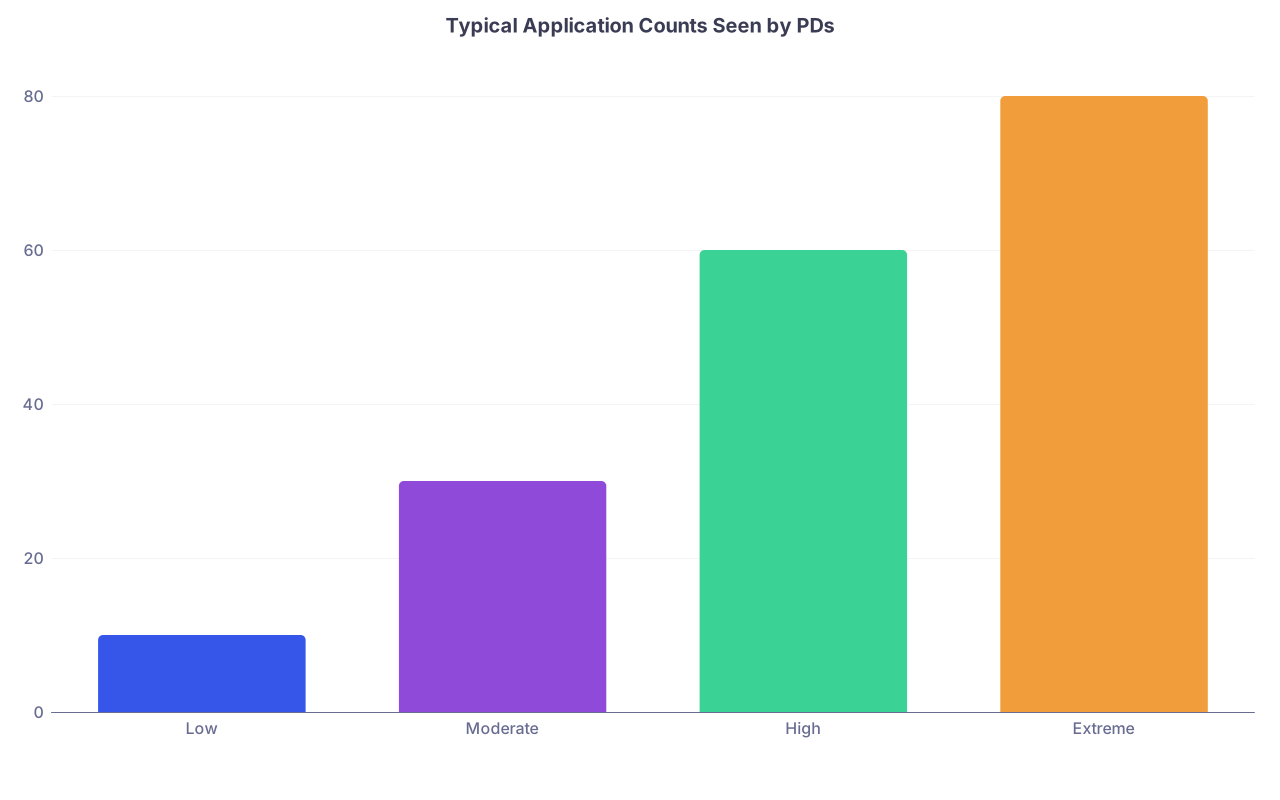
| Category | Value |
|---|---|
| Low | 10 |
| Moderate | 30 |
| High | 60 |
| Extreme | 80 |
Those categories are very rough. But here’s the insider interpretation by competitiveness level.
By specialty competitiveness
Use this as directional, not absolute. Every applicant’s risk profile shifts these ranges.
| Specialty Tier | Apps ~<20 | Apps 20–40 | Apps 40–60 | Apps >60 |
|---|---|---|---|---|
| Very Competitive (Derm, Ortho, Plastics, ENT, IR, NSG) | Reckless | Slightly light | Normal | Mild panic / red flag |
| Moderately Competitive (EM, Anes, Gen Surg, OB, Road subspecialties at strong places) | Risky | Normal | Anxious | Overapplying |
| Less Competitive (FM, Psych, Peds, Neuro at most places, IM community) | Usually fine | Conservative | Anxious | Why so many? |
Again—no one is pulling up a chart in a meeting saying, “She applied to 52 programs, thus anxious.” But after reading thousands of applications and interviewing hundreds of students, patterns become obvious.
What actually matters more than the raw number is the shape of your list. Are you clustering in a tier and geography that matches your profile? Or are you trying to stretch every axis at once—top tier, desirable city, competitive specialty—with mediocre metrics and then spamming 70 programs hoping something hits?
We can tell.
The Signals Hidden in Your Mix of Programs
Program directors are constantly triangulating three things:
- Your competitiveness.
- Your stated preferences.
- Your actual choices (where you applied, rotated, interviewed, and canceled).
The tension between 2 and 3 is where we really draw conclusions.
Example: “Academic mission” vs your list
You say in your personal statement you want a career in academic medicine with heavy research. You tell us this in your interview, earnestly.
Then we ask where else you’re interviewing, and:
- 10 of your 12 interviews are pure service, high-volume community programs, none with robust research infrastructure.
- You didn’t even apply to the big academic center two hours from your home school that matches your interest.
Internally, faculty think: “This person says the right words but is clearly just trying to match anywhere. Research is not really their priority.” That doesn’t mean we won’t rank you. But your self‑narrative loses credibility.
Flip side: If your list is anchored by several mid-tier academic programs plus a couple of high-research places, and your cancellations are mostly community programs far from your stated geographic preference, that looks coherent. Even if you applied wide numerically, the pattern aligns.
Example: Geography vs seriousness
Another thing PDs parse hard: whether you’re genuinely likely to come.
This is where your over- or underapplying interacts with location.
If you’re from New York, never lived outside the Northeast, and your entire history is coastal—and you’re interviewing at one midwestern program in a small city—that PD knows exactly what’s going on. You’re hedging. You overapplied. We are your safety geography.
If, on top of that, you:
- Emailed the coordinator to ask if the interview could be moved 3 different times.
- Show up distracted.
- Have 18 other interviews scheduled in big coastal cities.
You will be ranked accordingly. As in: not very high.
On the other hand, if your list shows clear geographic intent—clusters of applications in 2–3 coherent regions tied to real reasons (family, prior training, partner)—PDs feel comfortable investing in you. Even if your total number is large, it reads as deliberate, not random.
Visiting Rotations and Invisible “Non‑Applications”
One thing applicants severely underestimate is how loudly not applying somewhere can speak.
If you rotated at a program and:
- Didn’t apply there at all, or
- Applied but then never responded to interview communication,
that program will absolutely talk about you. And those conversations bleed into their networks.
I’ve been in meetings like this:
“Didn’t she rotate with us?” “Yeah.” “Did she apply?” “Nope.” “Interesting.”
“Interesting” is doing a lot of work there.
Program directors and faculty then make inferences:
- You had a bad experience with us (which may be our fault).
- You were told you were not competitive here.
- You’re aiming higher and we were always your safety.
None of these will help you if you later end up SOAPing or needing a prelim spot in that region.
So when you underapply by cutting out programs where you have real connections—or overapply by adding them just to “show face” but then ghost them—you create background noise that PDs do hear about.
How Many Programs Should You Apply To? The Real Answer
You’re expecting a number here. I’ll give you ranges, but if you start from “How many programs?” instead of “What’s my risk profile?” you’re already doing this backward.
The questions PDs wish you’d ask yourself first:
- What’s my true competitiveness in this specialty, based on data from my school’s match list?
- What are my red flags? (low Step 2, no home program, marginal clerkship grades, visa issues, failed test, career change, prior residency, etc.)
- How constrained am I geographically—by choice or necessity?
- What’s my Plan B if the Match doesn’t work in this specialty?
Then you size your list to your risk. But since you want numbers, here’s a blunt framework.
A rough insider calibration (per specialty applied to)
Assuming no catastrophic red flags:
- Very competitive specialties (Derm, Ortho, PRS, ENT, IR, NSG):
- Strong applicant: ~40–60 programs, but heavily curated.
- Average-ish applicant: ~60–80, plus a serious backup specialty.
- Moderately competitive (Anes, EM, Gen Surg, OB, competitive IM tracks, Rads):
- Strong applicant: ~25–40.
- Average-ish: ~40–60.
- Less competitive (FM, Peds, Psych, most IM, Neuro):
- Strong applicant: 10–20.
- Average-ish: 20–30.
- Weaker or with multiple red flags: 30–45.
Those aren’t rules. They’re what a lot of seasoned deans and PDs quietly tell their own students.
Where people get into trouble is:
- Applying at the upper bound of those ranges but with no actual curation. Just volume.
- Or applying at the lower bound while insisting they’ll only live in three zip codes.
Both look bad from our side, for different reasons.
Strategic Overapplying vs Blind Overapplying
There is a version of “overapplying” that PDs respect: strategic over‑coverage.
That looks like:
- You have one significant risk factor—say, Step 2 barely passing, or IMG status, or a prior career gap.
- You apply to a broad range of program types, but mostly in realistic tiers.
- Your geography is coherent, with 2–3 regions where you have actual ties.
- Your interview behavior is professional, and you do not mass‑cancel late for “better” places.
We interpret that as you taking your risk seriously. I’ve heard PDs say, “She applied smart. A lot, but smart.”
Blind overapplying is different:
- 80 programs, including all the name-brand places that have never taken someone with your profile.
- Random smattering of small community programs where you have zero connection and no story.
- No clear theme in your application that matches where you applied.
- Last‑minute cancellations that clearly show your tiering of programs.
That combination marks you as either poorly advised or impulsive. That can knock you down a few spots on rank lists where there’s a tie.
Strategic Underapplying vs Delusional Underapplying
There’s also a rare but real version of deliberate underapplying that PDs admire.
Strategic underapplying is usually:
- A strong or truly exceptional applicant with clear constraints (family, dual‑career partner, kids in school, immigration issues).
- They apply to a smaller number of programs—say 10–20—but all of them are appropriate fits and they’re transparent about their constraints.
- They tell PDs clearly on interview day what’s tying them to that region.
We view that as confident and honest. Programs in that region may rank you more aggressively because you’re actually likely to come and clearly know what you’re doing.
Delusional underapplying is different:
- Middle-of-the-pack applicant applying only to the top 4 academic programs in a major city because “I really like research and want to be near my friends.”
- Or someone with a marginal application applying to ~10 programs in a city everyone wants.
We read that as magical thinking. And yes, we talk about it.
How Cancellations Expose Your Real Priorities
One underappreciated part of how we infer your list quality: the pattern of your cancellations.
If you cancel:
- Early and respectfully, with a clear reason—we assume you’re rebalancing your schedule. Fine.
- Repeatedly, close to the date, often for smaller or less “prestigious” programs—your priorities are obvious.
Residents in competitive programs trade stories: “We were clearly their backup; they canceled us after they got a coastal invite.” PDs remember those names.
Now pair that with an extreme overapplication. You’ve essentially told the market: “I panicked, carpet‑bombed applications, and am now tossing aside the ones that don’t feel shiny enough.” Some PDs will shrug. Others will quietly decide you’re not worth much effort.
How To Build a List PDs See as “Smart”
Let me give you the version of this that many PDs wish every applicant would follow.
Start with your home institution’s match data in your specialty over the last 3–5 years. Find people with your approximate numbers, school reputation, and red flags. See where they matched and how many programs they applied to.
Cluster programs into three honest buckets for you:
- Reach: would be thrilled to match; your stats are below or at the bottom of their usual range.
- Target: match their usual profile reasonably well.
- Safety: you’re clearly above their typical range or bring something they really need (geography, language, niche interest).
Make sure your “target” bucket is big enough. This is where underapplicants blow it. They build a list full of reaches and safeties with almost no true middle.
Reality‑check geography. Make sure there are multiple programs in your target bucket in each region you care about. One dream program per city is not enough.
Add a buffer for randomness. Not neurotic excess. Just enough to forgive an off interview day or bad fit.
When PDs look at your interview list (because you’ll tell us when we ask), we’re listening for exactly that shape. Reach / target / safety in a coherent pattern. If we hear only reaches and vague “I’ll go anywhere” safeties, we know you applied badly.
FAQ: Overapplying vs Underapplying
1. Does the number of programs I apply to directly hurt me?
Not by itself. No PD opens ERAS, sees “applied to 70 programs,” and auto‑docks you. What hurts you is the pattern that usually comes with extreme numbers: generic materials, incoherent geography, unprofessional cancellations, and clear mismatch between your stated goals and your actual list.
2. If I underapplied and now have very few interviews, should I tell PDs?
Yes, selectively and honestly. If you have a genuine constraint (family, visa, dual‑career partner) or were poorly advised, you can be transparent, especially with programs you’re truly committed to. Something simple in an email or on interview day—“I limited my applications to this region because of X”—helps PDs interpret your risk and seriousness more accurately.
3. Can overapplying ever be the right move?
It can, if it’s strategic: you have clear risk factors, you focus on realistic tiers, your geography is coherent, and you behave professionally with scheduling. Volume as insurance is fine. Volume as a substitute for judgment is what PDs silently penalize.
Key points to walk away with:
Your list size is less important than the pattern it reveals about your judgment, self-awareness, and honesty. Overapplying and underapplying both become problems when they betray panic or delusion rather than a clear, data‑driven strategy. Build a list that a PD could look at and say, “Makes sense for who this applicant is”—and you’ve already differentiated yourself from half the field.