
The biggest hidden reason strong applicants don’t match isn’t their Step score. It’s geography chaos.
You can have a 250+, solid letters, good research… and still end up unmatched because you scattered your applications all over the country with no coherent regional strategy. I’ve watched it happen. More than once.
This is the geography mistake: spreading your residency applications too thin across regions, instead of building real depth where it matters.
Let me walk you through how smart applicants get this wrong, what actually happens behind the scenes when your list is geographically incoherent, and how to build a region strategy that protects you instead of sabotaging you.
The Core Geography Mistake: “I’ll Just Apply Everywhere”
The classic move:
- You’re anxious about matching.
- People keep telling you, “Cast a wide net.”
- So you decide “wide net” means randomly applying to 70–100+ programs across every time zone with no clear regional focus.
On paper, it feels safe. More programs = more chances, right?
In reality, it creates four specific problems that hurt you:
- Programs cannot see any geographic story in your file.
- Your application signals low likelihood of staying long-term.
- You dilute your own interview capacity and travel budget.
- You fail to build depth in any region’s ecosystem (med school, home, rotations, family, ties).
Here’s how it usually looks.
You end up with something like:
- 8 programs in the Northeast
- 10 in the Mid-Atlantic
- 12 in the Midwest
- 15 in the South
- 10 in Texas
- 12 on the West Coast
- 6 random outliers (Alaska, Hawaii, small places you know nothing about)
No pattern. No anchor. No story. Just fear-based volume.
Programs notice this. They’re not blind.
Why Programs Care About Geography More Than You Think
Programs don’t just want someone who can survive internship. They want:
- People who will actually move there
- People who will be happy there
- People who might stay in the region and feed their fellowship networks, jobs, and reputation
They’ve been burned by this before. They took a chance on someone from a far-away coastal school who said, “I’ve always wanted to live in [their city],” and that intern was gone the second fellowship opened a door closer to home.
So they look for:
- Existing ties to the region (family, undergrad, med school, SO’s job)
- Rotations in the area
- A cluster of applications nearby indicating you’re serious about that part of the country
- Personal statements and signals that match the region
If your app suggests you’re just spraying ERAS at the map hoping something hits, you become a risk.
They ask the quiet question:
“If we invest in this person, what’s the chance they’re miserable and out in 3 years?”
The Three Flavors of Geography Overreach
You’re not making just one mistake here. You’re usually stacking a few together.
1. The “Bi-Coastal But Rootless” Strategy
You grew up in California, went to med school in New York, and now your application is:
- 15 programs in CA
- 15 in NY/NJ
- 20 scattered everywhere else
Why this backfires:
- Programs in CA think: “They’ll go back to New York for family/support.”
- Programs in NY think: “They’re clearly trying to get back to California.”
- Everyone else thinks: “We’re obviously their backup.”
So instead of looking “flexible,” you look uncommitted.
2. The “Hyper-Competitive Cities Only” Strategy
I see this constantly in applicants gunning for big-name programs.
Your list is basically:
- NYC, Boston, SF, LA, Chicago, maybe Seattle and DC
- Zero mid-sized cities
- Zero community-heavy areas
- Zero places where your stats actually give you a margin of safety
You argue: “I’m willing to live anywhere… as long as there are Michelin stars and public transit.”
Problem: Tier 1 cities in competitive specialties are flooded with overqualified applicants who also have regional ties. If you don’t, you’re easy to pass over.
You end up with 20 interviews? No.
You end up with 4–6 interviews, all in December, across multiple distant regions, and now your entire Match depends on luck and flight prices.
3. The “No Regional Depth” Approach
Your total list might seem big and safe. But by region, you’re actually very shallow.
| Region | Superficial Strategy | Deep Strategy |
|---|---|---|
| Northeast | 5 programs | 15 programs |
| Midwest | 6 programs | 18 programs |
| South | 4 programs | 0 or 12+ (not both) |
| West Coast | 7 programs | 0 or 10+ |
| Texas | 3 programs | 0 or 8+ |
The superficial list looks “broad” but doesn’t create safety anywhere.
The deep list actually gives you a realistic shot at matching in at least one region that makes sense for your story.
How Geography Mistakes Wreck Your Interview Season
Let’s talk about the part applicants always underestimate: interviews are finite.
You can only:
- Attend so many interviews without collapsing your rotations
- Afford so many flights and hotels (yes, virtual is common, but not universal)
- Present your best self so many times before burning out
Now layer on a scattered regional strategy.
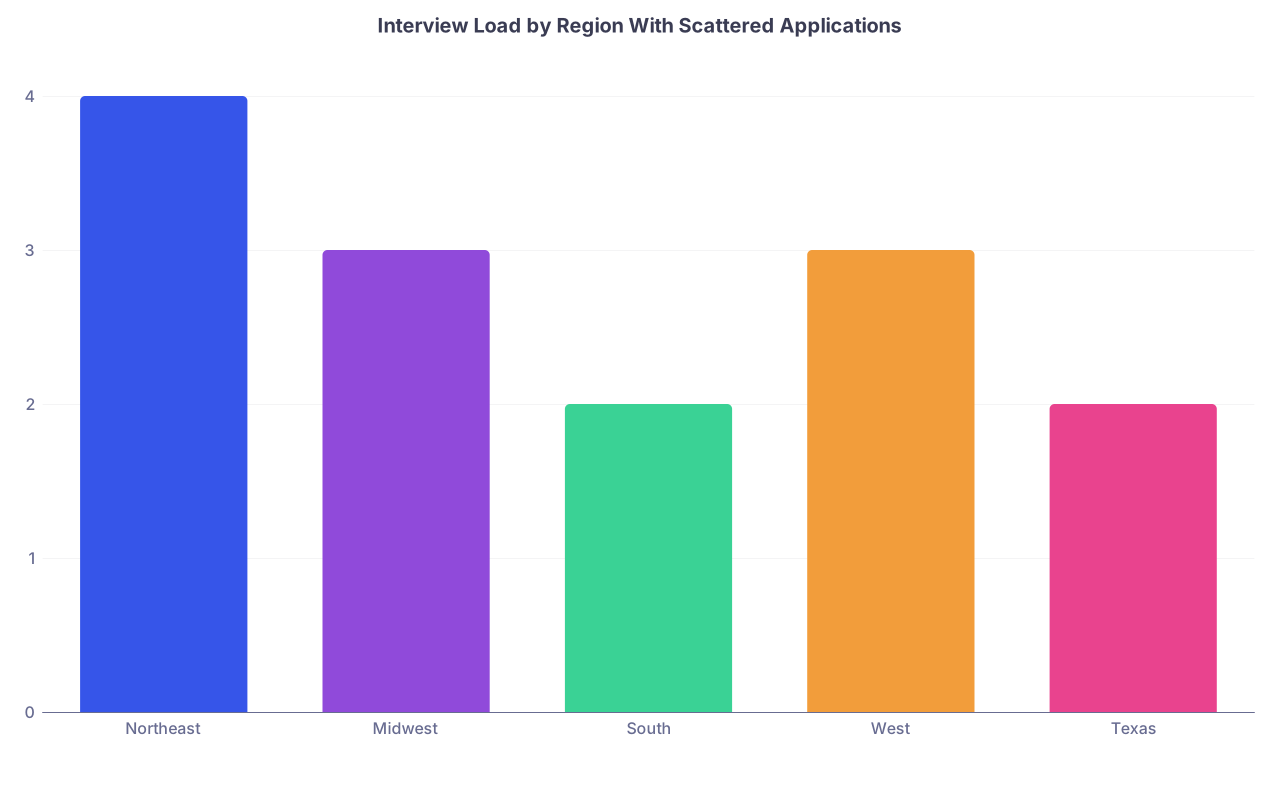
| Category | Value |
|---|---|
| Northeast | 4 |
| Midwest | 3 |
| South | 2 |
| West | 3 |
| Texas | 2 |
Result:
- 4 interviews in the Northeast
- 3 in the Midwest
- 2 in the South
- 3 on the West Coast
- 2 in Texas
Fourteen total interviews looks good… until you realize:
- They’re spread across 5 regions
- You’re exhausted, broke, and juggling time zones
- You can’t show any region a high rank preference because you’re emotionally scattered too
- Weather, flight cancellations, or illness easily knock out 2–3 of them
Compare that to someone who did 18 interviews in two adjacent regions. Much safer, much more coherent.
Step Scores & Geography: The Quiet Trap
Higher scores don’t exempt you from geography reality. They make you overconfident about it.
Common pattern with strong Step 2 CK (say 250+):
- You convince yourself “programs everywhere will want me.”
- You under-apply in safety regions you’re actually willing to live in.
- You send vanity applications to places you’d never choose unless forced.
And with lower scores (or red flags) the opposite mistake:
- You apply to way too many regions “just in case,”
- But you don’t create a compelling tie to any of them,
- So you still get screened out, just more expensively.
Building a Smart Regional Strategy (So You Don’t Get Burned)
Let’s get concrete. Here’s how to build a safer, tighter geography approach.
Step 1: Identify Your True Anchors
You probably have more regional anchors than you realize. List them out:
- Where you grew up
- Where you went to undergrad
- Where you’re in med school
- Places where you’ve done away rotations / sub-I’s
- Regions where you have family / partner / kids / serious friends
- Places where you speak the language / understand the culture
Now rank those regions honestly:
- Places you’d be genuinely happy to live for 3–7 years
- Places you’d tolerate if needed
- Places that would be a true last resort
Stop pretending “all 50 states are equal.” Programs know that’s not true. You do too.
Step 2: Pick 1–3 Primary Regions, Not 6
A generally safe structure:
- 1–2 primary regions where you build heavy depth
- 1 secondary region you sprinkle in, but only if it has a clear logic
For most people, primary regions are:
- Home region
- Region of med school
- Region of long-term partner / spouse
- Region where you did meaningful rotations
If you apply to 60 programs, I’d rather see:
- 50 clustered in 2 logical regions
- 10 in one backup region that still makes sense
…than 60 spread across 6 regions with no story.
Step 3: Balance Depth vs Spread By Specialty & Competitiveness
The more competitive your specialty, the more intentional you must be. For a mid-competitive field (IM, peds, FM depending on your stats), something like:
| Region | Number of Programs | Rationale |
|---|---|---|
| Midwest | 25 | Med school + rotations |
| Northeast | 20 | Family + prior residence |
| South | 10 | Specific cities you like |
| West Coast | 5 | True reach, strong reasons |
See the pattern:
- Depth where you have strong ties and realistic interest
- Limited “reach geographies” where you can still tell a story
- No random single applications in states you can’t even spell correctly
If you’re in a very competitive specialty, you might use more programs total—but still keep regions tight.
Step 4: Make Your Geographic Story Explicit
Programs shouldn’t have to guess why you’re applying to them.
You need geography-forward signals:
- Personal statement variants that mention certain regions (without sounding fake)
- Geographic preference signal if your specialty allows it
- Home / away rotation listed clearly and emphasized if regional
- LoRs from faculty in that region who can say, “This person wants to stay here.”
- Interview answers that are specific: neighborhoods, support systems, lifestyle fit
Do not say the same generic nonsense everywhere:
- “I’ve always loved the Midwest.” (You’ve never lived there.)
- “I’m open to anywhere in the country.” (No you’re not.)
Instead:
- “My parents live 45 minutes from here. I see them on weekends now. It matters to me to stay close enough to maintain that support system during residency.”
- “I did undergrad in this state, then came back for med school. At this point, this region feels like home.”
That’s the kind of thing that calms programs down.
When It Is OK to Be Broad
There are rare situations where broad geographic spread is actually rational. But you must own the narrative.
Examples:
Dual-career couples in different regions
- You: “My partner is applying to grad programs in these three states. I’m geographically flexible in that triangle. We’ve mapped it out.”
Immigrant applicants without strong US regional ties
- You: “I don’t have a single US ‘home region.’ I’m focusing on [X kind of city/region] where my language skills and cultural background match patient populations.”
Applicants from schools with historically weak local Match
- You can argue more “nationwide” spread, but still—cluster your choices. Don’t turn it into a pure lottery.
Even here, I’d still advise some clustering. Being broad doesn’t mean being random.
The Hidden Cost: Time, Energy, and Sloppy Applications
Another thing you’re underestimating: the more regions you chase, the sloppier your actual applications become.
I have seen all of these:
- Personal statement “I’ve always dreamed of moving to the West Coast” sent to a New York program.
- Cover letter referencing the wrong city.
- Generic, lifeless “fit” paragraphs that could apply to any program in any state.
- Mixed-up program names because applicants were speed-clicking in ERAS at 2 a.m.
Why does this happen? Because:
- 80+ applications = no time for customization
- Mixed regions = harder to remember why you applied to each place
- Cognitive load skyrockets, quality nosedives
Programs notice that too. They talk about it in committee:
“This one clearly mass-applied. The PS doesn’t mention anything about us or this city.”
How to Audit If You’re Already Making This Mistake
If you’ve built a draft list, do this now. Brutally.
Sort your programs by state or region.
Count how many programs per region.
Ask:
- Do I have at least one region with >20–25 programs in it (for most specialties)?
- Did I put 5 or fewer in several regions for no good reason?
- Does my life story actually line up with where I’m applying?
Look for “orphans”:
- Single-program states with no real tie
- Cities you’d never move to except in pure desperation
- Programs you know almost nothing about but kept “just because”
Be ruthless. If you wouldn’t rank a place above your SOAP safety net, why are you paying to apply there?
A Safer, Saner Way to Decide “How Many Programs”
The question you thought you were asking is “How many programs should I apply to?”
The better question is:
In how many regions can I tell a believable, compelling story that I will actually show up, stay, and thrive?
Then:
- Decide your total number based on specialty competitiveness and advisor input.
- Allocate that total into 1–3 coherent regions, not 5–7 scattered ones.
- Only add “extra” regions if you can clearly explain them out loud without sounding fake.
To make it more concrete, you can sketch something like this:

| Step | Description |
|---|---|
| Step 1 | Start Planning |
| Step 2 | List life anchors |
| Step 3 | Choose 1 to 3 primary regions |
| Step 4 | Set total program target |
| Step 5 | Allocate majority to primary regions |
| Step 6 | Add 1 logical backup region |
| Step 7 | Stop adding new regions |
| Step 8 | Customize PS and interview story per region |
| Step 9 | Need secondary region? |
If your real process looks more like:
“Open ERAS → sort by state → click everything that sounds big-name or coastal”
…you’re the exact person this geography warning is for.
The Bottom Line: Don’t Let Geography Quietly Sink You
You don’t control everything in the Match. But you absolutely control whether your application looks geographically scattered or grounded.
Keep these points clear:
- Depth beats random spread. You’re safer with strong clustering in 1–2 regions than 5 programs in every time zone.
- Programs care about whether you’ll actually live there. If you can’t tell a believable story about why you’re applying to their region, don’t be shocked when they don’t call.
- Your interview bandwidth is limited. A chaotic, multi-region approach drains your money, energy, and focus—and increases the odds you end up unmatched despite looking “broad.”
Do not make the mistake of treating geography like a minor detail. In residency applications, it’s often the quiet tiebreaker that decides who gets the interview… and who doesn’t.