
It’s late January. Rank list certification is one week away. You’re staring at your ERAS spreadsheet, scrolling through 18 programs you barely remember and 5 you’re irrationally obsessed with, wondering if you’ve totally sabotaged your future. Your group chat is exploding with:
“Is 9 programs enough for peds?”
“Should I rank that malignant place or just risk not matching?”
And the fear you won’t say out loud: What if I picked wrong and I’m stuck for years?
This is where people make the biggest mistakes. Not on interview day. Not in their personal statement. On the list. Quietly. Alone. Clicking “Certify.”
Let me walk you through the top 10 residency list mistakes I’ve watched people regret hard after Match Day—especially around how many programs they applied to and ranked, and how they built that list in the first place.
1. Playing “Match Chicken” With Too Few Programs
This is the classic arrogant move. Or the panicked “I’m tired of interviewing” move. Either way, it backfires.
You see it every year:
- The “mid-tier” EM applicant with 225 Step 2, average SLOEs, who interviews at 10 programs and ranks 7 “because the data said 7–8 is enough.”
- The competitive-leaning derm or ortho applicant who gets 6 interviews and still insists on ranking only 5 because they “didn’t vibe” with one place.
The NRMP charts are not a guarantee. They are population data, not a personal safety net. The line between “probably match” and “scramble into SOAP” is thin and you don’t feel that line until it slices you.
Here’s the mistake:
Thinking, “Historically, people with my stats matched with X ranks” and treating that as law, instead of asking, “Given my actual interview count and risk tolerance, how many ranks do I need to feel safe?”
If you’re in a competitive specialty or you have any red flags (exam failures, gap years, weak letters), under-ranking is essentially gambling with your future.
Basic rule of thumb:
If you’re anywhere near the margins, you do not play cute with small lists. If you have 10 interviews in a competitive field and you’re ranking 6 “because I didn’t love the others,” you are flirting with SOAP.
2. Applying Like You’re a Perfect Applicant When You’re Not
Different but related mistake: under-applying on the front end.
The optimistic narrative: “I’ll apply to 25 IM programs, I have a 240, solid pass, research, I’ll be fine.”
Then ERAS season happens, filters crush you, and you end up with 4 interviews and no backup specialty.
Here’s where people go wrong: they look at “average” matched applicant data and forget that programs don’t see average. They see one application at a time, through their specific filter settings, priorities, and biases.
Red flags that mean you should apply to more programs than your peers:
- Any Step/Level failure
- Step 2 score clearly below the average of your target specialty
- IMG (especially non-US)
- Few or no home rotations / away rotations in the field
- Career change or major gap without strong narrative and support
And yet I routinely see IMGs applying like they’re US MDs with 250s. Or DOs applying to insanely competitive specialties with single-digit interview expectations and no backup plan.
The thing people regret:
“I should’ve added 20 more mid/low-tier programs when I still had time. The extra cost would’ve been nothing compared to ending up in SOAP or unmatched.”
3. Ignoring Specialty-Specific Reality Checks
You cannot answer “how many programs should I apply to?” with one generic number. That’s how people get burned.
Different specialties have radically different interview and rank list expectations.
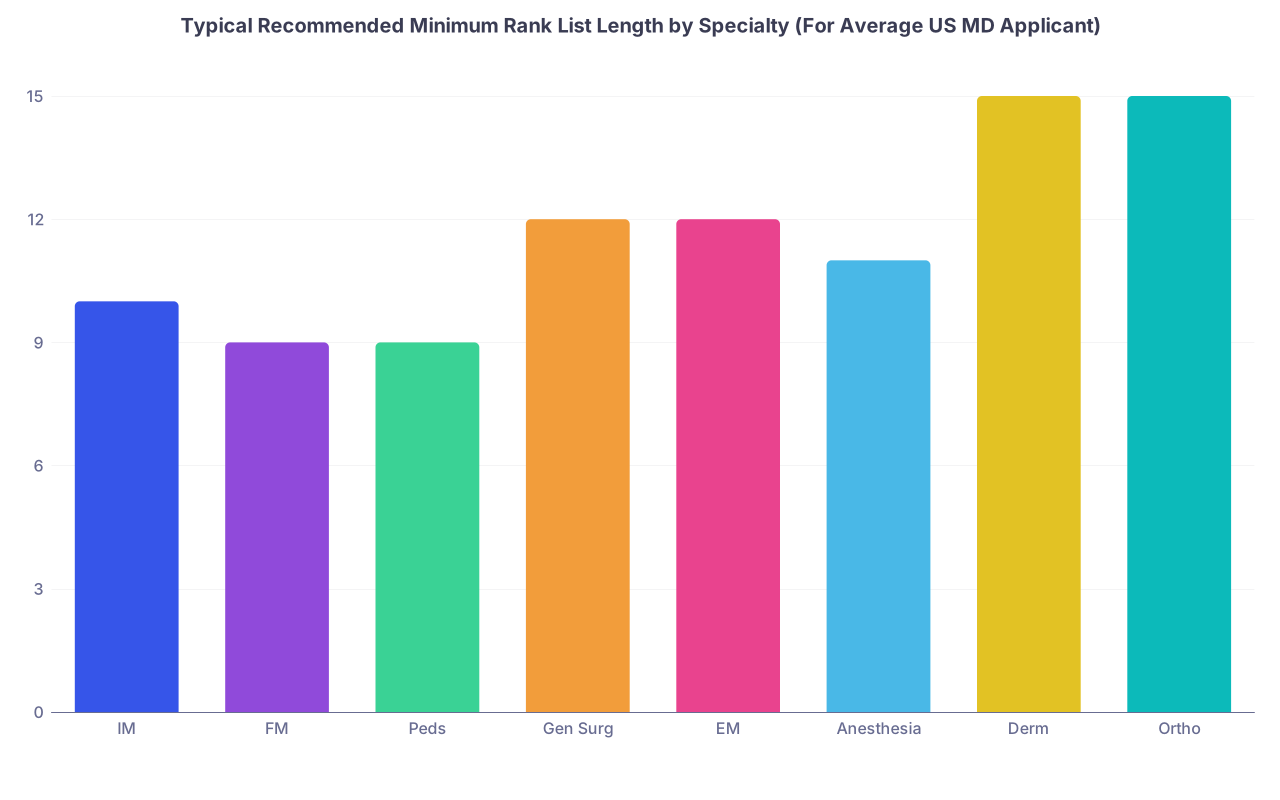
| Category | Value |
|---|---|
| IM | 10 |
| FM | 9 |
| Peds | 9 |
| Gen Surg | 12 |
| EM | 12 |
| Anesthesia | 11 |
| Derm | 15 |
| Ortho | 15 |
These are rough “feel safer” numbers for a typical US MD with no red flags. If you’re below-average, IMG, or in a super competitive coastal market, you need more.
Major mistake:
Using a friend’s experience in Internal Medicine to justify applying lightly to a competitive surgical field. Or hearing “I ranked 8 FM programs and matched” then deciding 8 ortho programs is reasonable. It’s not.
You need specialty-specific guidance:
- NRMP’s “Charting Outcomes in the Match” (your actual Bible for this)
- Specialty advisor who knows current cycles (not someone quoting 2015 vibes)
- Recently matched residents from your school in that specialty
If you skip this and just wing it, you’re not being bold. You’re being careless.
4. Overweighting “Vibe” and Underweighting Risk
I am not telling you to rank malignant programs highly. I am telling you that the “vibe” excuse is often a cover for fear and ego.
I’ve heard all of this:
- “The conference room chairs looked old. I can’t imagine 3 years there.”
- “The PD wasn’t very warm; I don’t want to be miserable.”
- “The city felt too small; I’d be bored.”
Meanwhile, this person has 6 total interviews in a moderately competitive specialty and no backup.
You don’t have to like every place you rank. You have to be willing to train there. That’s the bar.
If you’re ranking based on:
- Free lunch spread
- Shuttle organization
- How funny the residents were on Zoom
…you’re making a cosmetic list, not a rational one.
Here’s the real structure:
- Programs you’d be thrilled with → top of the list
- Programs you’d be okay with → middle
- Programs you’d tolerate rather than be unmatched → bottom
People regret this when they end up unmatched or in SOAP and realize they threw away perfectly acceptable training spots because they didn’t feel butterflies on interview day.
5. Blindly Trusting “Apply Widely” Without Strategy
Another mistake on the opposite end: spraying 80–100 applications with no targeting, and thinking volume alone will save you.
“Apply widely” doesn’t mean “apply randomly.”
It means “apply broadly to programs where you are at least within shouting distance of their usual applicant profile.”
What goes wrong:
- Applicants burn thousands of dollars applying to dream coastal academic programs that were never realistic, while under-applying to solid community or mid-tier places where they actually had a shot.
- They ignore geography. A mid-tier candidate applying to 30 Chicago/NYC/Boston programs and 2 in the Midwest is basically saying, “I’d rather risk not matching than leave the big city.”
You want smart breadth, not chaos.
| Approach Type | What It Looks Like | Likely Outcome |
|---|---|---|
| Smart Broad | 40–60 programs, mix of academic/community, multiple regions, realistic based on stats | Higher interview yield, safer rank list |
| Sloppy Broad | 70–100+ programs, heavy on ultra-competitive coastal programs, weak geographic spread | Many silent rejections, fewer interviews than expected |
| Over-Narrow | 15–25 programs, mostly prestige or one region only | Very sensitive to bad luck, high regret risk |
The regret hits when you see classmates with similar stats matching into solid programs because they didn’t cling to “NYC or nothing.”
6. Forgetting Geography Can Destroy Your List
You’d be shocked how often this one blows up in people’s faces.
Two major geography failures:
Too narrow
“My partner’s here. My family’s here. I only applied in California.”
Translation: “I tied my entire career to one overpriced state that everyone wants with fewer spots.”
Then they get 3 interviews and pretend it’s fine.Too random
Applying to 15 states with zero theme, zero connection, zero explanation. Programs wonder, “Why us?” You have no narrative. And some places just don’t like pure “flyover tourists” with no ties.
You should be able to clearly answer:
- Where are my priority regions?
- Where would I be ok living for training?
- Where am I realistically competitive?
If you’re limiting yourself geographically (partner, visa, kids), you compensate by:
- Applying to more programs in that region than your peers
- Including more community and lower-tier places
- Being brutally honest about risk and backup plans
The regret story I’ve seen a dozen times:
“I only applied NE + big cities because I didn’t want to be ‘stuck in the Midwest’… and then I didn’t match at all.”
7. Not Having a Backup Specialty When You Obviously Need One
This one is brutal. And avoidable.
If your numbers are borderline or below for a hyper-competitive field (derm, ortho, plastics, NSGY, ENT, ophtho, rad onc), and you don’t have:
- Home program support
- Strong research in the field
- Great letters from known names
- Enough interview invites early
…and you never built a real backup specialty list?
That’s how you end up unmatched, reapplying, or pivoting in panic.
A sane strategy for a risky specialty:
- Primary: your dream field
- Secondary: realistic field you could be happy in (IM, FM, psych, anesthesia, etc.)
- Actually apply and interview in the backup, not just “I’ll think about it if things go badly.”
The mistake is thinking a backup is an insult to your dream. It’s not. It’s an insurance policy.
Residents don’t regret having a backup. They regret not having one when the writing on the wall was obvious by November.
8. Misreading Interview Numbers and Timing
People obsess over how many programs to apply to and then completely misinterpret what their interview count is telling them.
Key points people screw up:
- Early cycles of invites (Sept/Oct) show how competitive you actually are. If you sent 60 apps and got 2 interviews by late October in a competitive specialty, the answer is not “coast.” It’s “panic strategy meeting.”
- A lot of people cling to “more invites will come” long after most programs have already filled their slots.
You should be asking:
- For my specialty and profile, is my invite number in a safe, borderline, or scary range?
- Do I need to add more programs (if possible) or urgently build my backup specialty?
I’ve literally watched people sit on 5 EM interviews in December saying, “I heard waves go out later,” then in January realize they’re stuck with 5 total and no backup.
Do not wait until rank list season to acknowledge reality. The ship sailed months before.
9. Ranking Based on Hype and Name Instead of Fit and Training
Here’s the hidden trap: prestige.
Applicants fall in love with big-name hospitals and cities. They rank a “Top 10” name high despite:
- Massive resident burnout
- Horrible call schedule
- Weak support for their career goals (e.g., no primary care focus, no global health, no research time)
Then Match Day hits, Instagram loves it, and by PGY-2 they’re miserable.
You are not in residency to impress your college friends. You’re there to train. Daily life matters more than the bumper sticker.
Red flags people ignore because of hype:
- Residents look exhausted and not faking it well
- Program leadership dodges questions about wellness, duty hours, or turnover
- Zero grads in the career path you say you want (academics, hospitalist, fellowship X)
The regret soundbite I hear every year:
“I ranked Program X higher because of the name. Program Y clearly cared more about residents. I should’ve trusted that.”
On the flip side, underestimating strong community programs because “they’re not academic enough” is another flavor of the same mistake. Many people discover too late that:
- Community programs can offer more hands-on experience
- Better work-life balance
- More autonomy and nicer culture
But they never applied or ranked them high enough to find out.
10. Treating Rank List Certification Like a Formality
This one’s subtle but deadly: not doing a serious, structured review of your rank list before you hit “certify.”
The rushed, half-baked process:
- Throw programs into NRMP in the order you “feel” in the moment
- Glance at it on your phone between rotations
- Maybe move one or two after a group chat argument
- Hit certify and never have a calm, private, rational review
You should be sitting down, alone or with a trusted advisor, and asking yourself:
- If I matched at my #1, would I be happy?
- If I matched at my #last, would I still rather that than go unmatched? If the answer is no, that program should not be on the list.
- Does the order reflect my priorities, not just “prestige > location > everything else”?
One thing people rarely consider and later regret:
Family, support system, and partner situation. On Match Day, the reality hits hard: “I moved to a city where we know no one, my partner can’t find work, and I ignored that because I was dazzled by the hospital name.”
Take a quiet hour, no distractions, and walk mentally through matching at each rank. If there’s a program where your gut says “absolutely not,” pull it. Matching there and spending 3–7 years resentful is worse than reapplying for many people.

| Step | Description |
|---|---|
| Step 1 | Start Application Planning |
| Step 2 | Choose Specialty |
| Step 3 | Assess Competitiveness |
| Step 4 | Add Backup Specialty |
| Step 5 | Primary Specialty Only |
| Step 6 | Apply Broadly with Strategy |
| Step 7 | Monitor Interview Invites |
| Step 8 | Build Rank List |
| Step 9 | Adjust Strategy or Backup |
| Step 10 | Careful Rank Review |
| Step 11 | Certify List |
| Step 12 | Risk High? |
| Step 13 | Interviews Adequate? |
FAQs
1. How many residency programs should I apply to if I’m an average US MD in Internal Medicine?
Most average US MD applicants applying categorical IM are safe in the 30–40 application range if they’re flexible on geography and program type. If you have any red flags (low Step 2, failure, gaps, IMG-like profile), I’d bump that closer to 50+ with a solid mix of community and academic programs across several regions. Do not copy someone who applied to 20 IM programs five years ago and matched; filters are harsher now.
2. Is there such a thing as applying to too many programs?
Yes—if it’s unfocused. There’s no moral issue with 80+ applications, but if half of those are fantasy long-shots (super-elite coastal academic places way above your stats), you’re wasting money and emotional energy. Past a certain number, every additional random reach program adds very little. More targeted programs where you’re realistically competitive are far more valuable than another famous name that will never look twice at your file.
3. How many programs do I need on my rank list to feel reasonably safe?
It depends on specialty and competitiveness, but rough ballpark for an average US MD/DO with no red flags:
- Primary care (FM, IM, Peds): 9–12 ranks
- Psych, Anesthesia, EM, Gen Surg: 12–15 ranks
- Highly competitive fields (Derm, Ortho, ENT, etc.): 15+ ranks if you even get that many interviews
If you’re an IMG, have exam failures, or are below-average for the specialty, you should aim above these numbers. And remember: more interviews → more ranks. If your rank list is short, your problem started back at application strategy, not on NRMP.
4. Should I rank a program I really hated just to avoid going unmatched?
This is a personal risk calculation. Ask yourself honestly: “Would I rather complete this residency, even if I’m unhappy, than go unmatched and potentially reapply or change fields?”
If the honest answer is yes—rank it at the bottom. That’s what the bottom of the list is for: “Rather this than unmatched.” If the answer is no—if you’d genuinely prefer to take the hit and try again or pivot specialties—do not rank it. The real mistake is not thinking this through ahead of time and then regretting being locked into a place you knew was toxic or completely wrong for you.
Key points to walk away with:
- Under-applying and under-ranking are preventable, self-inflicted wounds. Do not play games with tiny lists if you are anything less than a stellar, risk-free applicant.
- Strategy beats volume. Apply broadly but intelligently, with realistic targeting by specialty, geography, and your actual competitiveness.
- Your final rank list is not paperwork—it’s a 3–7 year decision. Review it slowly, honestly, and with your future self in mind, not your ego on Match Day.