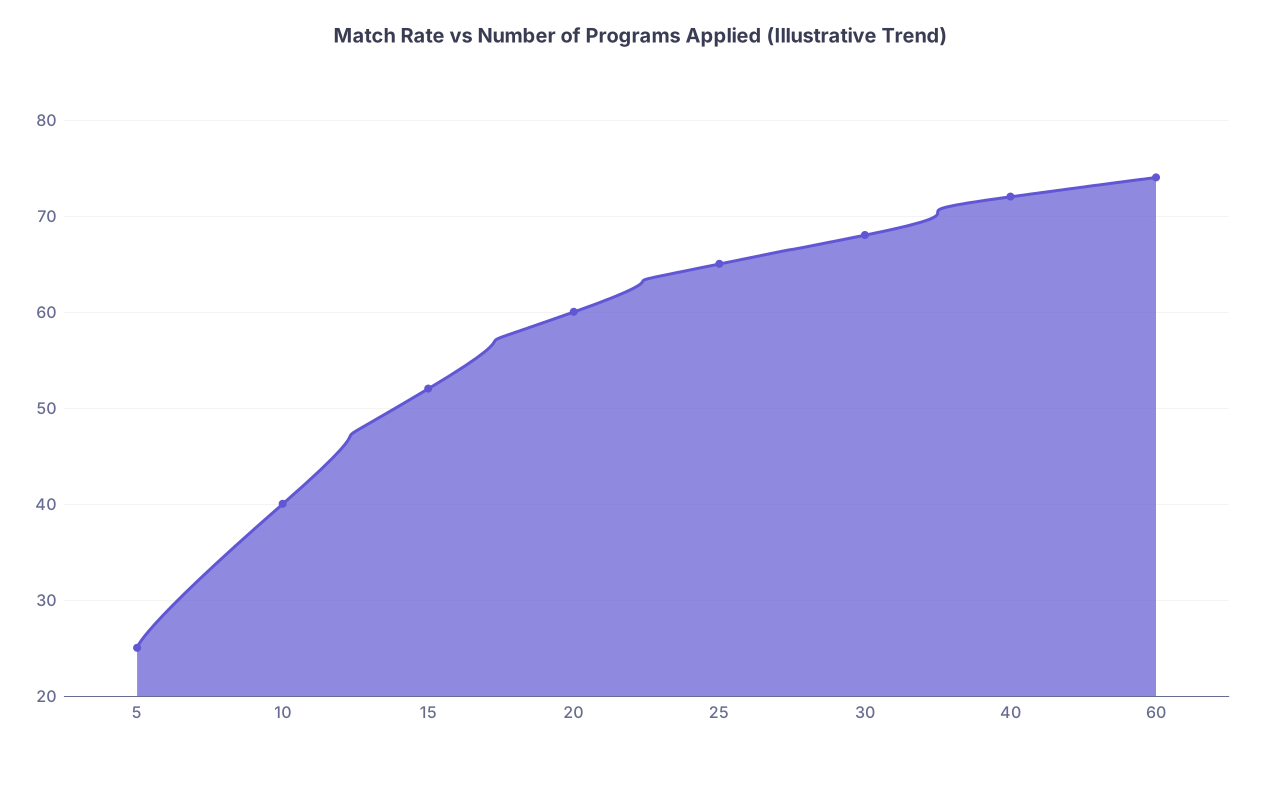
Selecting the right vascular surgery residency programs as an international medical graduate (IMG) is one of the most strategic—and stressful—parts of the Match process. Unlike large-core specialties, vascular surgery is small, competitive, and heavily relationship-driven. A thoughtful program selection strategy can make the difference between no interview invitations and a realistic path to matching.
This IMG residency guide will walk you through a step-by-step approach to choosing where to apply, how many programs to apply to, and how to prioritize integrated vascular programs versus alternative pathways.
Understanding the Vascular Surgery Landscape for IMGs
Before building a program list, you need a realistic understanding of the field and your position within it.
Integrated vs Independent Vascular Pathways
In the U.S., there are two main training pathways:
Integrated Vascular Surgery Residency (0+5)
- Length: 5 years directly after medical school.
- Structure: Combines core surgery and vascular training from PGY-1.
- Match: Separate NRMP match category; small number of positions nationally.
- Competition: Very high; historically favors strong U.S. MD candidates.
Independent Vascular Fellowship (5+2 or 4+2)
- Requires prior completion of general surgery residency.
- Length: 2 years after a 5-year (or 4-year + 1-year research) general surgery program.
- Path: Many IMGs match first into general surgery (categorical or sometimes prelim → categorical) and then apply for vascular fellowship.
For most IMGs—especially those without strong U.S. ties or extensive vascular research—an indirect route via general surgery is more realistic. However, some highly competitive IMGs with robust profiles do match directly into integrated vascular programs.
Competitiveness for IMGs
Key challenges specific to IMGs:
- Small number of positions per year in integrated vascular surgery.
- Many programs prefer or prioritize U.S. graduates, often from schools with which they have existing relationships.
- Visa sponsorship limitations: Not all programs sponsor J-1, and even fewer sponsor H-1B.
- Heavy emphasis on:
- US clinical experience (USCE), ideally in surgery or vascular.
- Strong letters of recommendation from U.S. vascular or surgical faculty.
- Demonstrated interest in vascular surgery (research, electives, presentations).
This does not mean IMGs cannot match directly into vascular surgery—but your program selection strategy must be laser-focused and data-driven.
Step 1: Honest Self-Assessment Before Building Your List
Program selection strategy starts with understanding who you are as an applicant. Your competitiveness will determine:
- Which tier of programs to target.
- How heavily to invest in integrated vascular vs general surgery programs.
- How many programs to apply to.
Core Metrics to Review
Consider the following components:
USMLE/COMLEX Scores
- Step 2 CK is now heavily weighted (especially post-Step 1 pass/fail).
- For vascular surgery, competitive Step 2 CK scores are often:
- 230–240+ for IMGs to be regionally competitive.
- 245–250+ to be competitive at more academic, research-heavy programs.
- Below ~225 does not disqualify you, but you must be strategic and realistic.
Medical School Background
- Region (Caribbean, South Asia, Eastern Europe, etc.).
- School reputation and historical record of sending graduates to U.S. training.
- Graduation year (many programs have cutoffs, often 3–5 years).
Clinical Experience
- U.S. clinical experience in surgery or subspecialties (sub-internships, electives, observerships).
- Direct exposure to vascular surgery is a significant plus (shadowing, electives, research).
Research
- Publications, abstracts, or presentations in:
- Vascular surgery.
- Endovascular interventions.
- Vascular imaging.
- Or at least general surgery topics.
- Academic integrated vascular programs weigh research heavily.
- Publications, abstracts, or presentations in:
Letters of Recommendation
- Strong U.S. letters from:
- Vascular surgeons.
- General surgeons with academic appointments.
- At least one letter should clearly state your interest and potential in vascular surgery (even if you’re also applying in general surgery).
- Strong U.S. letters from:
Visa Status
- U.S. citizen/green card holder vs needing J-1 or H-1B.
- Programs vary significantly in visa policies; this will narrow your list.
Categorize Yourself into a Competitiveness Tier
This isn’t official, but it helps structure your strategy:
Tier 1 (Highly competitive IMG for vascular)
- Step 2 CK > 250.
- Strong vascular or surgical research (publications/presentations).
- 2+ strong U.S. surgical letters (ideally including vascular).
- Recent graduation (≤3 years).
- U.S. clinical experience with excellent performance.
Tier 2 (Moderately competitive IMG)
- Step 2 CK 235–250.
- Some research (maybe not all vascular).
- Solid U.S. surgical letters.
- Some U.S. clinical exposure.
- Recent or relatively recent graduate.
Tier 3 (Underdog IMG / High risk)
- Step 2 CK < 235.
- Limited or no U.S. clinical experience.
- Older graduation year (>5 years).
- Limited research or weak letters.
Your tier doesn’t define your future, but it should shape how aggressive and diversified your program selection strategy is.
Step 2: Decide on Your Overall Pathway Strategy
Once you understand your profile, decide how to balance integrated vascular programs vs other options.
Pathway Options for IMGs Interested in Vascular Surgery
Direct Integrated Vascular Surgery Focus (0+5 Only)
- Most realistic for:
- Tier 1 IMGs.
- Those with very strong vascular exposure/research.
- Risk: If you only apply to integrated vascular and don’t match, you may have no backup.
- Recommendation: Usually not advisable as a sole strategy for IMGs.
- Most realistic for:
Dual Strategy: Integrated Vascular + General Surgery Categorical
- You apply to:
- A targeted set of integrated vascular programs.
- A broader list of general surgery categorical programs.
- Benefits:
- If you match integrated vascular → direct pathway.
- If you match general surgery → you can pursue vascular fellowship (5+2).
- Recommended for most serious IMG vascular applicants (Tier 1 and Tier 2).
- You apply to:
General Surgery Focus First, Vascular Fellowship Later
- You apply primarily or exclusively to general surgery categorical programs.
- Emphasize your interest in vascular surgery in your personal statement, electives, research, and networking.
- Build a vascular portfolio during general surgery residency to apply for an independent fellowship.
- Best for Tier 2–3 IMGs or those with weaker initial vascular exposure.
How Many Programs to Apply to in Each Category?
Specific numbers will vary by cycle and your competitiveness, but approximate guidance:
For Integrated Vascular Surgery (IMGs):
- Tier 1: 20–40 programs (essentially all that fit your visa and eligibility criteria).
- Tier 2: 10–25 very carefully chosen programs (those with a history of interviewing or matching IMGs).
- Tier 3: Usually not advisable to spend significant resources here unless you have strong networking or unique circumstances.
For General Surgery (as vascular pathway backup):
- Tier 1 IMG: 40–60 categorical general surgery programs.
- Tier 2 IMG: 60–80 (or more, up to 100+) categorical plus some preliminary surgery programs.
- Tier 3 IMG: 80–120+ including community, smaller academic, and prelim programs.
Your program selection strategy should explicitly combine:
- Integrated vascular (if appropriate), and
- General surgery (as either primary or backup).
That is the essence of an IMG residency guide tailored to vascular surgery.

Step 3: Researching Programs and Building a Targeted List
Now that you know your overall path, the next step is constructing your actual program list.
Sources for Program Information
Use multiple databases and resources:
FREIDA (AMA Residency & Fellowship Database)
- Filter by:
- Specialty (Vascular Surgery – Integrated; Surgery – General).
- Program type (academic vs community).
- Visa sponsorship (J-1/H-1B).
- Review details:
- Number of positions per year.
- Program size and structure.
- Filter by:
ERAS / AAMC Program Listings
- Review each program’s website.
- Look for:
- Eligibility criteria for IMGs.
- Score cutoffs.
- Graduation year limits.
- Visa sponsorship policy.
Program Websites
- Check:
- Faculty interests (endovascular, open vascular, research).
- Case volume, rotation sites.
- Current residents’ profiles: Are there IMGs? Are there non-U.S. schools represented?
- Check:
NRMP and Specialty Match Data
- Review previous match statistics.
- Identify patterns of competitiveness and fill rates.
Networking and Informal Information
- Talk to:
- Current residents or fellows (via email, LinkedIn, alumni connections).
- Your home/affiliated vascular or general surgery faculty.
- Ask specific questions relevant to IMG applicants.
- Talk to:
Key Filters for IMGs in Vascular Surgery
When considering how to choose residency programs, apply structured filters:
Visa Sponsorship
- Confirm J-1 vs H-1B policies.
- Some programs explicitly state, “We do not sponsor visas” or “We sponsor J-1 only.”
IMG-Friendliness
- Presence of current or recent IMGs in:
- Vascular surgery integrated residents.
- General surgery residents.
- Program website sometimes highlights diversity of backgrounds.
- Presence of current or recent IMGs in:
Score/Graduation Cutoffs
- Some programs list minimum USMLE scores.
- Others state a maximum years since graduation (e.g., “within 5 years”).
Academic vs Community Emphasis
- Academic programs:
- Often more research-heavy.
- More likely to run both general surgery and integrated vascular programs.
- Good for those with strong research backgrounds.
- Community-based programs:
- Often provide strong clinical volume.
- Sometimes more flexible with IMG applicants.
- May be an excellent general surgery route toward vascular fellowship.
- Academic programs:
Vascular Exposure During Training
- For general surgery programs:
- Look at whether there is an in-house vascular division.
- Ask: Does the program routinely send residents to vascular fellowships?
- For integrated vascular:
- Evaluate balance between open and endovascular training.
- Consider case mix and technology availability (hybrid ORs, advanced imaging).
- For general surgery programs:
Prioritizing and Categorizing Programs
After filtering, categorize your programs into three buckets:
Reach Programs
- Historically competitive or top-tier academic centers.
- Minimal or no IMG presence.
- High research expectations.
Target Programs
- Programs where your metrics are close to or above average.
- Some prior IMGs accepted.
- Reasonable match likelihood if you interview.
Safety Programs
- Community or smaller academic programs.
- More IMG-friendly track record.
- You clearly meet or exceed minimum requirements.
A balanced list often resembles:
- ~20–30% Reach
- ~40–60% Target
- ~20–30% Safety
For integrated vascular applications, the “safety” category may be thinner because of the overall competitiveness; you may offset this by increasing the number of safety/target general surgery programs.
Step 4: Strategic Decisions: How Many Programs to Apply To?
The question “how many programs to apply” does not have a one-size-fits-all answer, but for an IMG targeting vascular surgery, a conservative and strategic approach is essential.
Variables that Influence Number of Applications
Consider:
- Your competitiveness tier (1–3).
- Financial constraints (ERAS fees increase with program count).
- Time needed to complete tailored applications.
- Desire to include both integrated vascular and general surgery.
Practical Numerical Ranges
These are ballpark figures for IMGs interested in vascular surgery:
Tier 1 IMG (Strong profile)
- Integrated Vascular (0+5):
- 25–40 programs (nearly all that fit your eligibility/visa).
- General Surgery Categorical:
- 40–60 programs.
- Total: ~65–100 applications.
Tier 2 IMG (Moderate profile)
- Integrated Vascular:
- 10–25 programs (carefully targeted).
- General Surgery Categorical:
- 60–80 programs, plus 5–15 prelim if concerned about categorical chances.
- Total: ~70–100+ applications.
Tier 3 IMG (Underdog profile)
- Integrated Vascular:
- 0–10 programs, if you have specific connections or opportunities.
- General Surgery Categorical:
- 80–120 programs.
- Preliminary Surgery:
- 10–20 programs as added safety.
- Total: ~90–140 applications.
These numbers may feel high, but vascular surgery is a narrow field, and a strong program selection strategy means spreading your risk while maintaining quality and relevance.
Cost vs Benefit Consideration
- Each additional application has a marginal cost; weigh this against:
- Your likelihood of interview invitations.
- The importance of having a solid backup path to vascular via general surgery.
- Do not apply indiscriminately to every program—targeting always beats volume. An IMG residency guide that simply says “apply broadly” without structure is incomplete; you need both breadth and precision.

Step 5: Tailoring Your Application to Your Program List
Once you’ve identified where to apply, you must align your application materials with your strategy.
Personal Statements: Aligning Pathway and Programs
If you’re applying to both integrated vascular and general surgery, consider:
- Two versions of your personal statement:
- Vascular-focused statement for integrated programs:
- Emphasize your passion for vascular disease, complex decision-making, and longitudinal patient care.
- Highlight any vascular-specific research or experiences.
- Surgery-focused (with vascular interest) for general surgery:
- Emphasize becoming a strong general surgeon with an ultimate goal of vascular fellowship.
- Show that you value full surgical training, not just a stepping stone.
- Vascular-focused statement for integrated programs:
Be consistent: your stated goals should match your letters, experiences, and interview answers.
Letters of Recommendation Strategy
Aim for:
- At least one letter from a vascular surgeon, if possible.
- Other letters from:
- General surgeons.
- Surgical subspecialists familiar with your clinical performance.
When selecting which letters to assign:
- For integrated vascular programs:
- Prioritize letters that explicitly mention your potential as a vascular surgeon.
- For general surgery programs:
- Highlight your performance in broad surgical settings and team-based care.
Program-Specific Customization
For high-priority programs (especially reach and top targets):
- Mention specific features of the program in your application or interview:
- Named faculty whose research or practice aligns with your interests.
- Unique aspects of their vascular exposure, case mix, or training structure.
- This does not mean rewriting every application, but you should have:
- A shortlist of 10–20 “priority programs” where you invest extra effort in customization and networking.
Step 6: Common Pitfalls and How to Avoid Them
Many IMGs weaken their chances not by their credentials, but by mismanaging their program selection strategy.
Pitfall 1: Overfocusing on Prestige
- Applying mostly to top-tier academic integrated vascular programs with very limited IMG history can be seductive—but risky.
- Solution:
- Keep a few such programs as reach, but anchor your list in realistic options with documented IMG acceptance and visa support.
Pitfall 2: Ignoring Visa and Eligibility Rules
- Submitting applications to programs that:
- Don’t sponsor visas.
- Have strict graduation cutoffs you don’t meet.
- This wastes money and effort.
- Solution:
- Meticulously verify visa policies and eligibility before adding a program to your list.
Pitfall 3: Neglecting General Surgery as a Pathway
- Some candidates insist on integrated vascular only, underestimating the difficulty.
- Missing general surgery options can leave you unmatched with no pathway toward vascular training.
- Solution:
- Unless you are an exceptionally strong Tier 1 candidate with robust vascular support, include general surgery categorical programs in your strategy.
Pitfall 4: Shallow or Generic Interest in Vascular Surgery
- Saying “I find vascular interesting” without clear evidence (research, shadowing, electives, mentorship) may seem unconvincing, especially in a small specialty.
- Solution:
- Seek opportunities—even small ones—for:
- Case presentations.
- QI projects.
- Chart reviews.
- Observerships in vascular clinics or OR.
- Seek opportunities—even small ones—for:
Putting It All Together: Example Strategies by Applicant Type
To translate theory into practice, here are simplified examples.
Example A: Tier 1 IMG with Strong Vascular Background
- Step 2 CK: 255.
- 2 vascular surgery publications.
- 1 letter from a U.S. vascular surgeon; 2 from academic general surgeons.
- Graduation: 1 year ago.
- Needs J-1 visa.
Strategy:
- Apply to 30–35 integrated vascular programs that:
- Sponsor J-1.
- Have some history of at least interviewing IMGs.
- Apply to 45–55 general surgery categorical programs:
- Academic centers with strong vascular divisions.
- Larger community programs with vascular case volume.
- Prepare 2 personal statements and network actively with vascular faculty.
Example B: Tier 2 IMG with Balanced Profile
- Step 2 CK: 240.
- 1 general surgery paper, 1 vascular case report.
- 1 U.S. general surgery letter, 1 vascular letter from home country, 1 internal medicine letter.
- Graduation: 3 years ago.
- Needs J-1.
Strategy:
- Apply to 15–20 integrated vascular programs that:
- Are mid-tier academic.
- Have at least some openness to IMGs.
- Apply to 70–80 general surgery categorical programs:
- Mix of academic and community.
- Prefer those with in-house vascular surgery.
- Possibly add 10–15 preliminary surgery programs as insurance.
- Emphasize broad surgical training while clearly stating long-term vascular goals.
Example C: Tier 3 IMG with Limited Support
- Step 2 CK: 228.
- No U.S. rotations; a couple of home-country surgery electives.
- Older graduate (7 years out).
- Limited research.
Strategy:
- Focus almost entirely on general surgery categorical and preliminary programs:
- 90–120 categorical.
- 10–20 prelim.
- Apply to 0–5 integrated vascular programs only if:
- There is a personal connection or strong mentor support.
- Plan for a long-term path:
- Work hard in a general surgery residency.
- Seek vascular rotations, research, and mentorship.
- Apply for vascular fellowship after PGY-3/4.
FAQs: IMG Program Selection Strategy for Vascular Surgery
1. As an IMG, is it realistic to match directly into an integrated vascular surgery residency?
It is possible but challenging. The integrated vascular program is small and competitive, and many positions go to U.S. graduates. An IMG with high scores, strong vascular research, solid U.S. clinical experience, and powerful letters from U.S. surgeons can be competitive. However, most IMGs should keep general surgery as part of their strategy, as it offers a more reliable pathway to a vascular fellowship.
2. How should I decide how many integrated vascular vs general surgery programs to apply to?
Base the split on:
- Your competitiveness tier.
- The strength of your vascular-specific experiences.
- Your risk tolerance.
In general, an IMG with a solid but not exceptional profile might:
- Apply to 10–25 integrated vascular programs, and
- 60–80 general surgery categorical programs (plus some prelims).
The goal is to maintain a realistic chance of matching somewhere while still pursuing your vascular interest.
3. Do programs care if I clearly state I want to do vascular when applying to general surgery?
Most general surgery programs accept that residents will pursue fellowships, including vascular. Expressing a clear, thoughtful long-term interest in vascular surgery is usually seen as positive—especially at programs with an in-house vascular division. Just ensure your statement doesn’t sound like you view general surgery as “unnecessary” or purely a stepping stone. Emphasize your commitment to becoming a strong, well-rounded surgeon first.
4. Should I avoid programs that have never taken IMGs?
Not necessarily, but you should prioritize programs with at least some history of training IMGs, especially if you have visa needs. Applying to a few programs without prior IMGs can be reasonable if they strongly match your interests or if you have a connection there. However, your core list should be built around programs where IMGs are not an exception, but a normal part of the resident cohort.
By combining a realistic self-assessment, a clear decision on pathway (integrated vs general surgery vs both), and a structured approach to how to choose residency programs, you can create a powerful, data-driven program selection strategy. For an international medical graduate targeting vascular surgery, the right mix of ambition and pragmatism is the key to ultimately building a successful vascular career in the U.S.