Understanding the Landscape of ENT Residency
Otolaryngology (ENT) remains one of the most competitive specialties in the residency match. A sound program selection strategy is not just helpful—it’s essential. Before deciding how many programs to apply to or which ones should make your list, you need a clear view of the current landscape.
Competitiveness and Match Dynamics
ENT residency is characterized by:
- High applicant quality: Strong board scores (or robust alternative metrics where scores are pass/fail), extensive research, and solid letters are common.
- Relatively few positions: Compared with larger specialties like internal medicine or family medicine, the total number of ENT residency spots is smaller, increasing competition.
- Highly variable programs: Programs differ significantly in case volume, subspecialty exposure, research expectations, and culture.
Some consistent patterns:
- Highly competitive academic centers attract large numbers of applicants and often prioritize research, advanced metrics, and institutional connections.
- Mid-sized university and strong community-based programs can offer excellent training with slightly broader entry thresholds.
- Geographic clustering: Certain regions (e.g., Northeast, West Coast) may be particularly saturated with applicants, influenced by medical school locations and lifestyle factors.
What This Means for Your Strategy
A good program selection strategy in ENT residency must:
- Acknowledge the competitiveness of the otolaryngology match.
- Be honest about your current profile (metrics, experiences, letters).
- Balance ambition (reach programs) with pragmatism (safety programs).
- Address personal non-negotiables: geography, family, dual-career partners, and financial constraints.
You’re not just trying to match anywhere—you’re trying to match at a program where you can thrive for five years and launch your career.
Step 1: Honest Self-Assessment – Know Your Applicant Profile
Before you can decide how many programs to apply to or which programs fit, you need to understand your own strengths and vulnerabilities.
Core Components to Evaluate
Consider these major domains:
Academic Metrics
- Pre-clinical performance and class ranking (if reported)
- Clinical grades, especially in surgery, ENT, and key rotations
- Standardized exams (USMLE/COMLEX Step 1, Step 2 CK, or equivalents)
- Any academic difficulties or leaves of absence
Otolaryngology Exposure and Performance
- ENT sub-internships (home and away)
- ENT clerkship evaluations and narrative comments
- Observerships or longitudinal ENT experiences
Research and Scholarly Activity
- ENT-focused research (strongest for this specialty)
- Publications, presentations, posters, QI projects
- Advanced degrees (MPH, MS, PhD) if applicable
- Depth of involvement (initiated projects vs. joined late)
Letters of Recommendation (LoRs)
- At least 2–3 ENT letters are often expected
- Strength of letters (from mentors who know you well)
- Nationally recognized letter writers or department chairs can add weight
Personal and Professional Attributes
- Leadership roles and sustained engagement
- Volunteerism and service, especially in underserved care
- Teamwork, communication skills, maturity, and resilience
- Unique skills or experiences (language abilities, prior careers)
Contextual Factors
- Home ENT program vs. no ENT program at your school
- Couples match, visa status, or significant geographic constraints
- Non-traditional path, prior careers, or career interruptions
Categorizing Your Competitiveness
While no simple formula captures your entire profile, it’s helpful to estimate your competitiveness relative to typical ENT applicants:
- Highly Competitive
- Near-top percentile clinical performance
- Strong Step 2 CK scores or equivalent markers
- Multiple ENT publications or substantial research
- Stellar ENT LoRs, strong home program support
- Successful away rotations with strong evaluations
- Solid/Typical Competitive
- Above-average academic performance
- Some ENT research or at least meaningful scholarly work
- Good ENT letters from faculty who know you well
- No significant academic issues
- At-Risk/Underdog
- Lower academic metrics, test score challenges, or repeated exams
- Limited ENT exposure or research
- Fewer ENT letters or letters from less-known faculty
- No home ENT program, limited networking opportunities
- Visa requirement or other significant constraints
This self-assessment directly informs your program selection strategy and the breadth of your application list.
Step 2: How Many ENT Programs Should You Apply To?
The question of how many programs to apply to is central in the otolaryngology match. There is no single “correct” number, but there are evidence-informed ranges that can guide you.
General Ranges for ENT Applicants
Numbers vary year to year, but typical ranges for a single-applicant (not couples match) might look like:
Highly Competitive Applicants
- Often apply to ~35–50 programs
- Strategy: More selective targeting, fewer true “safety” programs
Solid/Typical Applicants
- Often apply to ~45–65 programs
- Strategy: Balanced list of reach/target/safety programs
At-Risk/Underdog Applicants
- Often apply to ~65–80+ programs
- Strategy: Broadest range, heavy inclusion of “safety” and mid-tier programs, and sometimes selective addition of preliminary/transitional backup plans (if advised by mentors)
These are not strict rules, but they reflect the intersection of competitiveness and financial/time realities. The number you choose should also reflect your geographic tolerance and personal limitations.
Factors That May Justify Applying to More Programs
Increase your application count if:
- You have no ENT home program and limited exposure.
- You have significant geographic restrictions (e.g., needing to stay in one region).
- You are in the couples match, especially if your partner is in a competitive specialty.
- You require visa sponsorship (particularly J-1 or H-1B).
- You have significant application “red flags” (low scores, interruptions, professionalism concerns) but have strong remediation and mentorship.
Factors That May Allow Fewer Applications
You might safely apply to fewer programs if:
- You are a top-tier candidate with strong national-level ENT research, major leadership, and widely known mentors.
- Your geographic preferences are broad—you are truly open to most parts of the country.
- Your mentors, including your ENT program leadership, advise that your profile is very strong for this cycle.
Strategic Considerations Beyond Pure Numbers
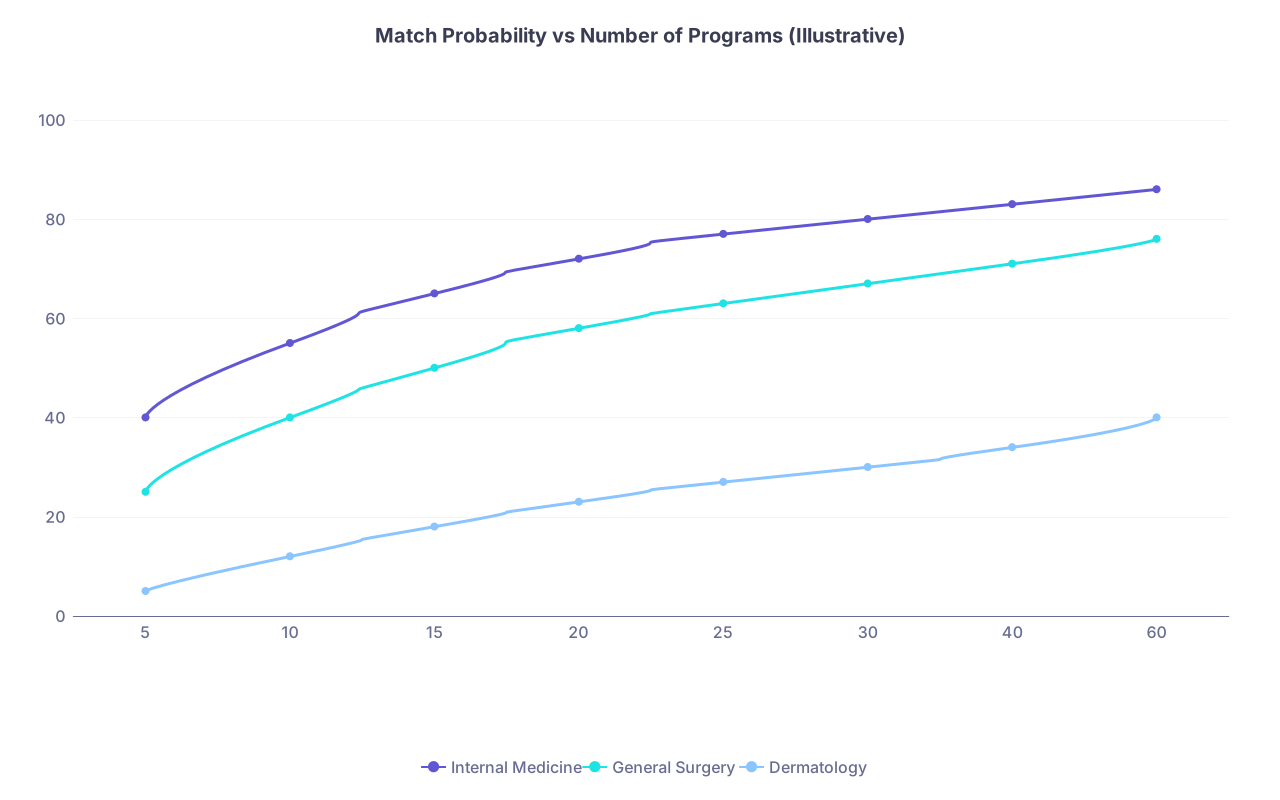
- Diminishing returns: After a certain point, adding more programs yields fewer incremental interviews, especially if those added programs are ultra-competitive and out of realistic range.
- Time and customization: You’ll need to tailor personal statements, preference statements (if applicable), and communications; an unmanageable list can dilute quality.
- Financial cost: ERAS fees add up quickly. Have a clear budget and prioritize programs where you are both competitive and genuinely interested.
In short, the quantity is important, but the quality of your program list and targeting matters even more.

Step 3: Building a Balanced ENT Program List
Once you have a sense of your competitiveness and a target range for how many programs to apply to, the next step is to build a balanced, rational program list.
Classifying Programs: Reach, Target, and Safety
It helps to divide programs based on your estimated odds:
Reach Programs
- Historically match applicants with very strong metrics, extensive research, or high-level connections.
- Highly renowned academic centers, top NIH-funded departments, or programs with intense competition.
- Your profile might be slightly below their usual averages or less connected.
Target Programs
- Programs where your profile matches or slightly exceeds typical residents’ profiles.
- Solid academic or hybrid programs with good case volume and research, but not at the extreme top in competition.
- You fulfill most stated criteria and have one or more strengths aligning with their mission.
Safety Programs
- Programs that historically match a broader range of applicants.
- Often include smaller university-affiliated or strong community-based academic programs.
- Your profile clearly meets or exceeds their usual ranges, and your application has minimal red flags.
A possible distribution (adjusted based on your competitiveness):
- Highly Competitive:
- ~40–60% target
- ~30–40% reach
- ~10–20% safety
- Solid/Typical:
- ~40–50% target
- ~20–30% reach
- ~20–40% safety
- At-Risk/Underdog:
- ~40–50% safety
- ~30–40% target
- ~10–20% reach
Criteria to Evaluate ENT Programs
When deciding which ENT residency programs to include, consider:
1. Clinical Training and Case Volume
- Breadth across subspecialties: head & neck oncology, otology/neurotology, rhinology, laryngology, pediatrics, facial plastics, sleep, skull base.
- Operative exposure early vs. late in training.
- Distribution of community vs. tertiary referral cases.
2. Faculty and Subspecialty Depth
- How many subspecialists in each area?
- Presence of fellowship-trained faculty in your potential area of interest.
- Faculty reputation and involvement in national societies.
3. Research and Academic Environment
- Protected research time for residents.
- Availability of basic science, translational, and clinical ENT research.
- Support for conferences, presentations, and funding.
- Optional or required research year.
4. Program Culture and Wellness
- Resident morale and burnout indicators.
- Approachability and mentorship style of faculty and program leadership.
- Support during crises, leaves of absence, and life events.
5. Location and Lifestyle
- Relationship to family, partner, or support systems.
- Cost of living, commute, and call-related logistics.
- Availability of spouse or partner employment opportunities.
6. Program Structure and Size
- Number of residents per year and total cohort size.
- Call schedule and cross-coverage expectations.
- Off-service rotations (ICU, general surgery, anesthesia) and how they’re integrated.
7. Outcomes and Alumni
- Fellowship match lists and breadth of fellowships (if you’re fellowship-oriented).
- Graduates entering private practice, academia, or sub-specialty training.
- Placement in your desired geographic region after graduation.
Concrete Example: Creating a Structured List
Imagine you’re a “solid” ENT applicant planning to apply to 55 programs. You might structure your list as:
- 14 reach programs
(Highly prestigious academic centers or ultra-competitive locations) - 26 target programs
(Academic or hybrid programs where your profile is well-aligned) - 15 safety programs
(Smaller university-affiliated or strong community academic programs with broad applicant ranges)
Within each tier, you can further note:
- Geographic region
- Strength of ENT subspecialties of interest
- Presence of mentors/alumni connections
This structure allows flexibility while ensuring that your list isn’t skewed only toward aspirational programs.
Step 4: Researching and Selecting ENT Programs Effectively
Knowing how to choose residency programs is a skill. Effective program selection strategy goes beyond name recognition.
Stepwise Approach to Research
Start with Comprehensive Lists
- Use the ERAS Program Directory, FREIDA, and specialty society resources (e.g., AAO-HNS) to identify all accredited ENT programs.
- Generate a “master list” before any filtering.
Apply Primary Filters
- Geography: Must-have, strongly preferred, and unacceptable locations.
- Program type: Academic center vs. hybrid vs. community academic.
- Visa policies, if applicable.
- Minimum requirements: Some programs disclose thresholds for exams or experiences.
Deep-Dive on Shortlisted Programs For each program that passes the initial screen:
- Review the program’s website carefully.
- Look at the resident roster (Are there residents from diverse schools, including from your type of institution?)
- Examine rotation schedules, call schedules, research expectations, and conference schedules.
- Search for recent resident/fellow publications and presentations.
Gather “Soft Data”
- Talk to current or recent ENT residents, especially at your home institution or schools you rotated at.
- Reach out (appropriately and professionally) to alumni from your medical school who matched in ENT.
- Attend virtual open houses, webinars, and Q&A events.
Document What You Learn
- Create a spreadsheet including:
- Program name and location
- Program type and size
- Highlighted strengths and weaknesses
- Your perceived fit and interest level
- Notes from residents or mentors
- This will later help with interview preparation and ranking, not just initial selection.
- Create a spreadsheet including:
Red Flags and Yellow Flags in Program Selection
When deciding how to choose residency programs, watch for:
Red Flags
- Consistently reported poor resident morale, high attrition, or bullying.
- Lack of transparency about surgical case volumes or schedules.
- Repeated rumors of unaddressed safety or professionalism issues.
- Frequent leadership turnover without clear communication.
Yellow Flags
- Minimal information on the website or outdated pages.
- Very heavy service load with limited educational structure.
- Lack of formal mentorship or wellness initiatives.
- Very narrow case mix (e.g., almost exclusively one subspecialty) without balanced training.
Not every concern is a deal-breaker, but patterns matter. Integrate these observations into your ranking of which programs are truly worth an application.

Step 5: Tailoring Strategy to Your Unique Circumstances
No program selection strategy is one-size-fits-all. Your background, goals, and constraints should shape your approach to the otolaryngology match.
If You Don’t Have a Home ENT Program
Challenges:
- Fewer automatic advocates and ENT letters.
- Less built-in exposure to the specialty.
Strategies:
- Plan multiple away rotations in ENT to gain letters and clinical exposure.
- Apply more broadly across program tiers; consider leaning slightly more heavily into “safety” and mid-tier academic programs.
- When deciding how many programs to apply to, err on the higher side within your competitiveness range.
- Emphasize your initiative in seeking ENT opportunities and mentorship externally.
If You’re in the Couples Match
Challenges:
- Two match outcomes must align geographically.
- Your partner’s specialty may be more or less competitive than ENT.
Strategies:
- Apply to more programs than you would as an individual applicant.
- Target cities and regions with multiple residency programs across both specialties.
- Use NRMP tools where available to optimize couples matching strategies.
- Be transparent with mentors so they can help you prioritize geographically flexible programs.
If You Need Visa Sponsorship
Challenges:
- Not all ENT programs sponsor J-1 or H-1B visas.
- Competition for visa-sponsoring positions can be intense.
Strategies:
- Early in the process, identify which programs historically sponsor visas.
- Filter your list accordingly before spending application fees.
- Aim for a relatively large number of programs, as your pool is constrained.
- Seek mentorship from prior international grads who successfully matched in ENT.
If You Have Academic or Personal “Red Flags”
Examples: exam failures, leaves of absence, professionalism concerns.
Strategies:
- Work closely with your Dean’s office and ENT mentors to address these issues transparently.
- Highlight remediation, insight, and growth; be prepared to discuss them maturely.
- Emphasize consistent upward trends and recent excellence.
- Expand your program list, with significant attention to safety and mid-tier programs.
- Some advisors may recommend a parallel plan (e.g., prelim surgery, research year) if risk is high—individual guidance is crucial.
Aligning Programs with Long-Term Career Goals
Think beyond the match and consider:
If you are fellowship-oriented (e.g., neurotology, head & neck, facial plastics):
- Favor programs with strong subspecialty exposure and robust research output.
- Look at their fellowship match history and mentorship in your area of interest.
If you are likely to enter general ENT practice:
- Prioritize programs with high operative volume, breadth of pathology, and strong general ENT mentorship.
- Community-based programs can sometimes provide outstanding hands-on experience for future private practice.
Your program selection strategy should reflect not only where you can match, but where you can become the ENT surgeon you envision.
Step 6: Putting It All Together – A Practical Workflow
To make this concrete, here is a streamlined workflow you can adapt:
Self-Assessment (Month 1)
- Honestly categorize yourself as highly competitive, solid, or at-risk.
- Discuss with at least one ENT mentor and one advisor from your Dean’s office.
Set a Target Application Range
- Based on competitiveness and constraints, decide a target range (e.g., 45–60 programs).
- Adjust for couples match, no home program, or visa issues.
Build a Master Program List
- Include all ENT programs initially (from ERAS/FREIDA and AAO-HNS).
- Filter out programs that categorically don’t fit (e.g., no visa sponsorship if needed, unacceptable geography).
Categorize Programs by Tier
- For each remaining program, label as reach, target, or safety.
- Aim for a balanced distribution that matches your planned total number of applications.
Conduct Deeper Research
- Visit each program’s website to refine your classification.
- Speak with mentors, residents, and alumni to gather qualitative data.
- Remove programs that clearly don’t align with your training needs or values.
Finalize the List
- Ensure the final list sits within your target application range.
- Confirm that you have enough programs in each tier, paying particular attention to target and safety programs.
- Discuss the final list with mentors for a last check.
Prepare Application Materials Strategically
- Tailor your personal statement or preference comments toward ENT themes relevant across programs.
- Be ready to articulate why you’re applying to each program (for interviews and potential correspondence).
By following this structured process, your approach to how to choose residency programs in ENT becomes deliberate rather than reactive—and your chances of a satisfying match improve.
FAQs: ENT Residency Program Selection Strategy
1. How many ENT residency programs should I apply to if I’m an average applicant?
Most “solid” or typical applicants in the otolaryngology match apply to roughly 45–65 programs. Your exact number should depend on your exam performance, research, ENT exposure, geographic flexibility, and any additional constraints (e.g., couples match, visa). Discuss a tailored range with your ENT mentors.
2. Is it better to apply broadly to big-name academic centers or include more mid-tier and community programs?
A healthy program selection strategy includes all three tiers: reach, target, and safety programs. Focusing only on big-name centers can be risky, even for strong applicants. Mid-tier academic and community-based academic programs often provide superb operative training and excellent career outcomes. Aim for a balanced list aligned with your realistic competitiveness.
3. How should I factor geography into my ENT residency program list?
Geography is important, but over-restricting can limit your match chances. If you have strong geographic constraints, increase the number of programs you apply to within that region and include a mix of tiers. If you are flexible geographically, you can somewhat reduce your total number of applications while maintaining strong odds of matching.
4. Do I need ENT-specific research to match into otolaryngology?
ENT-specific research is helpful but not always mandatory. Strong general research (clinical, translational, or QI) demonstrates scholarly ability. However, for highly competitive academic programs, ENT-focused research can be a significant advantage. If you lack ENT research, consider applying slightly more broadly and targeting programs where research expectations are less intense, while clearly emphasizing your interest and potential to contribute academically.
A deliberate, honest, and well-researched program selection strategy in otolaryngology (ENT) can transform a stressful application season into a focused, purposeful process. By understanding your own profile, knowing how many programs to apply to, and learning how to choose residency programs that genuinely fit your needs and goals, you’ll be far better positioned to secure an ENT residency where you can thrive.