
You’re on your couch at 11:47 p.m., laptop overheating your legs, scrolling ERAS for the tenth time today. Your “primary” specialty list is sitting at 32 programs. Your “backup” specialty list is at 19… or 54… or 7, depending on which spreadsheet you opened last. Group chat is chaos:
“Bro I applied to 120 IM prelim and 70 anesthesia.”
“Wait my advisor said 25 total is enough for FM + Peds?”
“Program director said quality over quantity, so I did 18 EM and 10 IM. That’s fine right?”
You feel it already: you’re about to guess. And guessing list size when you’re dual applying is how people quietly destroy their Match chances.
Let me be blunt: dual applying isn’t the problem. Dual applying wrong is. Especially when you misjudge how many programs to apply to in each specialty.
This isn’t about being “anxious” or “overcautious.” I’ve watched strong students go unmatched because they under-applied in the backup specialty. I’ve also watched people set $4,000 on fire applying to 140 programs in a second specialty they were never competitive for.
You’re here to avoid being either of those people.
The Core Error: Treating Dual Apply Like Two Separate Single Applies
The biggest mistake: acting like you’re doing two independent, normal applications. You’re not.
Your risk profile changes the second you add a second specialty. The math changes. The psychology of PDs changes. Your time and interview capacity definitely change.
Here’s the core truth people ignore:
The safer you want the Match to be, the more your backup list size must reflect reality, not hope.
If you remember nothing else, remember this:
- Your primary specialty list size should be shaped by competitiveness + your stats + your school type.
- Your backup specialty list size should be shaped by how likely your primary is to fail.
People flip that. They use emotions for the primary (“I love EM, I’ll shoot my shot”) and vibes for the backup (“I’ll toss in like 10 FM as insurance”). That’s how you end up SOAPing.
Let’s walk through where people blow this by specialty combination.
High‑Risk Combo #1: EM + IM – The “I’ll Just Add Some IM” Fallacy
I’ve lost count of how many EM applicants tell me in October, “I threw in some IM just in case,” like they added a pack of gum at checkout.
Typical pattern that fails:
- 35–45 EM programs (often okay, sometimes low if they’re mostly reach programs)
- 8–15 IM programs (scattered, random states, academic heavy)
- A personal statement that screams “I only care about EM”
- Maybe 1–2 IM letters. Maybe.
What goes wrong:
- EM is volatile and geographically weird. Half the country seems fine; the other half is shrinking. Interview distribution is lumpy.
- Many of those IM programs will never see you as serious. Your app is clearly EM-first.
- 10–15 programs is backup-in-name-only. That’s “I want to feel safer without actually being safer.”
Here’s the uncomfortable rule for EM + IM:
If EM is your primary and your score / school / geography are not top tier, your IM backup list needs to look like a real primary list, not a token gesture.
That usually means:
- US MD with solid but not stellar Step 2 (let’s say 225–240):
Think 40–60 IM applications minimum if you truly might need IM to save your Match. Yes, really. - US DO or IMG:
Often 60–80+ IM applications if your EM odds are shaky.
Why so many? Because IM PDs are pattern-recognition machines. They see:
- EM personal statement
- 2 EM letters, 1 IM letter, 1 generic
- 10 IM programs applied to (scattered across 7 states) And they correctly conclude: you will rank EM over them. They don’t want to be your floor.
You fix this by:
- Making your IM list bigger than feels comfortable if it’s truly your safety net.
- Biasing the IM list toward community and lower-tier academic programs more likely to take dual applicants.
- Making sure you have at least 2 strong IM letters and a tailored IM personal statement.
The mistake: 40 EM / 12 IM and calling that safe. It’s not.
High‑Risk Combo #2: Anesthesia + IM or Transitional/Prelim – The “Misbalanced Backup” Problem
Anesthesiology has gotten spikier. Some cycles look “fine,” but that just means the landmines moved around. The mistake I’ve seen repeatedly:
Someone with:
- Step 2 in the low–mid 220s
- Average school (or DO/IMG)
- Limited home anesthesia exposure
decides:
- 35–45 anesthesiology programs
- 10–15 IM + a handful of prelims or TY
- 1 generic “I love physiology and the OR” personal statement used for all
This is a fantasy strategy. It relies on a best-case scenario version of the market.
Here’s the rule you’re breaking when you do that:
If your primary specialty is competitive or semi-competitive and your metrics are middle/below-average, your backup list must be large enough to stand alone.
For anesthesia + IM/prelim:
- If anesthesia is your dream but you know your application is borderline:
- 40–60 anesthesia programs plus
- 40–70 IM (or a mix of IM + prelim + TY) depending on your risk and background.
And do not ignore this: a prelim year is not a real backup unless you’re ready to reapply. Some people treat prelims like “safely matched to something.” You’re not. You’re matched to a one-year holding pattern.
So if your worst realistic outcome (that you actually accept) is, “I’m okay doing IM,” then your IM list has to be robust. Not 12 programs in states you’d find “kinda nice.”
Mistake to avoid: assuming 10–20 prelim/TY/IM applications will catch you if anesthesia doesn’t work out. It often will not.
High‑Risk Combo #3: IM + FM – The “They’re Both Safe, Right?” Trap
This one gets people because IM and FM sound safe. “Less competitive.” “Primary care.” Whatever phrase your advisor uses.
The error is subtle but deadly: they under-apply to both.
Typical bad pattern:
- 20–25 IM programs, mostly university-heavy, same few states everyone loves
- 8–12 FM programs as “backup”
- Applicant is DO or IMG with mid Step 2 or US MD with multiple red flags (remediation, leaves, low shelf scores)
They think:
- “I’m applying to 30+ programs total, that seems like a lot.”
- “IM and FM are less competitive; those numbers should be fine.”
The reality:
- For DO/IMG, IM and FM can be very competitive in the regions you’re fixated on.
- If your red flags are significant, 20–25 IM may be nowhere near enough.
- Many “nice” FM programs are now flooded with unmatched IM/EM/OB/GYN refugees.
The math you should actually use:
- If you could realistically go unmatched based on:
- Non-US school
- Low Step 2 (220 or below)
- Failed attempt
- Significant professionalism or academic issues
Then each specialty list needs to be treated like a full backup for the other.
That often means:
- 60–80 IM and
- 40–60 FM
for very high-risk applicants (especially IMGs).
No one likes this answer because it’s expensive and time-consuming. But pretending 20 IM / 10 FM is safe for a high-risk applicant is how you create a March disaster.
High‑Risk Combo #4: “Dream” Surgical Field + IM or FM – The Denial Strategy
This combo is emotionally loaded: Ortho + IM. ENT + FM. Derm + IM. You love the dream field. You resent the backup. Your list sizes show it.
I see this all the time:
- 70+ in the dream specialty (ortho, ENT, etc.)
- 5–12 IM or FM “just in case”
- Backup personal statement clearly written out of obligation
Let me say something you may not want to hear:
If your backup specialty list is tiny because you “don’t really want to do it,” that isn’t a backup plan. That’s emotional procrastination.
The honest choices:
- Either commit to actually backing yourself up:
- Dream specialty: 40–60 (depending on your reality, not your ego)
- Backup: 40–80 (again, depending on your risk)
- Or admit you are going all-in on the dream and stop pretending you have a real safety net.
What’s catastrophic is the middle ground: telling yourself “I have a backup” with 8 FM programs in competitive suburban locations. That’s not backup; that’s narrative.
If you absolutely refuse to build a large FM/IM list, then own your risk: you are essentially single-applying to a competitive field. Make peace with reapplying, possibly doing a research year, and maybe SOAPing into something random.
The mistake to avoid is lying to yourself with a half-hearted backup list that cannot realistically save you.
The Hidden Constraint: Interview Capacity and the “Too Big” List Error
So far I’ve hammered on “too small.” There is a different mistake: bloating the backup list so much that you:
- Spend a ridiculous amount of money
- Get flooded with more interviews than you can attend
- End up canceling late or flaking, which programs remember
- Dilute your signal so no specialty thinks you’re serious
Consider this pattern:
- 80 IM programs
- 70 FM programs
- 50 Psychiatry programs
Because someone panicked and triple-applied.
They get:
- 20 IM invites
- 15 FM invites
- 10 psych invites
On paper that looks great. In reality:
- They can only reasonably attend ~12–15 interviews total without imploding.
- They cancel a ton late.
- PDs see a scattered application and a weak signal.
Your goal is not “maximum invitations.” It’s “enough invitations in at least one specialty to match safely.”
The rough math most advisors use:
- For most core specialties, ~10–12 solid interviews gives you a high likelihood of matching if you’re not red-flagged and you rank reasonably.
- More is better, but past ~15 in one specialty, the marginal safety gain drops off.
So you want to avoid:
- Building three 60-program lists when you only have the bandwidth to seriously interview in one or two fields.
- Applying to so many in your backup that your primary specialty sees an obviously divided focus and deprioritizes you.
The safe approach:
- One true primary.
- One true backup.
- List sizes large enough to be standalone if needed, but not so huge you drown in logistics.
Common Numerical Traps by Specialty (Read This Twice)
I’ll spell out some recurrent bad patterns and what safer numbers usually look like for dual applying. These are ballparks, not gospel, and assume an average-ish US MD without massive red flags. If you’re DO/IMG or have failures, the safer ranges skew higher.
| Combo (Primary + Backup) | Risky Pattern (Too Small) | Safer Range (Typical) |
|---|---|---|
| EM + IM | 35 EM / 10 IM | 35–45 EM / 40–60 IM |
| Anesthesia + IM/TY | 40 AN / 12 IM+TY | 40–60 AN / 40–70 IM+TY |
| IM + FM (higher risk) | 25 IM / 8 FM | 40–60 IM / 30–50 FM |
| Ortho/ENT/Derm + IM/FM | 70+ dream / 8 backup | 40–60 dream / 40–80 backup |
| Psych + FM | 25 Psych / 5 FM | 30–40 Psych / 25–40 FM |
Again: these are illustrative, not customized to you. But if your numbers look more like the left column than the right, there’s a good chance you’re under-applying in the backup.
The Red‑Flag Factor: When Both Lists Need to Be Big
Another mistake: keeping “average” list sizes even when you have below-average odds.
If any of these apply:
- Step 2 < 220
- Failed Step exam attempt
- Multiple course remediations or leaves of absence
- Non-US school with weak home support
- No home program in either specialty and limited letters
Then you do not get to use standard list sizes. You are playing a different game.
Common error:
- “My advisor said 25 is okay for IM, so I did 25 IM and 15 FM.” Except that advice was for a mid-230s US MD with a clean record, not for your situation.
For high-risk dual applicants, I routinely see safer outcomes with:
- 60–80 applications in the more realistic specialty (often IM or FM), and
- 30–50 in the slightly more competitive or “preferred” specialty.
Does it cost more? Yes. Is it fair? No. But pretending you’re in the same bucket as the clean-applicant group because the true numbers “feel too big” is how people end up unmatched and stunned.
The Psychological Trap: Building Lists for Ego, Not Safety
List size errors often aren’t about data; they’re about ego.
Common ego-driven moves:
- Applying to too few programs in the backup because it feels like “admitting failure” to build a real backup.
- Over-concentrating on name-brand or coastal programs, so a “big” list is actually a fake list of long shots.
- Under-applying as a DO/IMG because you’re tired of being told to “over-apply” and you want to prove you’re competitive.
Here’s the protective mindset you actually need:
Your application list is not a reflection of your worth. It’s a risk-management tool.
A big FM list does not mean you’re “less than.” It means you’re serious about not being 29, unmatched, and scrambling for a research position you don’t want.
How to Sanity‑Check Your Dual Apply List Today
Let’s make this concrete. You can do this in 20 minutes.

Open your spreadsheet (or ERAS if you must) and write down:
- Total programs in primary
- Total programs in backup
Ask yourself bluntly:
- If my primary specialty ghosted me completely, would this backup list alone feel adequate to reasonably match in that field?
- Would I feel comfortable if I had to rank only these backup programs?
If the honest answer is “no”:
- Your backup list is too small. Or too top-heavy. Or too geographically narrow.
Then check:
- Do I have at least one specialty where my list size matches the level I’d use if I were only applying to that specialty?
If the answer to both is no, you’re doing dual applying wrong.
A Quick Visual: When “Too Few” Starts to Hurt
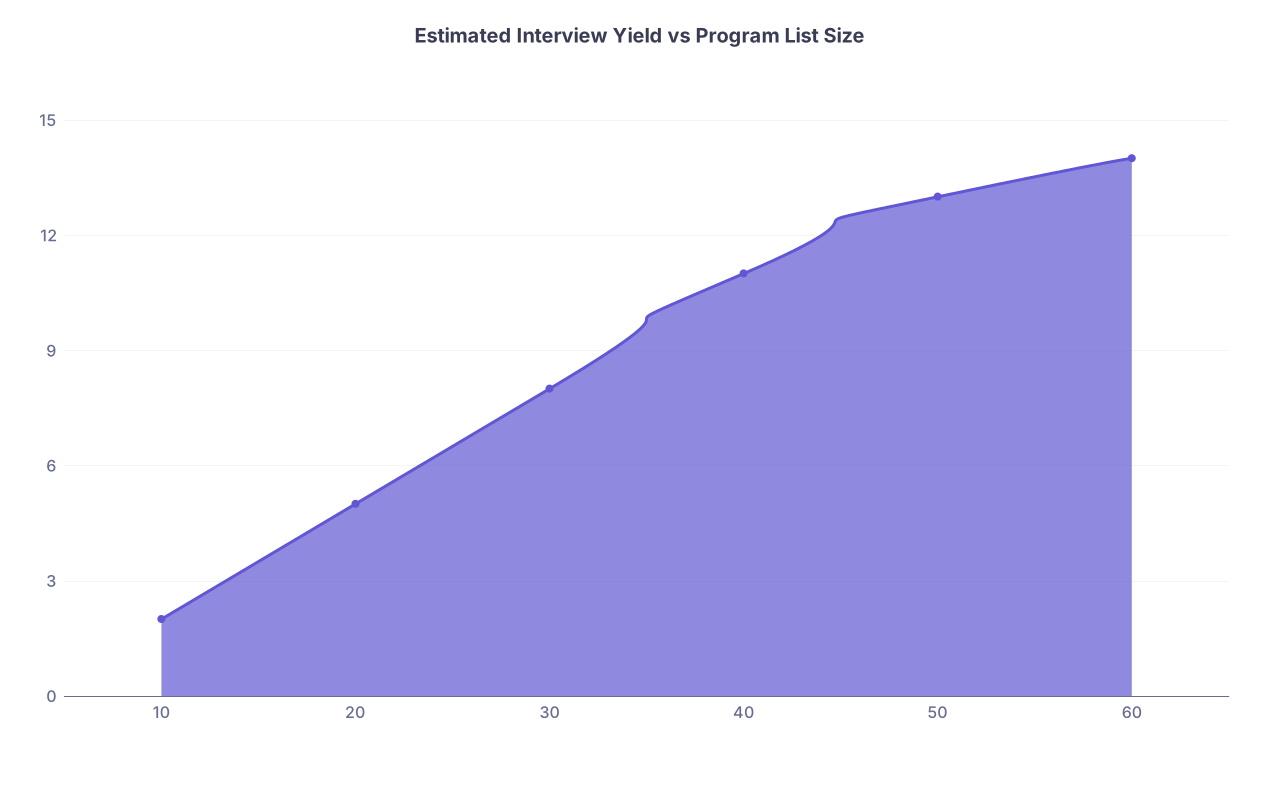
To drive home why size matters more than people think, look at a simplified depiction of how interview odds change with list size for a moderately competitive applicant in a relatively open specialty (think IM/FM/Psych for a mid-range US MD):
| Category | Value |
|---|---|
| 10 | 2 |
| 20 | 5 |
| 30 | 8 |
| 40 | 11 |
| 50 | 13 |
| 60 | 14 |
That’s the pattern: small lists severely cap your interview count. Yes, it’s made-up illustrative data—but it mirrors what advisors see: there’s a steep ramp-up from 10 to 40 programs, then it starts to plateau.
If your backup list is hovering in the “10–20 programs” zone, you’re playing the game on hard mode for no reason.
Quiet But Costly: Geographic Over-Restriction
A different version of list size error: you think your list is big enough, but half your effective options are fake because of geography.
I’ve watched:
- EM + IM dual applicants apply to 50+ IM programs, but 80% are in one or two coastal regions that are very popular and saturated with home applicants.
- Ortho + FM folks with 40 FM programs, but 30 of them are in ultra-desirable big cities or “lifestyle” locations.
On paper: “I applied to 40–60 programs. That’s plenty.”
In reality: your true, realistic interview pool might be 15–20 programs. And that’s if things go well.
If you’re dual applying, your backup specialty list must:
- Include a solid mix of community programs.
- Spread across less glamorous regions.
- Not be 80% “places all my friends also want.”
Otherwise you have a numerically large but structurally weak list.
One More Quiet Killer: Not Adjusting Lists When Interview Signals Come In
People don’t talk about this enough: list management is not one-and-done. Another mistake:
- By mid-October, your primary specialty interviews are clearly underwhelming (like 2–3 invites when you expected 8–10).
- You cling to “maybe more will come” and do nothing.
- You do not expand or shift your backup list for SOAP or prelim–heavy strategies in time.
Your list size decisions must be responsive:
- If you’re dual applying and by mid-October your primary specialty is ice-cold, that’s the time to:
- Aggressively bolster backup networks (email, mentors, advisors).
- Add a few more realistic backup programs if ERAS timing and your wallet allow.
- Stop lying to yourself that 8 FM or IM programs are enough.
Waiting until January to admit your primary specialty went poorly is too late.
Protect Yourself: Make One Concrete Move Today
You don’t need to solve your entire application strategy tonight. But you do need to stop flying blind.
Here’s your next step:
Open your current program list and, for each specialty you’re applying to, add one column labeled: “Would this list be enough if this were my ONLY specialty?”
Answer with a simple Yes/No for each specialty.
- If you don’t have at least one clear “Yes,” your lists are mis-sized and you’re gambling.
- If your only “Yes” is your most competitive, least realistic specialty, you’re in denial.
Fix one thing today: increase your backup specialty list by at least 10 realistic, geographically diverse, community-leaning programs that you would actually rank. Not dream locations. Not name brands. Real backup options.
Do that, and you’ll already be ahead of the crowd that’s still telling themselves, “I threw in a few extra programs, I should be fine.”
You’re not trying to be fine. You’re trying not to be the one texting in March, “I don’t understand how I didn’t match; I applied to 30 programs.”