
It’s late September. You just clicked “Certify & Submit” on ERAS and your bank account still hurts. You applied to 80 programs “to be safe,” your group chat is bragging about 120+, and now you’re refreshing your email like it’s your job.
Meanwhile, across town, your application is one row in a spreadsheet on a projector in a conference room.
The program director is at the head of the table. Chief resident on one side, coordinator on the other, a few attendings half-engaged, half-charting on their laptops. On the screen: a big ugly number.
“2,984 applications. Same number of interview spots.”
Someone mutters, “And they’re all identical.”
Someone else: “How many of these are just mass-applied with no real interest?”
This is the room where your “strategy” of applying to a huge number of programs actually collides with reality. And this is where most applicants have no idea how their volume affects their odds.
Let me walk you into that room.
What PDs Actually See When You Apply to 60, 80, 120+ Programs
The first thing you need to understand: no one is sitting there individually “judging” you for applying to a lot of programs. The system does that automatically.
Every PD I’ve worked with lives inside some version of the same constraints:
- Fixed interview slots
- Exploding application volume
- Limited human time to read anything in depth
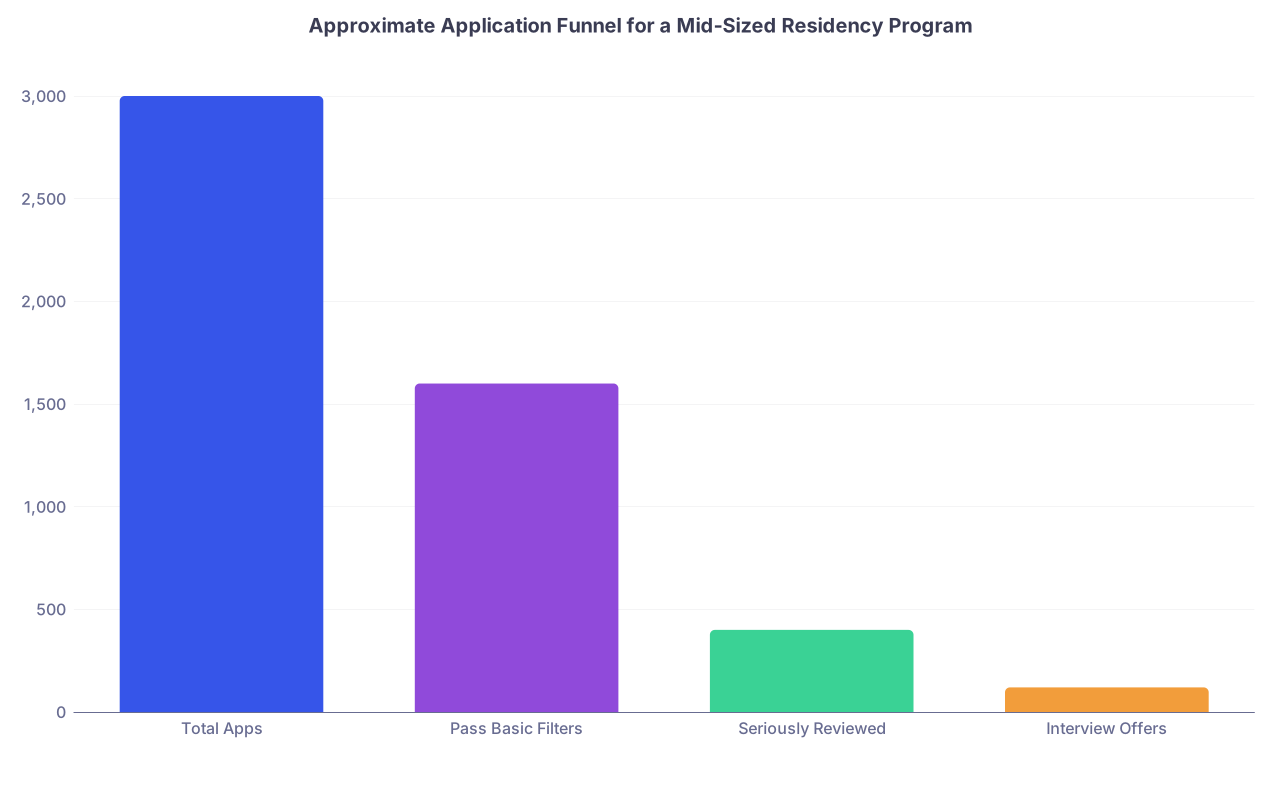
So what happens when 4,000 people apply to a program with 120 interview spots?
They don’t “holistically” review 4,000 files. They triage. Aggressively.
| Category | Value |
|---|---|
| Total Apps | 3000 |
| Pass Basic Filters | 1600 |
| Seriously Reviewed | 400 |
| Interview Offers | 120 |
That bar chart? That’s close to what I’ve seen in internal medicine, pediatrics, EM, even some mid-tier competitive programs. The exact numbers shift, but the funnel shape doesn’t.
Here’s the behind-the-scenes process in most programs:
Auto or semi-auto filter pass.
Step scores (if available), Step 2 if required, visa status, graduation year, sometimes school list, sometimes red-flag words in the MSPE. A huge chunk of applications never get a human’s eyes.Initial human scan.
This is 20–60 seconds per file, often done by chief residents, APDs, or a faculty committee. They flag “strong,” “maybe,” or “no.”Deeper review only for the short list.
The top 2–4× the number of interview slots get real attention. The rest are basically done.
Now here’s the part that applicants miss: when you apply to 100 programs, you’re not “giving yourself 100 chances.” You’re mostly putting yourself into 100 giant funnels that never get past step one.
Most PDs care about three things when they see your name in their system:
- Are you above our minimum filter thresholds?
- Do you look roughly like the applicants we’ve matched before?
- Did you show any sign you might actually come here?
The volume of your applications doesn’t show on your file. But it shapes the environment you’re entering: more noise, more mass-applicants, more suspicion that you have no real interest in them specifically.
The Myth of “More Applications = Linear Increase in Interview Odds”
Let me be blunt: the idea that every extra program you apply to adds the same amount of interview probability is fantasy. PDs know this. NRMP data screams this. Applicants ignore it because fear is louder than math.
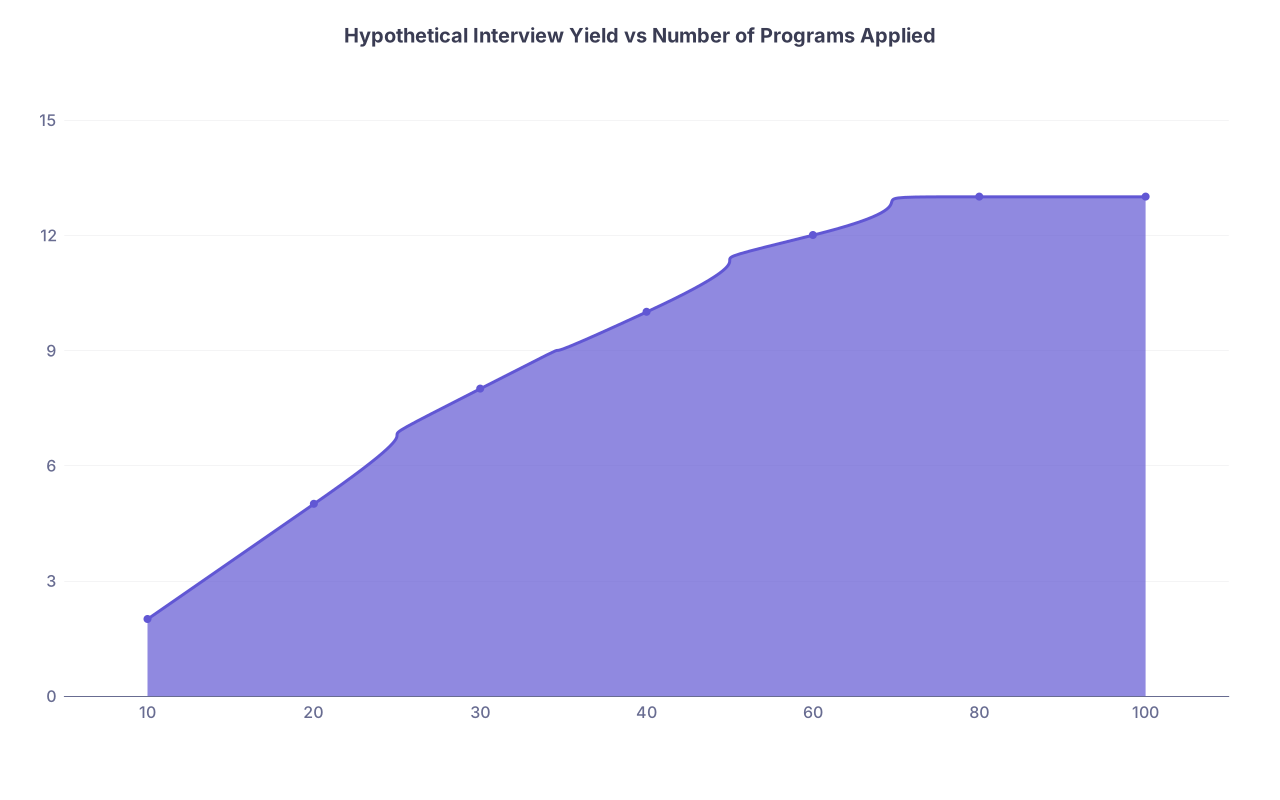
For most specialties, you see the same basic pattern: interview yield rises quickly at first as you apply to more programs, then flattens, then eventually barely moves.
| Category | Value |
|---|---|
| 10 | 2 |
| 20 | 5 |
| 30 | 8 |
| 40 | 10 |
| 60 | 12 |
| 80 | 13 |
| 100 | 13 |
I’ve seen real PD spreadsheets that look almost exactly like that shape when they back-calculate applicants’ behaviors.
Those first 20–30 programs you apply to? High-yield. You’re likely picking realistic targets: your home program, regionals, places where your school has a track record.
After that, what happens to most people?
- They start adding places they know nothing about.
- They throw in long-shot dream programs “just because.”
- They apply to random community spots they’d never actually rank high.
Program directors can’t see your entire application list, but they can see patterns locally:
- Applicants with no ties to the region, no mention of it anywhere, no geographic logic.
- Applicants with wildly mismatched profiles for their program’s usual incoming class.
- Applicants who never respond to outreach or interview invites because they’re juggling 30 other interviews.
There’s a quiet frustration in PD meetings that you don’t hear about on the applicant side: they know a good chunk of their interviews are going to people who will never genuinely consider them. They call these “tourists.”
You don’t want to be perceived as a tourist.
What Happens Inside the PD Meeting When Volume Explodes
Let me show you the tone of an actual discussion I’ve watched play out:
Coordinator:
“We’re at 3,400 applications this year. Same 130 interview spots. We’re already over 1,000 that pass filters.”
PD:
“Do the same as last year. Raise Step 2 minimum by three points. Drop grads older than three years. Drop non-citizen/non-permanent resident unless they have strong research or US experience.”
Chief resident:
“That’ll kill a ton of good IMGs.”
APD:
“We do not have the manpower. If they really want us, they’ll email. We can cherry-pick a couple from there.”
This is what “volume” does. It doesn’t make them more generous. It makes them harsher on the first pass and more reliant on shortcuts.
Shortcuts like:
- Strategic filters
- Known schools
- Home and away rotators
- Personal emails from your home faculty vouching for you
- Demonstrated regional ties
So yes, applying to more programs technically gives you more lottery tickets. But when the lottery organizers are doing everything they can to throw half the tickets away without looking, the quality of where you apply matters more than the raw count.
The Numbers PDs Don’t Say Out Loud (But Think About Constantly)
Here’s what’s going through a PD’s head during interview season, phrased a little more honestly than you’ll hear on Zoom Q&A sessions.
“How many interviews does an average solid applicant need to match with us?”
Internally, most of us are assuming:
- ~10–12 interviews → very likely to match somewhere in a moderately competitive specialty
- ~12–15+ → strong odds even in more competitive fields (if the list is reasonable)
- <8 interviews in a competitive field → they’re in trouble unless they’re focused on lower-tier but realistic programs
Now flip that to our side.
“How many interview offers do we need to send out to fill our 10 spots?”
We know:
- Some people will no-show or cancel.
- Highly competitive applicants are using us as a backup.
- Some will rank us low no matter what we do.
So a program with 10 PGY-1 spots might invite 120–160 people to interview. It varies, but that range is common.
Here’s the rough ratio reality:
| Stage | Approximate Ratio |
|---|---|
| Applications : Interview Slots | 20–40 : 1 |
| Interviews : PGY-1 Spots | 10–16 : 1 |
| Serious Consideration : Spots | 3–4 : 1 |
If you’re hoping to get, say, 12 interviews, you’re not playing an even game. You are one of thousands trying to fit into a few dozen chairs at each site.
Now add this ugly truth: the more obviously over-applied a candidate looks to us, the less we trust they’ll rank us highly.
We notice patterns like:
- People with superstar stats applying to every low-tier community program in multiple regions.
- People from West Coast MD schools applying heavily to small Southern rural programs with zero explanation in their application.
We don’t literally see your full list, but we can smell when you’re scattergunning.
How Many Programs Should You Actually Apply To (From the Other Side of the Table)
You want a number. Everyone wants a number. PDs will never give you one publicly because it depends on your profile, your specialty, and your risk tolerance.
But I’ll give you what I tell my own mentees, based on what I’ve seen and what PDs say when the Zoom is off.
This assumes you’re applying smart, not blindly:
Lower- to mid-competitiveness fields (FM, psych in many regions, peds, IM categorical at non-elite places)
- Strong applicant (solid scores, no red flags, US grad): 20–30 programs.
- Average applicant: 30–40.
- Red flags / IMG / older grad: 40–60, targeted.
Moderately competitive (EM, OB/GYN, general surgery at solid academic centers, anesthesia at good places)
- Strong: 30–40.
- Average: 40–60.
- Red flags / IMG / older grad: 60–80, but carefully chosen.
Highly competitive (derm, ortho, plastics, ENT, neurosurgery, some rads)
- Strong: 40–60, plus research years, connections, away rotations.
- Average (if you insist on trying): 60–80+. But with a very serious backup plan.
- With red flags: you should be thinking about a different primary specialty, not inflating volume.
The important part: once you push past ~60–80 in most situations, the marginal benefit per additional program is tiny. That extra “safety” quickly becomes “wasted money and emotional energy.”
More critical than the raw number is how your list is built:
- 20–30% reach
- 50–60% realistic matches based on your school’s history and your stats
- 10–20% true safeties you’d still be willing to attend
What PDs hate? When your list is 80% reach and 20% fantasy safety programs in regions or settings you obviously don’t care about.
Why Your Mass-Application Can Actually Hurt You Indirectly
Let me be clear: PDs are not sitting there saying, “This person applied to 100 programs; reject them.” We don’t see your number.
But your mass-application changes a few background variables that absolutely hit your odds:
1. Increased use of harsh filters
When programs drown in volume, the first thing they do is raise filters. If you’re in the gray zone (borderline scores, older grad year, IMG without home ties), you are exactly the person who gets cut.
Applicants think, “More applications = more chances to slip through a more generous program.” Reality: high volume makes every program less generous.
2. Less individual attention to your file
When a PD has 400 “filter-passing” apps to look at and one afternoon to do it, they’re speed-reading. They don’t catch your nuanced explanation, your beautiful personal statement paragraph about the region, or the letter from that subspecialist unless you’re already near the top of the pile.
The more bloated the pool, the more your detail work disappears into noise.
3. You become harder to schedule and trust
Guys who applied to 120+ and then shotgun-accept every interview? PDs talk about them.
I’ve heard this multiple times:
“We should stop over-inviting these superstar applicants. They cancel the day before or never show. I’d rather give the spot to someone who might actually come here.”
If you over-apply and then:
- Sit on invites for days.
- Cancel at the last minute.
- No-show or reschedule multiple times.
Don’t be surprised if word spreads informally among coordinators and PDs. Yes, the community talks.
4. You never create a coherent story
The best candidates have an application that makes sense:
- Clear interest areas.
- Geographic logic.
- Reasonable set of programs that match their narrative.
The mass-applicant often has an application that screams one thing (“I’m dedicated to big-city academic medicine”) and a program list that screams the opposite (rural Midwest community programs with no teaching track).
PDs notice when your story and your behavior don’t match.
Playing This Game Like Someone Who Understands the Other Side
If you want to use application volume intelligently, you have to stop thinking like a shopper and start thinking like a program.
A few specific, insider-driven moves:
1. Build around where you actually make sense
PDs are biased—but they’re predictable.
You get a quiet bump if:
- Your school has matched well at that program before.
- You’re from that region or have strong ties.
- You did an away there or at a nearby institution.
- A faculty member they know emails them about you by name.
So before you add your 50th program across the country that’s never taken anyone like you, make sure you’ve thoroughly covered:
- Your home institution and affiliates
- Your med school’s “usual suspects”
- Your home region (where you can argue family/partner/support reasons)
Only then start expanding outward logically.
2. Use targeted interest signals, not fake flattery
PDs are jaded. They’ve read thousands of “I love your program” emails that could be sent to any program by just swapping the name.
But I’ve watched PDs pull up apps from people who:
- Had done a sub-I in their region and wrote a line or two about why they liked that city’s patient population.
- Mentioned a specific track or clinic they run that clearly wasn’t generic.
- Had a realistic geographic story (partner job, family, children in local schools, etc.).
If you’re going to send “interest” emails, send 10–15 genuinely targeted ones to realistic programs, not 60 copy-pasted ones.
3. Protect your interview integrity
If you over-apply and actually get a lot of interviews, don’t be the chaos applicant.
Inside PD meetings, I’ve heard:
“Remember last year? Those three top-of-the-class applicants we scrambled to schedule early? All canceled for bigger-name places. Let’s not frontload with that profile again.”
They remember wasted spots. They remember no-shows. Coordinators absolutely remember who ghosted them.
So:
- Accept or decline quickly.
- Don’t hoard more interviews than you can reasonably attend.
- If you must cancel, do it early and with a brief, polite explanation.
That’s how you behave like someone programs would want to rank highly.
Reality Check: When You Actually Should Apply to a Lot of Programs
There are situations where high volume is justified. I’m not going to sugarcoat it.
If any of these are true, you’re swimming upstream:
- Multiple exam failures
- No US clinical experience (for IMGs)
- Very low Step 2 score for your specialty
- Significant time since graduation with little clinical continuity
- Changing specialties late with no track record or letters in the new field
In those scenarios, you might need:
- 60–80+ in a less competitive field
- 80–100+ if you insist on aiming at something more competitive (but you need a back-up specialty in parallel)
But even then, the same rules apply: targeted volume beats blind volume.
If you’re an IMG with one US letter and a Step 2 barely above cutoff, applying to 150 programs that have never historically taken IMGs at all is not “hustle.” It’s delusion.
PDs know exactly which programs take which kinds of applicants. You should too. There’s enough data out there—from FREIDA, from your school’s match list, from alumni—to avoid total fantasy.
A Quick Visual: When Extra Applications Stop Helping
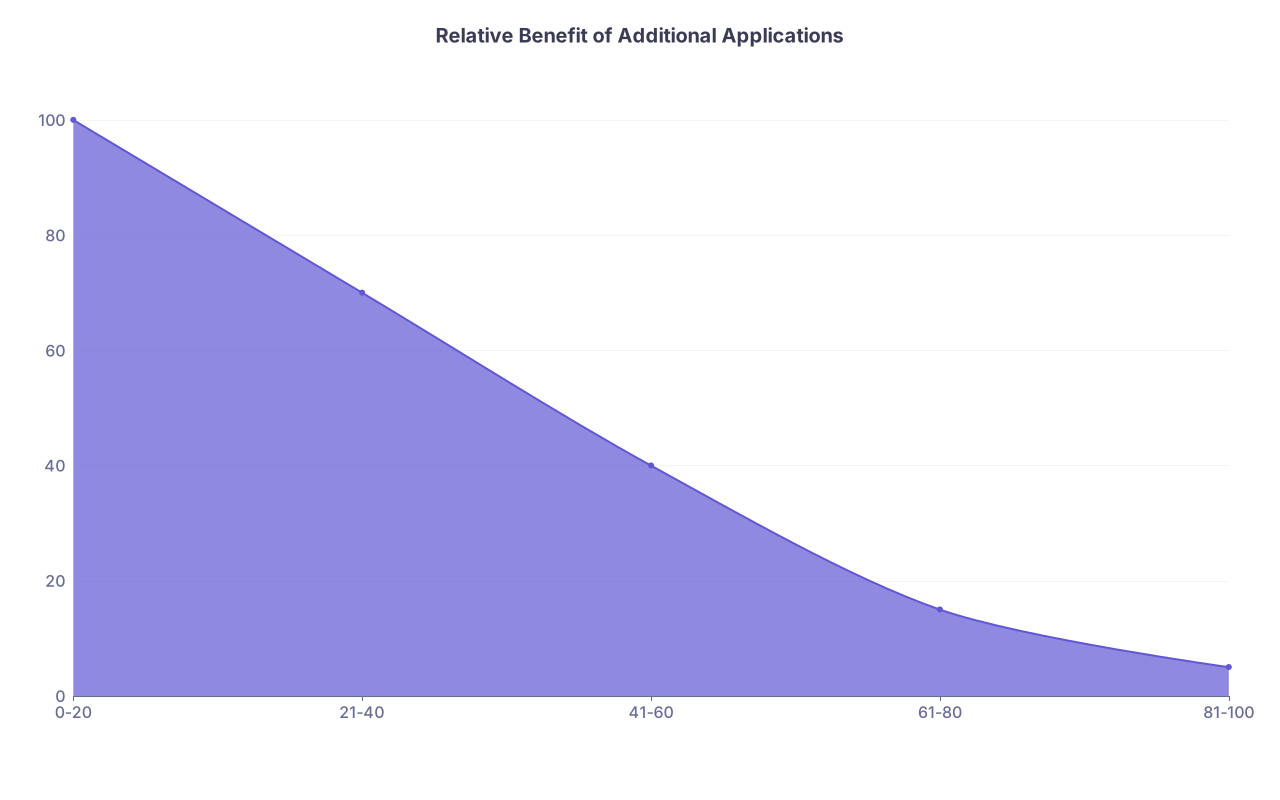
Here’s a way to think about it.
| Category | Value |
|---|---|
| 0-20 | 100 |
| 21-40 | 70 |
| 41-60 | 40 |
| 61-80 | 15 |
| 81-100 | 5 |
The first 20 are massively important.
20–40 are still doing real work.
40–60 help, mostly by shoring up your realistic and safety tiers.
Above 60–80, for most people, you’re paying for single-digit returns.
When PDs complain about “application inflation,” this is what they mean. They know those last 20–40 programs on your list aren’t thoughtful. They’re fear.
Programs respond to fear with blunt tools. Filters. Less time. More automation.
You can’t opt out of that system. But you can stop feeding it more than necessary.
So Where Does This Leave You?
You’re about to spend thousands of dollars and months of emotional bandwidth on this process. Here’s the insider lens you should keep:
- Your application is one row in a massive spreadsheet.
- PDs are overwhelmed; volume makes them harsher, not kinder.
- After a certain point, adding more programs gives you diminishing returns.
- The quality, coherence, and targeting of your list matter more than the raw count.
If you build a smart list, respect interview offers, and send genuine signals of interest to realistic programs, you’ll stand out—not just on paper, but in how you move through the system.
Because in that conference room, when your name comes up, you want someone to say:
“Oh, that’s the applicant who actually seems like they’d come here.”
Not: “Another tourist. Next.”
With that mindset, you’re not just spamming the system. You’re playing the same game the PDs are playing—just from the other side of the table.
You’ve handled the application volume question. Next comes the harder part: turning those interviews into high ranks. But that’s a story for another day.