
It’s September. Your ERAS token is active, your spreadsheet has mutated into a monster, and you’re staring at an insane number: 95 programs in your “Maybe” column. Your group chat is a mess of screenshots:
“Dude, my advisor said 40 minimum.” “My senior applied to 110 and matched derm.” “Some PD on Twitter said anything over 50 looks desperate.”
You’re stuck on the main question no one answers honestly:
Where’s the line between “smartly casting a wide net” and “this person has no judgment and is panic-clicking apply to all”?
Let me tell you what really happens on the other side of the screen.
What Program Directors Actually See (And What They Infer)
First truth: most PDs are not manually counting how many programs you applied to.
They see how many you applied to them, not your total. ERAS doesn’t hand them a big number on top that says: “This applicant applied to 102 programs.”
But. And this is the part students don’t understand.
They infer it. Very quickly.
They look at your profile, your geography, your specialty competitiveness, your school. Then they cross–reference the list of other programs you applied to in the institution’s ERAS “shared list” or during conversations with colleagues. Patterns show up fast.
I’ve sat in rooms where PDs and faculty are going through applicants and you hear comments like:
- “This DO with a 205 applied to 80 categorical surgery programs? No sense of reality.”
- “She applied to every program in the country. Red flag for me—what’s she running from?”
- “He applied to us, plus 30 top tiers, and skipped everything mid-tier around his home region. He’s going to drop us the second he gets a ‘better’ interview.”
So no, there isn’t a pop-up warning on their ERAS screen. But your application list leaks through in several ways:
- The types of programs you picked (or avoided).
- The geographic spread.
- Whether your application choices match your actual competitiveness.
- What comes out during interviews when they casually ask, “So what kind of places did you apply to?”
And here’s the key: the red flag isn’t just the raw number. It’s the mismatch between who you are on paper and how you’re applying.
Still, there is a number range where PDs start quietly labeling you as panicked, poorly advised, or lacking insight.
We’ll get to that.
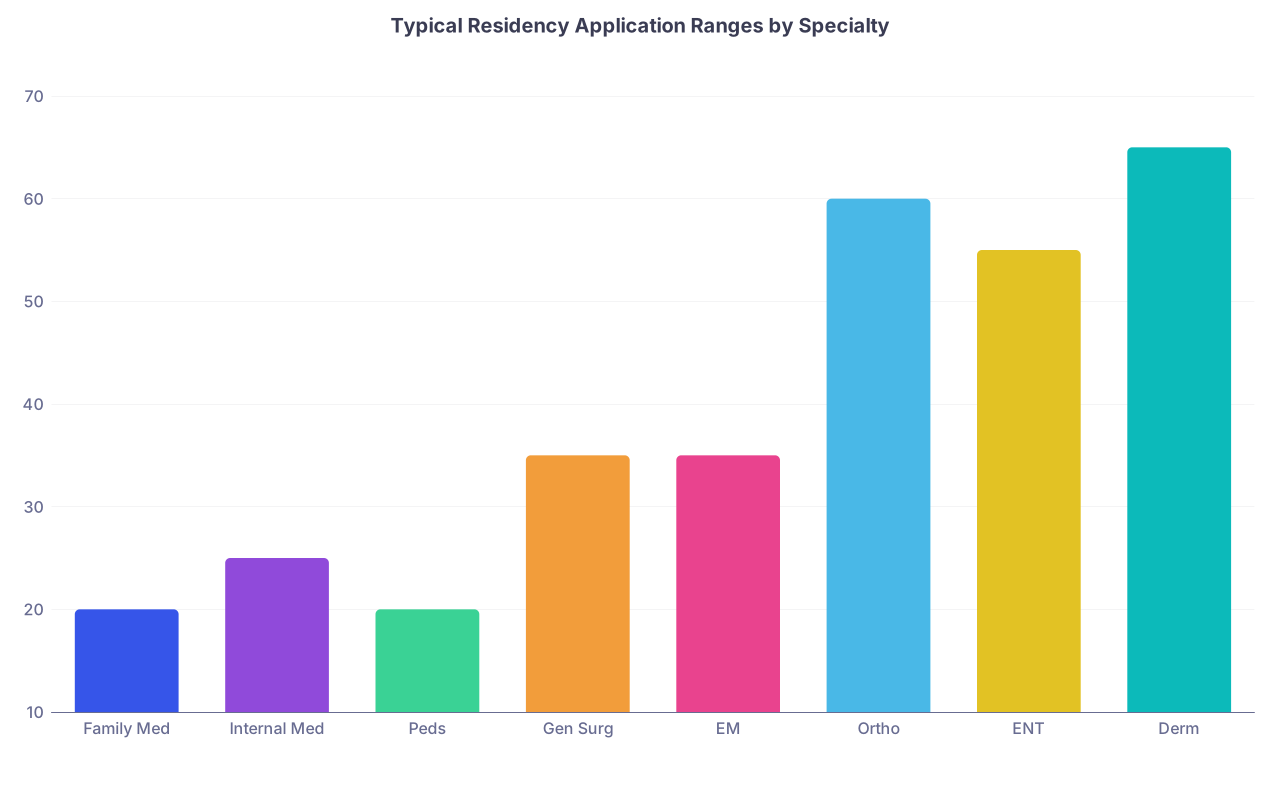
The Real Math: Typical Application Ranges by Specialty
Let’s lay down the insider baselines. These are the rough ranges PDs expect to see for a reasonably advised US MD applicant applying in one specialty, no catastrophic red flags.
| Category | Value |
|---|---|
| Family Med | 20 |
| Internal Med | 25 |
| Peds | 20 |
| Gen Surg | 35 |
| EM | 35 |
| Ortho | 60 |
| ENT | 55 |
| Derm | 65 |
Now translate that into what many of us in selection meetings assume:
Primary care (FM, IM, peds): 15–30 applications is expected for a normal candidate.
When you’re at 60+? We assume fear, weak advising, or that you’re hiding something.Mid-tier competitive (EM, anesthesia, OB/GYN, gen surg): 30–50 is common; 60–70 if you’re slightly weaker or from a lesser-known school.
Hyper-competitive (derm, ortho, ENT, PRS, neurosurgery): 60–80 is normal, 80–100 if there are real concerns (lower scores, DO, IMG, leaves, etc.).
The problem is that students hear “average” and react like this:
“If the average is 50… I’ll do 80. Just to be safe.”
That is how you drift right into the “this applicant has no insight” zone.
So What’s the Red Flag Number?
You want the unvarnished answer. Here it is.
Across most PDs I know, including my own experience in rank meetings, the following rules of thumb hold:
If you’re applying to a non-competitive or moderately competitive specialty and your total number crosses about 60–70 programs, you start to smell like a panic applicant.
If you’re applying to a hyper-competitive specialty and your number crosses about 100 programs, we start asking each other:
“Why is this person carpet-bombing the country? What’s the story?”
These are not hard cutoffs. No one says, “Over 71, automatic reject.” That’s fantasy.
But once you cross those zones, the narrative about you changes:
From:
“Normal applicant trying to be smart with the Match.”
To:
“Over-applier. Either has big problems or zero judgment. Might be a problem resident.”
And yes, PDs talk exactly like that behind closed doors.
The Three Things PDs Read Into Your Application Count
Raw number aside, what PDs truly care about are these three signals:
Judgment
If your Step 2 is 225, mid-tier school, no research, and you applied to 50 academic neurosurgery programs and 0 backups? Every person in that room says the same thing:
“This applicant has no idea how competitive this is.”
That’s lack of judgment. Huge red flag.Insight into your own file
A DO with a 214 applying to 30 categorical general surgery and 20 prelim surgery? That’s someone who understands risk.
Same student applying only to 20 categorical gen surg at big academic centers? We assume denial, or delusion.Stability and commitment
95 IM programs spread across the entire country, no clear geographic pattern, and you say, “I really want to be in the Midwest to be near family”? We don’t believe you.
That looks like: “I’ll go anywhere that will take me,” which is subtly different from “I’d be a good fit for you.”
If your application number plus your choices signal poor judgment or lack of self-awareness, that bothers PDs more than the number itself.
Over-Application: The Quiet Red Flag
Let’s talk about how PDs really respond when they sense over-application.
They will not send you an email that says, “We didn’t invite you because you applied to too many programs.”
What happens instead:
Your interview answers get interpreted harsher.
When you say, “I’m very interested in your program,” and they suspect you applied to 80 others that look just like it, they discount your sincerity.They assume you’ll rank them low.
Especially in mid/low-tier or less desirable geographic locations. So borderline applicants get cut because “they’re not really coming here.”Your lack of geographic focus becomes a liability.
If you applied to every region with no pattern, PDs doubt your commitment to their city, especially for lifestyle-heavy or high-burnout specialties.
I’ve seen it happen in real time:
Applicant A: Applied to 28 categorical IM programs clustered around two regions, with strong personal ties in both areas.
Applicant B: Similar stats, but applied to 85 IM programs across the entire country, including tiny places they clearly know nothing about.
Who do we trust more to actually come if we rank them highly? Applicant A. Every time.
Where Students Go Off the Rails
There are four classic “too many programs” mistakes that make PDs roll their eyes.
1. The “Apply to All, Decide Later” Strategy
This is how you get to 80–100 programs without realizing.
Students tell themselves:
“I’ll just apply broadly, then I’ll be selective with interviews.”
Translation from the PD side:
“This person has no plan, just fear.”
You waste money, you clog the system, and you signal that you didn’t think deeply about where you’d actually be happy. That doesn’t play well.
2. No Backup Specialty, Just More Programs
The student thinking:
“I don’t need a backup specialty; I’ll just apply to more programs in my main one.”
Behind the scenes, PDs say:
“So instead of a reasonable backup plan, they decided to spray and pray. Not someone I trust with high-stakes decisions.”
For many borderline candidates, a smart backup specialty with 20–30 extra programs looks much better than 40 more in your dream specialty.
3. Ignoring Geography Completely
I’ve seen this dozens of times:
Applicant from NYC with family, says in their personal statement they want to stay near aging parents… and then applies to 70 programs from California to Florida to Alaska.
Faculty in the room notice the mismatch and say:
“They’re just saying what they think we want to hear. Pass.”
A focused but still safe range (two or three regions with some outliers) looks much more adult than chaos.
4. Doubling or Tripling the National Averages “Just in Case”
This is epidemic.
You hear that the average matched applicant in your specialty applies to 45 programs. Without any real reflection, you say:
“Ok, I’ll do 80. Then I’ll be safe.”
What PDs actually see is:
“You had no mentor brave enough to look you in the eye and say, ‘No, this is unnecessary, and it makes you look anxious and undiscerning.’”
So I’m saying it now.
A Sanity-Check Table: Reasonable vs Red Flag Numbers
Use this as a blunt tool. Not perfect. But closer to how PDs talk behind closed doors than what your school will tell you on a polished slide.
| Specialty Type | Reasonable Range | Starts To Look Off | Clear Red Flag Zone* |
|---|---|---|---|
| Primary Care (FM, Peds) | 15–30 | 40–50 | 60+ |
| Internal Medicine | 20–35 | 45–55 | 65+ |
| EM, Anes, OB/GYN | 30–45 | 55–65 | 75+ |
| Gen Surg | 30–50 | 60–70 | 80+ |
| Ortho, ENT, Uro | 50–70 | 80–90 | 100+ |
| Derm, PRS, Neurosurg | 60–80 | 90–100 | 110+ |
*Again, not hard cutoffs, but psychological zones where your number starts telling an unflattering story.
How PDs Really Judge “Insight” in Your Application List
You might be thinking: “Fine, but how do I show I’m not that person?”
Here’s how people on selection committees quietly judge your application strategy:
Does your application number roughly match your risk level?
Low scores? DO? No home program? Then a slightly higher number makes sense.
Strong file across the board? Over-applying makes less sense and looks reactive.Do your geographic choices make sense with your story?
If your personal statement screams “I’m rooted in the South” and you only applied to the Northeast and West Coast, we notice.Did you pick a legitimate backup if you’re truly at risk?
PDs respect a student who applies to, say, 45 EM and 25 IM with a real IM personal statement tailored, versus 80 EM alone.
And during interviews, the more savvy PDs will test you.
They ask those throwaway questions:
“So how did you think about where to apply?”
“Which regions did you focus on?”
“Are we your first or second geographic choice?”
If you freeze, ramble, or obviously lie, they feel your lack of insight instantly.
A Simple Way to Decide Your Number (Without Looking Foolish)
Let’s build a rough framework like a PD would think about you.
Step 1: Rate Your Competitiveness Honestly
On a 3-point scale for your chosen specialty:
- 1 – Strong: Above-average scores, solid clinicals, no big red flags, home program support.
- 2 – Middle: Average scores, decent but not remarkable extras, maybe DO or unknown school.
- 3 – At-Risk: Below-average scores, failed exam, gap, IMG, or very late Step 2.
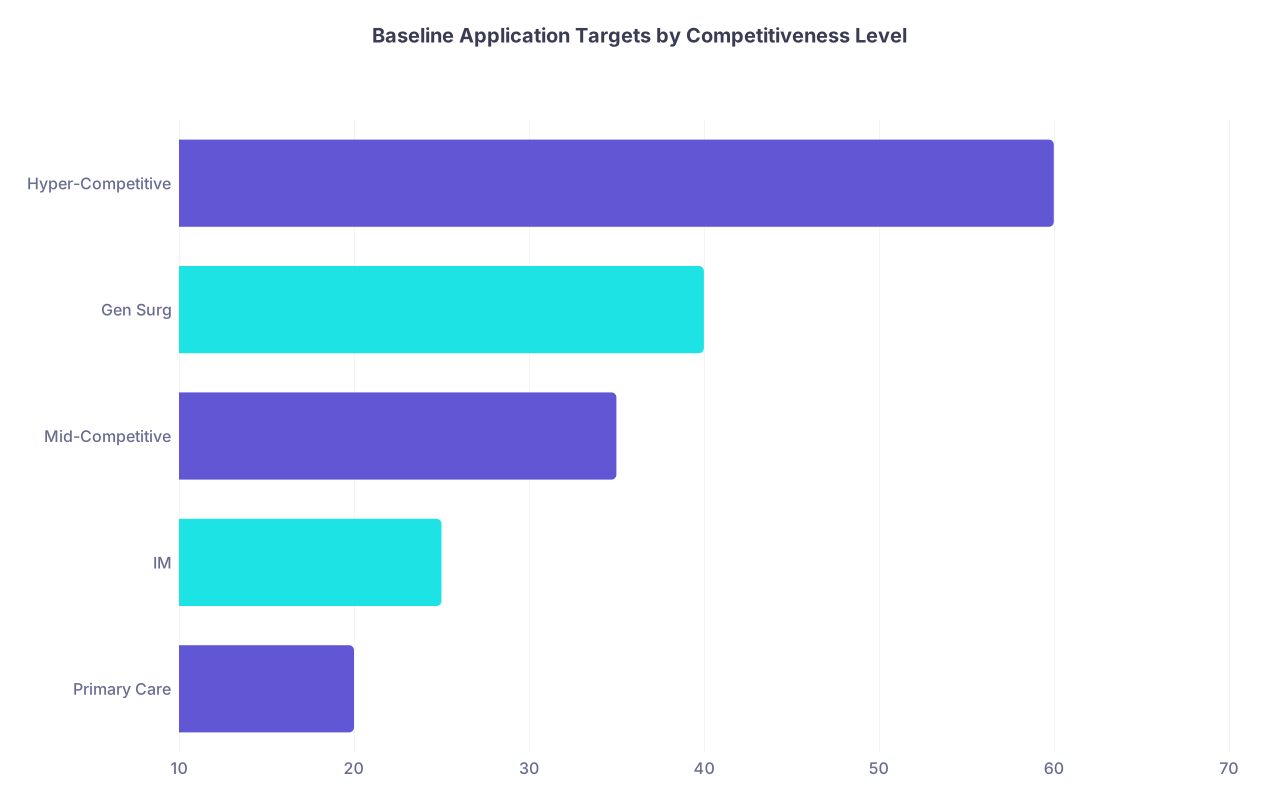
Step 2: Anchor to a Baseline Number
Use this chart as your anchor, not your final number.
| Category | Value |
|---|---|
| Primary Care | 20 |
| IM | 25 |
| Mid-Competitive | 35 |
| Gen Surg | 40 |
| Hyper-Competitive | 60 |
Baseline for average applicant (Level 2):
- Primary Care: ~20
- IM: ~25
- EM / Anes / OB / Radiology: ~35
- Gen Surg: ~40
- Ortho / ENT / Derm / PRS / Neurosurg: ~60
Then adjust:
- Strong (Level 1): Subtract ~5–10 (not below ~15–20, ever).
- At-Risk (Level 3): Add ~10–20 and strongly consider a backup specialty instead of just more programs.
You’ll notice this doesn’t push you into 90–100 unless you’re in a hyper-competitive field AND clearly at-risk. That’s the small group for whom those big numbers are not immediately a red flag.
Step 3: Add Geographic Logic
Now check your distribution.

| Step | Description |
|---|---|
| Step 1 | Choose Specialty |
| Step 2 | Assess Competitiveness |
| Step 3 | Set Baseline Number |
| Step 4 | Select 2 to 3 Core Regions |
| Step 5 | Add 20 to 30 Backup Apps |
| Step 6 | Refine Within Regions |
| Step 7 | Final Application List |
| Step 8 | Need Backup Specialty |
Two or three core regions plus a few outliers is adult.
“Every program east of the Mississippi” is not.
Step 4: Gut Check With Someone Who’ll Be Honest
Not your class group chat. Not Reddit.
Someone who:
- Knows your actual scores and red flags.
- Knows your specialty.
- Has seen at least a few match cycles.
Tell them your strengths and weaknesses. Show them a draft number. If they say, “Yeah… that’s a lot,” believe them.
What Happens If You’ve Already Over-Applied?
Some of you are reading this in October or November, after sending 90+ apps.
Too late to unsend. But not too late to fix the story you tell.
Here’s how you manage the damage:
- Be clear and honest in interviews about your thought process.
“I was concerned about X (late Step 2, non-traditional path, etc.), so I applied a bit more broadly than I probably needed to. After talking with mentors and seeing my response rate, I realized I was more competitive than I thought.”
That framing shows growth and insight now, even if your initial move was fear-driven.
Stop doubling down.
Don’t apply to a second specialty in December out of panic unless someone experienced explicitly tells you you’re in trouble. Blindly adding more chaos makes you look worse.Be selective with interviews.
If you’ve blanketed the country and now have more invites than you can practically attend, cancel the ones that are clear poor fits instead of hoarding. PDs absolutely remember the students who no-show or late-cancel; it burns bridges and annoys people.
The Behind-the-Scenes Truth: PDs Are Tired of the Arms Race
The unspoken reality: PDs are exhausted by 80, 90, 100+ app lists. Most of us think the system is broken.
I’ve heard PDs in EM, IM, and surgery say almost the same thing in different rooms:
“These students are scared and badly advised. But I can’t fix ERAS. I can just try to read between the lines.”
So PDs are increasingly using signals like:
- Geographic focus
- Proof of genuine interest
- Thoughtful backup planning
- Coherent narrative about why you applied where you did
To separate the anxious over-applier from the mature, self-aware applicant.
If you want to stand out now, in this chaotic climate, do the thing almost no one does:
Apply like an adult who knows themselves.
Not like a scared intern clicking “select all” at 2 a.m.

FAQs: The Red Flag Number to PDs
1. I’m applying to internal medicine and planned on 70 programs. Is that “too many”?
For a typical US MD or DO applicant with average stats, yes—70 IM programs usually looks like overkill. Inside the room, people will quietly label that as anxiety or poor advising. Unless you have real risk factors (very low Step 2, failed exam, IMG status, no US experience), you’re much better off in the 25–45 range with a logical geographic pattern than 70 scattered programs.
2. For derm/ortho/ENT, is there really such a thing as “too many”?
There is. These specialties are harsh, but the logic still applies. A well-advised, moderately competitive ortho applicant applying to 60–75 programs is normal. Once you start crossing 100+ without major red flags, people assume you’re panicking or not thinking clearly. The exception: IMGs or applicants with serious issues might need those numbers, but that comes with a story you should be able to explain.
3. Do PDs explicitly see my total number of applications?
Not as a single big number on their screen. But they can often infer it from conversations with colleagues, common shared lists, and the patterns of where you applied. The effects of over-application show up in how scattered and incoherent your choices look, not in a simple “95 apps” counter.
4. Is a backup specialty better than just applying to more programs in my main specialty?
In almost all borderline cases, yes. A student applying to 45 EM and 25 IM with a real IM personal statement and some evidence of interest looks thoughtful and realistic. A similar student applying to 90 EM alone looks anxious and poorly mentored. PDs respect a smart, honest backup plan more than they respect blind volume.
5. I already sent 90+ applications. How do I avoid looking desperate in interviews?
You cannot change the past, but you can control the narrative. Be candid and mature: “I was worried about X, so I cast a wider net than necessary. After seeing my interview responses and talking with mentors, I realize I undersold myself a bit. Right now I’m focusing on finding the right fit rather than sheer numbers.” That answer shows self-reflection and growth, which many PDs value more than initial perfection.
You’re standing at the front end of this process thinking it’s all about raw numbers. It isn’t. It’s about what those numbers say about you.
Get your range into a sane, defensible window. Make your geography make sense. Have an honest backup plan if you truly need one. Then the next chapter—triaging interviews, signaling real interest, building a rank list that matches your goals—starts to look a lot less like chaos and a lot more like strategy.
With those foundations in place, you’re finally ready to stop obsessing over how many programs you clicked and start focusing on the only thing that matters now: convincing a few of them that you belong there. But that part of the story comes next.