
The obsession with applying to 100+ residency programs is one of the most expensive, anxiety‑driven scams in modern medical education.
Not a literal scam. But a data‑illiterate, fear‑based arms race that almost nobody actually benefits from—except maybe ERAS and airlines.
You’ve heard the mantra: “Just apply broad. 80–100+ programs. Play it safe.”
I’ve watched students burn thousands of dollars and months of their life following that advice, only to discover it didn’t move the needle in any meaningful way.
Let’s talk about what the numbers actually show. Not what your panicked class group chat screams at 1 a.m. in September.
The Myth: “If You’re Not Applying to 100+ Programs, You’re Screwed”
This myth has three heads:
- More applications = more interviews
- More interviews = higher chance to match
- Therefore, maximize apps at all costs
The logic seems airtight—until you look at the actual data and how programs behave.
Residency applications don’t scale linearly. They hit diminishing returns fast. And those diminishing returns hit long before you cross the 80–100+ threshold in most specialties.
Let me show you what I mean.
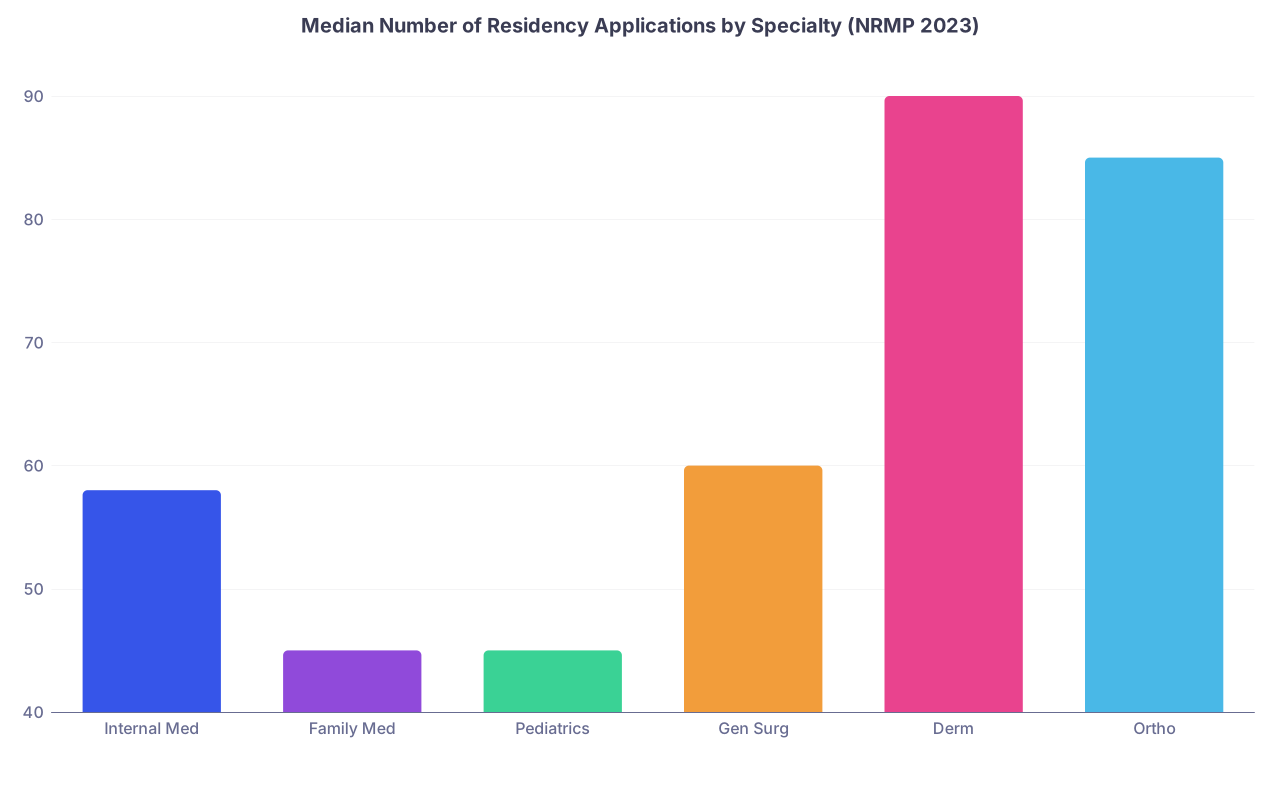
| Category | Value |
|---|---|
| Internal Med | 58 |
| Family Med | 45 |
| Pediatrics | 45 |
| Gen Surg | 60 |
| Derm | 90 |
| Ortho | 85 |
Students see numbers like this and think:
“If the median is 60, I should do 100+ to be safe.”
That’s not how this works.
Historically, NRMP and AAMC data show two key facts:
- Beyond a certain point, each extra application yields fewer and fewer additional interviews.
- Most matched applicants in most specialties don’t need anywhere near 100 programs.
It’s not just theory; it’s visible in the “applications vs match rate” and “applications vs interviews” curves. They flatten. Hard.
What the Data Actually Shows About Diminishing Returns
Let’s be concrete. Here’s a simplified snapshot of how additional applications usually perform for a typical applicant in a moderately competitive specialty.
| Total Programs Applied | Additional Programs (from previous row) | Typical Extra Interviews Gained |
|---|---|---|
| 20 | - | Baseline |
| 40 | +20 | +2 to 4 |
| 60 | +20 | +1 to 2 |
| 80 | +20 | +0 to 1 |
| 100 | +20 | 0 to +1 (often zero) |
Of course, numbers vary by specialty and your competitiveness. But the shape is consistent: steep at the beginning, flat at the end.
Why this happens:
Programs are not waiting breathlessly to see your application number 87 out of 127. They:
- Use filters (Step scores, school, visa status, etc.)
- Cap interview slots
- Get flooded with nearly identical applications from similar students
Once you’re in the pool of people they’d consider, extra programs don’t magically create proportionally more interview spots. You just add more noise and more cost.
How Many Interviews Actually Matter?
NRMP has been publishing the same story for years: there’s a point where more interviews don’t meaningfully boost your match odds.
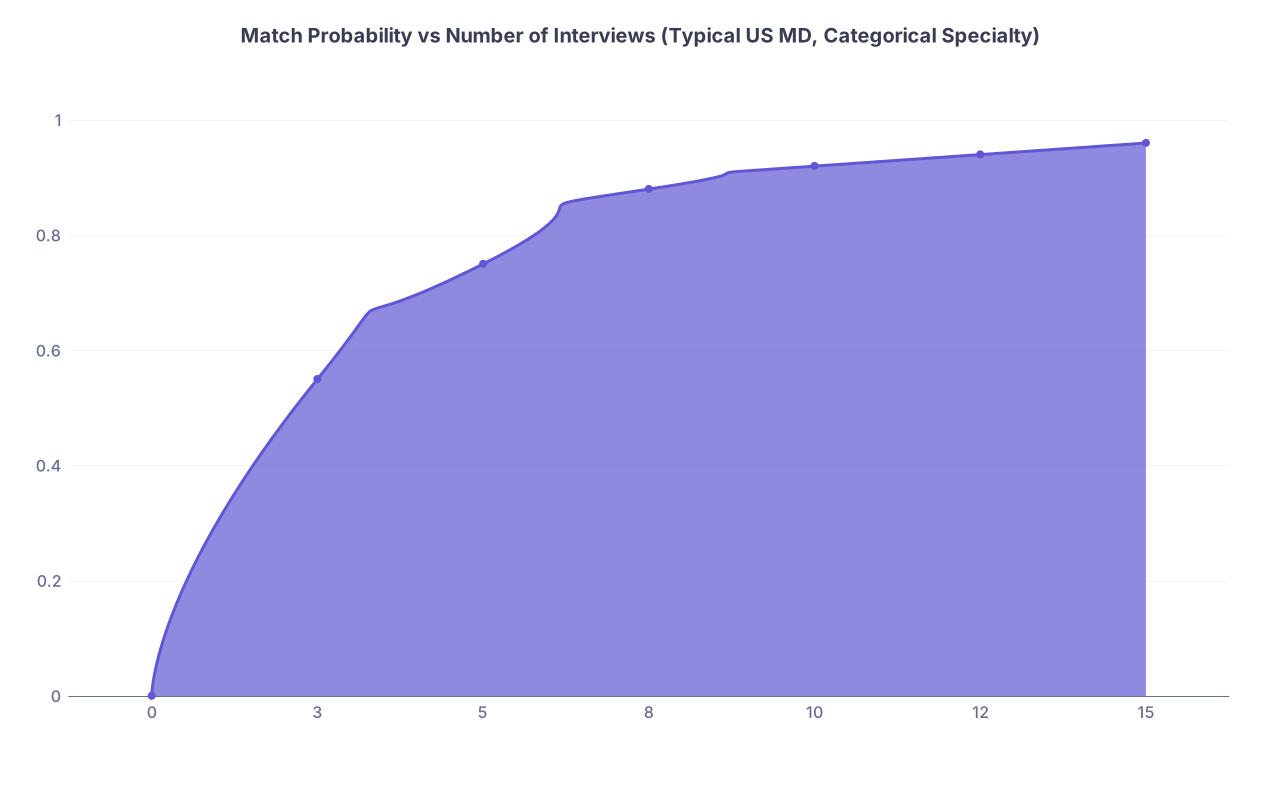
| Category | Value |
|---|---|
| 0 | 0 |
| 3 | 0.55 |
| 5 | 0.75 |
| 8 | 0.88 |
| 10 | 0.92 |
| 12 | 0.94 |
| 15 | 0.96 |
You’ll see minor differences by specialty, but the pattern is boringly consistent:
- Somewhere around 8–12 interviews, your match probability is already very high
- Going from 12 to 20 interviews doesn’t double your odds; it nudges them
So the real question is not “How do I get 100+ applications in?” but:
What’s the smallest number of applications I can send that gives me a realistic shot at ~10–12 interviews?
That’s the grown‑up, data‑driven question.
The Hidden Costs of Over‑Applying (That Nobody on Reddit Pays)
People talk about ERAS fees like they’re annoying. They’re not annoying. They’re predatory when you scale to 80–120 programs.
Let’s do some back‑of‑the‑envelope math.
| Number of Programs | Rough ERAS Fee (Single Specialty) |
|---|---|
| 30 | $600–$800 |
| 60 | $1,400–$1,700 |
| 100 | $2,500+ |
That’s just ERAS. Now add:
- Interview flights (less with virtual, but still)
- Hotels / Ubers / food
- Time off rotations
- Emotional burn
I’ve seen students spend $5,000–$10,000 chasing the “safety” of 100+ applications while:
- Copy‑pasting generic personal statements
- Half‑assing program‑specific questions
- Botching interviews because they’re exhausted by their 11th interview in 7 days
You are not a bot. You don’t scale infinitely.
Over‑Applying Hurts Your Application Quality
When you spray and pray:
- Your personal statement doesn’t speak to the specialty or type of program
- Your “Why this program?” paragraphs sound like they were generated by a random adjective machine
- You miss obvious details (wrong program name, wrong city, weird formatting)
I’ve sat in meetings where faculty say, “This looks like their 70th application—zero effort.” That’s not paranoia. They can tell.
If you cut from 100 programs to 55–60 carefully chosen ones, you free up:
- Time to actually research programs
- Energy to write specific, sharp secondary responses
- Bandwidth to practice for interviews and not sound like a robot reciting your CV
You trade quantity for signal. And programs are drowning in noise.
When You Do Need More Applications (And When You Really Don’t)
Here’s where everyone gets nervous. “Okay, but am I one of the people who actually needs 80–100?”
Sometimes, yes. But far fewer than you think.

Factors That Push You Toward a Larger List
You start leaning higher (maybe 70–100 in some fields) when multiple of these are true:
- You’re applying to a very competitive specialty (Derm, Ortho, ENT, PRS, some ROAD fields)
- You have red flags: exam failures, long leaves, professionalism issues
- You’re an IMG or non‑US citizen needing visa sponsorship
- Your application is below average for the specialty (Step 2 well below typical matched applicants, minimal home support, almost no research where it’s expected)
Notice I said “toward a larger list.” Not “guaranteed 100+.”
Even in these scenarios, I’ve seen people match very respectably with 60–80 targeted applications and 8–12 interviews. The key word: targeted.
Factors That Let You Apply More Sanely
You can usually stay in the 30–60 range (sometimes even lower) if:
- You’re a US MD with no major red flags
- Your Step 2 is around or above your specialty’s matched median
- You have solid letters, at least one from your chosen field
- You’re applying to a less competitive specialty (FM, Peds, Psych, some IM categories, etc.)
- Your school has a decent match history in that field
“Sanely” still doesn’t mean “recklessly low.” It means strategic, not panic‑driven.
How to Build a Rational Program List (Without Hitting 100+)
Here’s the part most people skip: actually mapping your profile to what’s realistic.

| Step | Description |
|---|---|
| Step 1 | Start |
| Step 2 | Pick specialty |
| Step 3 | Assess competitiveness honestly |
| Step 4 | Target 60 to 90 apps |
| Step 5 | Target 30 to 60 apps |
| Step 6 | Stratify programs by reach, target, safety |
| Step 7 | Refine list by location and fit |
| Step 8 | Check cost and time reality |
| Step 9 | Finalize list |
| Step 10 | Red flags or IMG? |
Notice there’s no branch that says “If anxious, add 40 more.”
Step 1: Know Your Specialty’s Reality
Pull recent NRMP Charting Outcomes and look—really look—at matched vs unmatched data for:
- Step 2 scores
- Number of contiguous ranks
- Research expectations
- IMG vs USMD vs DO numbers
If the median matched applicant in your specialty has 10 interviews and you’re competitive, you don’t need 25 interviews “just in case.”
Step 2: Stratify Programs (Like an Adult)
Think of your list as:
- Reach programs (you’d be thrilled, but odds are lower)
- Target programs (you’re squarely in their typical range)
- Safety‑leaning programs (where your stats and profile are stronger than their average)
What most over‑applicants do wrong: they add more reach programs, not more realistic ones. So they pay more and don’t actually boost interviews.
Better approach: once you have some reaches, aggressively fill the middle and lower tiers. Places that actually interview people like you.
Step 3: Use Geography Intelligently, Not Sentimentally
If you’re geographically flexible, you don’t need 100 programs. You just need to stop being picky about coasts and city prestige.
If you’re geographically restricted (partner, kids, visa, family obligations), then you must be more careful. But even then, many people over‑compensate by applying to every program in a 2‑state radius—including ones they’d hate.
Be honest: would you really go there? If not, why are you paying to apply?
The Systemic Problem: Over‑Applying Hurts Everyone
Let’s zoom out for a second.
This is not just about your wallet. The 100+ apps culture actively breaks the system:

- Programs can’t meaningfully review thousands of applications
- So they escalate their filters and rely even more on blunt metrics
- Which scares students into applying even more broadly
- Which further floods programs, which triggers tighter filters
It’s a feedback loop based on fear and bad incentives.
Over‑applying:
- Makes holistic review harder
- Punishes people with non‑linear paths
- Pushes programs to lean on Step 2 and school name even more
You’re not just hurting yourself by blasting 120 programs; you’re contributing to the mess.
What Actually Moves the Needle (Instead of 30 Extra Apps)
Here’s the part most people don’t want to hear, because it doesn’t have a “pay ERAS more” button.
The things that move your match odds more than going from 70 to 110 apps:
- A strong, specific, field‑appropriate personal statement
- At least one or two heavyweight, detailed letters from your chosen specialty
- Doing a sub‑I or away rotation where they actually know your name
- Practicing interviews until you’re not reciting your CV like a robot
- Having a realistic mix of reach/target/safety programs and ranking them all you’d actually attend
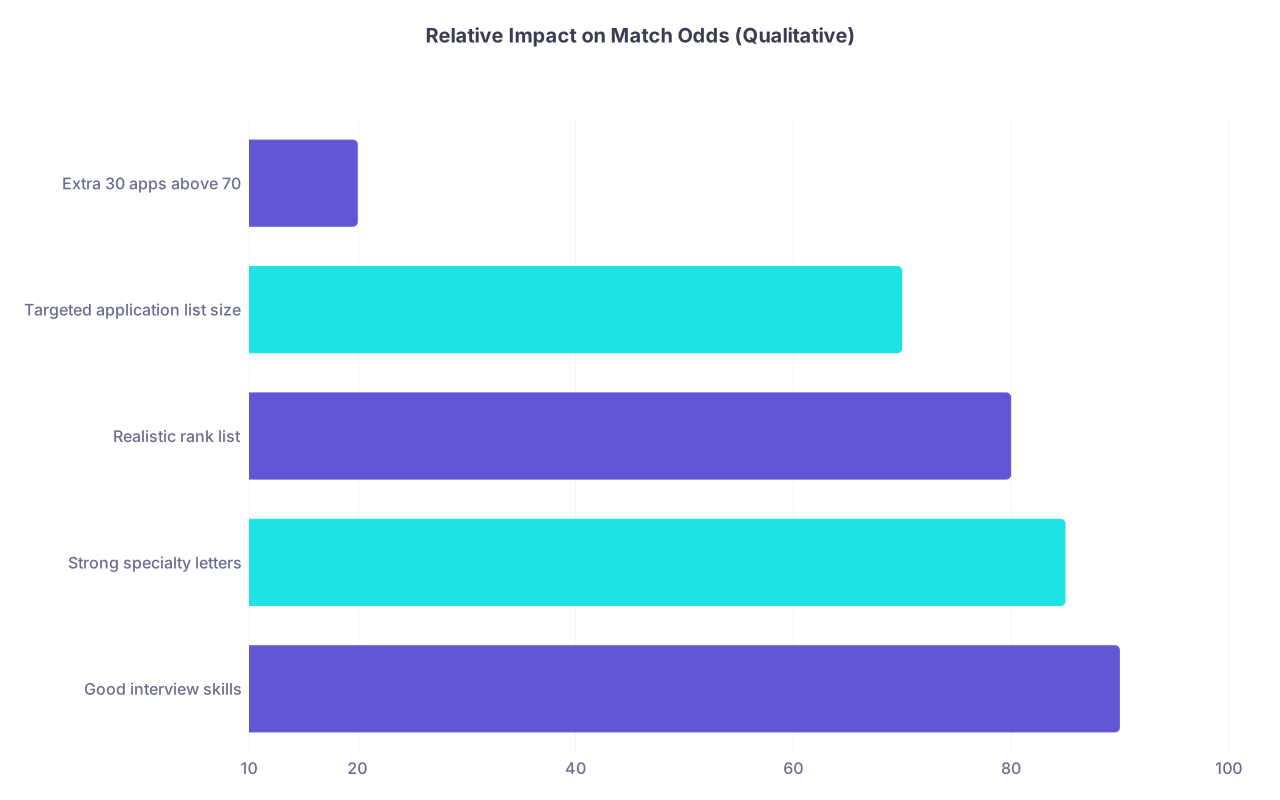
| Category | Value |
|---|---|
| Good interview skills | 90 |
| Strong specialty letters | 85 |
| Realistic rank list | 80 |
| Targeted application list size | 70 |
| Extra 30 apps above 70 | 20 |
You’re not short on opportunities to improve your application. You’re just being sold the lazy, expensive shortcut: more applications.
A Simple, Rational Framework by Competitiveness
Let’s put some guardrails around all this. Not a rigid rulebook, but a sanity check.
| Applicant Profile | Typical Reasonable Range |
|---|---|
| Strong US MD, less competitive specialty | 25–40 |
| Average US MD, less competitive specialty | 35–55 |
| US MD, moderately competitive specialty | 45–70 |
| US MD, highly competitive specialty | 60–90 |
| US DO / IMG, moderately competitive | 60–90 |
| US DO / IMG, highly competitive | 80–110 (targeted, not random) |
Yes, there are edge cases. But if you’re wildly outside these ranges, you should have a data‑driven explanation, not just “Reddit said so.”

The Bottom Line
Here’s what this all distills down to:
- More is not linearly better. After a moderate number of programs, additional applications add cost and stress with minimal interview gain.
- Interviews, not raw application count, drive match odds. Your realistic goal is ~8–12 interviews, not 100 programs.
- Targeting beats panic. A well‑researched, stratified list of 40–70 programs usually outperforms a sloppy list of 100+.
If you’re about to click “submit” on 120 apps, stop.
Run the numbers. Check your specialty’s data. Trim the fat. Put that money and time into making each serious application—and each interview—actually count.