
The “apply everywhere” residency strategy is lazy advice—and the data shows it backfires more often than it saves you.
People push it because it’s simple, fear-based, and sounds safe: “Just apply to as many programs as possible, you’ll increase your odds.” That’s not strategy. That’s panic spending.
Let me walk you through what actually happens when applicants carpet-bomb ERAS with 80, 100, 150+ applications, and why the numbers—and program behavior—don’t support it for most people.
The Data Reality: More Applications ≠ Proportionally More Interviews
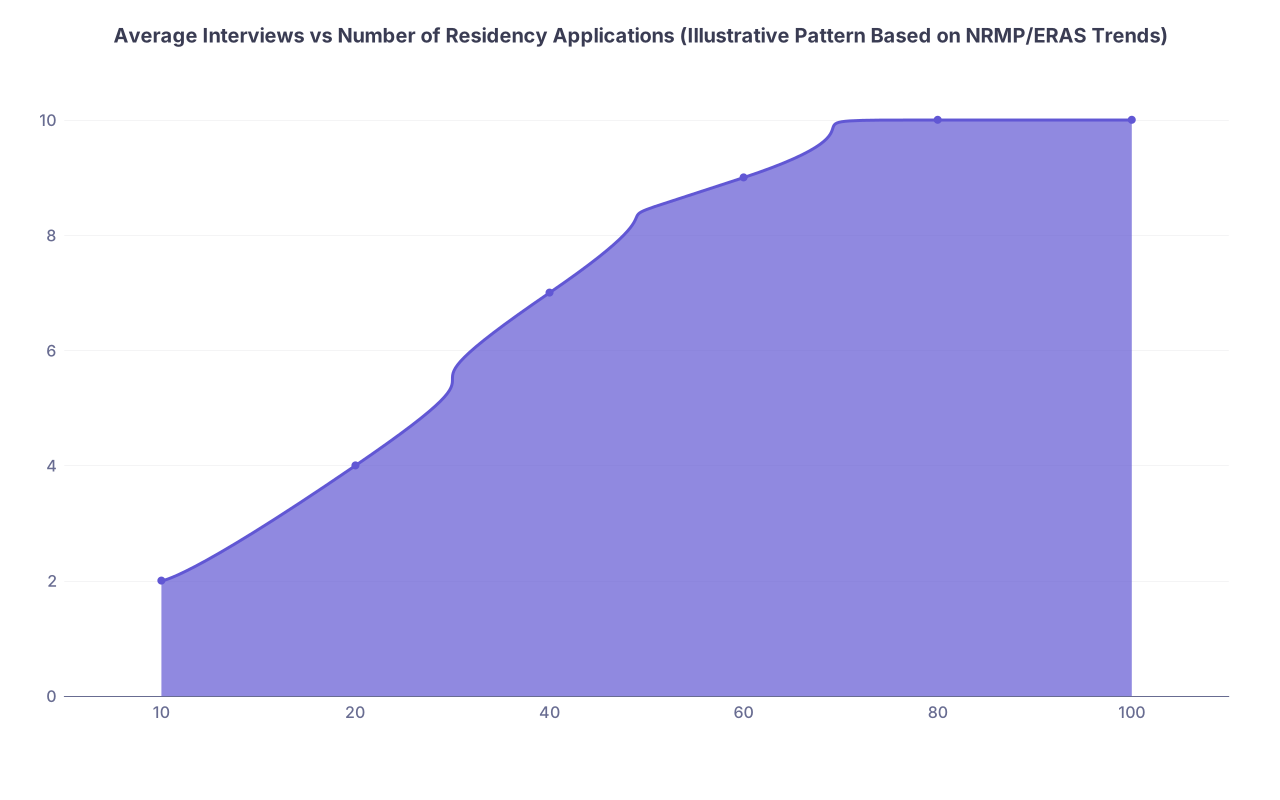
There is a correlation between number of applications and interview counts. But it’s weak, nonlinear, and ugly.
| Category | Value |
|---|---|
| 10 | 2 |
| 20 | 4 |
| 40 | 7 |
| 60 | 9 |
| 80 | 10 |
| 100 | 10 |
You can argue with exact numbers program by program, but the shape is right:
- You get big returns going from 10 → 40 applications
- You get diminishing returns from ~40 → 60
- Past about 60–70 in most core specialties? The curve flattens hard
ERAS and NRMP have published multiple reports showing:
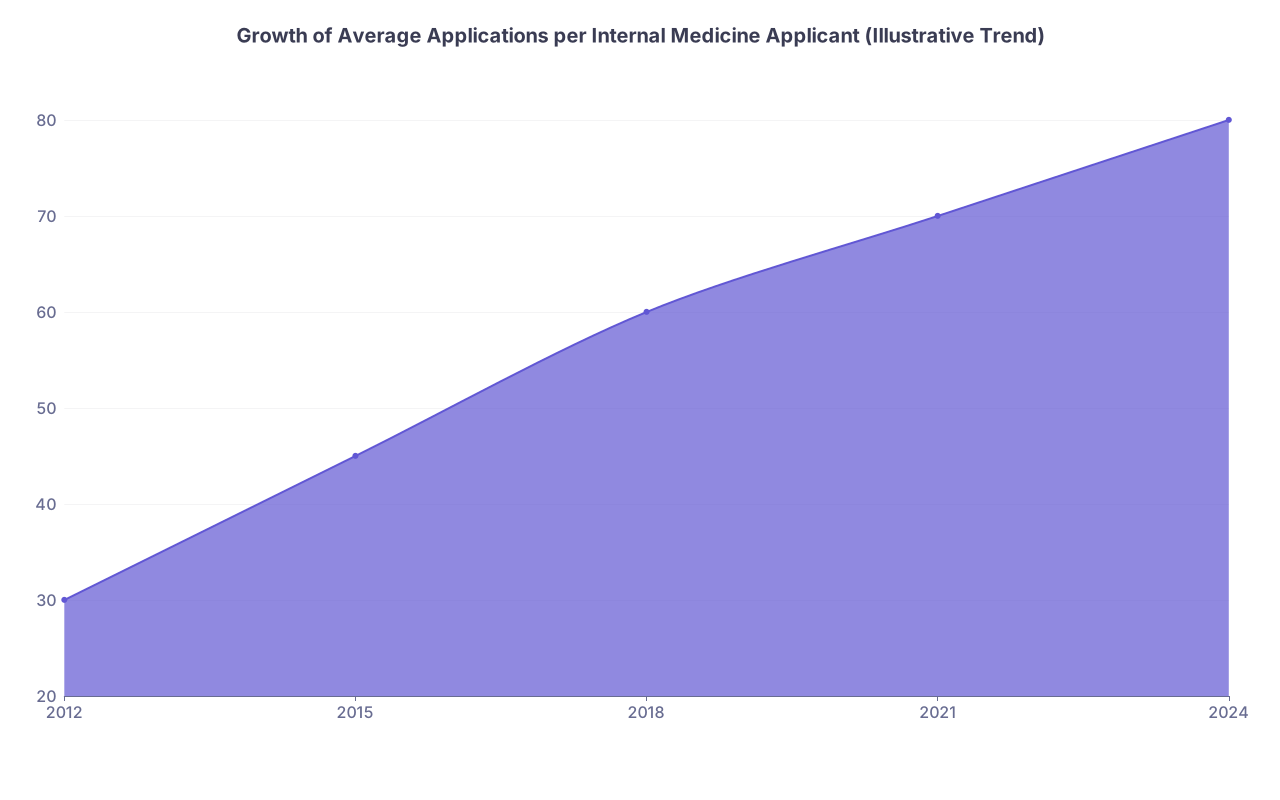
- Applicants are applying to more programs every year
- The match rate has not increased proportionally
- The interview offer per application ratio drops as application counts climb
Programs respond rationally when they’re flooded:
- They raise filters (Step scores, med school, visa status)
- They lean harder on prestige and “known” schools
- They rely more on signals (in specialties that use them) and meaningful interest
In other words, the more everyone applies everywhere, the less your individual application means to each program. You become noise in a giant inbox.
So yes, going from 10 to 40 is usually smart. Going from 60 to 120 because you are terrified? That’s mostly paying to be ignored.
The Hidden Cost: Time, Quality, and Red Flags
People talk endlessly about the money cost of over-applying. That’s real but not the main problem. The bigger cost is quality and the artifacts of desperation your file starts to carry.
1. Your personal statement and experiences get worse
Nobody writes 100 program-specific applications well. They just don’t.
Here’s what I keep seeing:
- Generic personal statements that could be sent to any of 200 programs
- Sloppy edits—wrong program names, wrong city, wrong specialty mentioned
- Boilerplate “I am drawn to your program’s commitment to excellence and diverse patient population…” (which means nothing)
Program directors and faculty interviewers routinely tell me some version of:
“If your materials look copy-pasted and generic, we assume you don’t actually care about us. And we move on.”
Programs are choosing among applicants who:
- Rotated there
- E-mailed the coordinator intelligently
- Mention specific faculty, tracks, or clinical strengths
Your “apply everywhere” blast makes it impossible to show that level of intentionality to more than a fraction of programs.
2. You cannot manage the interviews you do get
Over-applying often leads to a new problem: interview overload for strong applicants.
You apply to 80–100 Internal Medicine programs, your numbers are above average, and suddenly:
- You get 25+ interview invites in the first few weeks
- You start canceling and rescheduling last minute
- You come to interviews exhausted, repetitive, and obviously “going through the motions”
Programs notice things like:
- Late cancellations
- Generic answers to “Why our program?”
- Applicants who can’t remember basic details about the program they’re interviewing with
That’s how a “safety net” strategy becomes a way to look disorganized and uninterested.
3. Desperation patterns creep into your behavior
I’ve seen this repeatedly around October–November:
- Applicants with 4–5 interviews panic and fire off more applications late
- They mass-email programs with poorly written, template-style “letters of interest”
- They start asking advisors if they should apply to another specialty last minute
Programs see this behavior and interpret it correctly: lack of focused planning.
Over-applying is almost always a symptom of unfocused strategy. Programs prefer people who know what they’re doing.
Who Actually Benefits From Applying Broadly? (Much Narrower Than You Think)
Here’s the part people misread. I’m not saying everyone should apply to 20 programs and chill. I’m saying “apply everywhere” as default advice is garbage.
Who might reasonably need broad applications?
- Applicants in ultra-competitive specialties (Derm, Ortho, Plastics, ENT, NSGY)
- Applicants with major red flags: failure(s), large Step gap, no home program in the specialty, visa dependency, or very late specialty switch
- IMGs (especially non-US IMGs) in certain fields
Even in these groups, though, “broad” doesn’t mean “totally indiscriminate.”
A US-IMG applying Medicine might need 100+ programs. Fine. But it should still be a curated 100, not a random ERAS scrape.
For most US MD/DO applicants in core fields like IM, Peds, FM, Psych, Neuro, Gen Surg:
- A focused, high-quality 35–60 program list usually beats a random 70–100 list
- Program selection matters more than raw number past a threshold
The obsession with “just add more” hides the more useful question: which programs are actually realistic and aligned with your file?
What the Data and Programs Actually Suggest: Strategic Ranges
Let’s talk practical numbers with the obvious disclaimer: these are ballparks, not prescriptions. Your Step, school type, red flags, and specialty competitiveness all matter.
But here’s a more honest starting framework.
| Applicant Type | Reasonable Range | When To Go Higher |
|---|---|---|
| Strong US MD (no red flags) | 25–40 | Aiming mostly at top-tier programs |
| Average US MD / Strong US DO | 35–60 | Step 2 below average or limited geographic flexibility |
| Average US DO / US-IMG (solid scores) | 60–90 | No home program, visa issues, or failed attempt |
| Non-US IMG or with major red flags | 80–120 | Competitive specialty or multiple significant red flags |
Those ranges are for core specialties (IM, Peds, FM, Psych, Neuro).
Surgery and competitive fields often push higher, but the same principle holds: past a certain point, you’re just buying lottery tickets with terrible odds.
How Over-Applying Warps the Whole System (And Hurts Everyone)
This is the part people pretend is somebody else’s problem. It’s not.
| Category | Value |
|---|---|
| 2012 | 30 |
| 2015 | 45 |
| 2018 | 60 |
| 2021 | 70 |
| 2024 | 80 |
As average applications climb:
- Programs drown in files, so they lean more on:
- Rigid score cutoffs
- School name / prestige
- Existing connections
- Geographic bias
- Holistic review becomes basically impossible at scale
- More applicants get zero interviews—not because they are terrible, but because they’re buried in noise
And then those same people are told: “See, you didn’t apply to enough places, next year just apply to more.”
So each cycle, everybody dials up the number again.
Your personal decision to apply to 90 instead of 55 isn’t just about you. It amplifies the arms race that makes the process dumb and unfair for everybody with normal stats and no elite branding.
The Better Question: How Many Can You Apply To Well?
Let me be blunt. You should not apply to more programs than you can:
- Research meaningfully
- Mention something specific about (at least in your interview prep)
- Manage logistically if they all offered you interviews
That last piece gets ignored all the time. Look at this:

| Step | Description |
|---|---|
| Step 1 | Applications Sent |
| Step 2 | Interview Invites |
| Step 3 | Risk of not matching |
| Step 4 | Reasonable for most |
| Step 5 | Burnout and cancellations |
| Step 6 | Max realistic interviews |
Most applicants match comfortably with around 10–14 interviews in non-crazy specialties. Above ~20, extra interviews add more stress than safety.
So if your realistic top-end capacity is 18 interviews before you start burning out and canceling:
- Applying to 120 programs when 60 well-chosen ones would likely give you those 18 is wasteful
- You’re clogging the system and making it harder to show genuine interest to any one program
How To Choose A Smart Number (And Smart Programs)
Here’s the strategic version of “how many programs should you apply to” for residency, minus the fear-based nonsense.
Start with three realities:
- How competitive is your specialty this year?
- Where do you sit statistically relative to that specialty?
- What geographic or visa constraints limit you?
Then build from there.
Step 1: Define your realistic interview target
For most people:
- 10–12 interviews = generally safe to match in non-competitive fields if programs are appropriate
- 12–15 interviews = solid cushion
- 16–20 = plenty, often overkill unless you’re in a more competitive specialty or have specific constraints
Step 2: Estimate your interview yield
This is where advisors usually fail. They either grossly underestimate risk or catastrophize.
Rough idea for core specialties if your list is appropriately targeted:
- Strong US MD: 1 invite per 2–3 applications
- Average US MD / strong US DO: 1 per 3–4
- Average US DO / solid IMG: 1 per 4–6
- Weaker IMG or with red flags: 1 per 6–10
So if you’re an average US MD aiming for 12 interviews:
- Expect 1 interview per ~3–4 apps
- That’s around 36–48 programs
- You might bump that to 50–55 if your Step 2 is soft or you’re geographically inflexible
That’s strategy. Not vibes.
Why “Apply Everywhere” Feels Safe (And Why It Isn’t)
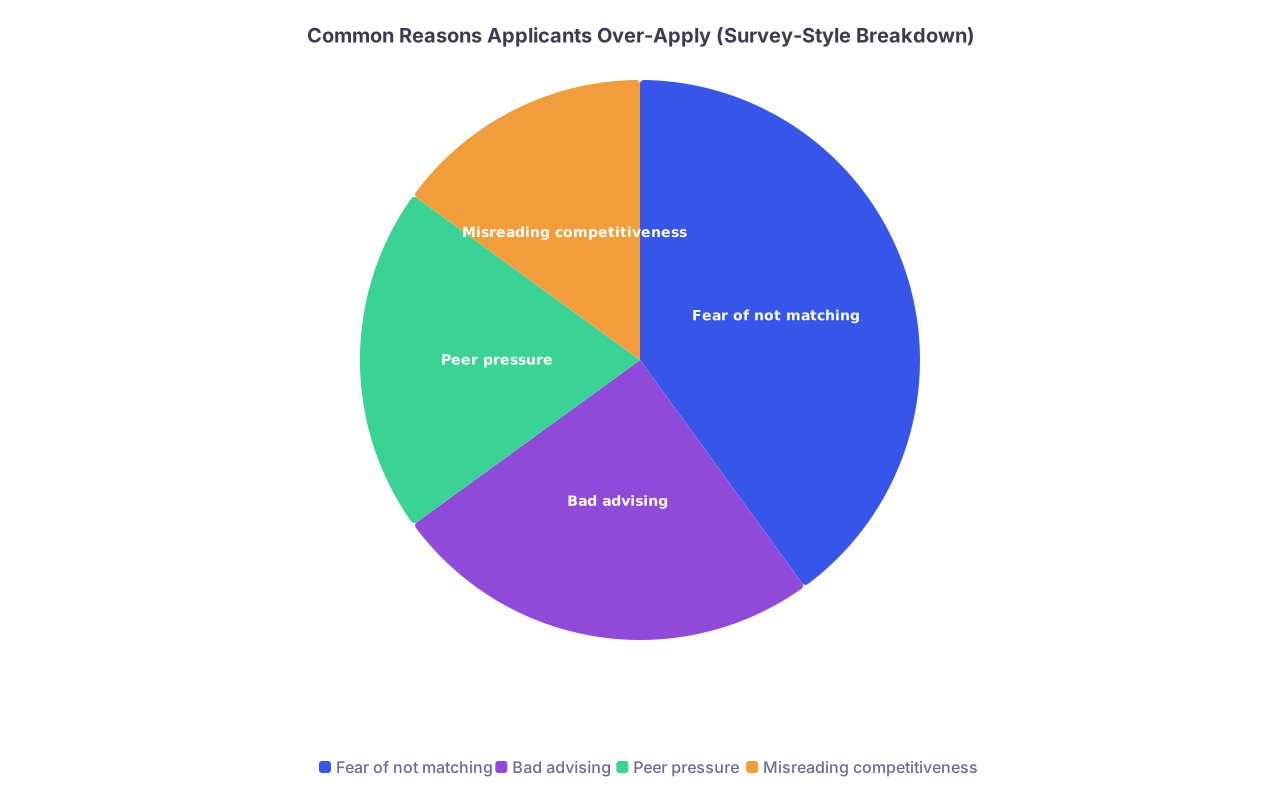
There are three psychological traps driving over-application:
| Category | Value |
|---|---|
| Fear of not matching | 40 |
| Bad advising | 25 |
| Peer pressure | 20 |
| Misreading competitiveness | 15 |
- Fear of not matching
- Bad or lazy advising (“just apply broadly”)
- Peer pressure and rumor (“my friend applied to 120 and matched great”)
- Misreading competitiveness stats (e.g., ignoring that averages hide red flags)
The irony: over-applying often increases your risk of not matching in subtle ways:
- Sloppier applications → fewer interview invites
- Poor prioritization → you miss interview slots at programs that were actually best fits
- Burnout → you underperform on the interviews that matter most
Playing pure defense rarely wins this game. Programs gravitate to applicants who look focused, intentional, and prepared—not those who sprayed their file all over the country.
What To Do Instead Of Panicking
A sane approach looks like this:
- Use a realistic program count based on your stats and specialty (not your anxiety level).
- Build a tiered list:
- Some reaches (10–20%)
- A heavy core of solid “match-range” programs
- A meaningful number of true safeties based on data, not vibes
- Make your materials actually good:
- One strong specialty-focused personal statement
- Optional minor tweaks for specific programs you really care about
- Thoughtful experiences descriptions that read like a human wrote them
- If, after interview season starts, you’re under-interviewed (say, <5 by mid-November in a non-ultra-competitive specialty), then you consider a targeted late-application expansion or a re-evaluation of list and strategy.

Notice what’s missing from that plan: “Automatically apply to 100 because I’m scared.”
Quick Reality Checks Before You Click ‘Submit to All’
If any of these are true, your problem is not “too few programs”:
- You haven’t opened more than 10 actual program websites yet
- You cannot explain why you’d fit at each program beyond “it’s in a city”
- Your PS or experiences still read like a draft
- You don’t know the rough average Step 2 / COMLEX scores or IMG rate for the programs you’re applying to
- You can’t afford to go on 20 interviews, but you’re applying like you can
Fix those first.

The Bottom Line: Why “Apply Everywhere” Fails More Than It Works
The myth sounds comforting. It is also lazy, wasteful, and often counterproductive.
What the data and real-world behavior actually show:
- Applications have ballooned, but match rates and interview yields have not kept pace. Past a sane threshold, more applications mostly = more noise.
- Over-applying destroys quality, makes you look generic or desperate, and strains your ability to perform well on the interviews that matter.
- A targeted, data-informed list sized to your true interview needs beats carpet-bombing in almost every situation except the most high-risk or ultra-competitive edge cases.
If you remember nothing else:
Don’t apply to more programs than you can research, represent well, and reasonably interview with if they all said yes.

FAQ (Exactly 3 Questions)
1. Is there ever a situation where applying to 100+ programs actually makes sense?
Yes—usually for non-US IMGs, applicants with multiple significant red flags, or those applying to very competitive specialties from a weaker position. Even then, it should be a curated 100, not “every program in the country.” Raw volume without strategy just burns cash.
2. I’m an average US MD applying Internal Medicine. Is 80 programs too many?
For most average US MD IM applicants, 80 is overkill and a sign of anxiety, not strategy. A well-chosen 40–60 list based on your Step 2, geography, and program types is usually sufficient and far more manageable. Put your extra effort into quality, not more checkboxes.
3. How do I know if I under-applied after ERAS is submitted?
Watch your interview count and timeline. If you have zero interviews by late October or fewer than ~4–5 by mid-November in a non-ultra-competitive field, that’s a red flag. At that point, talk to an informed advisor about whether to add a targeted batch of additional programs rather than blindly spraying more applications.