
The biggest lie about residency applications is simple: “I’m geographically flexible, so I’ll just apply everywhere.”
That sentence quietly wrecks more application strategies than a low Step score.
People think geographic flexibility automatically means “apply to more programs and you’ll be safe.” The data says almost the opposite: vague flexibility usually leads to bloated, unfocused program lists that cost thousands of dollars and do not meaningfully improve your match odds.
Let’s tear this apart properly.
The “I’ll Go Anywhere” Myth vs How Programs Actually Work
I’ve sat with students who said the exact same line:
“I don’t really care where I go, I just want to match. I’ll list like 100 programs.”
Then we pull out a real map, real programs, and real constraints. Within 20 minutes, their “anywhere” shrinks to 3–5 vague regions and a long list of places they swear they’d never move to.
Here’s the core problem:
You’re overestimating both:
- How much you’re actually willing to move
- How much programs care that you’re “flexible”
Programs do not rank you higher just because you say, “I’ll go anywhere.” They care about:
- Do you fit their usual applicant pool?
- Do you have any connection to their region?
- Does your application scream, “I want to be here,” or “I panic-applied to 80 places at 2 AM”?
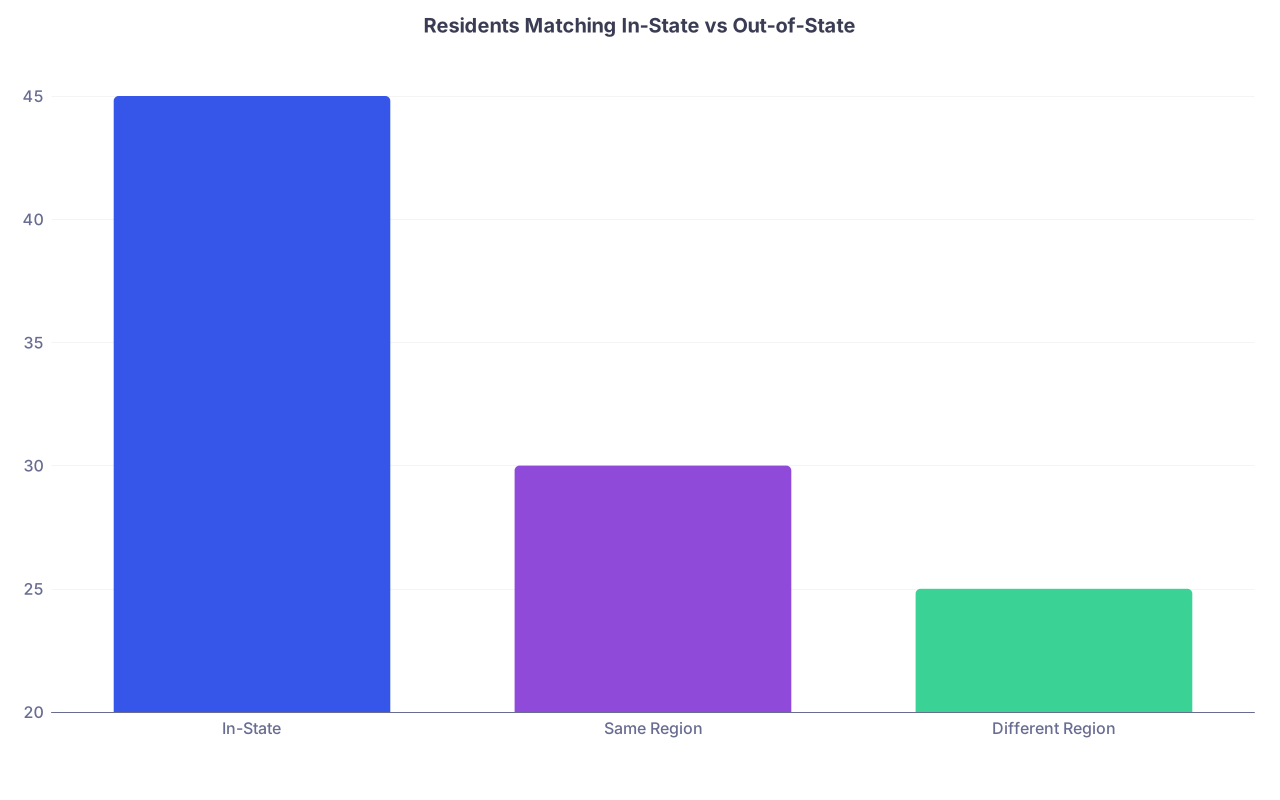
And the evidence backs this up. Look at NRMP data on geographic distribution:
| Category | Value |
|---|---|
| In-State | 45 |
| Same Region | 30 |
| Different Region | 25 |
Almost half of residents match in the same state as their medical school. Another big chunk stays within the same region. Only a minority truly cross regions.
So no, the average applicant is not “geographically flexible.” They’re geographically predictable. Programs know this. You should plan like you know it too.
Myth: More Regions = Safer Strategy
The conventional wisdom:
“If you’re open to the whole country, apply to way more programs. It’ll increase your chances.”
What the numbers actually show:
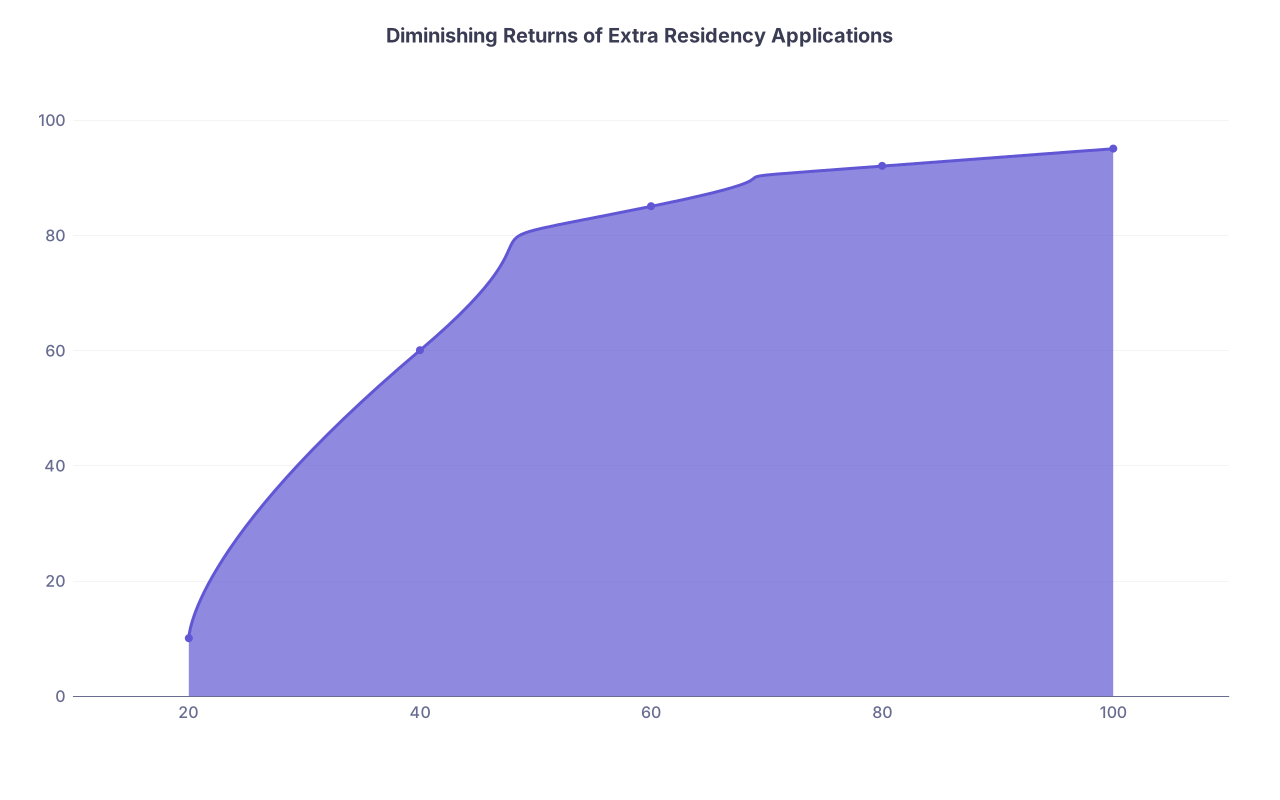
Your return on each additional application falls off a cliff after a certain point.
Let’s talk about this in real terms.
Say you’re applying to Internal Medicine with a reasonably competitive profile:
- Step 2 CK: 240–245
- Mostly Honors/High Pass on rotations
- Some research, nothing stellar
- No major red flags
If you keep your search focused on 2–3 well-defined regions and build a thoughtful list of 40–60 programs that actually interview people like you, you’re already in a solid range.
What most people do instead: they expand to every region “just in case” and go from 60 to 100+ programs.
The cost goes way up. The marginal benefit barely moves.
| Category | Value |
|---|---|
| 20 | 10 |
| 40 | 60 |
| 60 | 85 |
| 80 | 92 |
| 100 | 95 |
Those numbers aren’t exact NRMP outputs (no one gives you that clean a curve), but this is the consistent pattern: going from 20 to 40 programs is huge. From 40 to 60 still helps. From 60 to 100? You’re burning money and sanity for tiny incremental gains.
The trap is psychological. You feel safer with more programs, especially in “extra” regions. In reality, you’re:
- Diluting your signal (“Why is this person applying to 18 states they’ve never set foot in?”)
- Creating more work (customizing, researching, stressing)
- Paying a huge premium for low-yield options
I’ve seen people with 100+ applications end up with fewer interviews than people with 50–60 smartly chosen ones. Not because the algorithm was cruel. Because their application looked like a shotgun blast.
Being “open to the whole country” is not a strategy. It’s an excuse not to make decisions.
Myth: Geography Doesn’t Matter If You’re Strong
Another delusion: “My scores are great so region won’t matter.”
Strong applicants absolutely have more flexibility, but geography does not suddenly disappear.
Programs still:
- Prefer people who show plausible reasons to come and stay
- Notice when your entire life is in California but you’re applying heavy to small Midwest towns with zero explanation
- Worry you’re a flight risk who will jump to a ‘better’ coastal program if given the chance
There’s also the silent gatekeeping: a lot of regional, community, and smaller academic programs quietly favor:
- Local med schools
- DO schools they know
- Students from nearby states
Not always written, rarely advertised, but very obvious when you talk to enough applicants and PDs.
So if you’re “strong” and scatter your apps across 6–7 regions without any coherent pattern, you’re leaving signal on the table. You’d be better off:
- Picking 2–3 anchor regions where you can tell a credible story
- Possibly adding 1 “stretch” region you actually would move to
- Writing region-aware personal statements and highlighting ties
Which you cannot do well if you’ve applied to every ZIP code with a residency program.
Myth: Geographic Flexibility Means No Real Constraints
The funniest part? Most “I’ll go anywhere” people already have hard constraints. They just have not admitted them yet.
I’ll show you what I mean.
You say you’re flexible. I ask:
- Are you okay being a 5–6 hour flight from family?
- Do you have a partner with a specific job market?
- Kids or caregiving responsibilities?
- Any dealbreakers on climate (brutal winters, extreme humidity, etc.)?
- Any places you viscerally know you’d be miserable?
Suddenly your “anywhere” drops from 50 states to maybe 12–15. Then we filter by program density, competitiveness, and specialty. The real map is much smaller.
Geographic flexibility is not binary (flexible vs not). It’s a spectrum with specific axes:
- Distance from family
- Cost of living
- Urban vs suburban vs rural
- Climate
- Region culture (political, social, language, etc.)
- Spouse/partner job viability
You don’t need a spreadsheet for every factor, but you do need honest non-negotiables.
Because here’s the key point:
If you would not rank a program highly enough to actually match there, there is no point applying to it. Full stop.
Yet people cram low-probability, low-desirability regions into their lists “just in case.” They tell themselves they’re flexible. They’re not. They’re panicking.
How Geography Really Should Shape Your Program List Size
Let’s ground this in something useful. Common pattern I see:
You have 3 basic variables:
- Competitiveness (relative to your specialty)
- True geographic flexibility (what you’d actually rank)
- Willingness to tolerate risk (and possibly a reapplication year)
You build your program list at the intersection of those three. Not by blindly maxing out ERAS.
Here’s a simplified comparison of what smart list sizes look like when you factor in real, not imaginary, geographic flexibility:
| Profile Strength | Geographic Flexibility | Typical Region Count | Reasonable Program Count |
|---|---|---|---|
| Strong | Low (1 region) | 1–2 | 25–40 |
| Strong | Moderate (2–3) | 2–3 | 40–60 |
| Average | Low | 1–2 | 40–60 |
| Average | Moderate | 2–3 | 60–80 |
| Average | High | 3–4 | 70–90 |
You’ll notice what’s not there: “Apply to 120+ because you’re ‘open to anywhere.’”
That over-100 world is reserved for:
- Very competitive specialties (Derm, Ortho, ENT, Plastics, etc.)
- Reapplicants
- Applicants with significant red flags
And even then, mindless geographic sprawl is still a bad strategy. You target clusters, not every dot on the map.
The Hidden Cost: You Can’t Fake Genuine Interest in 100 Places
There’s a practical limit to how many programs you can convincingly care about.
You’ll hear PDs say things like:
- “We could tell they knew nothing about our program.”
- “Their personal statement was generic; it looked like everyone else’s.”
- “I asked why they were interested in our city and they had nothing.”
That’s what bloated program lists do. You don’t have time to:
- Learn the structure, strengths, and vibe of 80+ places
- Remember who’s 3+1, who’s X+Y, who’s heavy ICU, who’s clinic-heavy
- Write tailored meaningful “why us” comments or answer interview questions well
So what happens? Your interviews feel shallow. You sound like you’re reading off the website. The PD has 20 other applicants who actually know what city they’re in and why.
You got the interview because you mass-applied. You lose the spot because you never had the bandwidth to invest.
I’ve watched this play out with people who landed 10–12 interviews but matched disappointingly low on their rank list, or not at all. Not because of raw numbers, but because their entire strategy screamed: “I am trying to brute-force this with quantity.”
Programs do not reward that.
Use Geography To Focus, Not Inflate
So what should you actually do with geographic flexibility?
You use it to sharpen your list, not expand it into nonsense.
Here’s a simple, adult way to do that.
First, map your real regions:
- Region A: Must-apply (family, partner job, you’d be happy here long-term)
- Region B: Strongly interested (no ties, but you’d move willingly)
- Region C: Backup region (you’d go, but not ecstatic)
Second, estimate capacity in each region. A quick mental exercise:

| Step | Description |
|---|---|
| Step 1 | Choose Specialty |
| Step 2 | Identify Real Regions |
| Step 3 | Check Program Density |
| Step 4 | Prioritize and Apply |
| Step 5 | Add New Region |
| Step 6 | Enough Programs? |
If Region A alone has 10–15 programs in your range? Great, but not enough by itself (for most people).
Add Region B with another 15–25. Now you’re at 25–40.
If you’re average-competitive, add Region C with another 20–30 realistic options.
You’re probably landing in that 60–80 range that actually makes sense for a normal, non-super-competitive specialty.
And yes, sometimes you do need to add another region or two if your chosen specialty is competitive or your regions are low-density. But that’s done consciously, not by default.
You’re not letting “I’ll go anywhere” balloon your list. You’re asking:
- Does this region give me enough realistic shots?
- Would I rank programs here high enough to actually match?
- Do I have the time and energy to research and interview here?
If the answers are no, you do not apply “just to be safe.” There is nothing safe about wasting money and attention on places you will not rank.
When “Anywhere” Is Actually Legit
There are people who are truly geographically flexible:
- Single, no kids, no partner constraints
- Comfortable living in almost any urban/suburban setting
- Not intensely attached to specific regions or climates
- Deeply committed to just training in their specialty, wherever that is
Those people exist. But even then, smart ones do not just spray ERAS across every possible program.
They still:
- Cluster applications in 3–4 regions for interview efficiency
- Favor places where their metrics align with typical matched residents
- Use their “anywhere” flexibility to reach into both high-tier and safety regions in a deliberate way
Think of it like this: geographic flexibility is leverage, not a license to be sloppy.
You use it to:
- Boost your odds in slightly stronger regions where others are shy
- Add a few extra programs in solid backup areas
- Pivot if interview season shows clear patterns (more love from Midwest? Shift your focus there)
You do not use it to turn your program list into a random US census of hospitals.
The Real Takeaways
Let’s strip this down.
- “I’m geographically flexible” is usually a story you tell yourself, not a real constraint analysis. Once you confront actual dealbreakers, your map shrinks fast.
- More regions and more programs don’t scale linearly with match odds. After a sane threshold, your returns plummet while your cost and chaos explode.
- Geography should help you focus your list and tell a believable story, not inflate it into a 100-program panic move you cannot meaningfully follow through on.
If your program list size is built on the myth of unlimited geographic flexibility, it’s almost certainly too big, too random, and too expensive—and not actually safer.