
Most of what you’ve heard about how many programs to rank on NRMP is wrong. Not mildly off. Flat-out contradicted by the data NRMP publishes every few years.
You’ve probably heard some combination of:
- “Just rank your top 10, anything else is a waste.”
- “Never rank a place you wouldn’t be happy at.”
- “If you rank too many programs, it makes you look desperate.”
- “You only need to rank where you had a ‘good feeling’.”
I’ve watched too many otherwise sharp applicants sabotage themselves because they trusted vibes over math. The match algorithm is not mystical. It’s a very predictable piece of machinery. And it rewards strategy, not sentimentality.
Let’s walk through what the data actually shows about how many programs to rank — and demolish some popular myths along the way.
Myth #1: “You shouldn’t rank programs you’re not in love with”
This is the most dangerous half-truth in the whole process.
Here’s the reality:
The NRMP algorithm tries to match you to the highest-ranked program on YOUR list that also ranks you high enough. It does not “punish” you for having backup options. It does not infer anything about your “true” interest. It does not care about your feelings.
The only real rule is much simpler:
Don’t rank a program you would truly rather go unmatched than attend.
That’s it. Not “don’t rank a program you wouldn’t brag about on Instagram.” Not “don’t rank a program that didn’t serve lunch.” You are not curating a portfolio. You are trying to avoid unemployment in March.
I’ve seen this exact story play out more than once:
Student with a decent but not stellar application, interviewed at 9 programs in a moderately competitive specialty. They “only” ranked 5 because “the other 4 felt like a bad fit.” They went unmatched. Scramble (SOR). Stress. A year of research they never wanted. When I asked which of the 4 “bad fit” programs they would’ve preferred to a forced research year, they said “Honestly? All of them.”
That’s the point. Your “fit” radar is not that precise. Especially after 8–15 scripted, Zoom-polished interview days.
The sensible rule:
- Rank every program where:
- You interviewed
- There is a non-zero chance you’d actually go there if it’s your only option
If your personal line is “I’d rather be unmatched and SOAP into prelim surgery than do FM,” fine — don’t rank FM. But be very sure you’re not just being prideful.
What the NRMP Data Actually Shows About List Length
NRMP doesn’t hide the ball here. They literally publish graphs every few years showing match rate vs. number of programs ranked by specialty and applicant type.
The curves all say the same thing: longer rank lists are strongly associated with higher match rates. Especially for independent applicants (DOs, IMGs) and competitive specialties.
Here’s a simplified snapshot-style view to make the pattern obvious.
| Applicant Type / Specialty Example | 5 Programs Ranked | 10 Programs Ranked | 15 Programs Ranked | 20+ Programs Ranked |
|---|---|---|---|---|
| US MD, Internal Medicine | ~85% | ~93% | ~96% | ~98%+ |
| US MD, General Surgery | ~75% | ~88% | ~92% | ~95%+ |
| US MD, Dermatology | ~45% | ~65% | ~75% | ~80%+ |
| DO/IMG, Internal Medicine | ~55% | ~70% | ~78% | ~85%+ |
| DO/IMG, General Surgery | ~30% | ~50% | ~65% | ~70%+ |
Numbers are rounded and illustrative, but the shape of the curves matches the NRMP “Charting Outcomes” reports.
To drive it home visually:
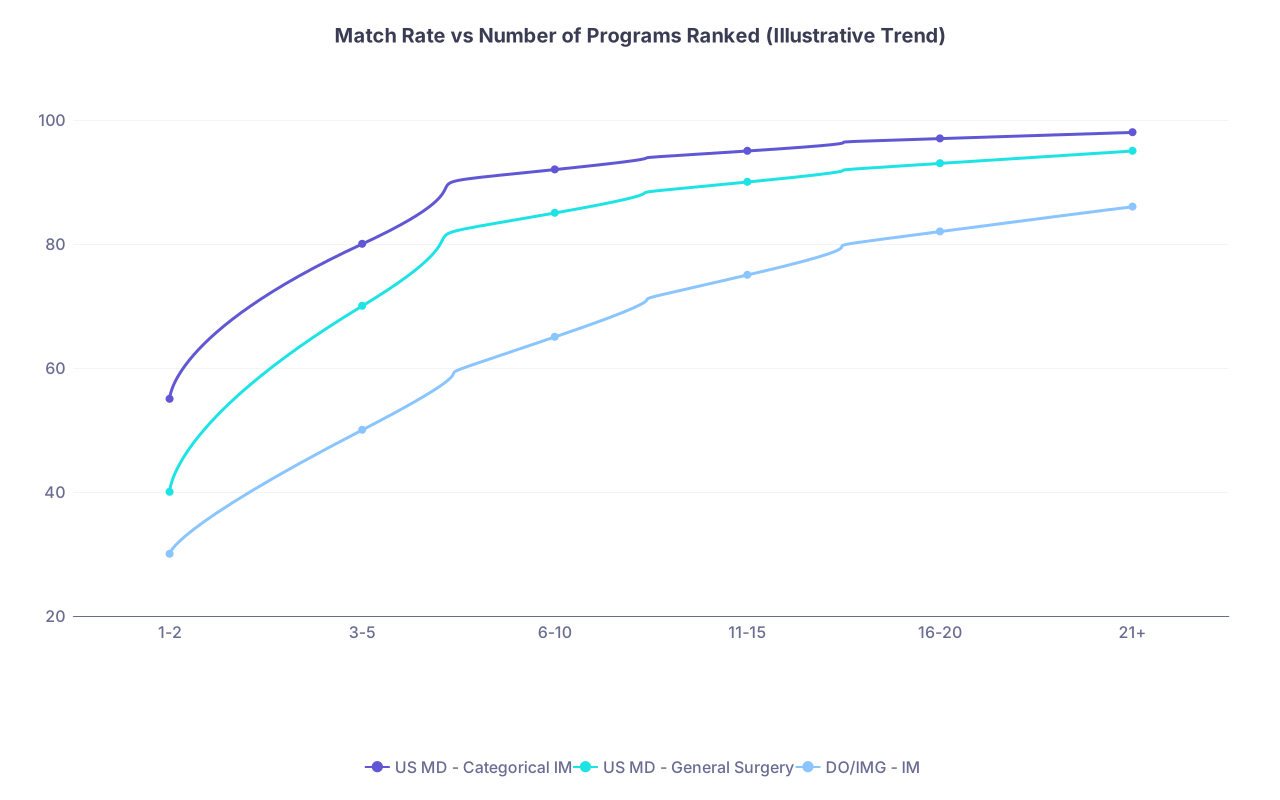
| Category | US MD - Categorical IM | US MD - General Surgery | DO/IMG - IM |
|---|---|---|---|
| 1-2 | 55 | 40 | 30 |
| 3-5 | 80 | 70 | 50 |
| 6-10 | 92 | 85 | 65 |
| 11-15 | 95 | 90 | 75 |
| 16-20 | 97 | 93 | 82 |
| 21+ | 98 | 95 | 86 |
The key pattern: the first 8–12 ranks usually give you the biggest jump, but the curve doesn’t totally flatten until somewhere around 15–20+ for many combos of specialty and applicant type.
Yet every year I hear people say, “After 10 it doesn’t matter.”
That’s not what the graphs show.
Myth #2: “Ranking more programs makes you look desperate / hurts you”
Wrong at the conceptual level.
Programs never see how many places you ranked or where you ranked them. That information is private to you and the algorithm. There is literally no signal to them that you “added safeties.”
The match algorithm is applicant-proposing. That’s jargon for: it starts with your preferences and tries to give you the best outcome for you, not what’s most convenient for programs.
Let me spell out what that means in plain English:
- You can rank 30 programs.
- Your #1 still behaves exactly like your #1.
- Your #15 doesn’t “dilute” your interest in your top 5.
- You’re not going to “fall” to a lower option just because you listed it.
You only end up at #15 if:
- Programs #1–14 didn’t rank you high enough to reach you, or
- They filled all their slots with people they ranked higher.
In that world, #15 didn’t hurt you. It saved you.
Here’s a simple flow:

| Step | Description |
|---|---|
| Step 1 | Start with applicant top choice |
| Step 2 | Temporarily assign spot |
| Step 3 | Move to next choice |
| Step 4 | Assignment final |
| Step 5 | Program keeps higher ranked applicant |
| Step 6 | Applicant unmatched |
| Step 7 | Program ranked applicant high enough |
| Step 8 | Conflict with another applicant |
| Step 9 | More programs on list |
Nowhere in there: “Punish applicant for ranking many programs” or “Reward applicant for only ranking 8 because they’re confident.”
Confidence doesn’t change the math.
Myth #3: “You only need to rank where you ‘felt a connection’”
Translation: “I’m going to throw away statistical advantage because I’m overweighting my 20-minute chat with Dr. Smith over Zoom.”
Program “fit” is real, but applicants massively overestimate their ability to judge it during curated interview days.
Here are some of the phrases I hear, year after year:
- “I just vibed with them more.” (Based on meeting 3 residents total.)
- “They said they were family-friendly.” (So does everyone.)
- “The PD called me by my first name.” (That is literally their job.)
What actually predicts your day-to-day satisfaction a year into residency?
Things like:
- Call schedule and true workload
- Toxic vs. supportive senior culture
- Program organization and responsiveness
- Quality of teaching and supervision
- How malignant or humane their response is when you screw up at 2 a.m.
You don’t really see that on interview day. You see whatever they choose to show you.
Am I saying ignore fit? No. I’m saying you’re overconfident about how well you’re measuring it.
Here’s a saner way to handle it:
- Use “fit” to order programs relative to each other, not to prune your list down to a fragile top 6.
- Rank the places you loved higher. Absolutely.
- But still rank the ones you found “fine but not exciting” below them.
Residency is 3–7 years. The difference between your #5 and #11 on the list is tiny compared with the difference between #11 and “unmatched.”
Myth #4: “After X programs, adding more doesn’t help”
I’ve lost count of how many times I’ve heard a random number inserted here: 8, 10, 12. None of them are universally true.
The correct answer is annoying but clear:
The marginal benefit of extra programs depends on:
- Your applicant type (US MD vs DO vs IMG)
- The specialty’s competitiveness
- How strong or weak your application is relative to that specialty
What NRMP data consistently shows:
- For US MDs in less competitive fields (IM, peds, FM), things plateau around 12–15 programs.
- For US MDs in mid-competitive fields (EM, general surgery, OB/GYN), more like 15–20.
- For very competitive specialties (derm, ortho, ENT, plastics), the “long list” people do better, and even 20 isn’t crazy if you have that many interviews.
- For DOs and IMGs, the plateau is higher and softer — extra programs keep adding real value longer.
Let’s visualize the “diminishing but not zero” returns idea:
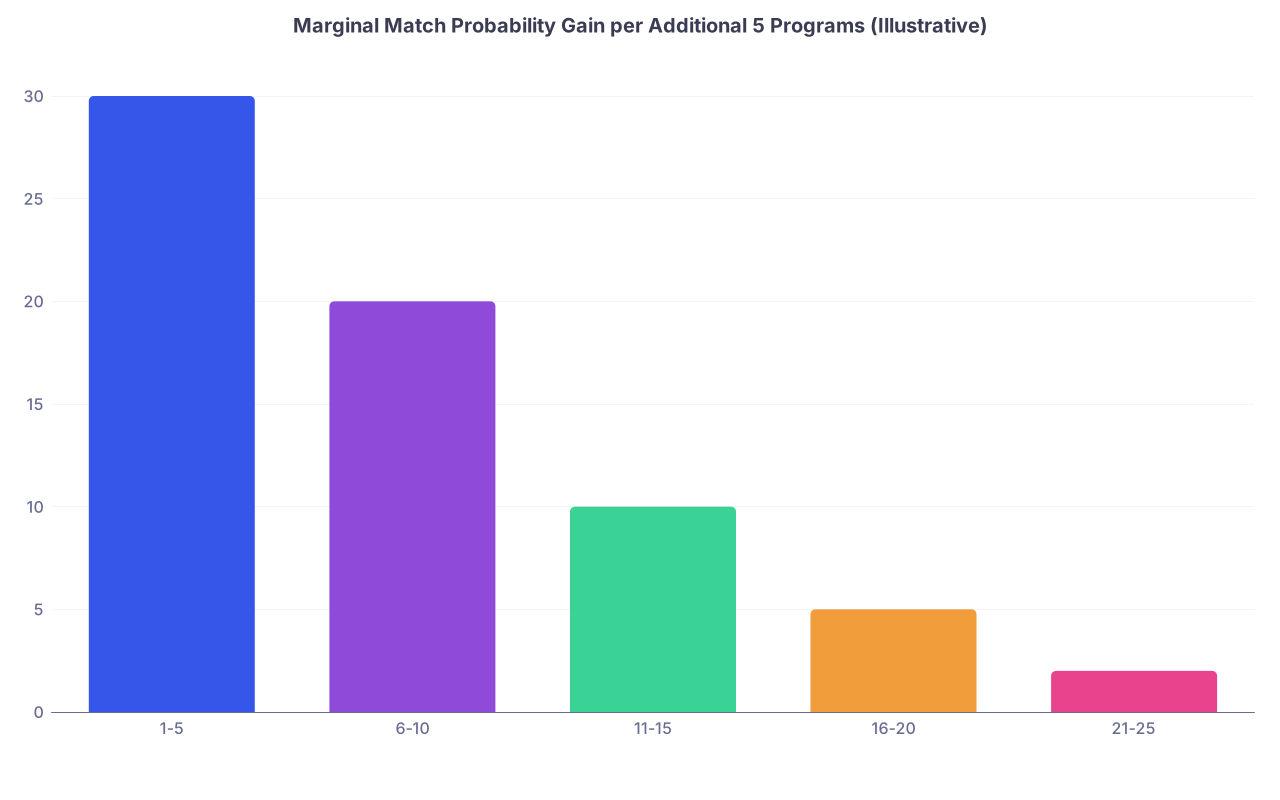
| Category | Value |
|---|---|
| 1-5 | 30 |
| 6-10 | 20 |
| 11-15 | 10 |
| 16-20 | 5 |
| 21-25 | 2 |
You see the big jumps at the beginning. But the tail isn’t flat. If you’re on the bubble, that extra 5–10% might be the difference between matched and unmatched.
So, no, “After 10 it doesn’t matter” is simply wrong. The better phrasing is:
- After ~15–20, gains shrink, and for very strong US MDs in noncompetitive specialties, they may be minimal.
- For everyone else, especially DO/IMG or competitive fields, those extra programs still buy real insurance.
Myth #5: “Ranking prelims / backups on the same list will screw things up”
This one’s more specific but it terrifies people into under-ranking.
For advanced specialties (like radiology, anesthesiology), you often have:
- A rank list for the advanced programs
- A separate rank list for prelim / transitional year programs (in some configurations)
Applicants worry: “If I rank more prelims or backup specialties, will I get stuck there instead of my chosen field?”
No. The algorithm treats those as separate problems:
- It tries to match you to your top categorical or advanced choices based on that list.
- For advanced tracks, it then separately tries to pair you with prelim spots that fit the year structure.
It does not say, “Well, they ranked 5 prelim IM programs very highly, so let’s abandon their desire for anesthesia.”
Where people do get into trouble is sloppy logic:
- Ranking a categorical field they don’t actually want above an advanced program in the field they do want.
- Not understanding which rank list is for which track (categorical vs advanced + prelim).
So yes, you need to understand which track is which, but that has nothing to do with “ranking too many.” It’s about ordering fields honestly.
Myth #6: “If you interview at 15+ places, you’re safe no matter what you rank”
I’ve seen people blow a strong interview season by getting lazy at the rank-list stage.
They think:
“I interviewed at 15 programs, so I’ll just rank the 8 I liked and still be fine.”
Then they realize half of those 8 are hyper-competitive academic places where they were clearly middle-of-the-pack, and the others are in extremely desirable cities where everyone wants to be.
The programs you liked most are usually the ones everybody liked most.
You know who often ends up at the “solid but less flashy” community or mid-tier academic programs?
- People who interviewed there…and then actually ranked them instead of pretending they only exist as emotional leverage.
If you have 15 interviews, the responsible move is simple:
- Order them in genuine preference.
- Then rank them all, unless there is one you’re 100% sure you’d rather go unmatched than attend.
There’s no bravery in leaving programs off your list. Just unnecessary risk.
How to Decide Your Realistic Rank List Length
Let’s put some structure around this instead of throwing random numbers.
Start with three questions:
What type of applicant are you?
- US MD seniors have the highest baseline match rate.
- DOs and IMGs need longer lists for similar safety.
How competitive is your specialty?
- FM vs derm is not the same sport.
How strong are you relative to that specialty?
- Step/COMLEX scores, research, AOA, home program, red flags.
Here’s a very rough target band for rank list length if you have that many interviews. Not a rule. A sanity check.
| Applicant / Specialty Situation | Sensible Rank List Target |
|---|---|
| US MD, FM / IM / Peds, strong | 10–12+ |
| US MD, FM / IM / Peds, average or weaker | 12–15+ |
| US MD, EM / OB / Psych / Gen Surg, strong | 12–15+ |
| US MD, EM / OB / Psych / Gen Surg, average/weaker | 15–20+ |
| US MD, very competitive (Derm, Ortho, ENT, etc.) | Rank every interview |
| DO or IMG, less competitive specialties | 15–20+ |
| DO or IMG, competitive specialties | Rank every interview |
“+” means: don’t cut the list short just to fit the range. If you have 18 interviews as an average DO applying IM, rank all 18.
The One Legit Reason to Leave a Program Off
Let’s be balanced. There is one good reason to intentionally shorten your list:
You visited a program and realized something non-negotiable:
- You’d be unsafe (severe personal or family reason, discrimination, etc.).
- The training is dangerously inadequate (near-absent supervision, consistently unsafe patient loads, major accreditation concerns).
- You have life constraints (partner, immigration, health) that make that location truly impossible.
Not “I didn’t like the resident who toured us.” Not “the PD seemed awkward.”
We’re talking “I’d seriously prefer to go unmatched and reroute my life rather than be there for 3–7 years.”
If a program clears that very high bar, sure — remove it. Otherwise, it should probably stay.
What Applicants Get Wrong Emotionally
A lot of rank-list self-sabotage boils down to ego:
- Not wanting to admit “I might need a safety.”
- Imagining an idealized version of Match Day where they only feel joy, no ambivalence.
I’ve watched people swallow their pride, rank programs they felt “meh” about, match lower on their list than they hoped…and then, a year later, tell me:
“Honestly, I dodged a bullet. I’m hearing horror stories from my friends at my ‘dream’ place.”
And I’ve watched others insist on a “short, high-quality list,” go unmatched, and suddenly discover an incredible tolerance for programs they arrogantly wrote off three months earlier.
The algorithm doesn’t care about your narrative. It cares about ordered lists and probability.
Be greedy with outcomes, not with appearances.
Bottom Line
- Longer rank lists are safer. The NRMP data is crystal clear: more programs ranked → higher match rates, especially for DOs/IMGs and competitive specialties.
- Rank almost every place you interviewed. The only reason to leave a program off is if you would truly rather be unmatched than train there. “Meh vibes” don’t qualify.
- You can’t “game” the algorithm by ranking fewer programs. The system is designed to favor your true preferences. Extra backups don’t hurt your chances at the top — they just save you when the top doesn’t work out.