
The idea that “you must apply to 80+ programs or you won’t match” is lazy, fear-based nonsense.
There is a real risk in this process. But the biggest danger for many applicants is not “too few programs.” It’s applying blindly, expensively, and stupidly—then blaming a “small list” when the strategy was the real problem.
Let me walk through what the data actually says about number of applications, and where this “apply to everyone with a pulse” advice completely falls apart.
What The Numbers Actually Show (Not What People Yell On Reddit)
The NRMP, AAMC, and specialty organizations have been quietly publishing data that torpedoes the myth that bigger is always better.
Here’s the key pattern across multiple specialties: return on additional applications drops off very fast.
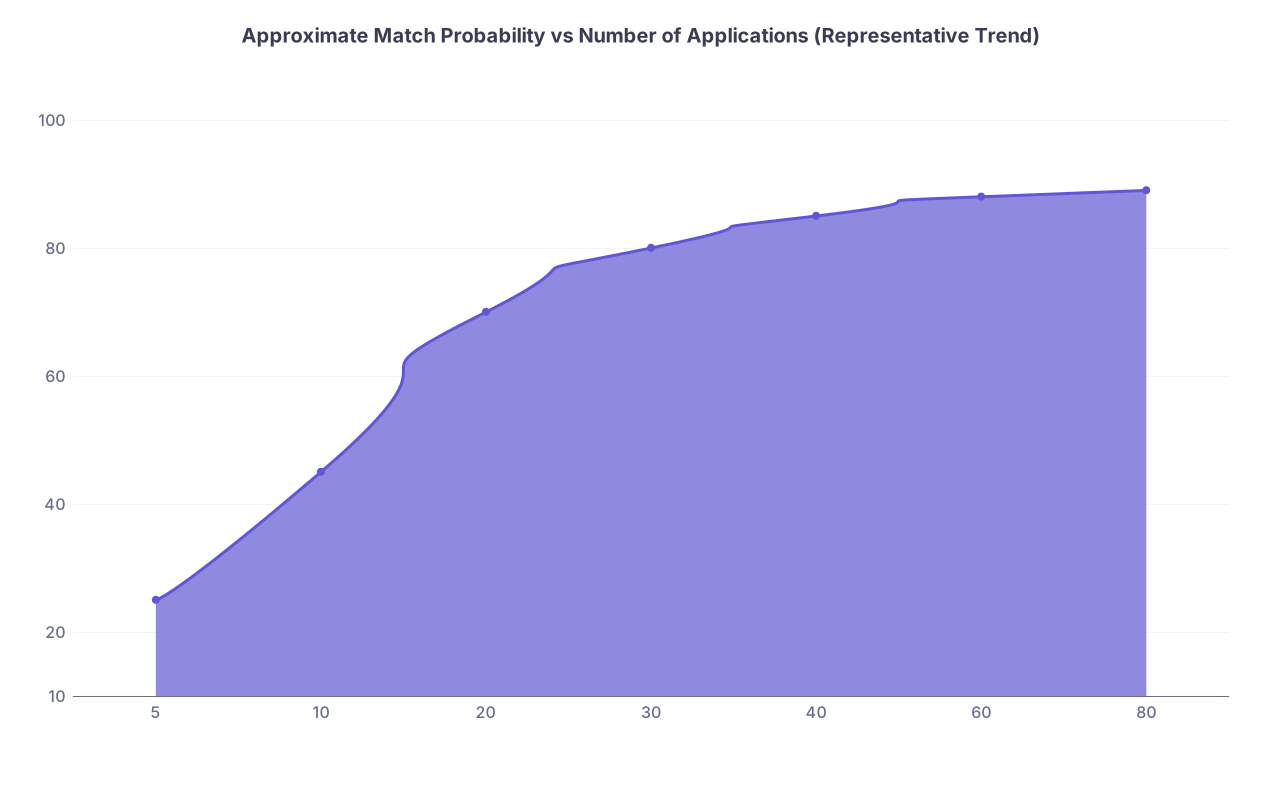
| Category | Value |
|---|---|
| 5 | 25 |
| 10 | 45 |
| 20 | 70 |
| 30 | 80 |
| 40 | 85 |
| 60 | 88 |
| 80 | 89 |
You see this sort of curve over and over:
- Big jump in match probability from very few applications up to a moderate number
- Then a plateau, where going from, say, 40 to 80 applications adds almost nothing
Is this exact curve true for every specialty and every applicant type? No. But the shape is the same: early applications matter a lot, later ones barely move the needle.
NRMP’s Charting Outcomes and “Interactive Charting Outcomes” tools show this clearly when you play with filters. For most mainstream specialties:
- U.S. MD seniors with competitive scores and no red flags: match probabilities level off well before 40 applications
- U.S. DO and IMGs: the curve flattens later—but it still flattens
- Ultra-competitive specialties (Derm, Ortho, Plastics, ENT): you need more, but they plateau too
The harsh truth: the endless-application arms race is driven less by data and more by anxiety and herd behavior.
Programs know this. That’s why more and more are using filters and signaling. You can dump 100+ applications into the void; that does not mean 100 people actually look at your file.
The Real Problem: People Confuse “Small List” With “Bad List”
When someone says “I applied to 25 programs and didn’t match—small list was my mistake,” dig into the details and you usually find a different story.
I’ve seen it so many times:
- 24 of 25 programs were in hyper-desirable coastal cities
- Applicant applied to multiple top-20 academic centers with a middle-of-the-road Step 2
- Zero geographic connection beyond “I’d like to live there”
- Not a single true safety program on the list
That’s not a small list problem. That’s a “delusional targeting” problem.
Here’s the uncomfortable distinction people avoid:
- A small but well-constructed list of 20–30 programs, with realistic reach/target/safety choices, aligned to your stats and story, can absolutely be enough for many applicants
- A huge but terrible list of 80 where you’re not actually competitive at half of them is just an expensive comfort blanket

If you’re applying:
- Only to big-name university programs
- Only in New York, California, Boston, Chicago
- Only to places with research-heavy reputations when your CV has minimal research
Then your odds tank—no matter how many you apply to.
Applicants love to simplify the story for emotional reasons: “I didn’t match because I didn’t apply to enough programs.”
What they really mean is: “I didn’t match because my list didn’t match my profile and the market.”
Where the Small-List Myth Comes From (And Why It Clings On)
Let’s be blunt. There are a few factories that keep this myth alive:
Anecdote bias in forums and group chats
The loudest voices in group threads are often:- People who matched after applying to 80–100 programs, so they assume causation
- People who didn’t match and are looking for the least painful explanation
Number of applications is an easy scapegoat. Much easier than “my letters were tepid” or “my interviews went badly.”
Advisors who are risk-averse to the point of being unhelpful
Some schools and advisors have one-size-fits-all scripts:- “You’re IM? 40–60 programs.”
- “You’re FM? 25–40.”
- “IMG? 100+ or bust.”
They rarely sit down and do the gritty work: actually map your specific stats, red flags, geography, and CV against real program behavior.
The money machine
ERAS makes more money when you apply to more programs. Nobody at ERAS is going to campaign for “actually 25 is enough if you do it right” messaging.
The default UX encourages clicking “add” far more than forcing you to think.Psychology
When you’re terrified of not matching, more = safer. Even when the data says the marginal benefit of going from 60 to 80 is tiny, people will still do it. Fear wins over probability curves.
The myth hangs on because it feels right. It feels like action. But that feeling is not evidence.
The Plateau Is Real – And It’s Different For Different People
Let’s get concrete with a simplified example. Say you’re a U.S. MD senior applying Internal Medicine with:
- Step 2 = 246
- Solid but not superstar research (1–2 posters, maybe a paper)
- No red flags, decent letters, from a mid-tier med school
For this profile, NRMP data and multiple advising offices I’ve worked with converge on a similar pattern: beyond ~25–30 medicine programs, you’re mostly just paying to feel safer.
Now contrast that with:
- U.S. DO with a 215–220 Step 2, no home program, applying Internal Medicine
- Or an IMG with a 230+ Step 2 applying IM, no U.S. experience beyond a couple observerships
For them, the curve is shifted. They often need:
- More mid-tier community programs
- A wider geographic net
- Less selectivity about program prestige
So their efficient point might be 40–60, sometimes more.
Still—not infinite. Not “avoid 80 and you die.”
Here’s the key: the point where the curve flattens depends on your risk profile, but it always flattens.
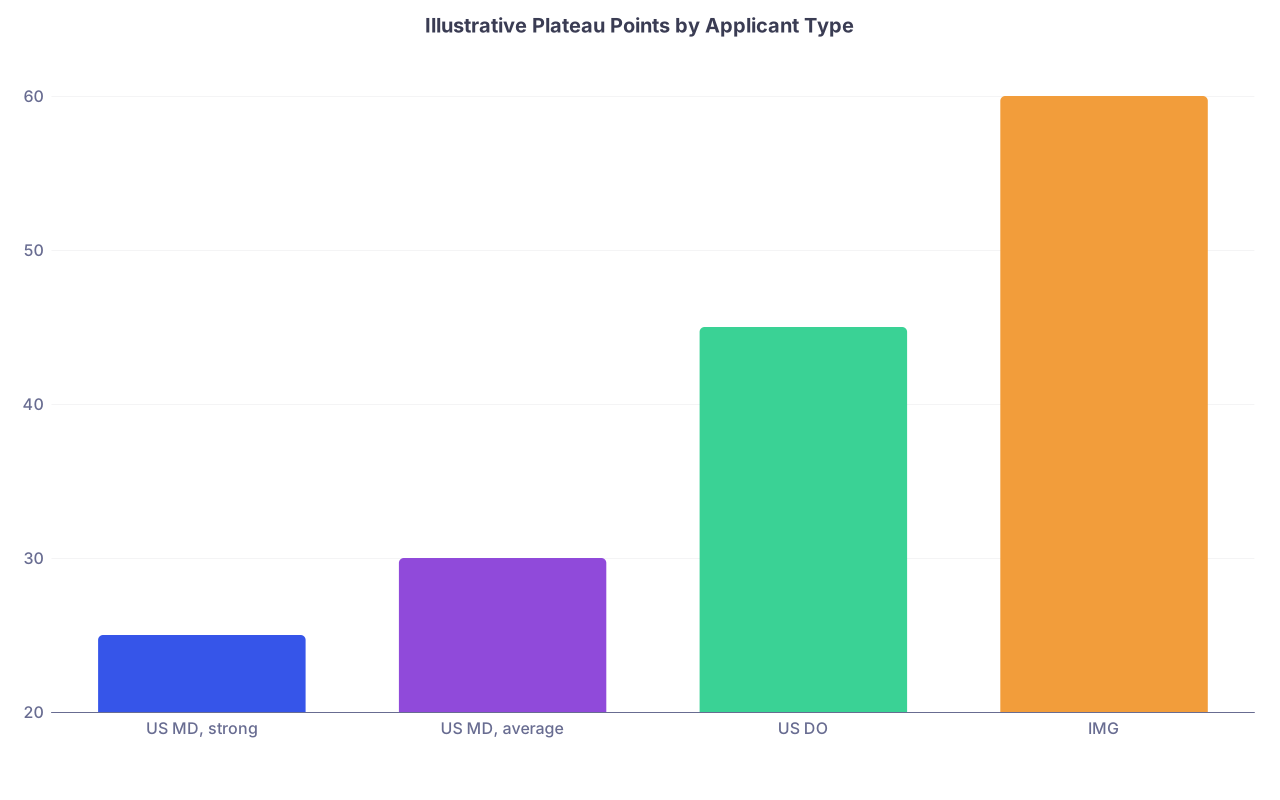
| Category | Value |
|---|---|
| US MD, strong | 25 |
| US MD, average | 30 |
| US DO | 45 |
| IMG | 60 |
Before someone jumps down my throat: those numbers are illustrative, not hard caps. The takeaway is the shape, not the exact values.
What Actually Matters More Than Raw Application Count
There are at least five levers that usually matter more than whether you applied to 35 vs 55 programs:
Program fit and plausibility
Not “do I like them?” but “would they, based on past behavior, actually like me?”
Look at:- How many IMGs they usually take
- How many DOs
- What range of Step 2 they historically interview
- Whether your school currently sends people there
Programs are creatures of habit. If your med school, degree type, or score range has never touched that program, you’re not just aiming high. You might be throwing money into a shredder.
Geographic strategy
Programs heavily favor:- Their region
- Their own med school and nearby schools
- Applicants with real ties (family, prior education, lived there for years)
If you ignore this and shotgun the coasts because you “love the vibe,” you’re already handicapping yourself, no matter how many you apply to.
Application quality and cohesion
I’ve read personal statements that tanked an otherwise decent application. Generic, incoherent, or worse—desperate.
Same applicant applies to 30 programs with a tight narrative and clear interest → 10 interviews.
Then rewrites to a vague “I like teamwork and lifelong learning,” sprays 20 more apps, and wonders why nothing changes.Timing and filters
Programs use score filters, time-from-graduation filters, “has US clinical experience” filters.
If you apply late or fall below silent thresholds, program count is irrelevant. You’re filtered out before a human ever reads your file.INTERVIEW performance and rank list construction
The number of interviews correlated with matching is strong. But once you hit a certain number of interviews (commonly around 10–12 for many core specialties), how you rank and how you interview matters more than whether you squeezed out two extra low-yield interviews by applying to 20 more programs.
When a “Small” List Is Actually Enough
Let me be specific about cases where a lean list can be completely rational:
- U.S. MD senior, mid-to-upper Step 2, no red flags, applying primary care specialties (FM, IM, Peds, Psych) with a balanced list across academic and community programs and multiple regions
- U.S. MD or DO with strong home program support in a non-ultra-competitive specialty, who gets realistic intel: “Our students with your stats consistently match with 20–30 applications”
- Couples matching where both applicants are reasonably competitive in non-insane specialties, and they actually sit down and map realistic pair options instead of panic-applying 90 each
- Someone reapplying who has hard, specific feedback from prior cycle and has fixed those issues (more US clinical experience, improved Step 2 score, better letters), and who is now targeted instead of random
You’ll never see these people posting on Reddit about their 24 carefully chosen programs and 14 interviews. Because they’re busy starting residency, not arguing with strangers about whether 80 is the “new minimum.”

When You Actually Should Have a Huge List
Now for the other side. There are cases where a big list is not paranoia, it’s just math.
If you’re in one of these groups, you probably need a larger number:
- Applying Derm, Ortho, Plastics, ENT, Neurosurgery, Integrated Vascular, PRS
- IMG without strong U.S. clinical experience, or from a newer / lesser-known med school
- DO applying to a specialty or region where DOs have historically struggled
- Significant red flags:
- Step failure
- Long time since graduation
- Prior attempt at residency that ended badly
In these cases, a long list is rational. But the principle still stands: once you’ve saturated the realistic universe of programs that actually take applicants like you, more is just more.
At some point you’re adding programs that:
- Have never taken an IMG
- Have never taken a DO
- Have Step averages way above your score
- Are in regions with a dense local applicant pool that they prefer
Those extra applications look impressive on your ERAS payment invoice. They don’t necessarily translate into interviews.
How To Build A Smart List (Instead Of A Long One)
If you want to escape the small-list panic but also not be foolishly optimistic, you need to earn your confidence with actual work.
Here’s the short version of a sane approach:
Start with reality, not vibes
Pull your Step 2, class rank if available, research output, degree type, and any red flags.
Brutally honest assessment: are you above average, average, or below typical matched applicants in your specialty?Segment your options
Aim for a true mix of:- Reach programs
- Solid target programs
- True safeties (yes, even in residency this concept exists—programs where your profile is clearly stronger than their historical averages)
Respect geography
Build clusters of programs in regions where your background, ties, or med school pipeline actually matter.Use actual data sources
- NRMP Charting Outcomes
- Program websites (look at current residents’ schools and backgrounds)
- Past match lists from your med school
- Alumni and upperclassmen intel—this is often better than any website
Stop when the marginal benefit is tiny
When you’re adding programs that:- Look less appealing than ones already on your list
- Have worse outcomes
- Are in places you don’t actually want to live
You’re in the low-yield zone. If you’re up to, say, 35–40 in a core specialty with good spread and alignment—and you’re a reasonably competitive applicant—you’re not in “small list, no chance” territory anymore.
| Program Type | Count | Description |
|---|---|---|
| Academic reach | 5 | Higher Step averages, big centers |
| Academic mid-tier | 8 | Solid, realistic options |
| Community strong | 7 | Stable, teaching focused |
| Community safety | 5 | Historically lower averages |
This 25-program skeleton, tweaked for geography and your exact profile, is far more powerful than a random 60.

| Step | Description |
|---|---|
| Step 1 | Assess stats and red flags |
| Step 2 | Choose specialty |
| Step 3 | Check historical data |
| Step 4 | 20 to 30 focused programs |
| Step 5 | 30 to 45 balanced programs |
| Step 6 | 45 plus targeted programs |
| Step 7 | Mix reach, target, safety |
| Step 8 | Finalize geographically diverse list |
| Step 9 | Competitive level |
The Bottom Line: What “Small List, No Chance” Gets Wrong
Let’s strip this down.
First: there is no universal “right” number of programs. Anyone giving you a hard cutoff is selling comfort, not accuracy.
Second: the myth that a smaller list automatically means you will not match is just that—a myth. The real driver is how well your list, your profile, and program behavior line up.
Third: more applications past a certain point don’t fix bad strategy. They just generate larger credit card statements and more rejections.
If you remember anything, make it this:
- Volume helps up to a point; after that, targeting wins.
- A “small but smart” list beats a “huge and delusional” one every single time.
- The right number for you isn’t what your classmate did. It’s where your personal match curve starts to flatten.